
Substation independent lightning rod grounding device and optimization method
A technology for grounding devices, optimization methods, applied in the direction of connecting contact materials, etc.
Patent Information
- Authority / Receiving Office
- CN · China
- Patent Type
- Applications(China)
- Current Assignee / Owner
- Publication Date
- 2021-03-26
- Estimated Expiration
- Not applicable · inactive patent
Smart Images
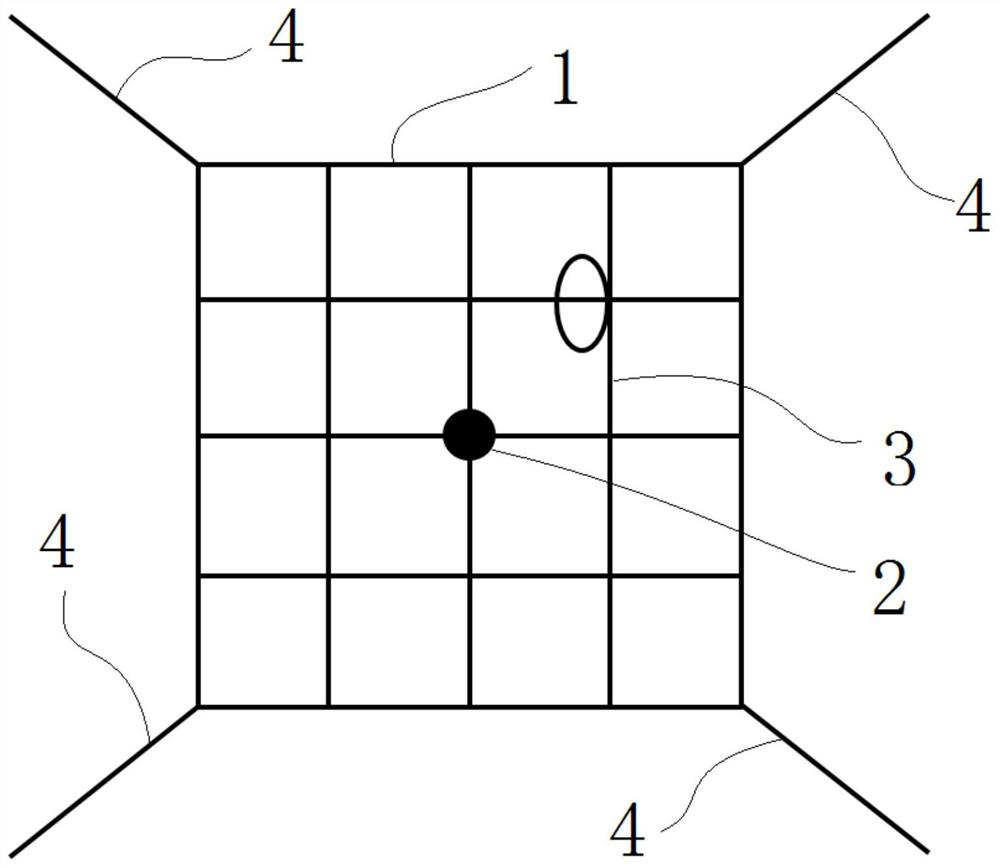
Figure 1
Abstract
Description
technical field
[0001] The invention belongs to the technical field of electric power engineering grounding, and in particular relates to a substation independent lightning rod grounding device and an optimization method. Background technique
[0002] There are many types of lightning, not only direct lightning strikes, induction lightning, but also lightning intrusion waves that pass along the line. A lightning rod is a device that prevents direct lightning strikes. It uses the principle of tip discharge to guide the discharge of lightning to the earth to the lightning rod and discharge into the ground. That is to say, for the object protected by the lightning rod, the lightning rod can actually be called a lightning rod. It is more likely to be struck by lightning itself, so that the object protected by it is not struck by lightning. Therefore, the lightning protection principle of the lightning rod determines that the lightning rod will only choose to guide a strong dir...
Examples
Embodiment Construction
[0027] In order to make the purpose and technical solution of the present invention clearer and easier to understand. The present invention will be further described in detail below in conjunction with the drawings and embodiments. The specific embodiments described here are only used to explain the present invention, not to limit the present invention.
[0028] In describing the present invention, it should be understood that the terms "center", "longitudinal", "transverse", "upper", "lower", "front", "rear", "left", "right", " The orientations or positional relationships indicated by "vertical", "horizontal", "top", "bottom", "inner" and "outer" are based on the orientations or positional relationships shown in the drawings, and are only for the convenience of describing the present invention and Simplified descriptions, rather than indicating or implying that the device or element referred to must have a particular orientation, be constructed and operate in a particular ori...