
SKLB1039 compound, and preparation method and application thereof
A compound and reaction technology, applied in the field of preparation of new compounds, can solve problems such as poor physical and chemical properties, large amount of raw material reagents used, high cost, etc.
Patent Information
- Authority / Receiving Office
- CN · China
- Current Assignee / Owner
- Publication Date
- 2021-10-22
Smart Images
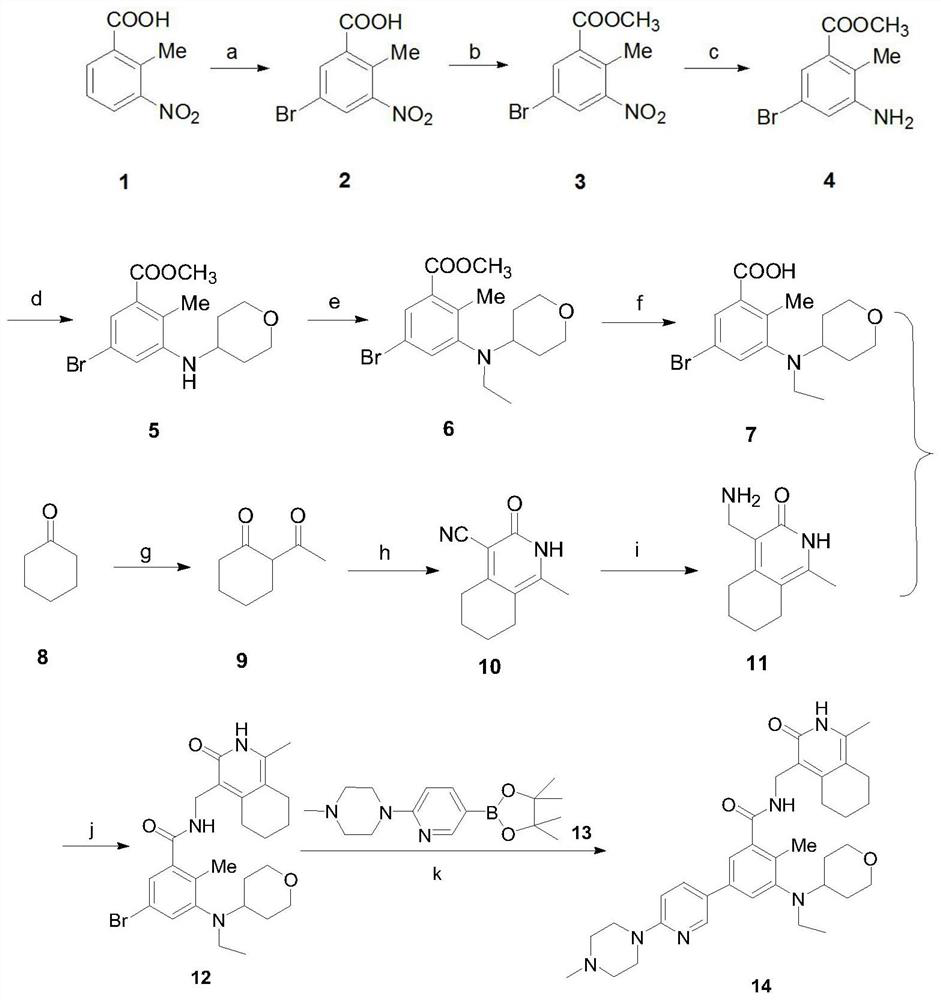
Figure 1 
Figure 2 
Figure 3
Abstract
Description
technical field
[0001] The invention belongs to the technical field of preparation of new compounds, specifically a SKLB1039 compound and its preparation method and application. Background technique
[0002] Cancer is a major public health problem worldwide, and targeting epigenetic regulators provides us with a new cancer treatment strategy; enhancers of Zeste Homolog 2 (EZH2), a family of histone lysine methyltransferases A member of polycomb repressive complex 2 (PRC2), PRC2 catalyzes the methylation of histone 3 lysine 27 (H3K27), resulting in trimethylation of H3K27 (H3K27me3), which is a transcriptional repressor Germ genetic markers and can silence target genes.
[0003] Overexpression of EZH2 has been observed in many blood and solid tumors, such as Hodgkin's disease, non-Hodgkin's lymphoma, prostate cancer, breast cancer, kidney cancer, melanoma, and tongue cancer, and EZH2 is widely involved in cancer progression , metastasis, and poor prognosis; somatic mutation...
Examples
Embodiment 1
[0040] A preparation method of SKLB1039 compound, comprising the steps of:
[0041] Synthesis of S1, 5-bromo-2-methyl-3-nitrobenzoic acid (compound 2):
[0042] Under the protection of nitrogen, add 6.5L of concentrated sulfuric acid with a mass fraction of 98% in a 20L reactor, add 1.63kg of 2-methyl-3-nitrobenzoic acid (compound 1) under stirring, continue to stir and cool down to 3°C , until all the solids in the reactor are dissolved, and the solution is dark brown at this time; slowly add 1.425kg of 1,3-dibromo-5,5-dimethyl-2,4-imidazolidinedione in batches, during which the thermal effect Obviously, the temperature rises from 6°C to 19°C. After the addition, the solution in the reactor turns light brown and solids gradually precipitate out, making the system cloudy; keep the low temperature bath and cool it down to 10°C, then remove the low temperature bath. Warm bath, naturally heat up to 15-25°C and stir for 30 minutes, the solution in the reaction kettle gradually tu...