
Method for transferring a tower crane and a frame and take-up mechanism therefor
a technology of tower cranes and frames, applied in the direction of wind motor assemblies, cranes, etc., can solve the problems of time-consuming, high logistical effort, and inability to adapt to the practical situation, and achieve the effect of ensuring the freedom of movement of the tower crane and being particularly easy to adjus
Patent Information
- Authority / Receiving Office
- US · United States
- Patent Type
- Patents(United States)
- Current Assignee / Owner
- Publication Date
- 2019-11-26
Smart Images
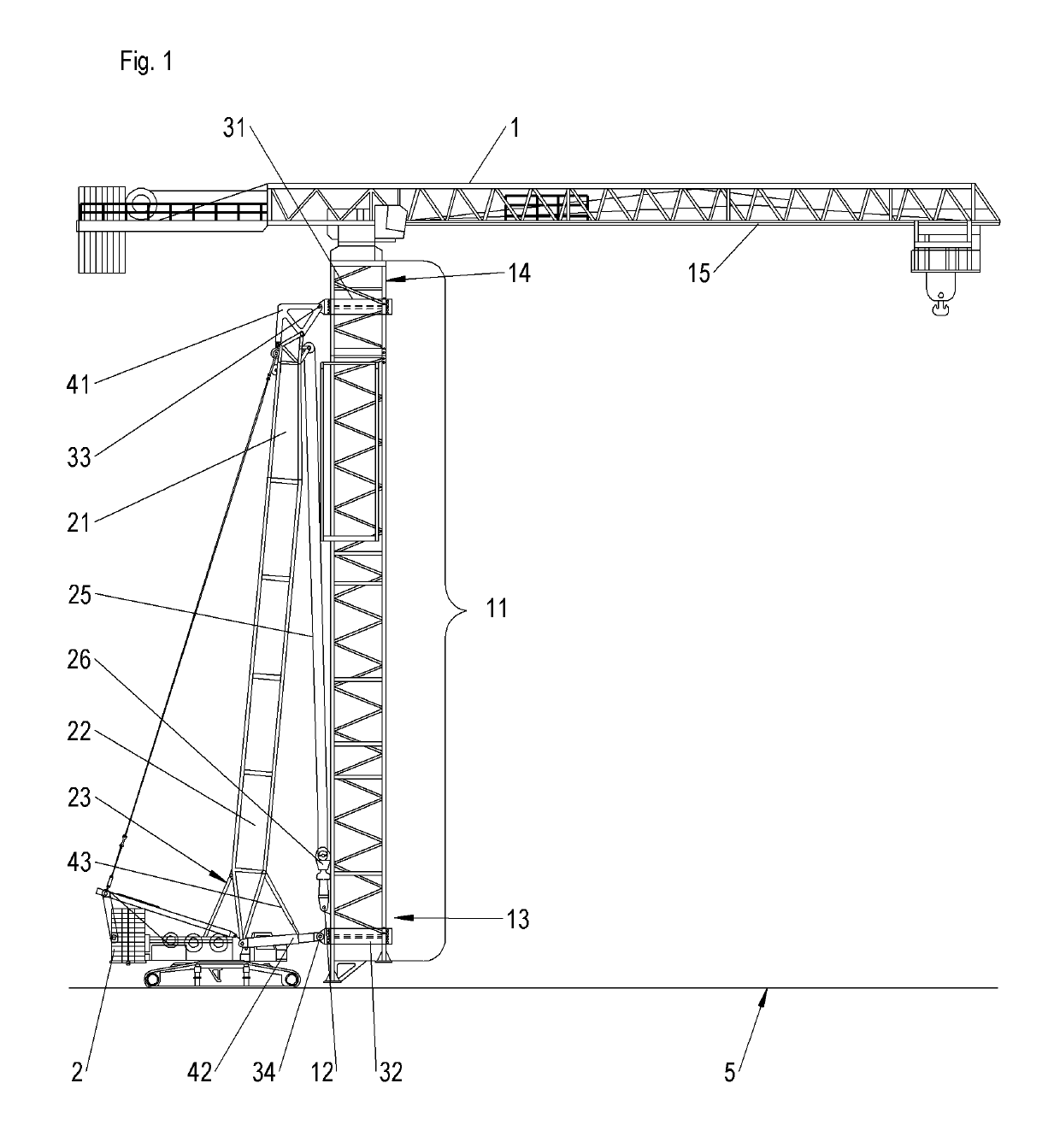
Figure 1 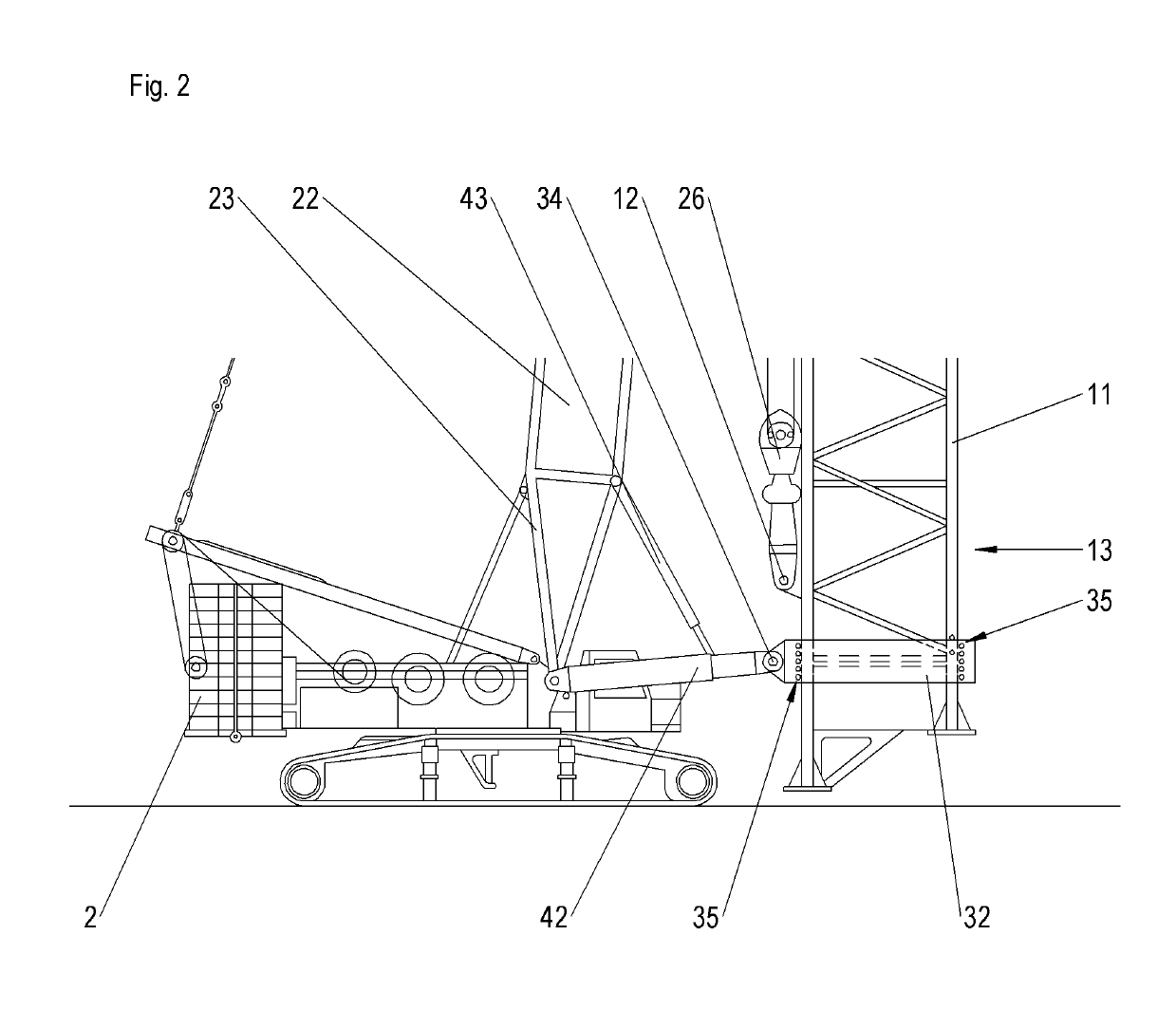
Figure 2 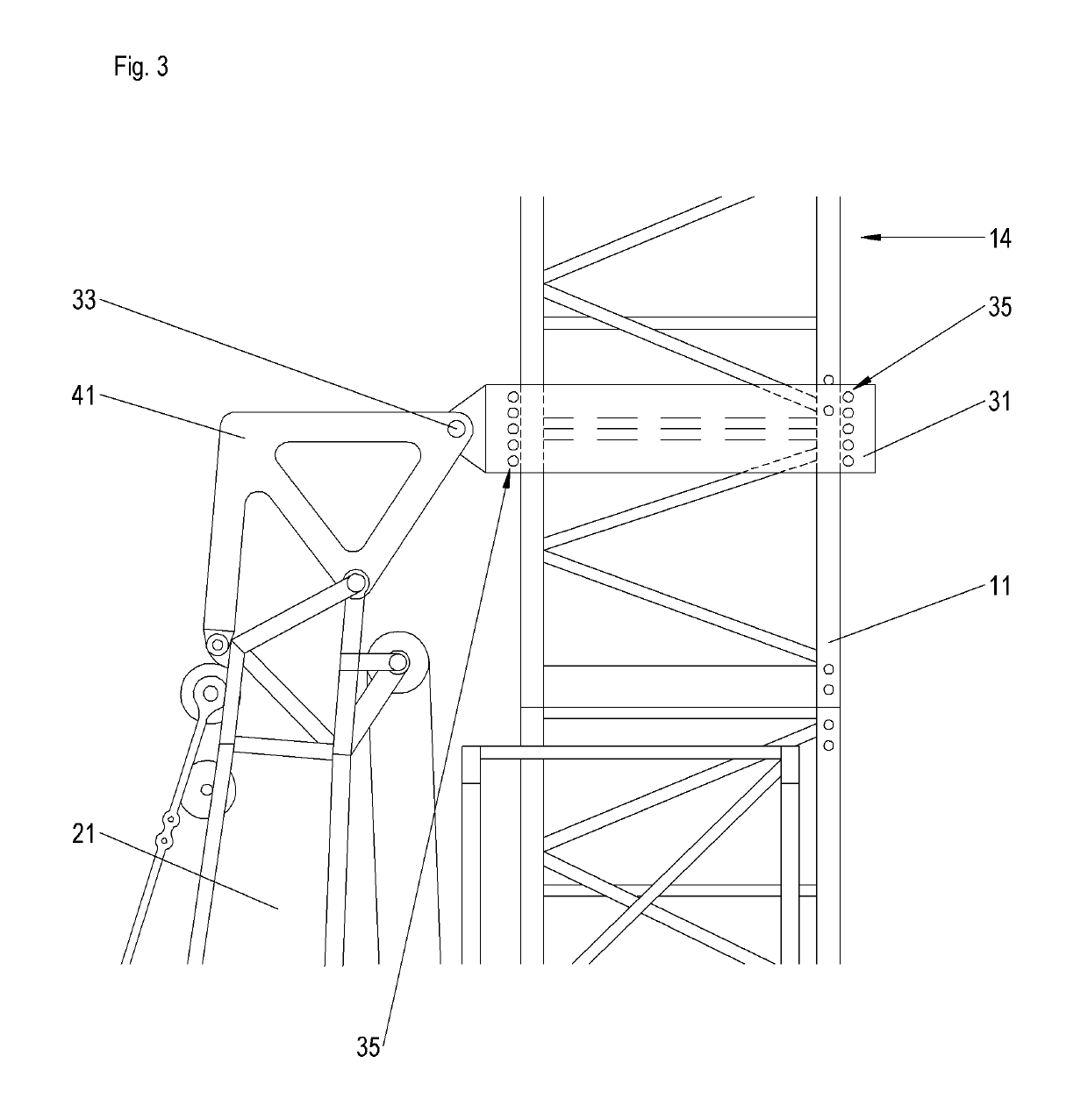
Figure 3
Abstract
Description
BACKGROUND OF THE INVENTION
[0001] This invention relates to a method for transferring a tower crane.
[0002] For the assembly of wind turbines tower cranes are used due to the required large lifting heights. These generally stationary crane towers are transported to the site of use in individual parts and subsequently are mounted for the lifting operation.
[0003] Especially during installation of so-called wind farms with a number of wind turbines it is desirable to transport such tower cranes from one site of use to the next site of use as quickly and easily as possible. So far, the cranes are disassembled completely by means of a mobile crane, loaded onto transport vehicles in individual parts, and moved to the next construction site by means of these transport vehicles. At the target site, the tower crane must again be mounted by means of an auxiliary crane and be put into operation. This procedure not only is time-consuming, but also requires a high logistical effort. In general, at l...
Examples
Embodiment Construction
[0034]FIG. 1 shows both a crawler crane 2 and a tower crane 1 during the execution of the method according to the invention. The tower crane 1 is configured in a manner known per se and comprises a crane tower 11 composed of individual lattice pieces, on whose tower tip 14 a boom 15 is rotatably mounted via a slewing gear. This tower crane 1 is to be moved from a site of use A to a succeeding site of use B by means of a crawler crane 2, but without demounting the tower crane 1 into its individual parts. For moving the crane it merely is necessary to release the tower base 13 from the ground 5 of the site of use A.
[0035]For this purpose, two supported connecting frames 31, 32 are mounted around the crane tower 11 of the tower crane 1, which completely or at least partly enclose the outer circumference of one lattice element each of the crane tower 11. The first connecting frame 31 therefor is fixed at the top of the tower 11 in the region of the tower tip 14. The second connecting fr...