
Coded modulation for partially coherent systems
a partially coherent system and modulation technology, applied in the field of signal constellations, can solve the problems of increasing the error frequency at the decoder, increasing the error rate, and inducing the increase of the error ra
Patent Information
- Authority / Receiving Office
- US · United States
- Patent Type
- Applications(United States)
- Current Assignee / Owner
- Publication Date
- 2005-04-07
- Estimated Expiration
- Not applicable · inactive patent
Smart Images
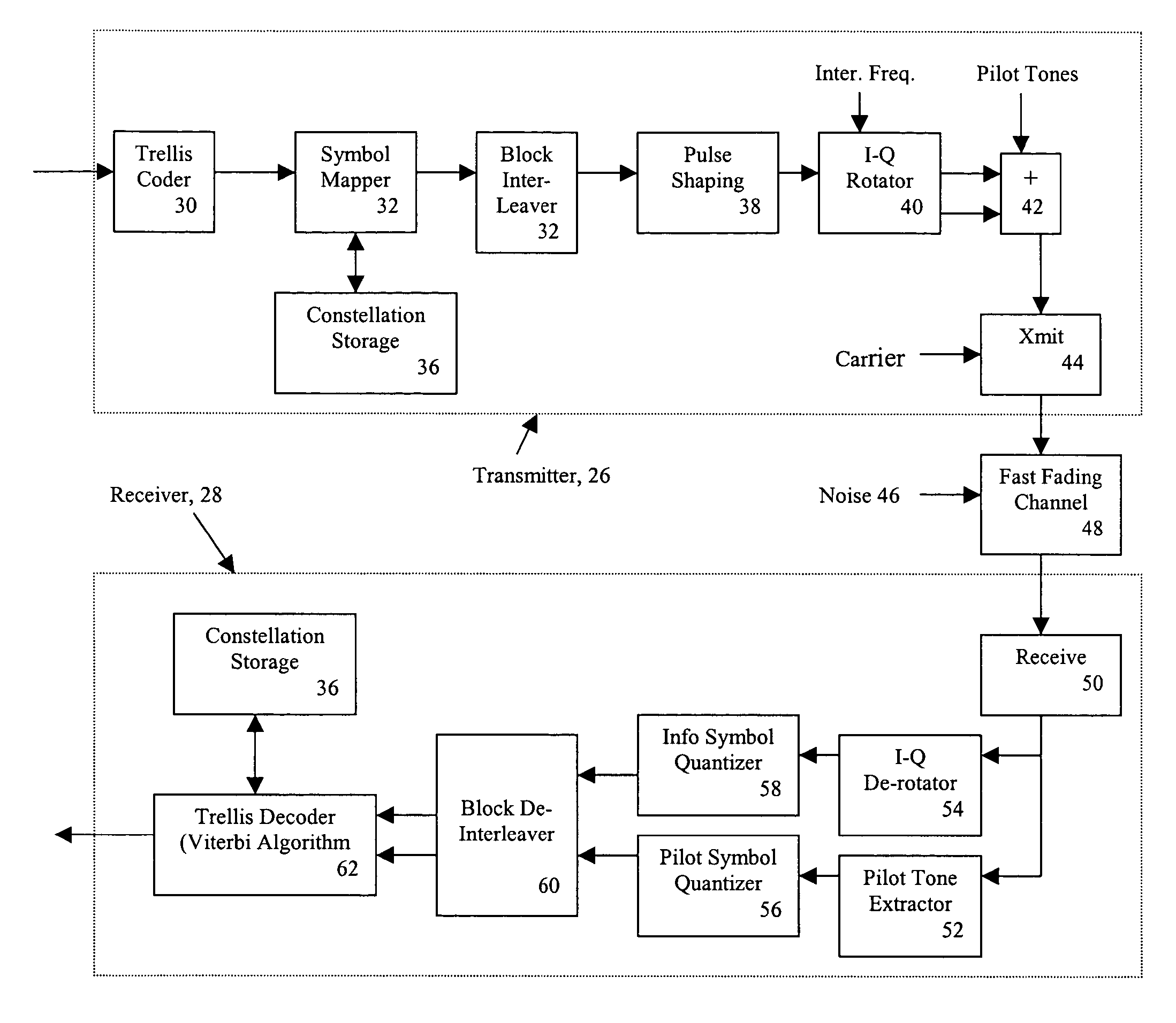
Figure 1 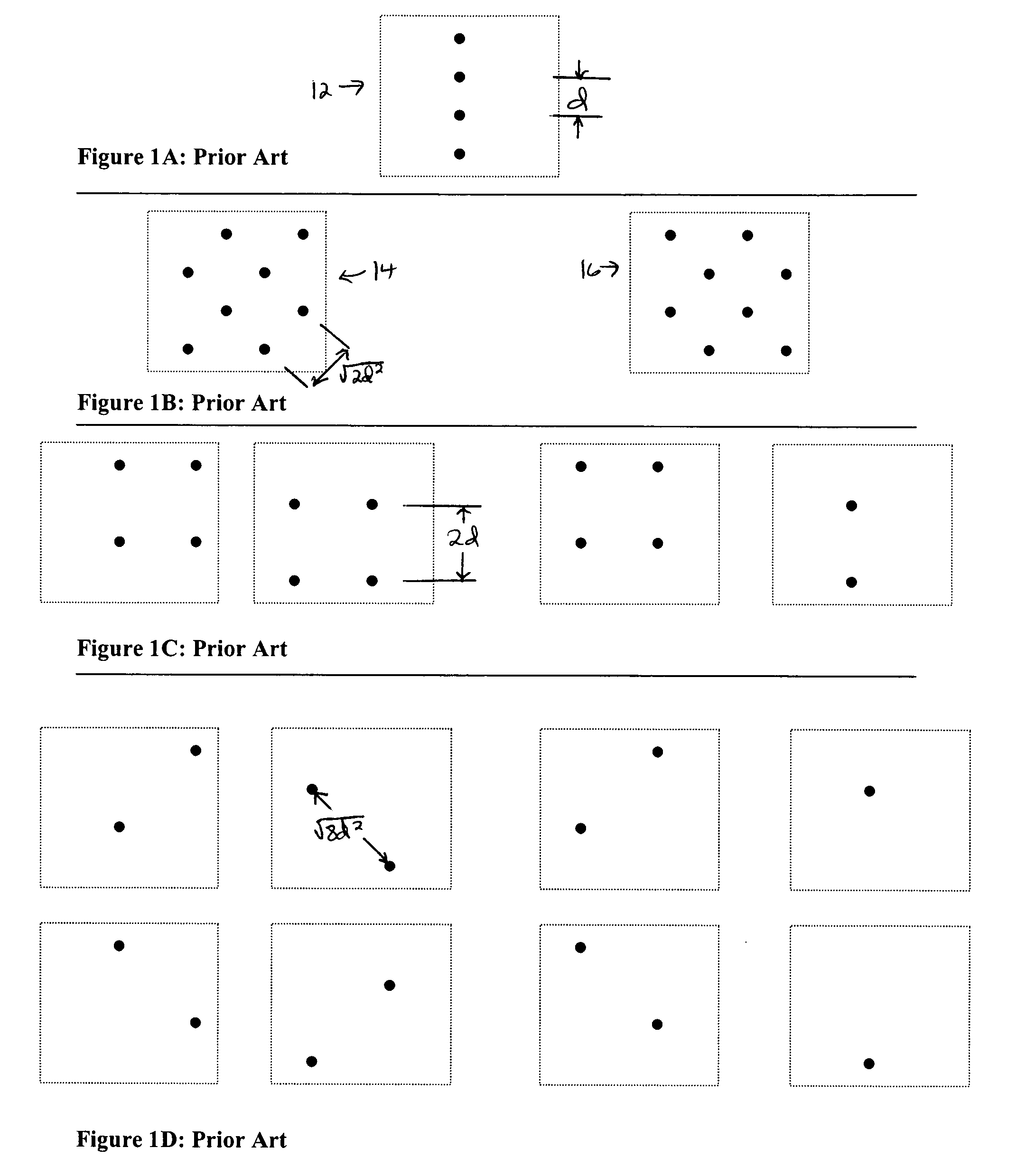
Figure 2 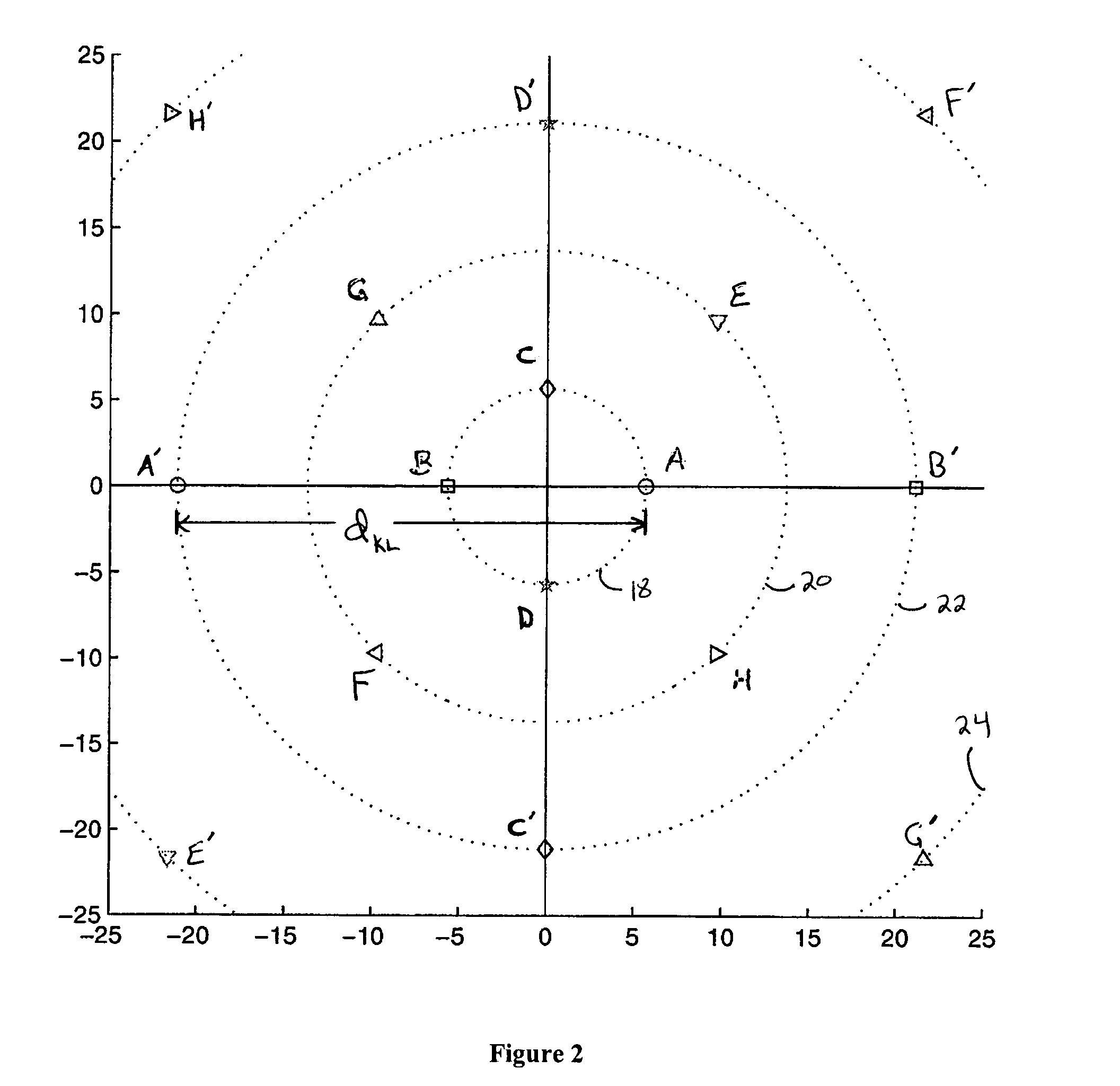
Figure 3
Abstract
Description
FIELD OF THE INVENTION The present invention relates to signal constellations used in coded modulation for digital communication systems, especially wireless systems using trellis coded modulation and multiple transmit antennas. BACKGROUND Digital communications entail transmitting a bit sequence by modulating a carrier signal onto a carrier wave to assume discrete signal values, or constellation points. While increasing the number of available constellation points allows increased data rates over a given bandwidth, the increase necessarily increases error frequency at the decoder because adjacent constellation points are closer in proximity to one another as compared to a constellation with fewer points. Considering that the decoder uses a maximum likelihood or other probability algorithm to determine exactly which constellation point it has received, the increased error rate is inherent. Trellis coded modulation (TCM) is a coding technique wherein modulation and coding are combi...
Examples
Embodiment Construction
The present invention builds upon work detailed in International Patent Application PCT / IB03 / 02088, filed with the U.S. Receiving office on May 29, 2003 and entitled “METHOD AND APPARATUS TO ESTABLISH CONSTELLATIONS FOR IMPERFECT CHANNEL STATE INFORMATION AT A RECEIVER”. That work described signal constellations wherein the individual constellation points were separated by a distance determined from conditional distributions, such as a Kullback-Leibler (KL) distance. This invention also builds on U.S. Patent Application No. ______, filed on Jun. 25, 2003 and entitled “SIGNAL CONSTELLATIONS FOR MULTI-CARRIER SYSTEMS”, which details partially coherent signal constellations particularly adapted for multi-path communication systems. Both of the above related applications are herein incorporated by reference.
As used herein, a partially coherent system is a communication system in which the receiver does not have accurate knowledge of channel state information (CSI), and a partially co...