
Cell-cycle checkpoint genes
a cell cycle and checkpoint technology, applied in the field of cell cycle checkpoint genes, can solve the problems of lethal damage and disruption of several checkpoints required for an appropriate response to ionising radiation
Patent Information
- Authority / Receiving Office
- US · United States
- Patent Type
- Applications(United States)
- Current Assignee / Owner
- Publication Date
- 2006-09-14
- Estimated Expiration
- Not applicable · inactive patent
Smart Images
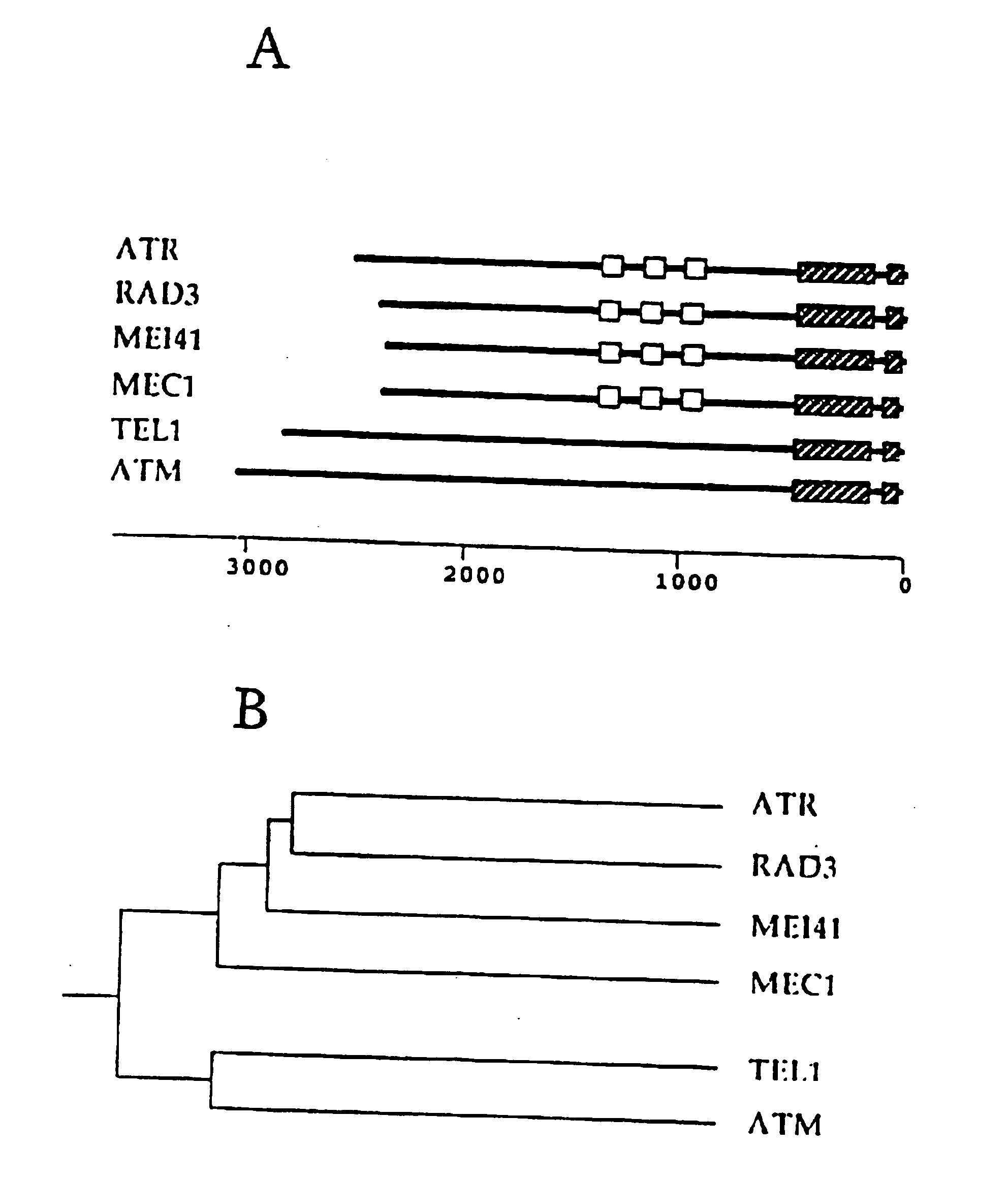
Figure 1
Abstract
Description
[0001] The present invention relates to a class of checkpoint genes which control progression through the cell cycle in eukaryotic cells. BACKGROUND TO THE INVENTION
[0002] Control of the cell cycle is fundamental to the growth and maintenance of eukaryotic organisms, from yeast to mammals. Eukaryotic cells have evolved control pathways, termed “checkpoints” which ensure that individual steps of the cell cycle are completed before the next step occurs. In response to DNA damage, cell survival is increased both by direct DNA repair mechanisms and by delaying progression through the cell cycle. Depending on the position of the cell within the cycle at the time of irradiation, DNA damage in mammalian cells can prevent (a) passage from G1 into S phase, (b) progression through S phase or (c) passage from G2 into mitosis. Such checkpoints are thought to prevent deleterious events such as replication of damaged DNA and the segregation of fragmented chromosomes during mitosis (Hartwell and ...
Examples
example 1
[0138] The rad3 gene of S. pombe is one of six genes absolutely required for the DNA structure checkpoints in S. pombe (Al-Khodairy and Carr. 1992; Al-Khodairy et al. 1994). A sequence representing part of the rad3 gene was reported by Seaton et al. (1992). In attempting to clarify the intron / exon structure of this gene we identified sequencing anomalies at both the 5′ and 3′ ends. We have sequenced the complete gene (see Experimental Procedures) and find that rad3 is capable of encoding a product of 2386 amino acids. The C-terminal region contains the consensus sequences typical of a sub-class of kinases known as lipid kinases, the founder member of which is the p110 catalytic subunit of P13 kinase (Hiles et al. 1992).
[0139] A truncated rad3 clone lacking the amino terminus and the kinase region has been reported to complement the rad3::pR3H1.0 gene disruption mutant of rad3 (Jimenez er al. 1992). This disruption mutant does not remove the potential kinase domain. To clarify the r...