
Method and apparatus for improved regression modeling
a regression modeling and regression technique technology, applied in the field of data analysis, can solve the problems of increasing the difficulty of learning an accurate functional mapping, affecting and suffering from the curse of dimensionality, etc., to achieve the effect of improving the accuracy of the function approximator on the set of exemplars and improving the regression modeling
Patent Information
- Authority / Receiving Office
- US · United States
- Current Assignee / Owner
- Publication Date
- 2008-06-26
- Estimated Expiration
- Not applicable · inactive patent
Smart Images
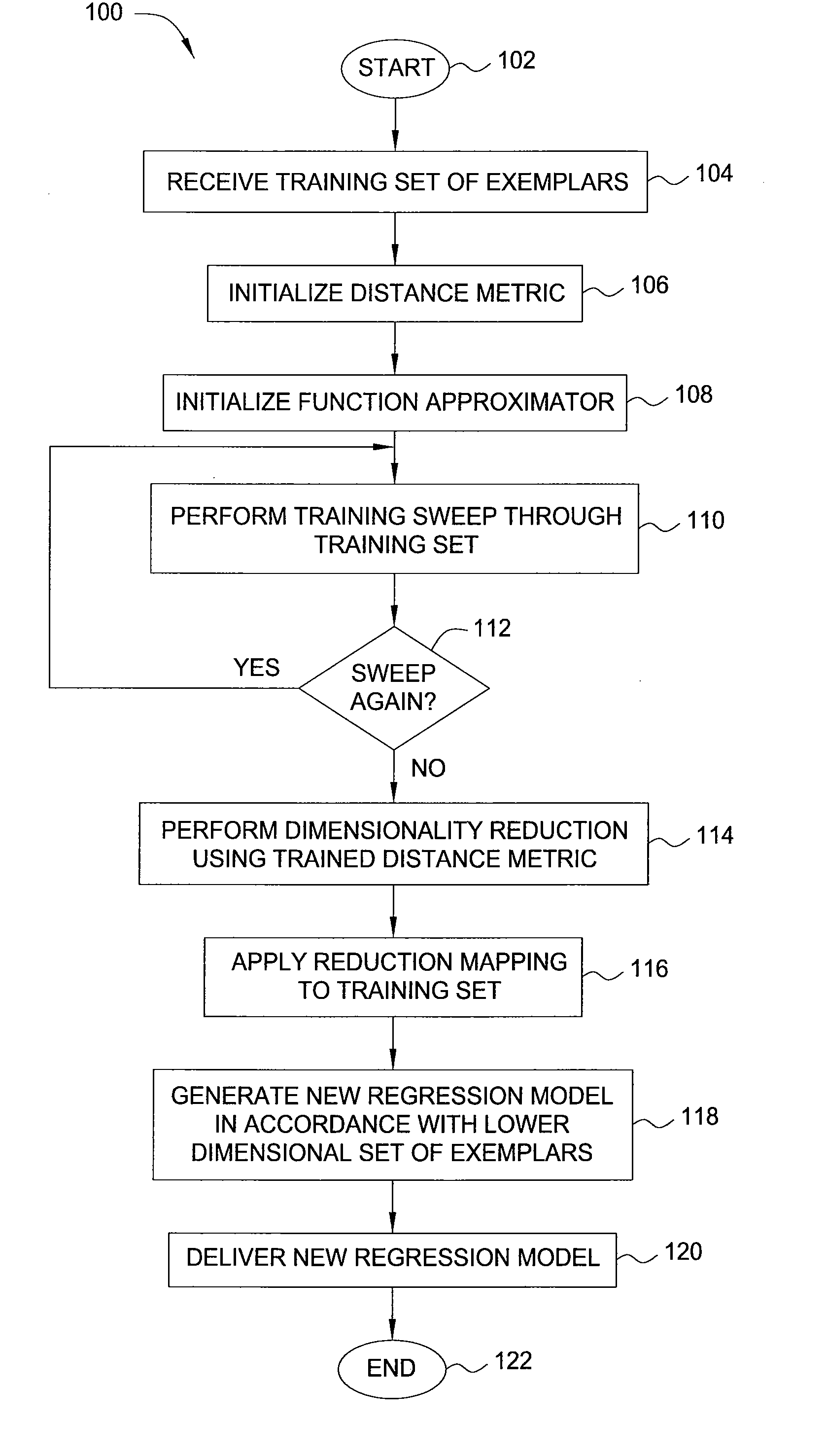
Figure 1 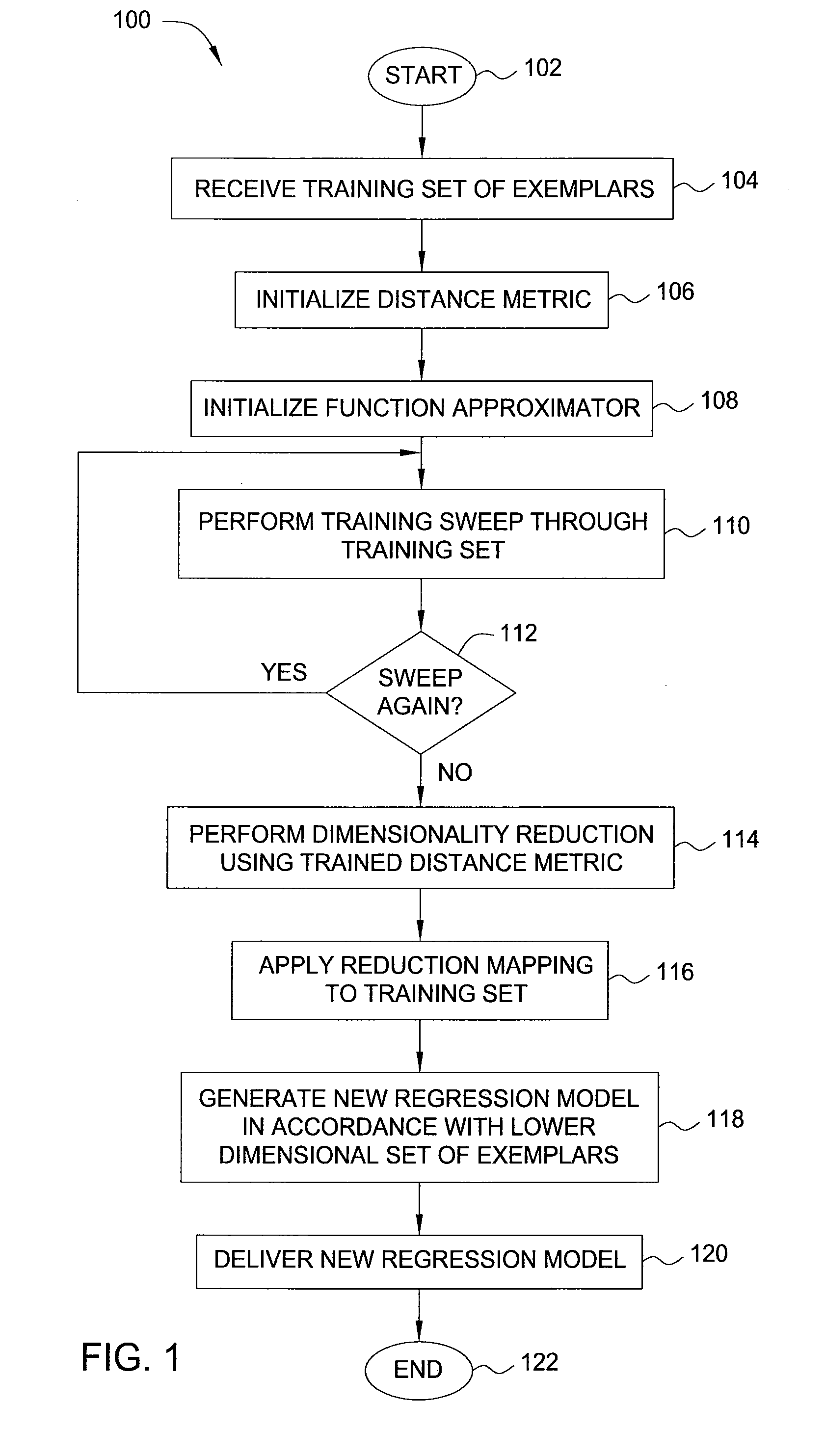
Figure 2 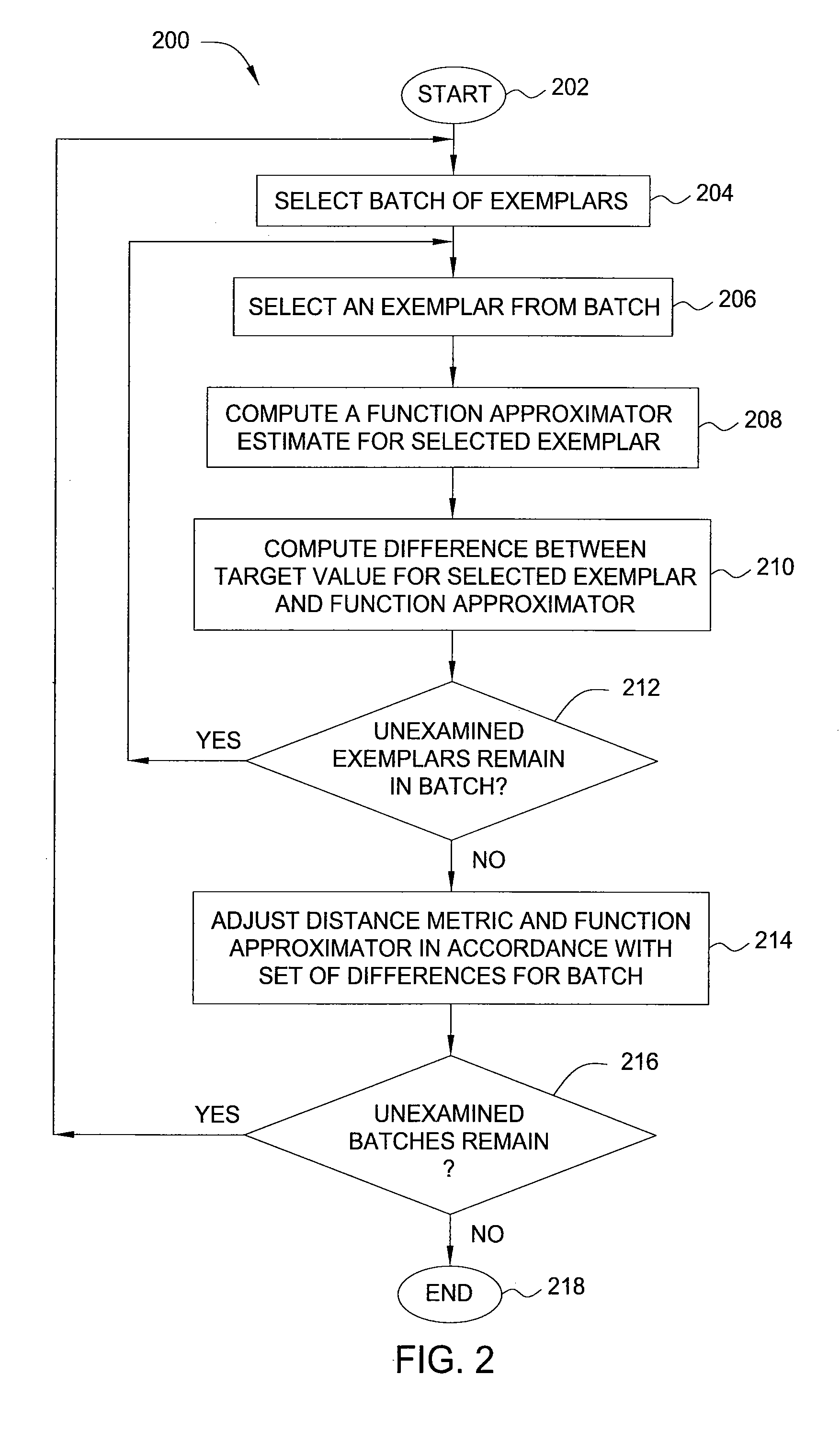
Figure 3
Abstract
Description
BACKGROUND
[0001] The invention relates generally to data analysis, and relates more particularly to data analysis techniques using nonlinear regression.
[0002] Nonlinear regression refers to the development of empirical models often used in data analysis to encapsulate temporal and / or structural relationships between observed quantities (“input variables”) and quantities of interest (“output variables” or “target variables”), which may be difficult to observe directly. Specifically, the goal of nonlinear regression is to construct a mathematical model that is capable of accurately estimating an unobserved target variable as a function of the settings of the collection of input variables to particular input states or patterns.
[0003] Typically, these mathematical models are produced by applying machine learning or training techniques to a data set that contains a number of historical exemplars, where each exemplar i comprises a particular input pattern {right arrow over (x)}i (with each o...
Examples
Embodiment Construction
[0012]In one embodiment, the present invention is a method and apparatus for improved regression modeling to address the curse of dimensionality. Embodiments of a present invention simultaneously learn a distance metric (between points in an input space) and a distance-based function approximator. These quantities are broadly useful for purposes of estimation, prediction and control throughout many areas of science and engineering, including, but not limited to, systems management, medical science, pharmacology, bioinformatics, geophysical and atmospheric sciences, financial and economic modeling and consumer / customer modeling.
[0013]FIG. 1 is a flow diagram illustrating one embodiment of a method 100 for regression modeling, according to the present invention. The method 100 may be implemented, for example, to perform a data analysis task.
[0014]The method 100 is initialized at step 102 and proceeds to step 104, where the method 100 receives a training set of S exemplars. At least tw...