
Carbon Black Aqueous Dispersion and Method of Producing the Same
Patent Information
- Authority / Receiving Office
- US · United States
- Current Assignee / Owner
- Publication Date
- 2008-07-17
- Estimated Expiration
- Not applicable · inactive patent
Smart Images
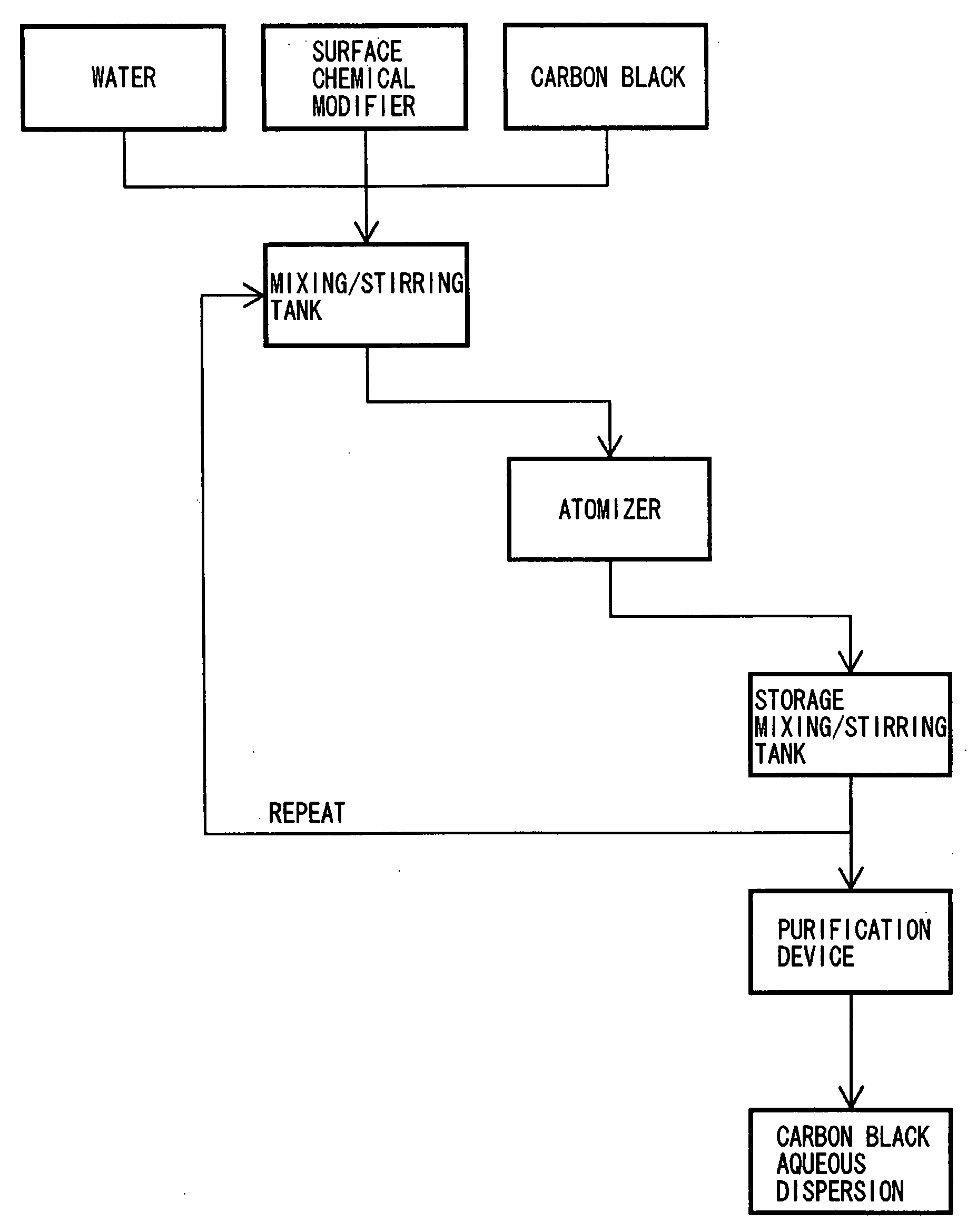
Figure 1 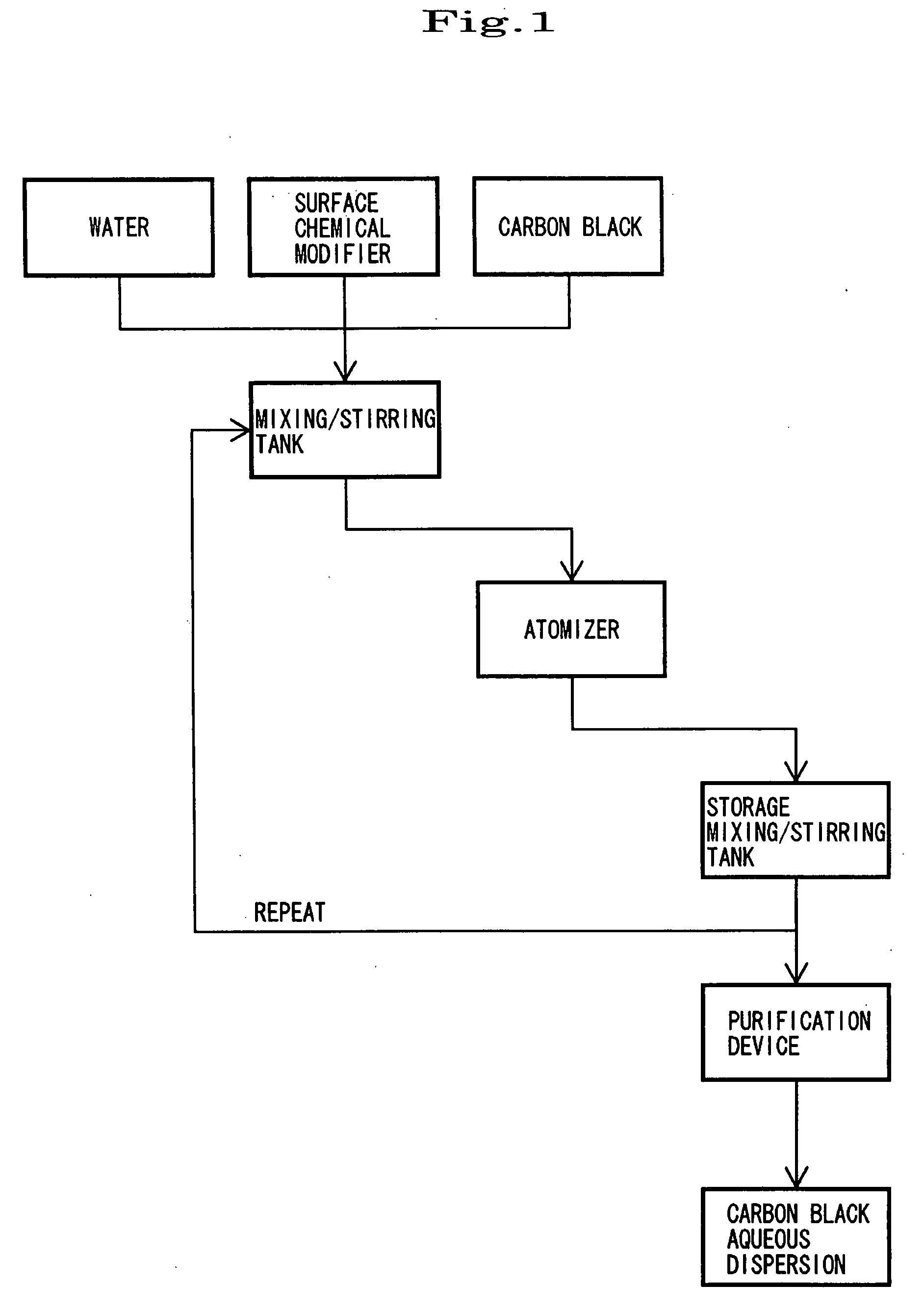
Figure 2
Abstract
Description
TECHNICAL FIELD
[0001] The present invention relates to a carbon black aqueous dispersion suitable as an aqueous black ink for an inkjet printer or the like, and a method of producing the same.BACKGROUND ART
[0002] It is extremely difficult to stably disperse carbon black in water at a high concentration due to hydrophobicity and low wettability with water. This is because the surface of carbon black has an extremely small number (amount) of functional groups having high affinity with water molecules (e.g., hydrophilic hydrogen-containing functional groups such as a carboxyl group and a hydroxyl group). A known established measure is to improve the dispersibility of carbon black in water by oxidizing the carbon black to form hydrophilic functional groups on the surface of the carbon black.
[0003] For example, JP-A-48-018186 discloses a method of oxidizing carbon black using a hypohalite aqueous solution, and JP-A-57-159856 discloses a method of oxidizing carbon black using low-temperature...
Examples
example 1
[0039]A mixing / stirring tank was charged with Tokablack 7550F (manufactured by Tokai Carbon Co., Ltd.) as carbon black, sodium peroxodisulfate as a surface chemical modifier, and deionized water in a proportion stated below. The mixture was sufficiently stirred and mixed to obtain a slurry. The slurry was continuously stirred and mixed.
Carbon black: 10 parts by weight
Sodium peroxodisulfate: 10 parts by weight
Deionized water: 80 parts by weight
[0040]An Ulthimaizer (manufactured by Sugino Machine Limited) was used as an atomizer. The slurry was fed to the Ulthimaizer and was sprayed under a pressure of 245 MPa to cause collision between sprayed streams. The slurry was transferred temporarily to a storage mixing / stirring tank, cooled with stirring, and transferred back to the mixing / stirring tank. The slurry was atomized by repeating the above operation of causing the slurry to collide 10 times. The temperature of the slurry rose from 45° C. (initial temperature) to 90° C. by friction ...