
Potato Fibres, Methods of Preparing Them and Their Use
a technology of potato fibres and potato fibers, which is applied in the field of potato fibre preparation methods, can solve the problems of limited functionality, large number of plant fibres known for human consumption and likewise for technical applications, and high cost of raw materials and/or limited availability and/or production processes, etc., and achieves low content of glycoalkaloids, high water binding capacity, and freedom from allergens
Patent Information
- Authority / Receiving Office
- US · United States
- Patent Type
- Applications(United States)
- Current Assignee / Owner
- Publication Date
- 2008-09-18
- Estimated Expiration
- Not applicable · inactive patent
Smart Images
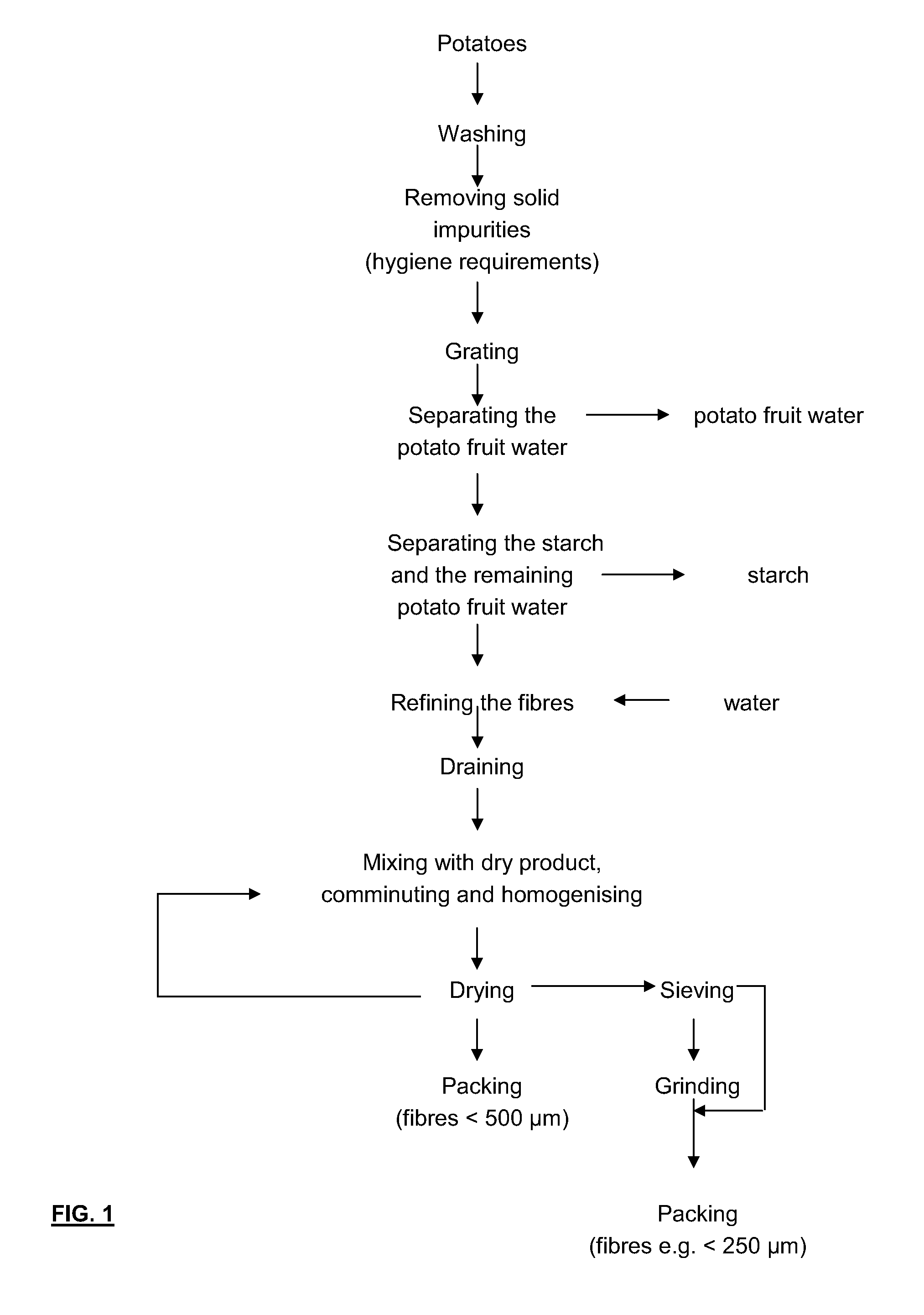
Figure 1
Abstract
Description
FIELD OF THE DISCLOSURE
[0001] The present disclosure relates to a method of preparing potato fibres, potato fibres prepared in accordance with that method, and their use.BACKGROUND OF THE DISCLOSURE
[0002] A large number of plant fibres are known for human consumption and likewise for technical applications. Fibres are important, for example, for nutrition, in food technology as gelling agents and emulsifiers, and as structure-reinforcers or texturisers both in technical and in food applications. Fibres are particularly important as roughage, which is indispensable for human digestion.
[0003] First of all, fibres can be isolated in a targeted manner from plants, but secondly, they can also be prepared by recycling production residues, such as by processing pomace. Standard commercial fibres, such as fruit, vegetable or sugar beet fibres, involve various disadvantages, such as raw materials which are expensive and of limited availability and / or expensive production processes, limited func...
Examples
Embodiment Construction
[0012]It has surprisingly been found that the methods disclosed herein for preparing potato fibres is extremely inexpensive, because no additional effort compared to the production of potato starch is necessary until the separation of the potato starch and fibres, and it is only after this point that the special production process for the potato fibres begins, which causes lower costs than the state of the art and at the same time improves the quality of the fibres compared to the state of the art. Starch potatoes are used as the starting materials, and these are inexpensive and available in large quantities.
[0013]A major advantage of the present methods is that potato fibres with a low glycoalkaloid content of only 100 to 120 ppm can be prepared, in contrast to a content of 320 to 450 ppm of glycoalkaloids if, for example, the method of EP 0 413 681 B1 is used. A content of about 100 to 120 ppm of glycoalkaloids corresponds to about half the levels which potatoes naturally contain....