
Method for Coupling Terahertz Pulses Into a Coaxial Waveguide
a technology of terahertz pulses and coaxial waveguides, applied in waveguides, waveguide type devices, instruments, etc., can solve the problem of extremely low attenuation due to conductivity losses in this configuration, and achieve the effect of effective thz waveguides, efficient coupling of thz energy into waveguides, and simple geometry
Patent Information
- Authority / Receiving Office
- US · United States
- Patent Type
- Applications(United States)
- Current Assignee / Owner
- Publication Date
- 2008-12-18
- Estimated Expiration
- Not applicable · inactive patent
Smart Images
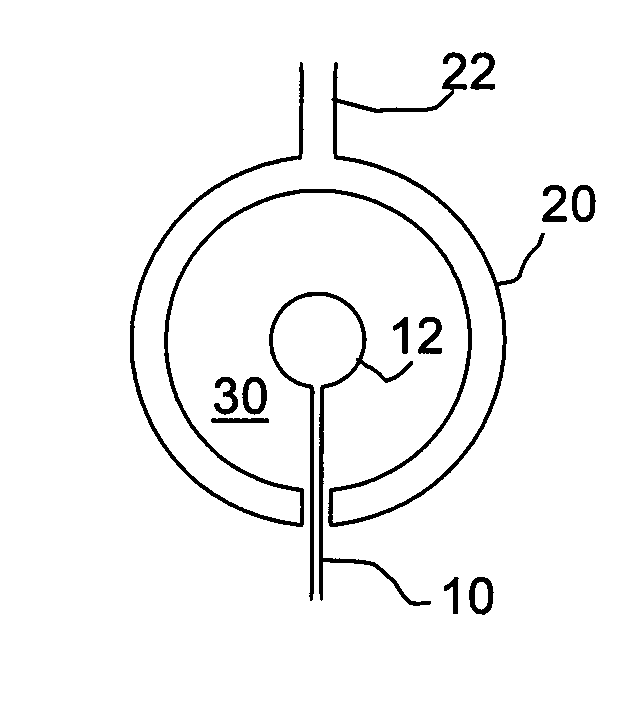
Figure 1 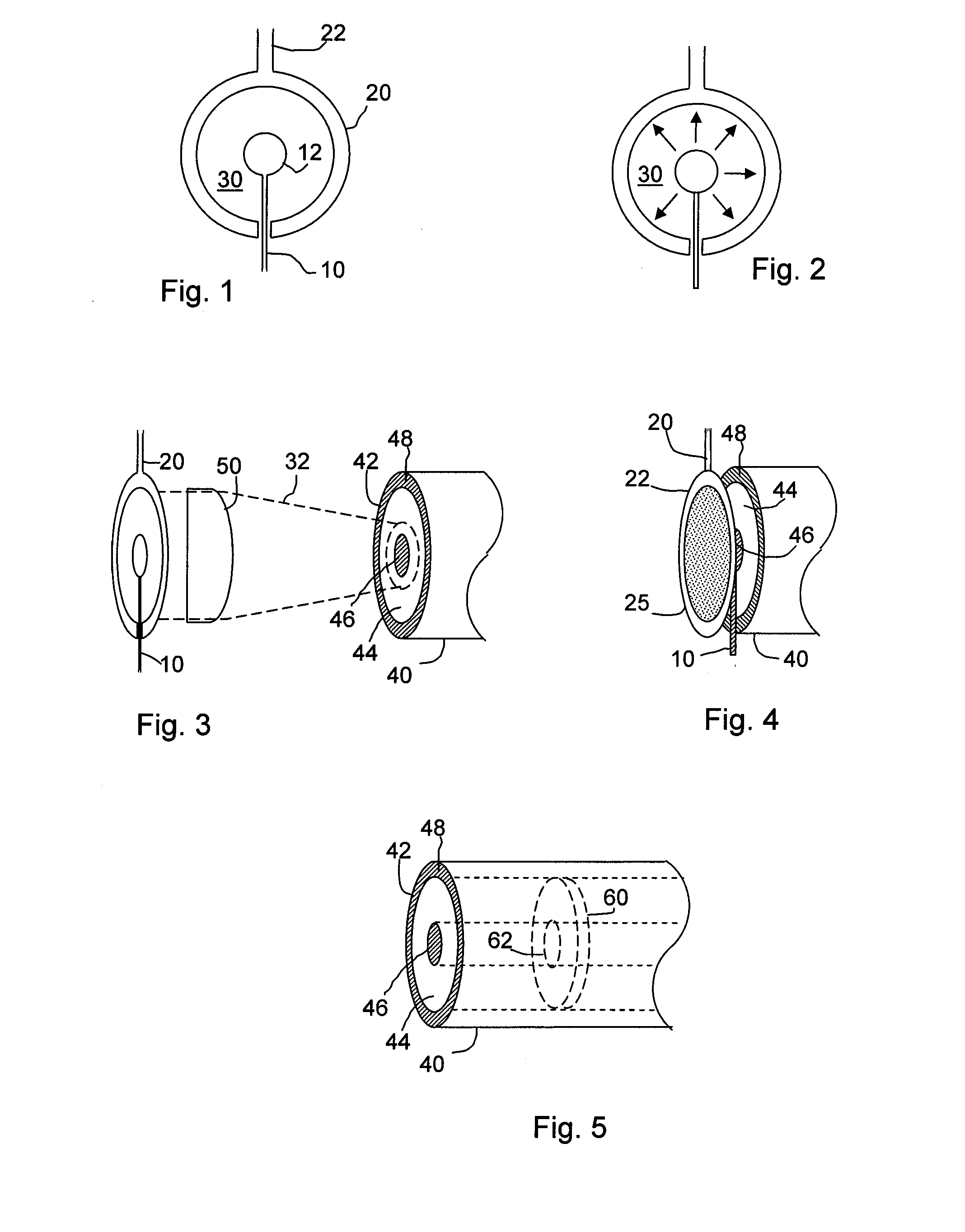
Figure 2 
Figure 3
Abstract
Description
CROSS-REFERENCE TO RELATED APPLICATIONS
[0001] This application is a filing under 35 U.S.C. 371 of International Application No. PCT / US2005 / 024783 filed Jul. 13, 2005, entitled “A Method for Coupling Terahertz Pulses into a Coaxial Waveguide,” claiming priority of U.S. Provisional Patent Application No. 60 / 587,706 filed Jul. 14, 2004, which applications are incorporated by reference herein in their entirety.TECHNICAL FIELD OF THE INVENTION
[0002] The present invention provides a method for guiding terahertz pulses over practical distances with low loss and low dispersion.BACKGROUND OF THE INVENTION
[0003] Rapid advances in laser technology have enabled various techniques for the generation and detection of electromagnetic radiation in the terahertz region (spanning from ˜100 GHz to ˜10 THz, or wavelengths between ˜30 μm and ˜3 mm). As a result, numerous uses of terahertz radiation have been explored, including trace gas detection, medical diagnosis, security screening, and defect analysis...
Examples
Embodiment Construction
[0035]Certain terms are used throughout the following description and claims to refer to particular system components. In the following discussion and in the claims, the terms “including” and “comprising” are used in an open-ended fashion, and thus should be interpreted to mean “including, but not limited to . . . .”
[0036]As used herein, a waveguide is intended to refer to a device designed to confine and direct the propagation of electromagnetic waves.
Antenna
[0037]In order to efficiently couple radiation into a waveguide, it is desirable to match the spatial pattern (the mode) of the incident radiation to the mode of the waveguide. For a coaxial waveguide, this requires that the incident beam be radially polarized, since this is the characteristic of the waveguide mode with the lowest loss. Such a polarization profile is typically very difficult to generate for free-space radiation, which is why coaxial waveguides have not often been used at high frequencies. The present invention ...