
Cruise controller for saddle-seat vehicle
a technology for driving controllers and saddle seats, applied in the direction of electrical control, process and machine control, etc., can solve the problems of degrading drive feel, and achieve the effect of avoiding impairment of drive feel and generating unnecessary engine output, simple configuration, and avoiding the generation of unnecessary engine outpu
Patent Information
- Authority / Receiving Office
- US · United States
- Patent Type
- Applications(United States)
- Current Assignee / Owner
- Publication Date
- 2009-07-09
- Estimated Expiration
- Not applicable · inactive patent
Smart Images
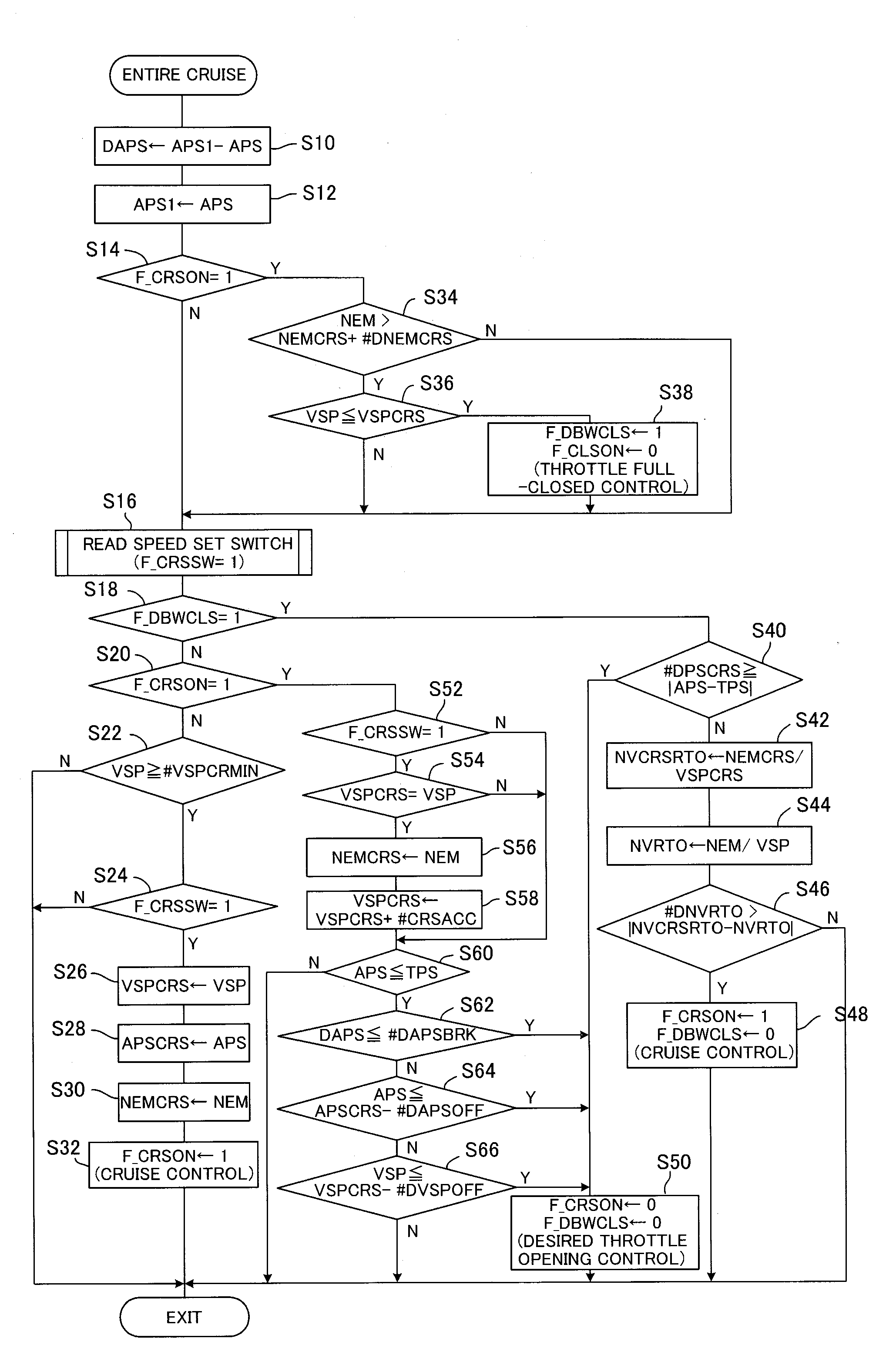
Figure 1 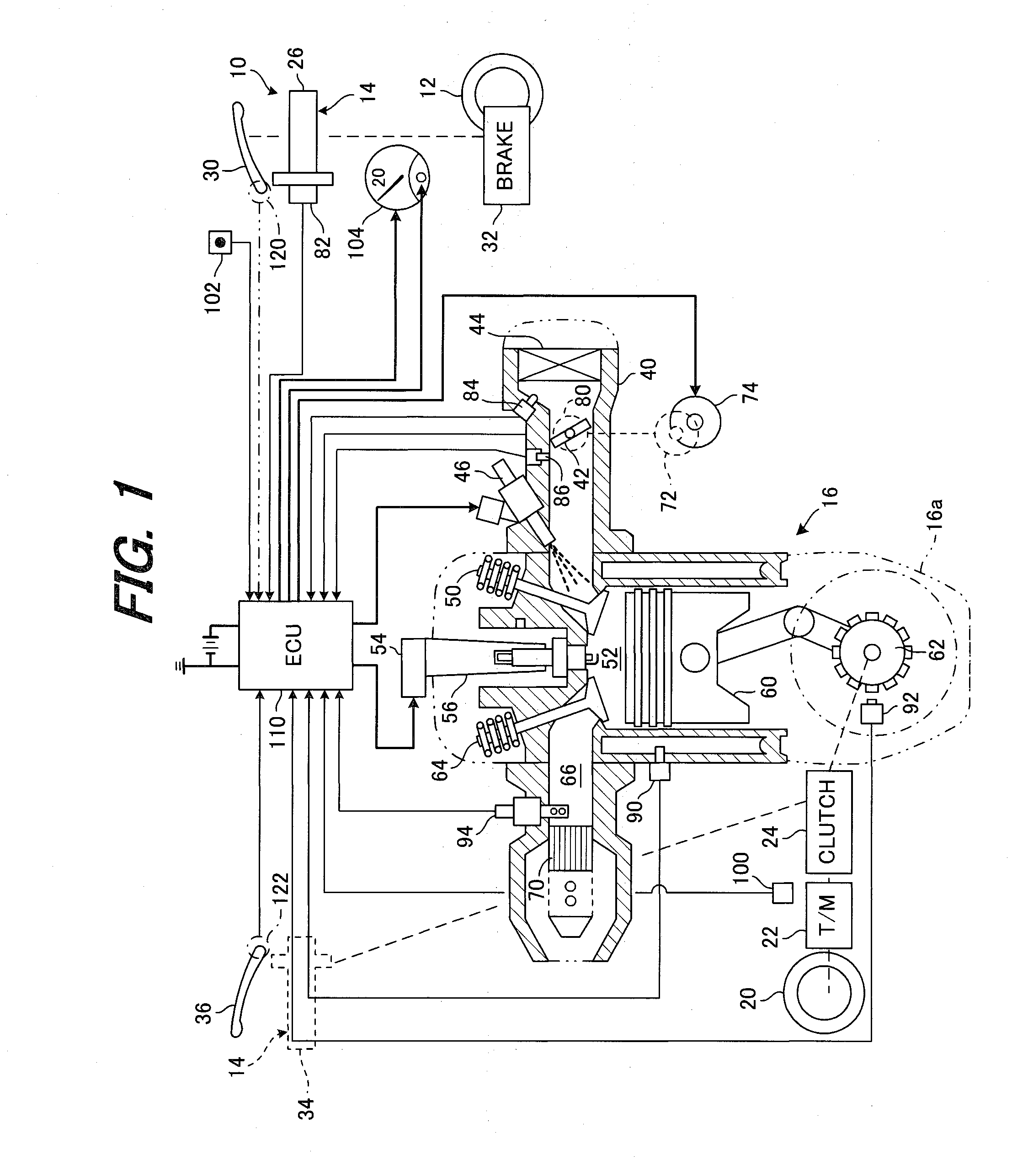
Figure 2 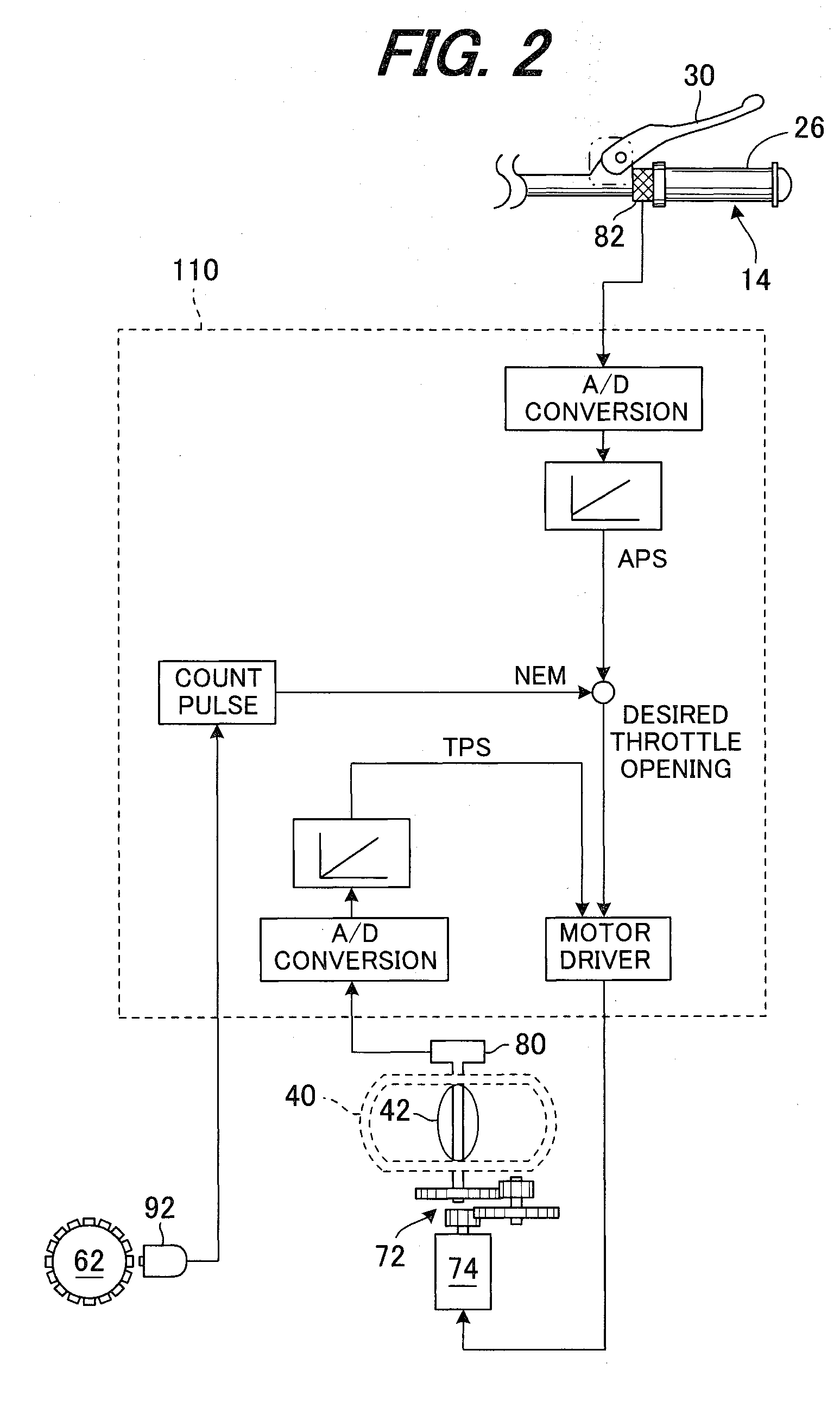
Figure 3
Abstract
Description
TECHNICAL FIELD
[0001] This invention relates to a cruise controller for a saddle-seat vehicle such as a motorcycle, scooter or ATV (All Terrain Vehicle).BACKGROUND ART
[0002] As a conventional cruise controller for a saddle-seat vehicle is known the one taught by Patent Reference 1. The proposed controller is configured to initiate cruise control when the operator operates a speed set switch upon reaching a desired vehicle speed and to enable the cruise control to be temporarily suspended simply by returning the throttle grip (accelerator) in the close direction. In other words, the configuration is such that, in addition to the cruise control being disabled by brake operation and clutch operation, the cruise control is temporarily suspended by returning the throttle grip in the close direction and is restored by again turning the throttle grip in the open direction, thereby facilitating use of engine braking by speed reduction.Patent Reference 1: Japanese Published Utility Model Appli...
Examples
first embodiment
[0059]FIG. 1 is a diagrammatic view schematically showing a cruise controller for a saddle-seat vehicle according to a first embodiment of this invention. “Saddle-seat vehicle” as termed here means any kind of vehicle that the operator rides by straddling a seat (saddle) and includes, for example, motorcycles, scooters and ATVs (All Terrain Vehicles). In this embodiment, a motorcycle is taken as an example of a saddle-seat vehicle.
[0060]In FIG. 1, the motorcycle is designated by the symbol 10. The motorcycle 10 is equipped with a handlebar 14 attached to the upper end of a telescopic fork (not shown) of a front wheel 12, an internal combustion engine 16 mounted at the middle of a frame (not shown), and a rear wheel 20 attached to the rear end of the frame through a shock absorber (not shown). Symbol 16a designates a crankcase of the engine 16.
[0061]The output of the engine 16 is varied in rotational speed by a transmission 22 (designated T / M in the drawing) and sent to the rear whee...
second embodiment
[0129]A cruise controller for a saddle-seat vehicle according to a second embodiment of the invention will be explained in the following.
[0130]FIG. 10 is a flowchart similar to part of the flowchart of FIG. 3, partially showing the sequence of operations of the controller according to the second embodiment.
[0131]The following explanation focuses on the points of difference from the first embodiment. In the second embodiment, the program passes through S58 to S60a, in which it is determined whether the throttle opening command APS is approximately equal to the actual throttle opening TPS, i.e., whether one of the throttle opening command APS and the desired throttle opening, particularly the throttle opening command APS, is near the actual throttle opening TPS, and when the result is YES, it is determined whether the throttle opening command APS and the actual throttle opening TPS are in a predetermined relationship.
[0132]In S60a, determination as to whether the throttle opening comm...
third embodiment
[0136]A cruise controller for a saddle-seat vehicle according to a third embodiment of the invention will be explained in the following.
[0137]FIG. 11 is a flowchart similar to that of FIG. 3, showing the sequence of operations of the controller according to the third embodiment. Steps in the flowchart of FIG. 11 that perform the same processing as steps in the flowchart of FIG. 3 are assigned the same reference symbols as in FIG. 3 and explanation thereof will be omitted.
[0138]The following explanation focuses on the points of difference from the earlier embodiments. In the third embodiment, when the result in S14 is a YES, the program proceeds to S200, in which brake operation is discriminated.
[0139]Specifically, in the third embodiment, as indicated in phantom lines in FIG. 1, the front wheel brake lever 30 is equipped with a brake switch (brake operation detection means) 120 for outputting an ON signal when the operator operates the front wheel brake lever 30 (when the motorcycle...