
Methods of increasing gene expression through RNA protection
a technology of gene expression and protection, applied in the field of increasing gene expression through rna protection, can solve the problems of interfering with the ability of the target rna to interact, e, etc., and achieve the effect of increasing the expression of the gene corresponding to the target mrna
Patent Information
- Authority / Receiving Office
- US · United States
- Current Assignee / Owner
- Publication Date
- 2011-01-13
- Estimated Expiration
- Not applicable · inactive patent
Smart Images
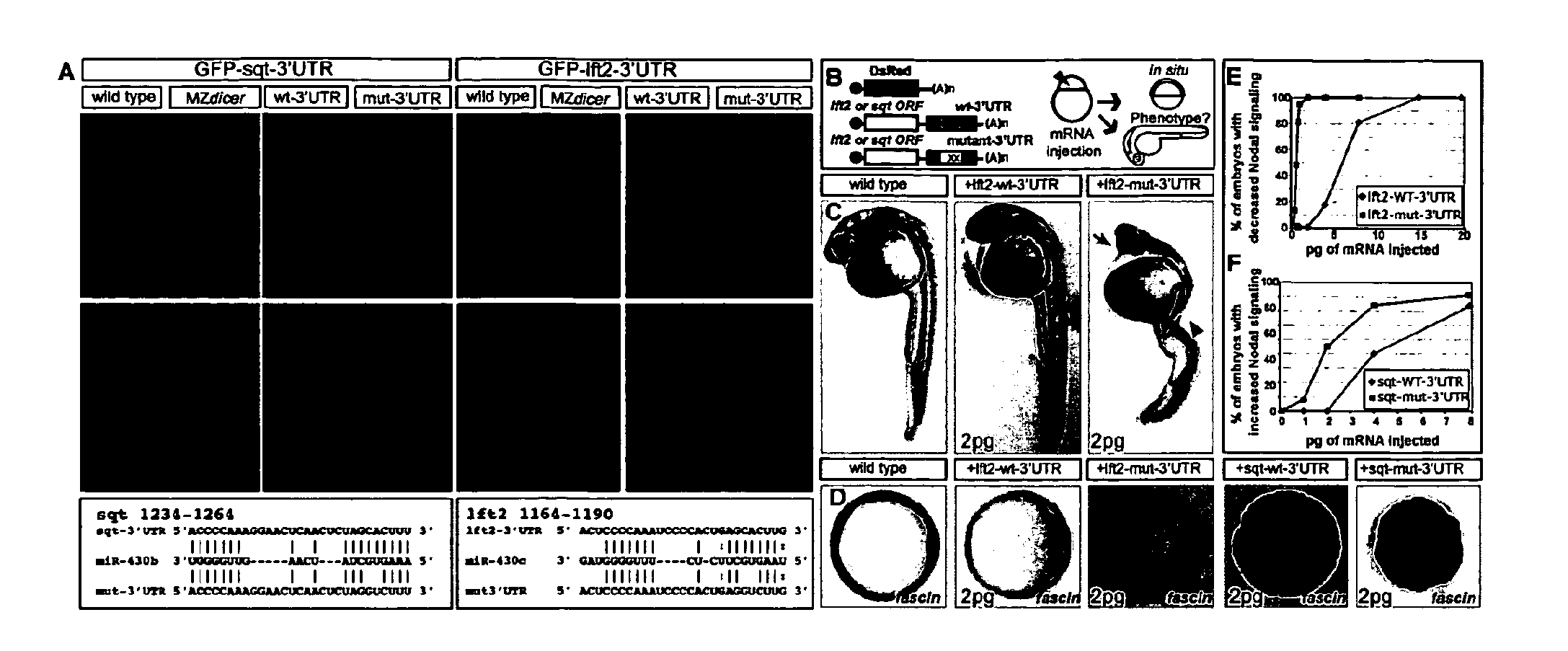
Figure 1 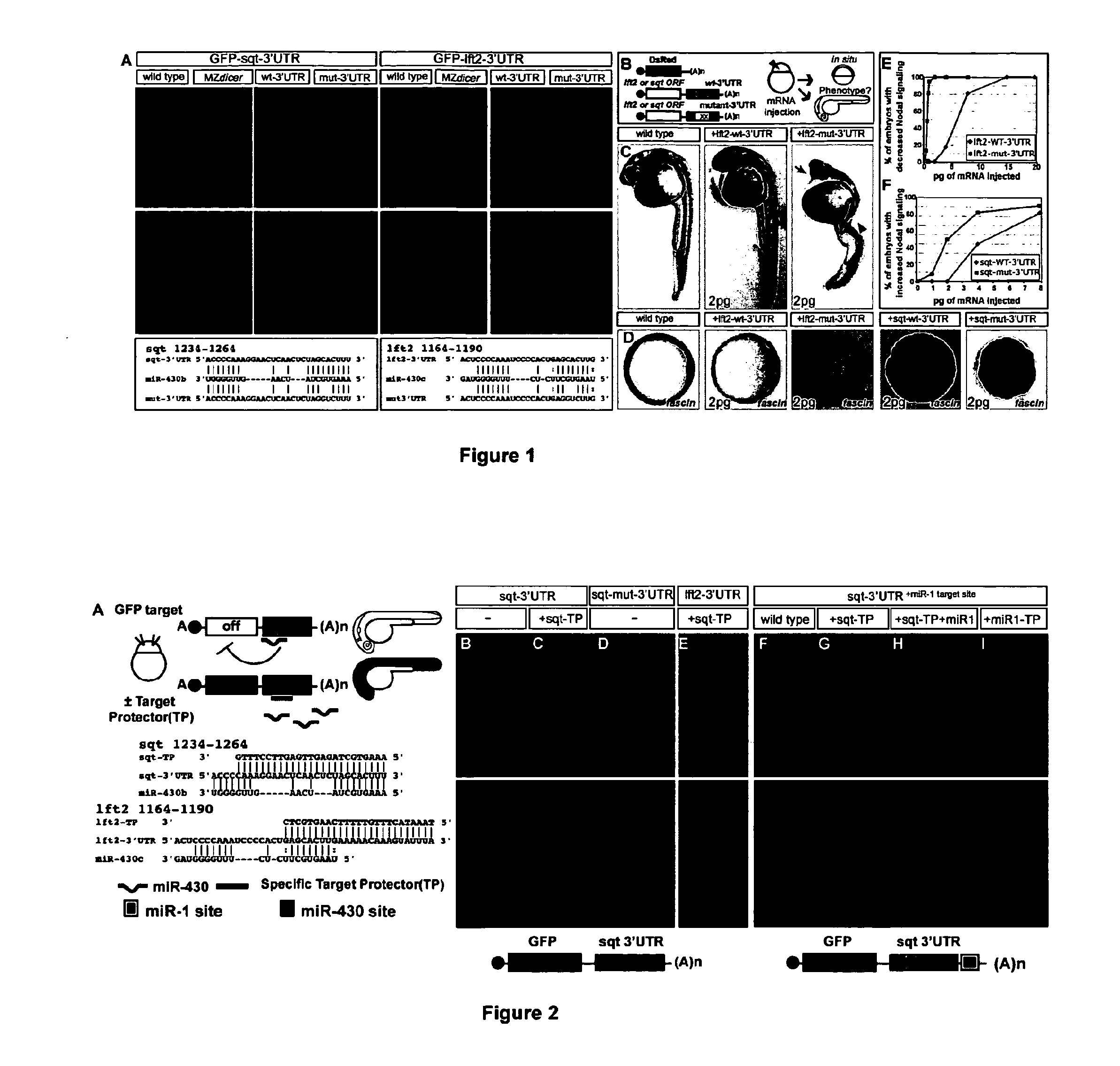
Figure 2 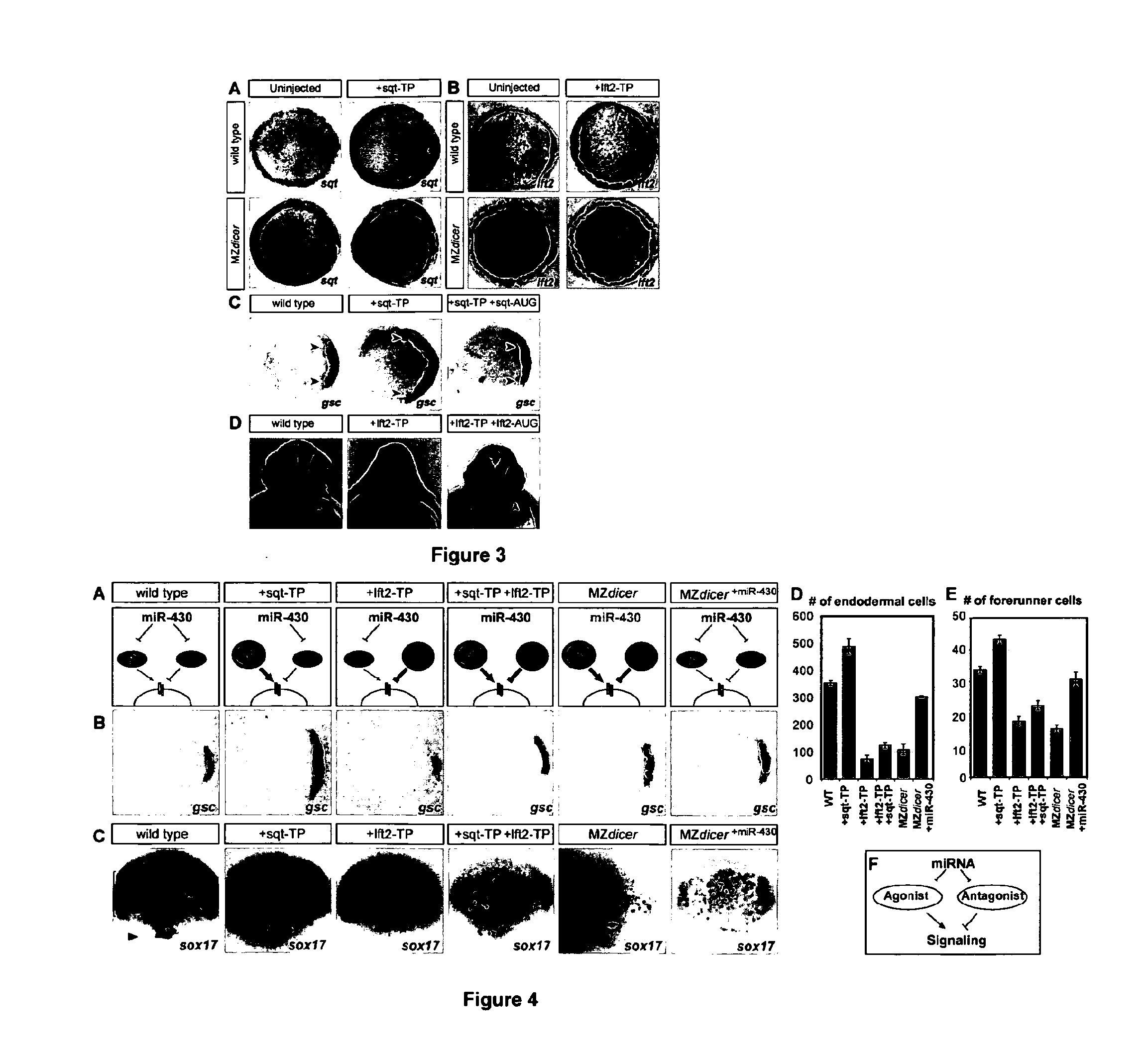
Figure 3
Abstract
Description
REFERENCE TO RELATED APPLICATIONS
[0001] This application claims the benefit of the filing date under 35 U.S.C. §119(e) to U.S. Provisional Application No. 60 / 966,867, filed on Aug. 29, 2007, the entire content of which (including the specification and drawings) is incorporated herein by reference.STATEMENT REGARDING FEDERALLY SPONSORED RESEARCH
[0002] Work described herein was supported by Grant No. GM-56211 from the National Institutes of Health (NIH). The U.S. Government has certain rights in the invention.FIELD OF THE INVENTION
[0003] This invention relates to the use of one or more RNA target protectors to inhibit the interaction of an RNA, e.g., small RNA (miRNA, etc.), with a target RNA (e.g., mRNA), thus increasing the stability of the target RNA and its function (e.g., gene expression of the gene corresponding to a target mRNA). An RNA target protector of the invention may be, for example, an oligonucleotide, e.g., a morpholino, or a small molecule. The invention further relates ...
Examples
examples
[0080]The specific examples provided herein focus on the zebrafish miR-430 family. This miRNA family is highly expressed during early zebrafish development, targets hundreds of mRNAs, and is required for embryonic morphogenesis and clearance of maternal mRNAs (A. J. Giraldez et al., Science 308:833-8 (2005); A. J. Giraldez et al., Science 312:75-9 (2006)). It should be noted, however, that the invention described herein is not limited to this particular embodiment, as this embodiment is intended merely as a representative example. Analysis of 3′ UTRs with sites complementary to miR-430 identified squint (sqt), a member of the Nodal family of TGFβ signals, and lft1 and lft2, members of the Lefty family of TGFβ signals (FIG. 5). Nodals are the key regulators of mesendoderm induction and left-right axis formation, whereas Leftys act as antagonists of Nodal signaling (A. F. Schier, Annu Rev Cell Dev Biol 19:589-621 (2003); M. M. Shen, Development 134:1023-34 (2007)). The balance between...