
Peptide-based inhibitor of interleukin-10 or interferon-gamma signaling
Patent Information
- Authority / Receiving Office
- US · United States
- Current Assignee / Owner
- Publication Date
- 2013-05-02
Smart Images
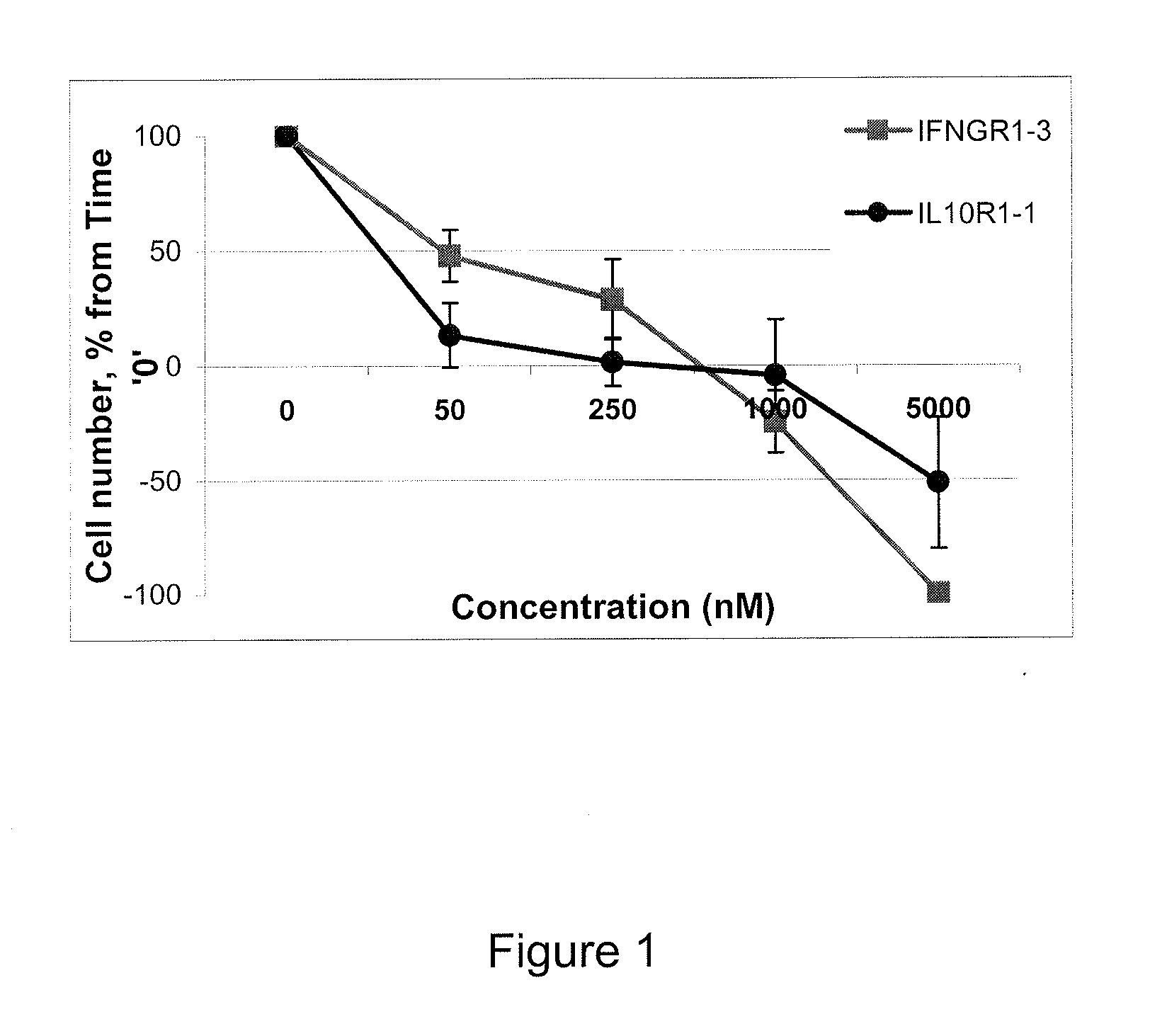
Figure 1 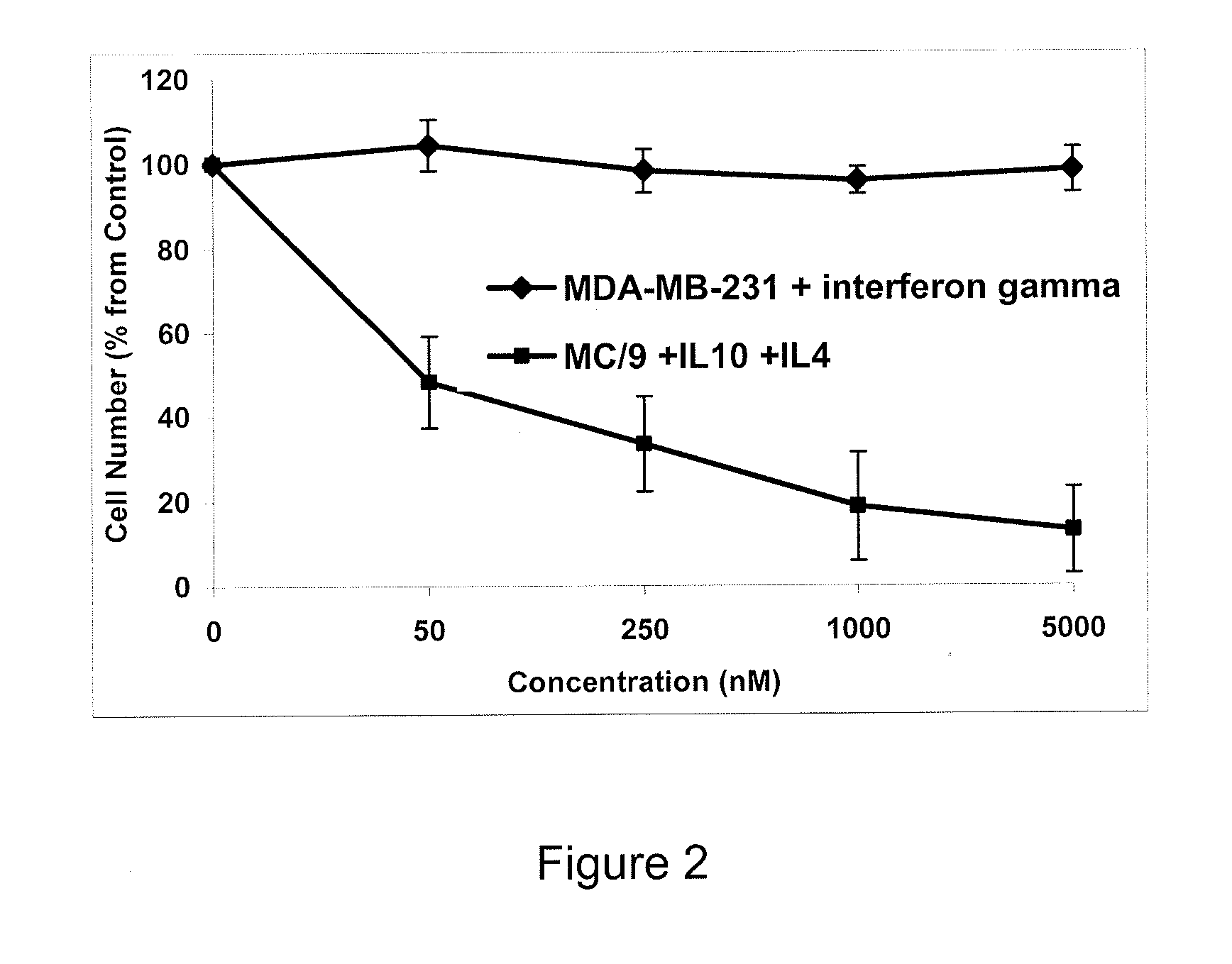
Figure 2 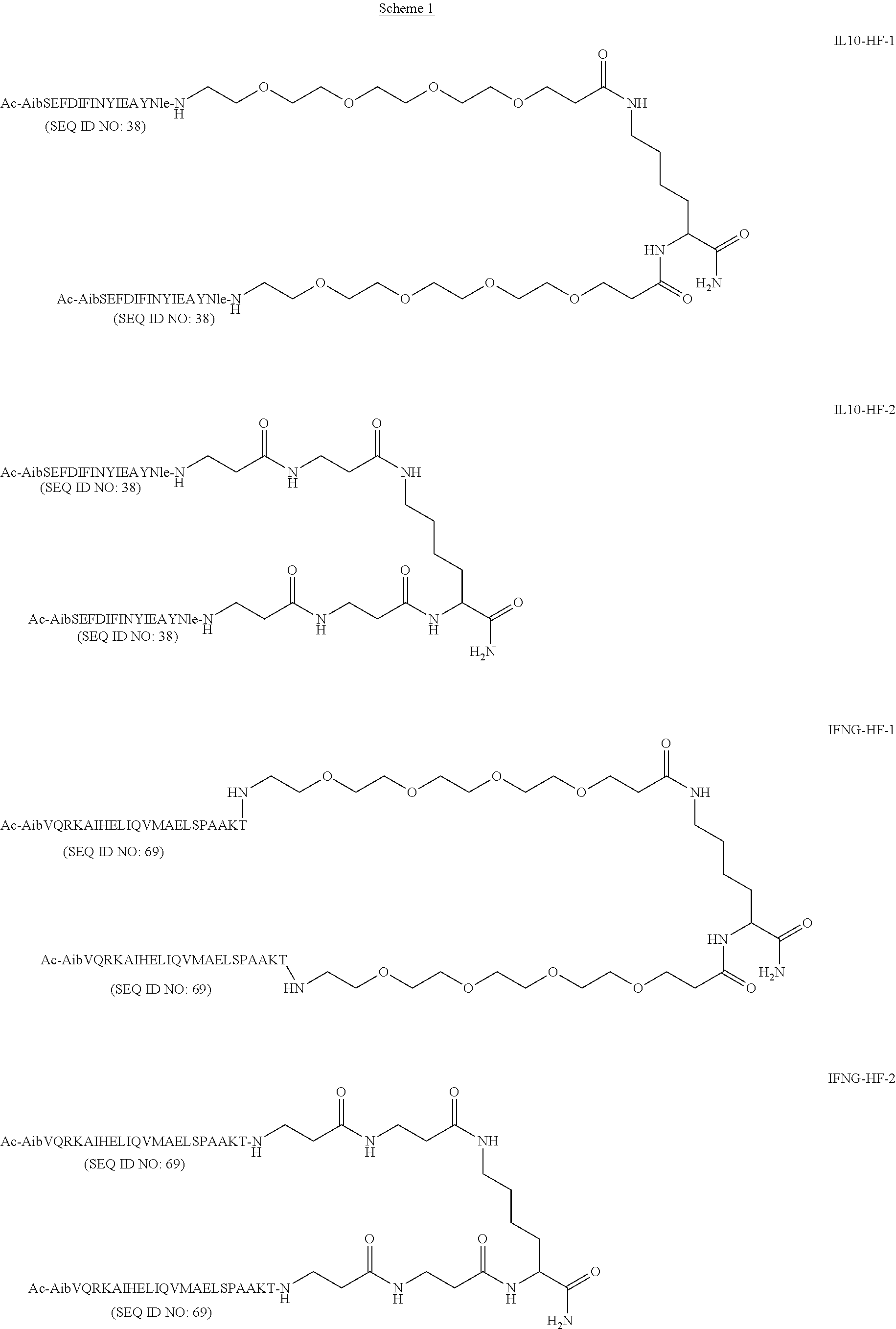
Figure 3
Abstract
Description
SEQUENCE LISTING
[0001] Incorporated by reference in its entirety herein is a nucleotide / amino acid sequence listing submitted concurrently herewith.BACKGROUND OF THE INVENTION
[0002] Cytokine signaling by IL10 and IFN-gamma plays crucial roles in inflammation, cancer growth and autoimmune diseases. IFN-gamma, produced primarily by natural killer cells, is associated with anti-virus, pro-apoptotic tumor functions. However, recent studies have shown that aberrant IFN-gamma expression is associated with a number of autoimmune and auto-inflammatory diseases, liver cancers, papillomas, and breast cancers. In addition, IFN-gamma signaling on T cells is a critical step in initiating an adaptive immune response in graft-versus-host-disease (GVHD). GVHD remains one of the most prevalent causes of morbidity and mortality after bone marrow transplantations in leukemia patients.
[0003] IL10 is an anti-inflammatory cytokine and is involved in immune regulation and inflammation. It controls the immune...
Examples
example 1
[0070]The following Example illustrates the use of peptides according to the invention to inhibit cytokine signaling.
[0071]Comparison of IL10R1, IL10R2, IFNGR1, and IFNGR2 sequences from different species allowed identification of conserved regions. Alignment of the relevant portions of the sequences are provided below, in which conserved regions are identified with underlining.
[0072]Regions labeled “A” on the alignments are believed to be involved in the interactions of the receptors with JAK1. Regions D and E of IL10R1 are believed to bind STAT3 upon phosphorylation of tyrosine residues that are a part of YXXQ motifs. Region D of IFNGR1 is thought to bind STAT1 and STAT5 upon phosphorylation of tyrosine. It is also believed to interact with SOCS3 that competes for this site with STAT1 and STAT5, thus, inhibiting phosphorylation and activation of transcription factors by IFNGR. The functions of the other highly conserved region of IL10R1 and IFNGR1 cytoplasmic domains are unknown.
[...
example 2
[0081]The following Example illustrates the use of peptides according to the invention to inhibit cytokine signaling.
[0082]Both IFN-gamma and IL10 monomers are L-shaped predominantly helical molecules that dimerize into a symmetrical dimer held together by the interactions of two C-terminal helixes (helix F and helix E) with a bundle of four N-terminal helixes, A, B, C and D (Zdanov et al., Protein Sci., 5, 1955-1962 (1996)). The C-terminal helix F is involved in extensive interactions with helixes B, C, and D. In addition, crystal structures of human and viral IL10 complexed with a soluble form of IL10-R1 suggest that residues Ser141, Asp144, and Glu151 of helix F are essential for the binding of IL10 to the receptor (Yoon et al., Structure, 13, 551-564 (2005); and Jones et al., Proc. Natl. Acad. Sci. U.S.A., 99, 9404-9409 (2002)).
[0083]To evaluate whether synthetic helix F analogs could interact with the corresponding cytokine, fluorescent derivatives of helix F were synthesized. ...