

Convertible wearing apparel
a technology for infants and clothing, applied in the field of convertible infant wearing apparel, can solve the problems of infants being exposed to germs and bacteria, infants being easily scratched by infant's fingernails, and uncomfortable for infants and diaper changes, and achieve the effect of minimizing the bunching minimizing the bunching of the front side fabri
Patent Information
- Authority / Receiving Office
- US · United States
- Patent Type
- Applications(United States)
- Current Assignee / Owner
- Publication Date
- 2019-04-11
- Estimated Expiration
- Not applicable · inactive patent
Smart Images
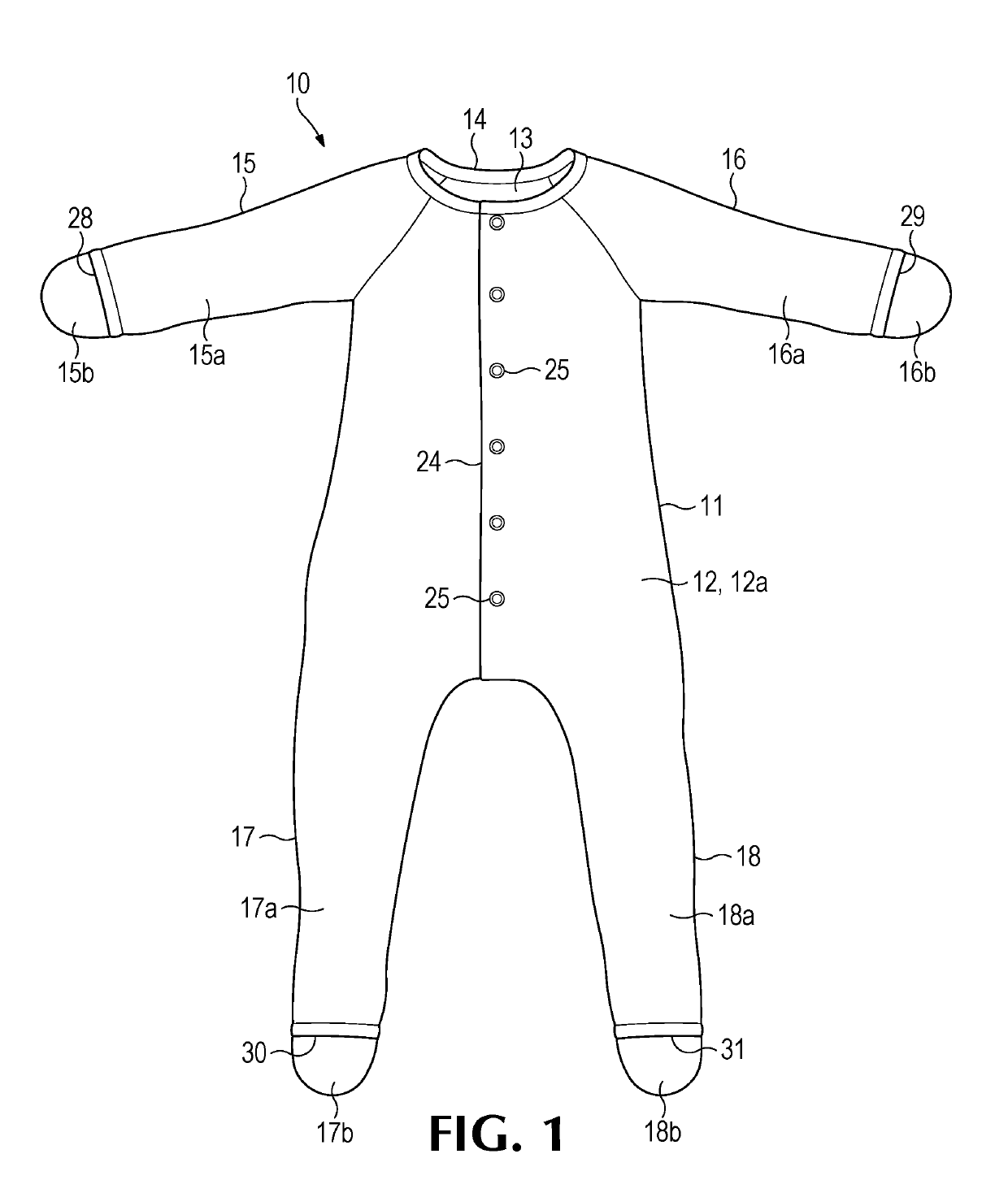
Figure 1 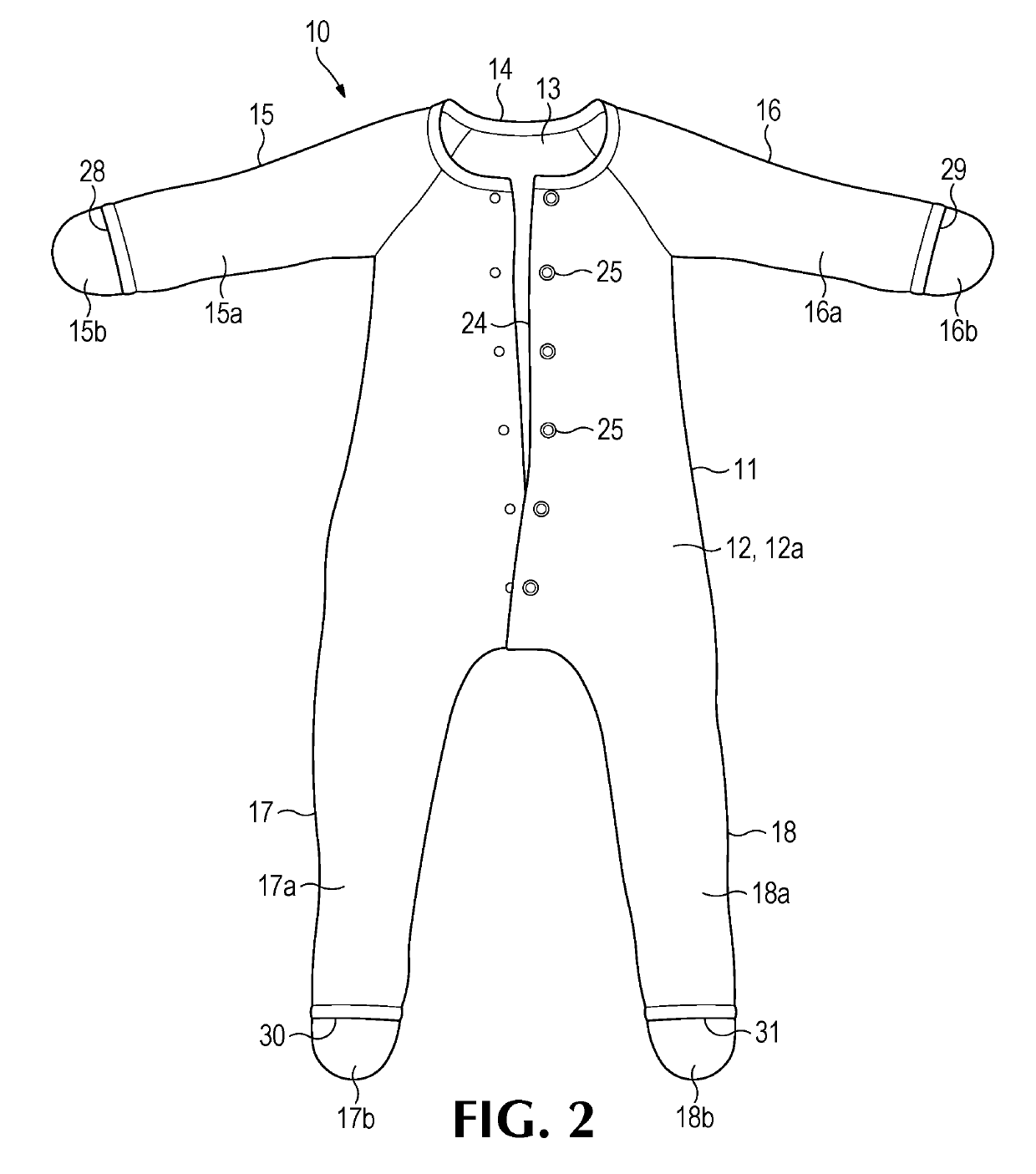
Figure 2 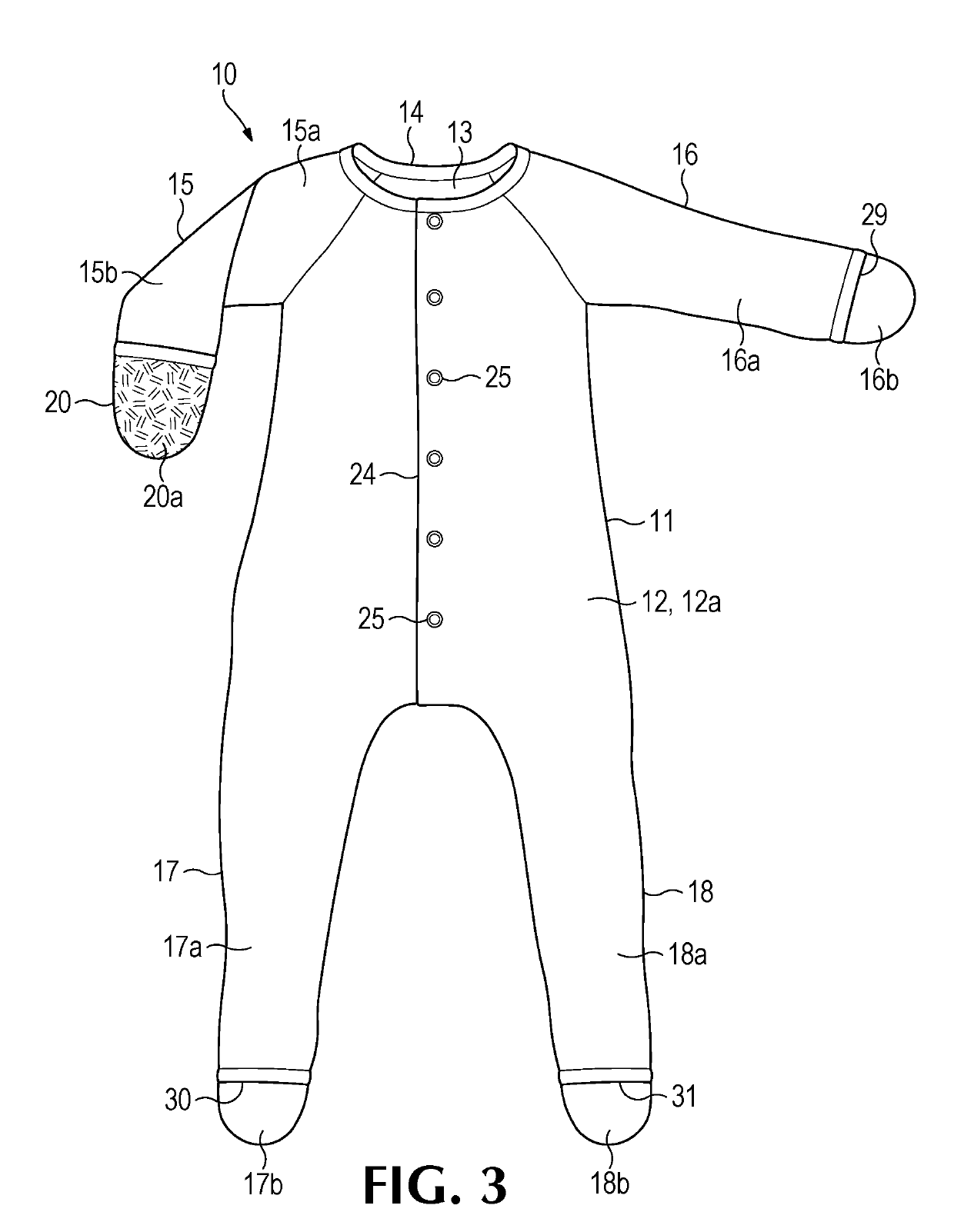
Figure 3
Abstract
Description
BACKGROUND OF INVENTION1. Field of the Invention
[0001] This invention relates generally to infant wearing apparel, and more particularly to convertible infant wearing apparel.2. Description of Background
[0002] Infant “footies” are garments that generally include arm portions, leg portions, and enclosures at the distal end of the leg portions for the infant's feet which are permanently affixed to the leg portions such that the infant's toes and feet cannot be exposed without removing the garment. To access the infant for activities such as diaper changes, a zipper running the length of the front side of the garment must be unzipped, exposing the infant's torso, making the infant uncomfortable and the diaper change more difficult. These “footies” also do not enclose the infant's hands, leaving the infant exposed to germs and bacteria, and susceptible to scratches from the infant's fingernails.SUMMARY OF THE INVENTION
[0003] In accordance with one aspect of the invention, a garment compris...
Examples
Embodiment Construction
[0022]With reference initially to FIGS. 1-3, a convertible garment 10 having a trunk 11, a top opening 14, sleeves 15 and 16, and legs 17 and 18 is shown. Sleeves 15, 16 extend from a portion of the trunk 11 that is near the top opening 14, and legs 17, 18 extend from a portion of the trunk 11 that is distal from the top opening 14. In an embodiment, the garment 10 additionally may have a rear opening 19 on the back side 13 of the garment 10 (see FIG. 6).
[0023]Sleeves 15, 16 may be formed from one or more pieces of fabric that are attached to trunk 11 near top opening 14 by any conventional means, such as in the embodiments shown in FIGS. 1-3 and 6 and discussed further below. Alternatively, sleeves 15, 16 may be formed from the same piece or pieces of fabric that form trunk 11. Similarly, legs 17, 18 may be formed from one or more pieces of fabric that are attached to trunk 11 distally from the top opening 14 by any conventional means. Alternatively, legs 17, 18 may be formed from ...