
Method of Improving Wellbore Integrity and Loss Control
a wellbore and integrity technology, applied in the direction of sealing/packing, wellbore/well accessories, chemistry apparatus and processes, etc., can solve the problems of significant loss of pressure containment, failure of cement/casing bond, and costly drilling, so as to improve the integrity of the wellbore
Patent Information
- Authority / Receiving Office
- US · United States
- Current Assignee / Owner
- Publication Date
- 2019-10-17
Smart Images
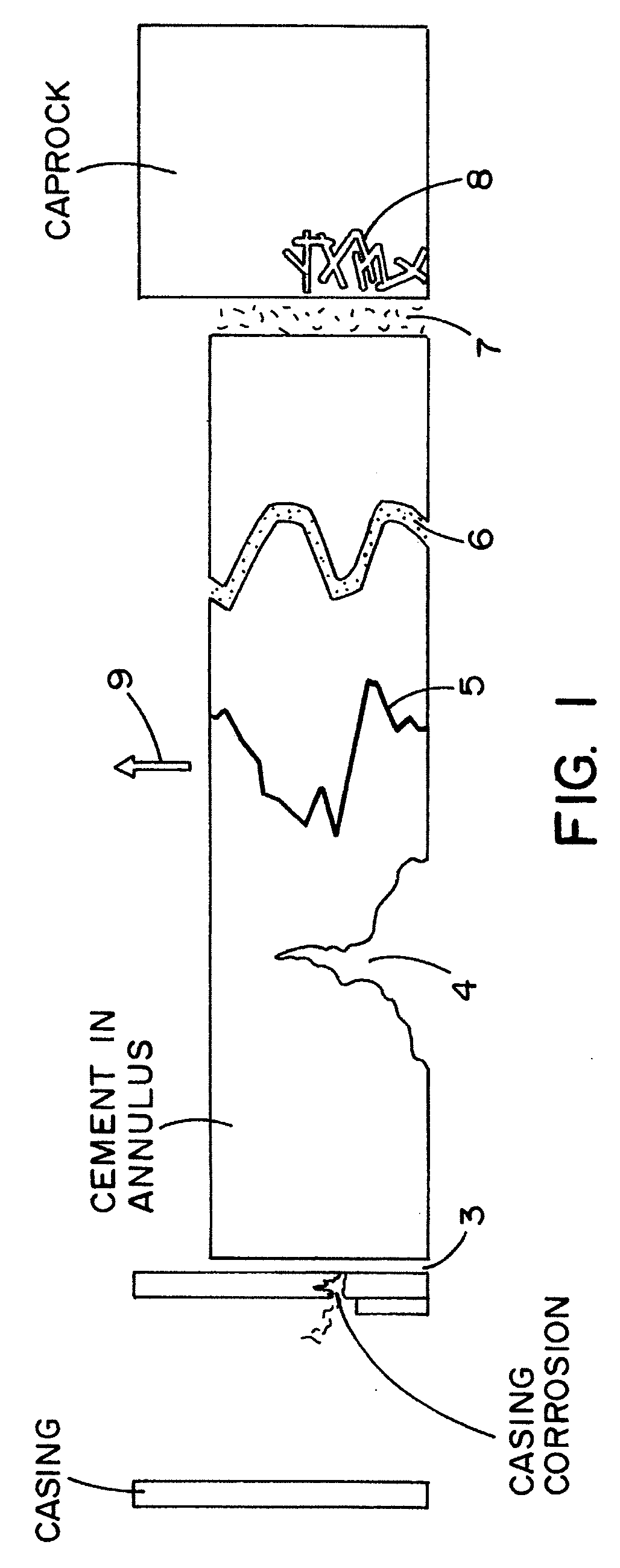
Figure 1 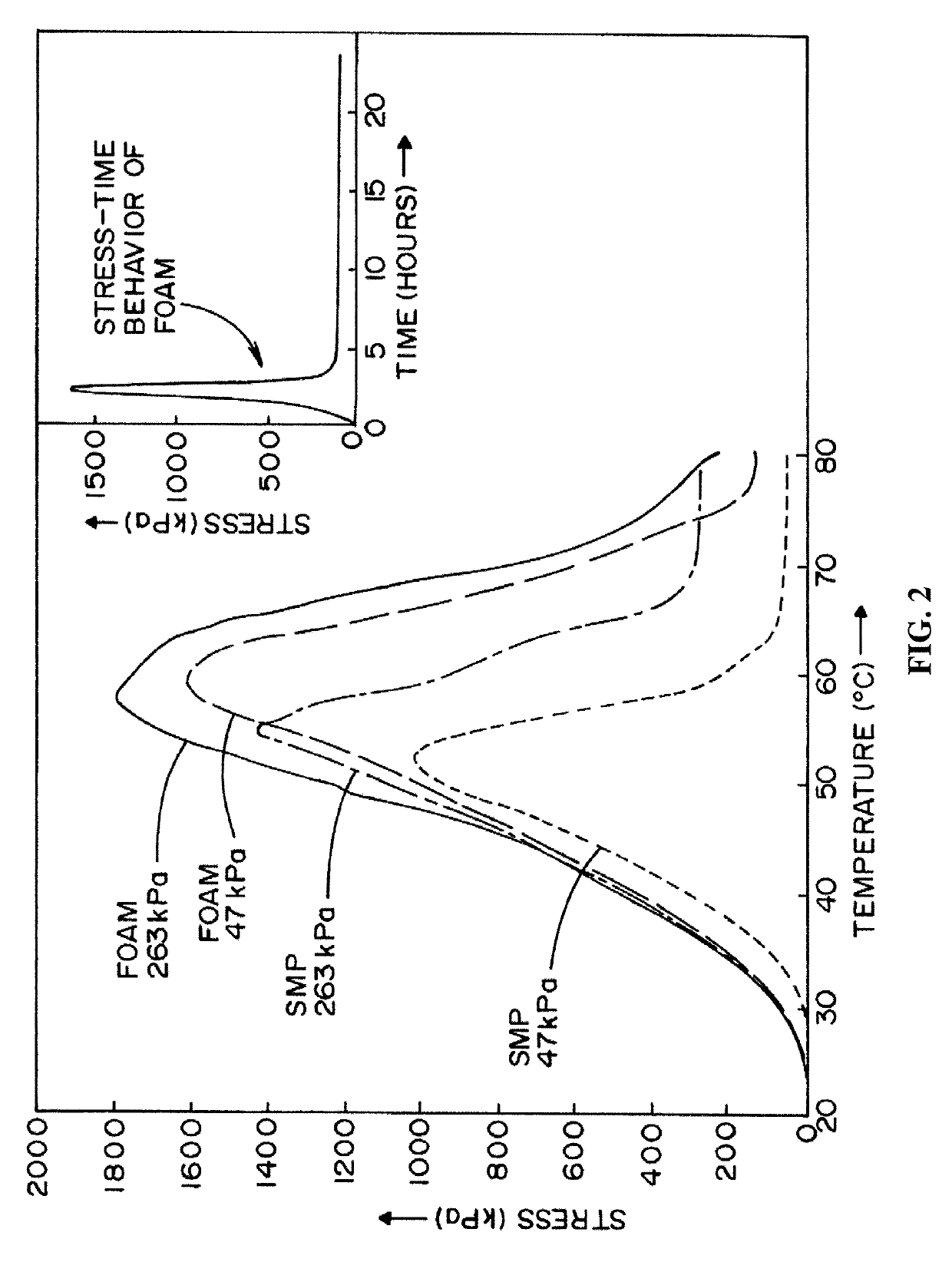
Figure 2 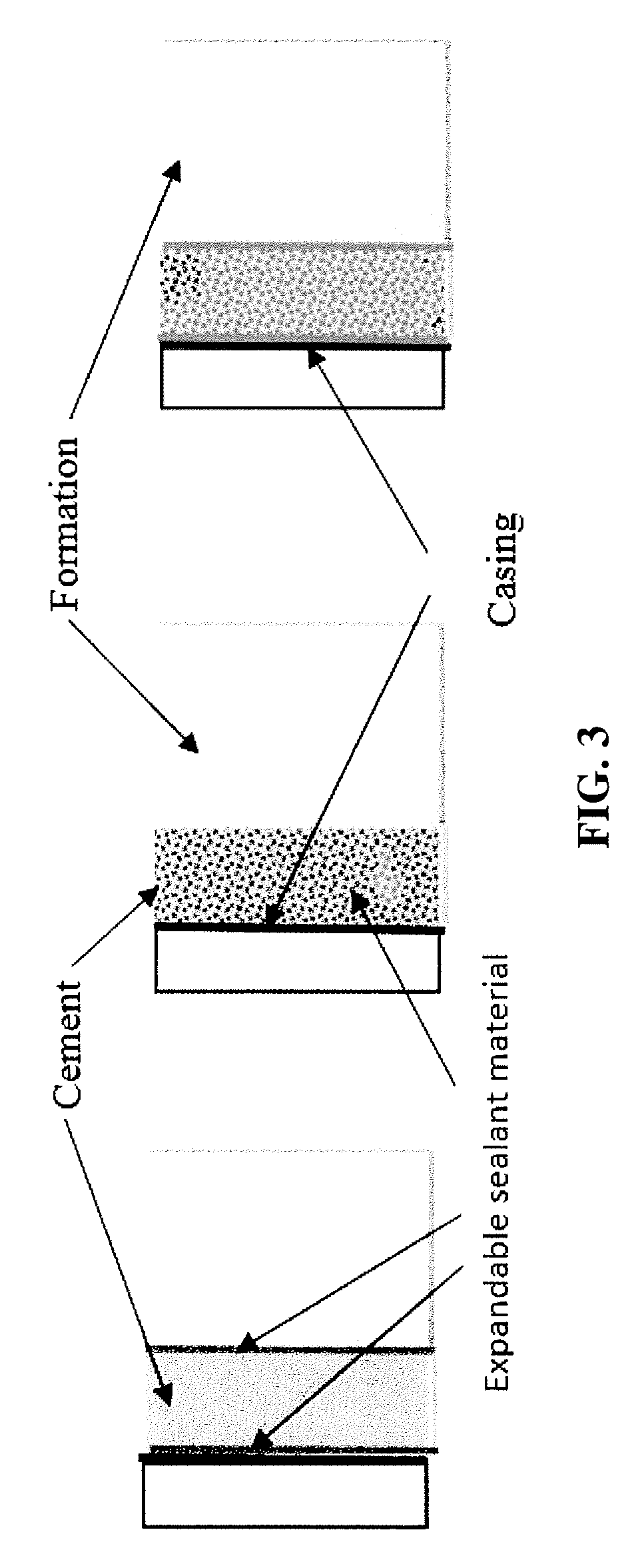
Figure 3
Abstract
Description
[0001] The present invention claims priority on U.S. Provisional Application Ser. No. 62 / 658,279 filed Apr. 16, 2018, which is incorporated herein by reference.TECHNICAL FIELD
[0002] The present invention relates to a method for inhibiting or preventing leakage in cemented, cased boreholes, and / or for controlling fluid losses during drilling and open hole completion operations, and to an expandable material that can be used to inhibit or prevent leakage in cemented, cased boreholes. As such, the present invention pertains to a method for enhancing wellbore integrity and / or for sealing a wellbore by sealing formation and / or micro-annulus fractures in a wellbore. Such sealing can be at least partially accomplished by the use of timed expansion of an expandable sealant material that is placed in a wellbore. The expansion of the expandable sealant material causes the cement surface or formation surface to be compressed, thereby creating a tight seal and / or eliminating annulus cracking, fra...
Examples
example 1
[0142]An expandable sealant material is fabricated by compounding 35 wt. % of milled degradable magnesium chips (Tervalloy™) with S-series™ ellastolan thermoplastic polyurethane (BASF) in a compounding extruder and then injection molding the mixture into 30 mesh beads. Upon exposure to 70° C. water for 48 hours, the expandable sealant material exhibited a 94% volumetric expansion, and the expanded expandable sealant material has a 92 shore A hardness.
example 2
[0143]The expandable sealant material beads of Example 1 were blended at 3 wt. % into a class B cement and poured in the annulus between two pipes. A strain gauge was attached to the outer casing, which showed a ½% strain, indicating that the cement was placed in compression. Sectioning of the cement after one week showed no significant microcracking or micro-annulus cracking at either cement / steel interface.
example 3
[0144]An expandable sealant material was fabricated by compounding 30 wt. % milled, degradable magnesium chips into elasstolan TPU using a mixtruder. The extrudate was extruded into filaments which were twisted into rope with a ¼″ diameter. The rope was cut to 4″ lengths and knotted to form ⅝+ diameter knots. 300 knots were added to circulating mud where the expandable sealant material successfully sealed fractures and reduced circulation loss by over 95% after four hours.