
Combinations with a c-19 steroid for treating cancers
a combination therapy and steroid technology, applied in the field of medicine, can solve the problems of not showing any therapeutic effect, the administration of the above-mentioned combination therapy may be accompanied by several severe or less severe side effects, and the treatment of cancer is still a challenge for physicians and patients
Patent Information
- Authority / Receiving Office
- US · United States
- Current Assignee / Owner
- Publication Date
- 2021-11-11
Smart Images
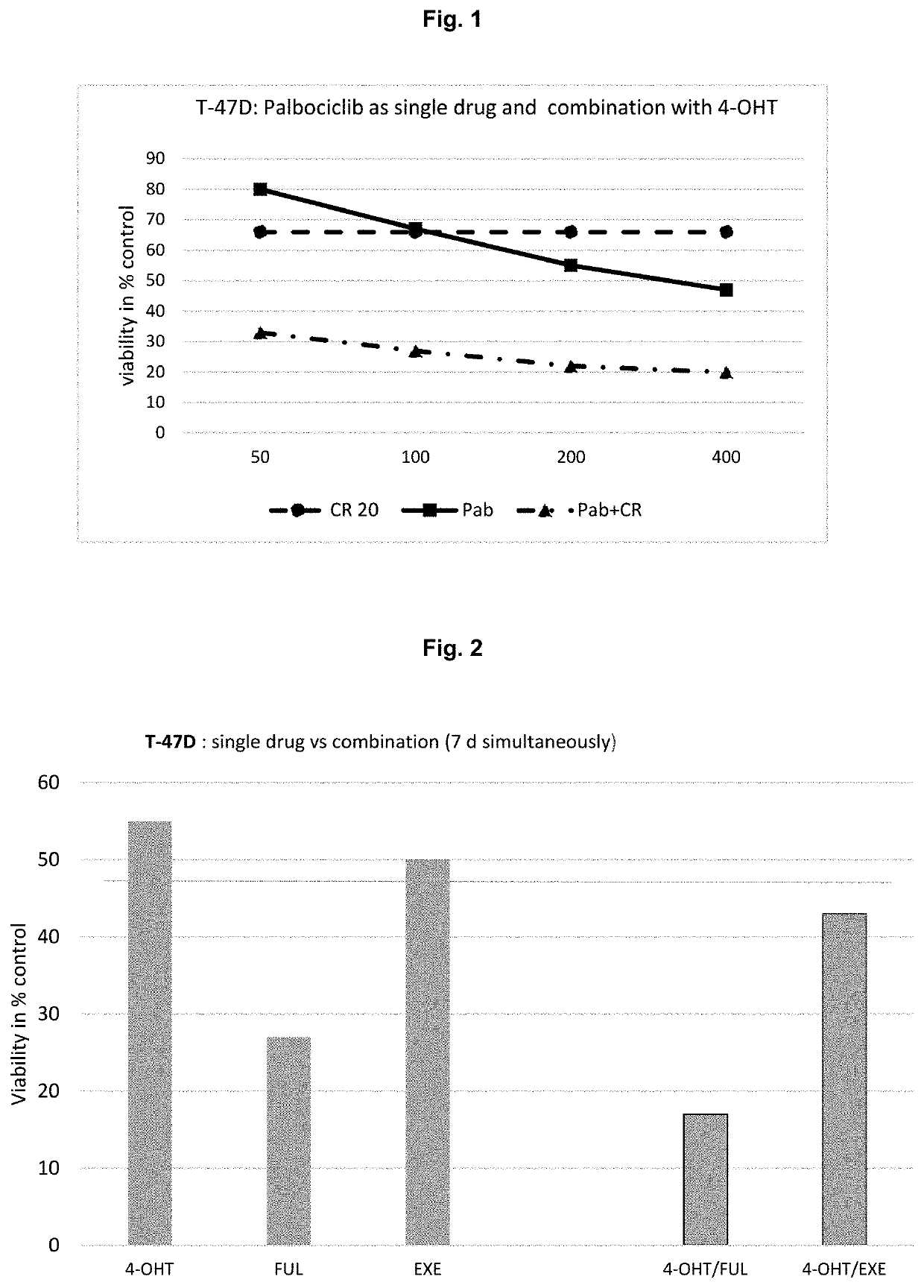
Figure 1 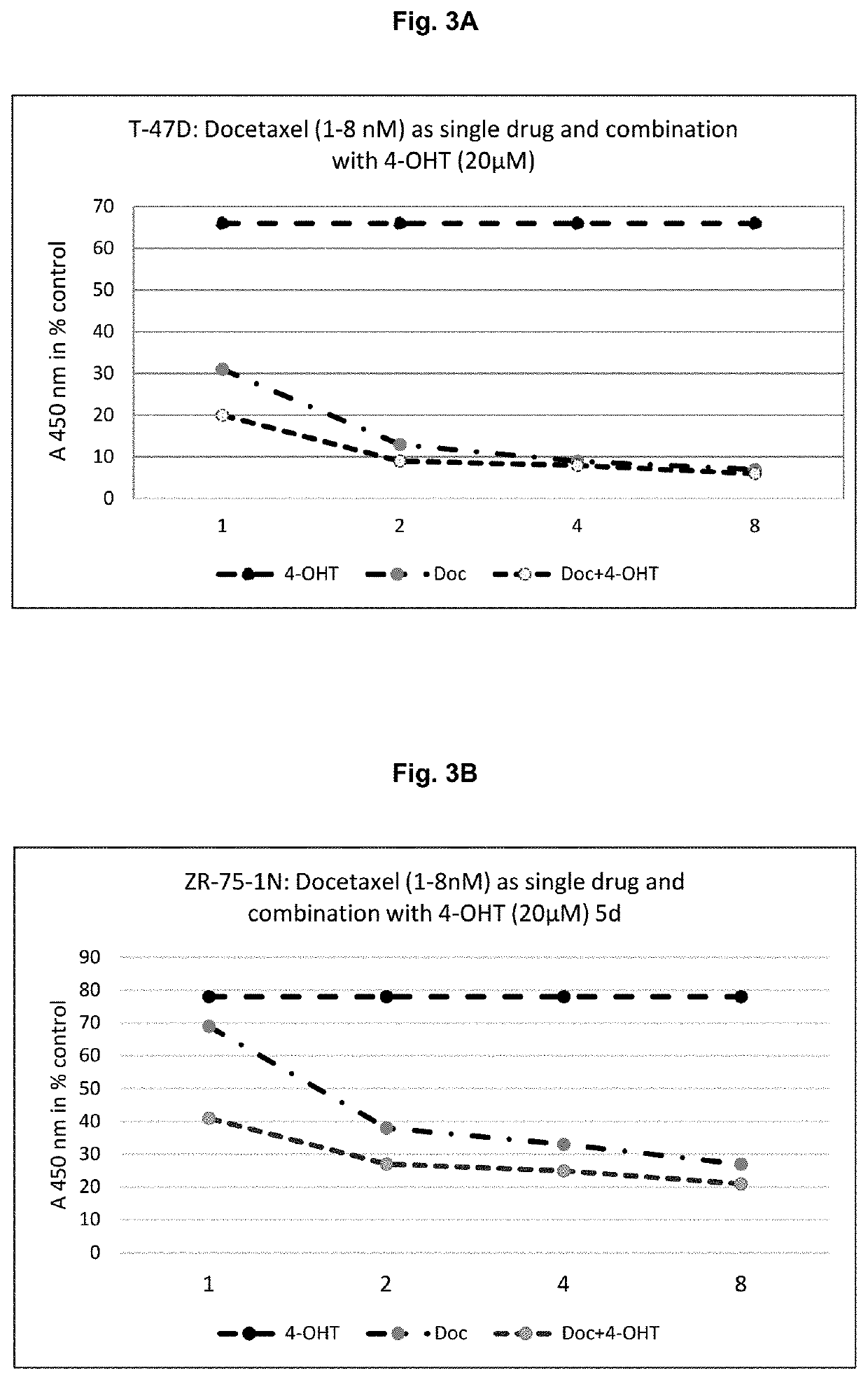
Figure 2 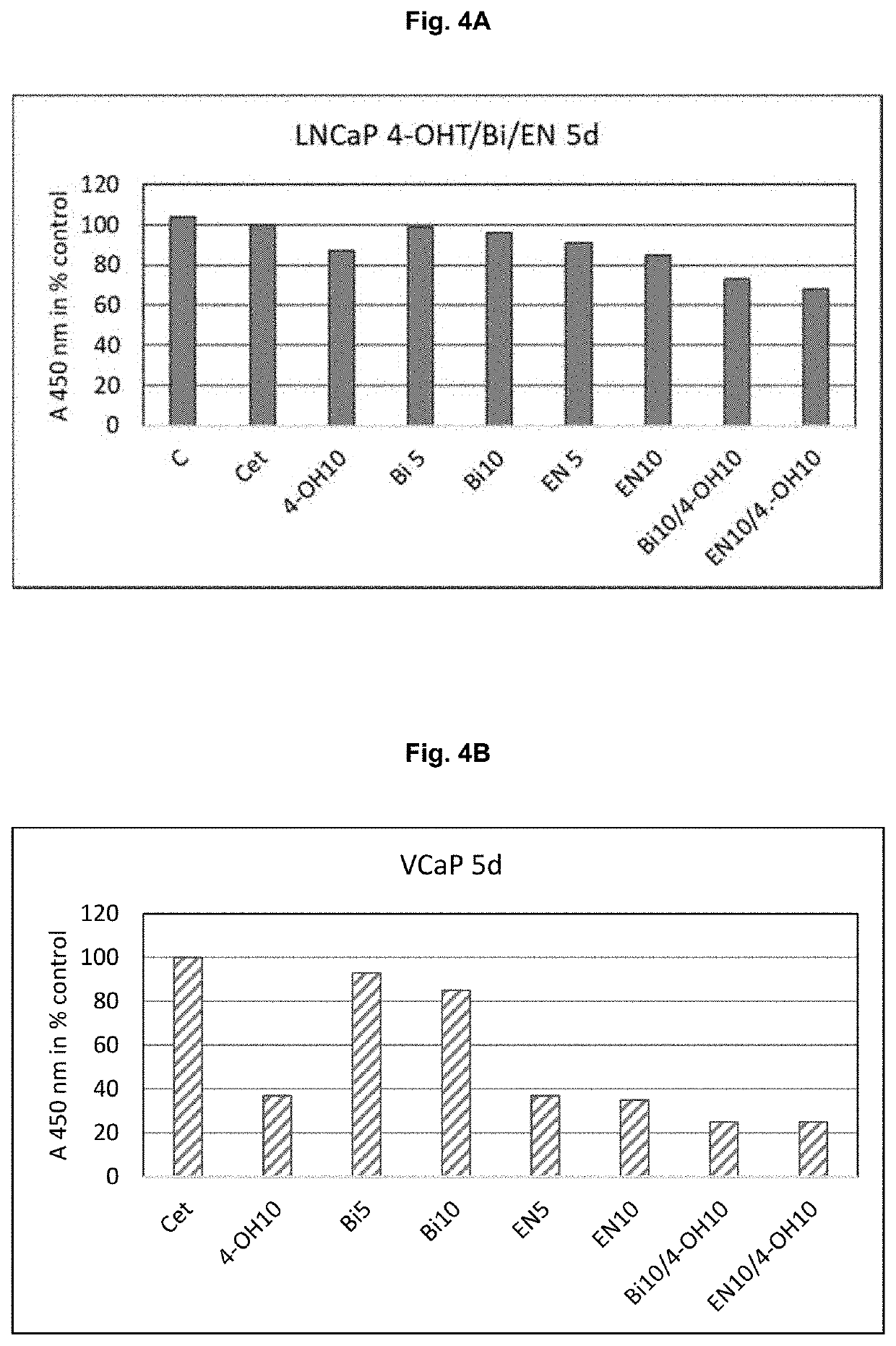
Figure 3
Abstract
Description
FIELD OF THE INVENTION
[0001] The present invention relates to the field of medicine, particularly to novel uses of C-19 steroid compounds, more particularly to C-19 steroids having an androsten-3-one structure with specific structural configurations, in particular at the 4- and / or 17-position, for inhibition of cancer cell growth in combination with another anticancer agent or as second or third line treatment. The present invention particularly relates to selected C-19 steroids inhibiting the proliferation of tumor cells expressing an androgen receptor and show only limited sensitivity to other cancer agents such as aromatase inhibitors, androgen receptor antagonists, androgen synthesis inhibitors, chemotherapeutics as well as CDK4 / CDK6 inhibitors.DESCRIPTION OF THE BACKGROUND ART
[0002] The therapy of cancer is still a challenge for physicians and patients. Numerous approaches are used in the clinical setting based on (i) radiation, i.e. killing of tumor by radioactive materials or h...
Examples
example 1
on of 4-OHT with CDK4 / CDK Inhibitors
[0129]In a set of in vitro experiments, 4-OHT (20 μM) was used in combination with the CDK4 / CDK inhibitor Palbociclib, currently used in therapy of breast cancer. Palbociclib was tested at various concentrations (50, 100, 200, and 400 nM) in combination with 4-OHT (20 μM).
[0130]The human breast cancer cell line T-47 D (ACC 739) was obtained from DSMZ as frozen cell pellet (Deutsche Sammlung von Mikroorganismen und Zellkulturen). Originally, these cells T-47D cell line was isolated by Keydar et al. (1979) from a pleural effusion obtained from a 54-year old female patient with an infiltrating ductal carcinoma of the breast T-47D is expressing the ER, PR and AR but lacking HER2 / neu overexpression. Thus, T-47D may represent a cell line representative for the most prevalent breast cancer subtype.
[0131]T-47D were grown routinely in RPMI medium containing 10% fetal calf serum (FCS) and antibiotics in a humidified incubator at 36.5° C. / 90% humidity and 5%...
example 2
Combination with an Aromatase Inhibitor or an Estrogen Antagonist
[0133]T-47 D cells described above were cultured for 7 days either in the presence of the aromatase inhibitor Exemestane (EXE), the estrogen receptor degrader Fulvestrant (FUL) or 4-OHT or a combination of 4-OHT with Fulvestrant or Exemestan with 4-OHT, respectively. Growth was as compared to control using WST-1 assay (monitoring absorption at 450 nm wavelength as indicator for cell viability compared to growth control).
[0134]As illustrated in FIG. 2, combination of Exemestan or Fulvestrant with 4-OHT results in a significant growth inhibition when comparing to the individual substances alone.
example 3
Combination with Chemotherapeutics
[0135]In another series of experiments, the effect of the combination of 4-OHT and chemotherapeutics was assessed.
[0136]T-47D cells were grown routinely in RPMI medium containing 10% fetal calf serum (FCS) and antibiotics in a humidified incubator at 36.5° C. / 90% humidity and 5% CO2. Cells were maintained in cell culture bottles for less than 20 passages before the individual experiments were conducted; cell suspensions were cultured 96 well plates and exposed at various concentrations of Docetaxel (1, 2, 4, and 8 nM) for 5 days. WST-1 assay was used to monitor proliferation at 450 nm wavelength.
[0137]As can be seen in FIG. 3A, combination of 4-OHT with Docetaxel has a synergistic effect on proliferation of T-47D cells and dose-dependently reduces cell growth when comparing to the single drugs. Remarkably, the synergistic effect is highest at the lowest concentration indicating that the dose of Docetaxel given to a patient in need of an anti-cancer ...