
Dynamic latch circuitry
a latch circuit and dynamic technology, applied in logic circuits, pulse generators, pulse techniques, etc., can solve the problems of incorrect latching of data, data outputs that cannot be evaluated, and the safety margin of latching data is reduced, so as to improve efficiency, reduce size, and enhance operating characteristics
Patent Information
- Authority / Receiving Office
- US · United States
- Current Assignee / Owner
- Publication Date
- 2000-07-11
- Estimated Expiration
- Not applicable · inactive patent
Smart Images
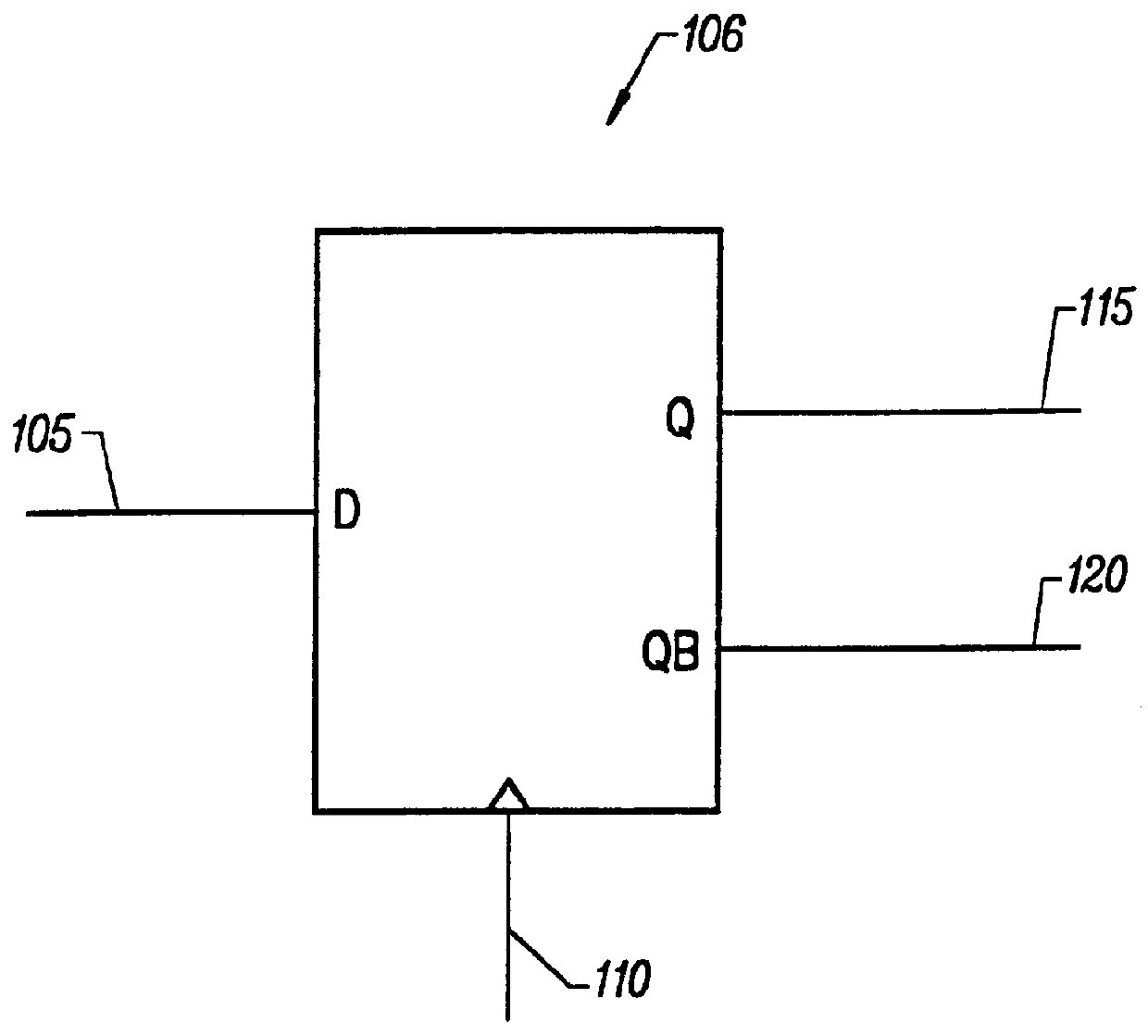
Figure 1 
Figure 2 
Figure 3
Abstract
Description
BACKGROUND OF THE INVENTIONThis invention relates to the field of digital logic circuits. More specifically, the present invention is a high-performance flip-flop circuit, especially useful in the design of high-performance electronic circuits.A digital system is made up of logic elements including AND gates, OR gates, NAND gates, NOR gates, inverters, flip-flops, multiplexers, and many others. These basic logic elements are combined and used to create larger, more complex logic functions such as registers, shifters, accumulators, state machines, processing units, and microprocessors, to name a few. These functions may be embodied on integrated circuits, printed circuit boards, and other similar techniques. Ultimately, these logic elements are used to create digital systems, which may contain millions of logic elements, or even more. Some examples of digital systems are computers, automated teller machines, modems, network servers, telecommunications systems, global positioning syst...
Examples
Embodiment Construction
The present invention is a flip-flop circuit. A flip-flop is a basic logical building block used to create larger, more complex logic circuits. For example, flip-flops may be used in the design of many types of electronic and digital systems including computer systems, telecommunication systems, networking systems, manufacturing systems, graphical systems, consumer systems, and numerous other types of systems. Moreover, the present invention may be embodied on integrated circuits, which may be used to build these systems. In particular, the present invention may be used in microprocessors, memories, ASICs, gate arrays, field programmable gate arrays, programmable logic devices, and many others types of products.
FIG. 1 is a diagram of a flip-flop 100. FIG. 1 shows the logic symbol for a basic D-type flip-flop. There are many other types of flip-flops such as T, S-R, and J-K flip-flops. In fact, D flip-flops may be used in the implementation of these other types of flip-flops. In this...