
Shaped body made of fiber-reinforced composites having a segmented covering layer, its production and its use
Patent Information
- Authority / Receiving Office
- US · United States
- Current Assignee / Owner
- Publication Date
- 2005-06-21
- Estimated Expiration
- Not applicable · inactive patent
Smart Images
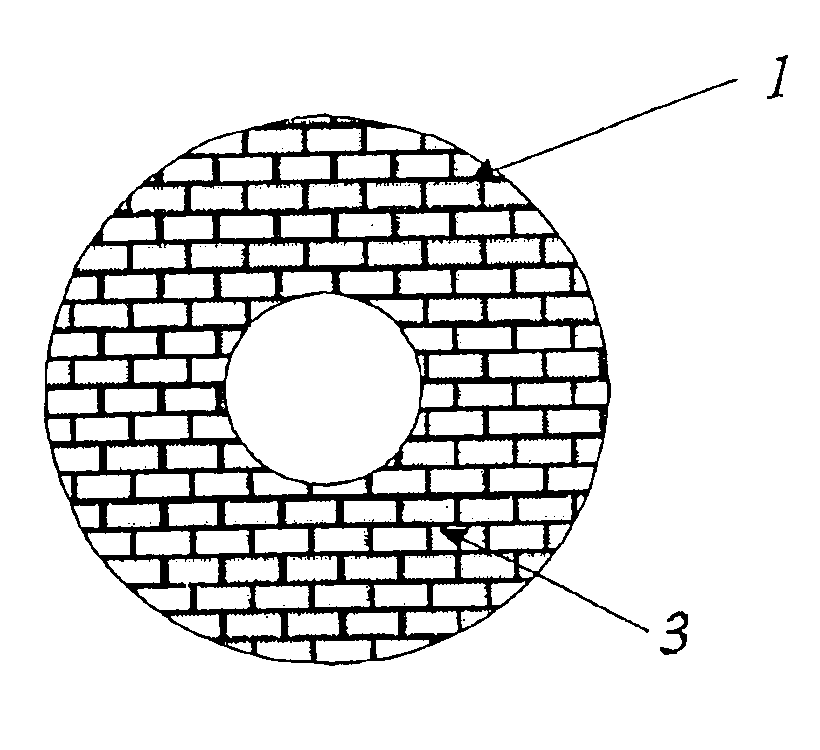
Figure 1 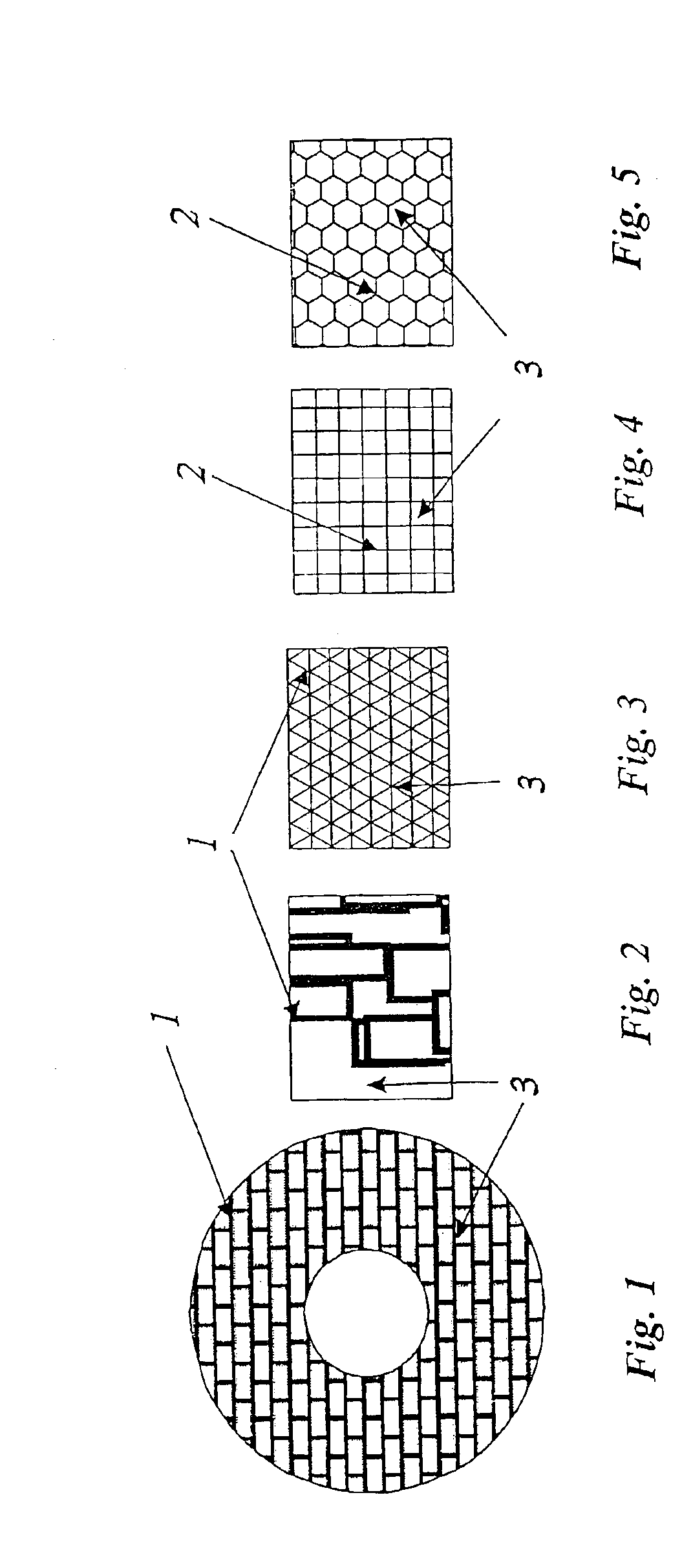
Figure 2
Abstract
Description
FIELD OF THE INVENTION
[0001] The invention relates to a shaped body made of fiber-reinforced ceramic composites which is built up of a core layer and at least one covering layer and whose matrix comprises predominantly silicon carbide (SiC), silicon (Si) and carbon (C) The invention also relates to a process for producing a shaped body made of fiber-reinforced composites and shaped bodies of this type which are configured as friction disks, brake disks or clutch disks. A particularly preferred embodiment of the invention comprises brake disks which are made up of C / SiC or C / C-SiC and in which the covering layer has a higher coefficient of thermal expansion or a higher SiC content than the core zone.BACKGROUND OF THE INVENTION
[0002] C / SiC materials (ceramic materials which are reinforced with carbon fibers and have a matrix comprising SiC) for the shaped body of the invention include, inter alia, the materials described in the following documents: DE-A 198 56 721, DE-A 197 11 829 and D...
Examples
first embodiment
[0040]In the invention, gaps in the form of grooves are provided as separation between the segments. For some applications it is inconsequential whether the gaps are truly empty or are filled with a filler. The filler should merely have a significantly lower tensile and compressive modulus of elasticity and a significantly lower strength than the material of the covering layer. The gaps are usually filled with plastics or light metal when the fiber-reinforced composite is used as a material of construction. These filler materials are used, in particular, for adhesive bonding or joining to further components.
[0041]The joints or gaps located between the segments preferably have a width in the range from 0.1 to 10 mm, preferably from 0.5 to 5 mm.
second embodiment
[0042]In the invention, the segments are separated from one another by means of bridging zones, with the material of the bridging zones having a coefficient of thermal expansion which is higher than that of the covering layer material in the segments. Selecting the coefficients of thermal expansion in this way results in cracks being formed preferentially in the region of the bridging zones. The cracks generated in the production of the shaped bodies made of fiber-reinforced composites are thus, according to the invention, restricted to precisely defined regions, namely the region of the bridging zones. Newly formed cracks in the region of the segments formed as a result of cyclic thermal stress during use for the intended purpose can therefore be readily recognized. An advantage is that the function of the covering layer within the segments is not initially impaired by undesirable cracks.
[0043]Depending on the difference between the coefficients of thermal expansion and the bonding...