

Triple-expanded mechanical pipe coupling derived from a standard fitting
Patent Information
- Authority / Receiving Office
- US · United States
- Current Assignee / Owner
- Publication Date
- 2006-10-17
- Estimated Expiration
- Not applicable · inactive patent
Smart Images
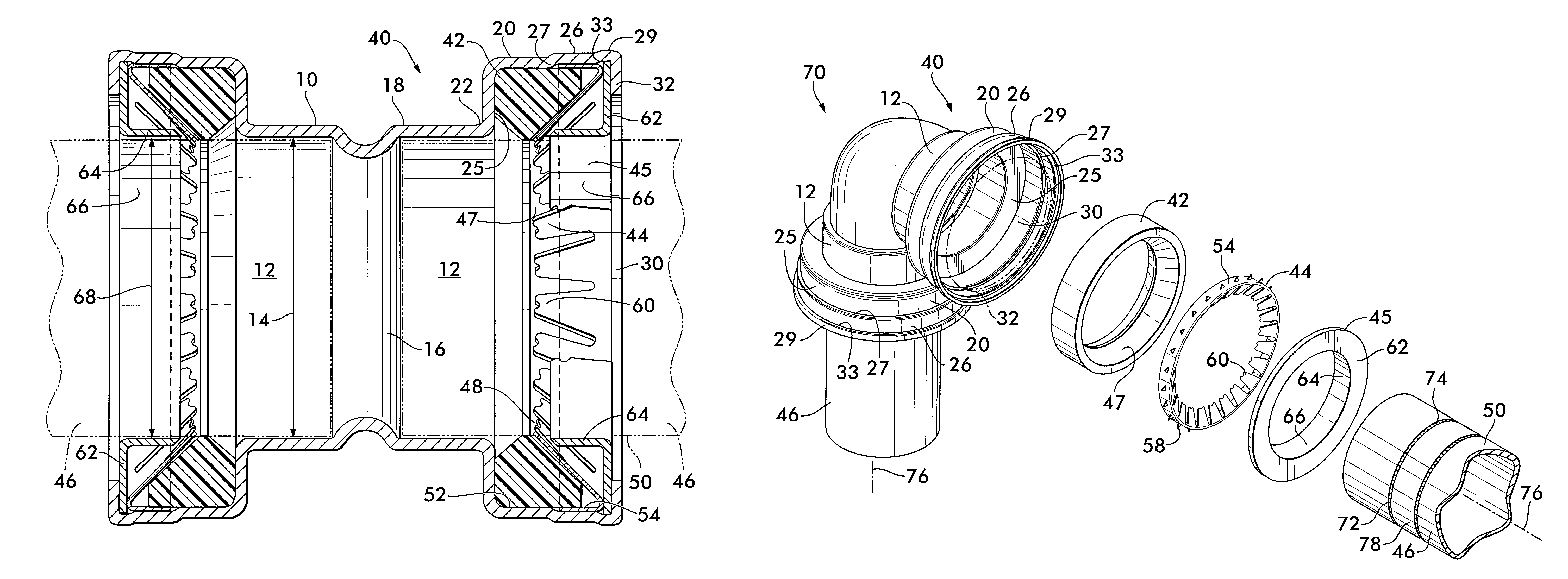
Figure 1 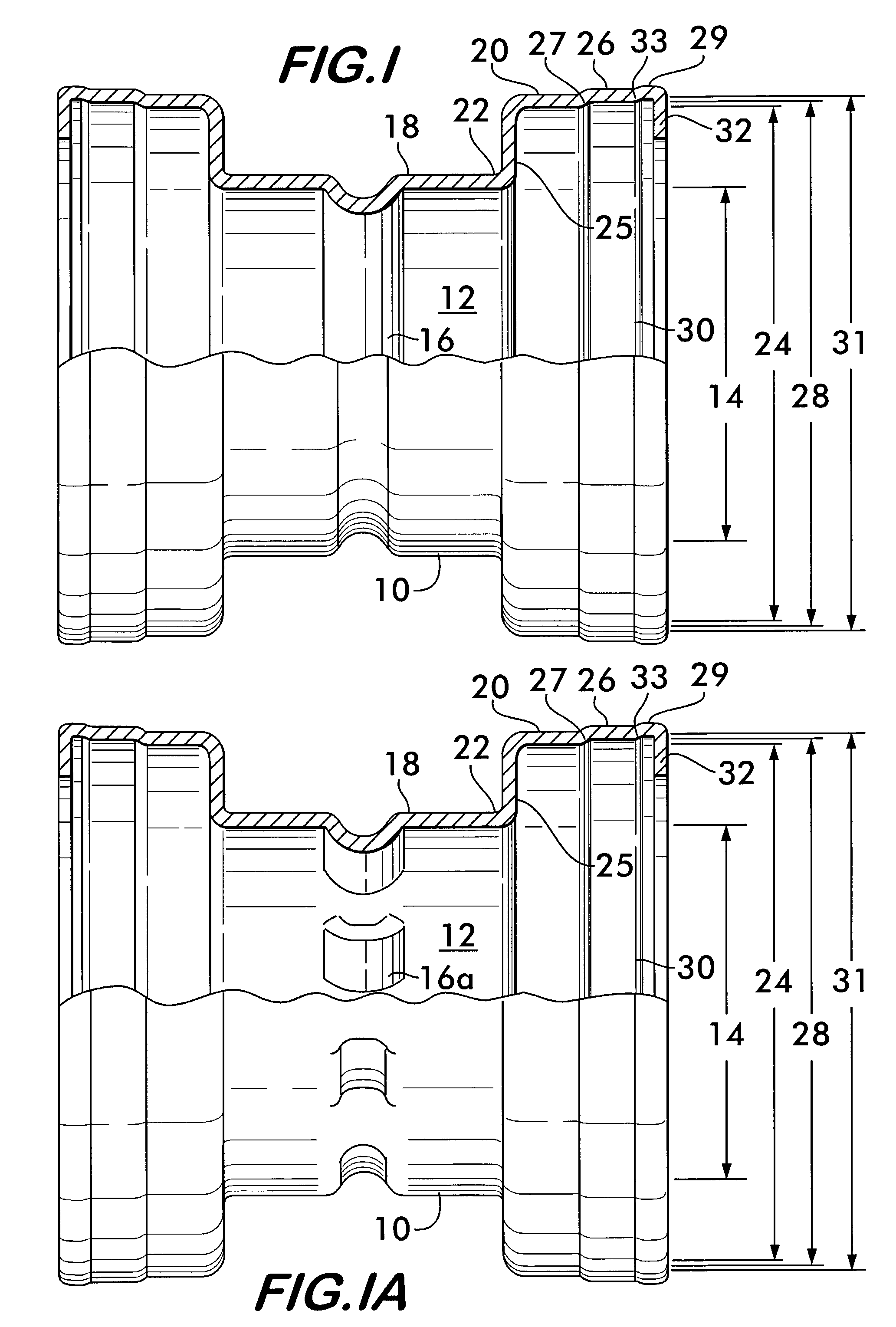
Figure 2 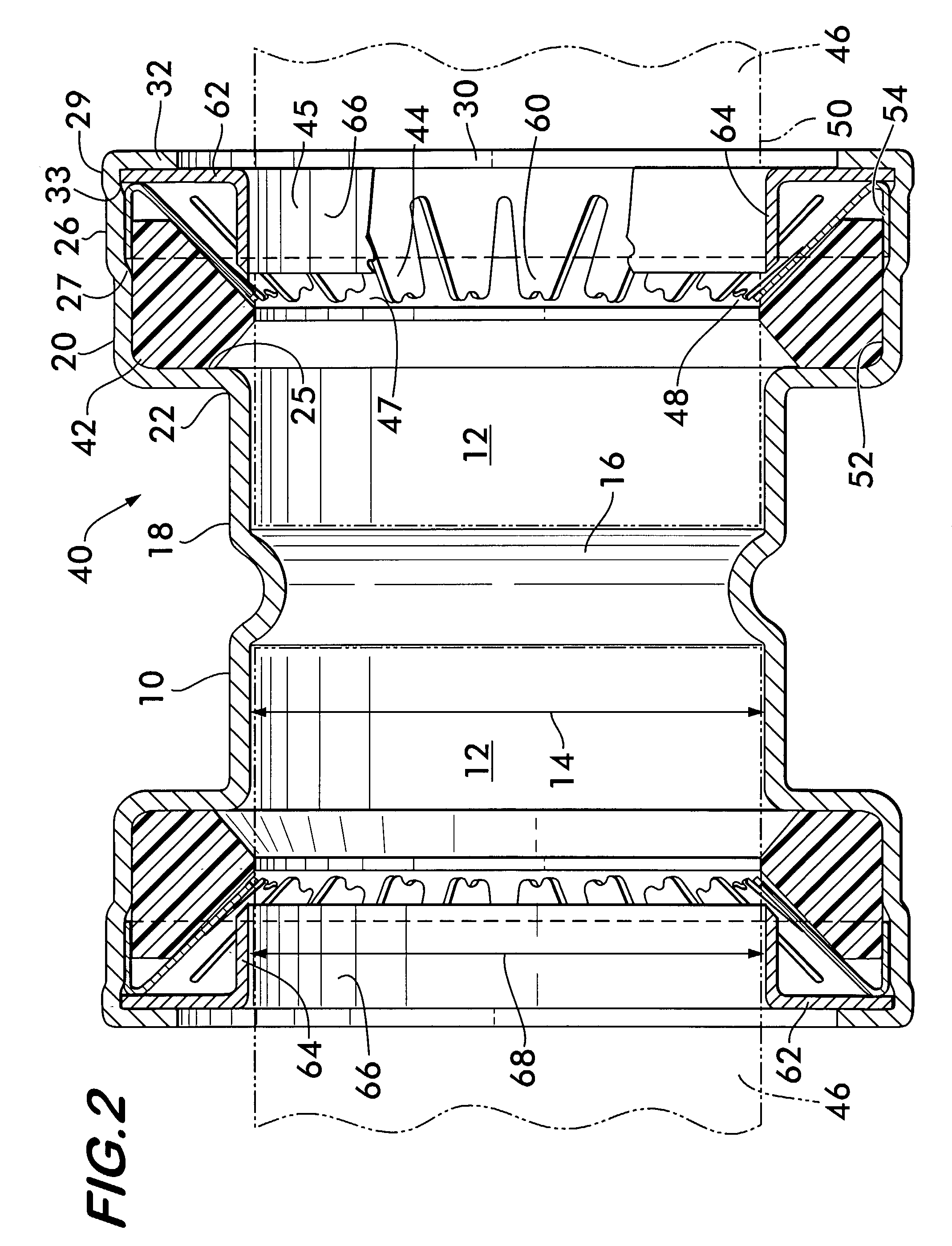
Figure 3
Abstract
Description
RELATED APPLICATION
[0001] This application is a continuation-in-part of U.S. application Ser. No. 10 / 123,607, filed Apr. 16, 2002, now U.S. Pat. No. 6,913,292 which is a continuation-in-part of U.S. application Ser. No. 10 / 007,951, filed Dec. 3, 2001, which is based on and claims priority of U.S. Provisional Application No. 60 / 262,820, filed Jan. 19, 2001.FIELD OF THE INVENTION
[0002] This invention relates to couplings for pipes and especially to mechanical couplings derived from standard fittings which effect a strong, reliable joint with a fluid-tight seal without the need for brazing or soldering.BACKGROUND OF THE INVENTION
[0003] The construction of piping networks requires couplings that can form fluid-tight joints between pipe ends which can withstand external mechanical forces, as well as internal fluid pressure and reliably maintain the integrity of the joint. Many forms of joints are known, such as brazed or soldered joints, threaded joints, welded joints and joints effected by...
Examples
Embodiment Construction
[0044]FIG. 1 shows a pipe coupling housing 10 according to the invention having a socket 12 with an inner diameter 14 sized according to a standard to receive a pipe end sized, according to a compatible standard, to interfit within the socket 12. Preferably, coupling housing 10 is a modification of an existing standard pipe fitting, for example, an ASME Standard pipe fitting according to Standard number B16.22a-1998 for wrought copper and copper alloy solder joint pressure fittings. Fittings meeting the specification of other standards, such as the German DIN standard and the British BS standard, may also be modified to derive the coupling housing 10.
[0045]A stop surface 16 is positioned adjacent to one end 18 of the socket 12. Stop surface 16 extends radially inwardly and is, thus, engageable with an end of a pipe received within the socket to prevent the pipe end from passing through the coupling housing. Stop surface 16 is circumferentially continuous around housing 10, but may a...