
N-cyclohexylaminocarbonyl benzensulfonmide derivatives
a technology of n-cyclohexylaminocarbonyl benzenesulfonamide and derivatives, which is applied in the direction of drug compositions, peptide/protein ingredients, metabolic disorders, etc., can solve the problems of increased and premature morbidity and mortality, elevated plasma insulin levels are not sufficient to overcome the pronounced insulin resistance, and the serum glucose level is not elevated enough to meet the criteria of type 2 diabetes, etc., to improve the insulin resistance of non-
Patent Information
- Authority / Receiving Office
- US · United States
- Patent Type
- Patents(United States)
- Current Assignee / Owner
- Publication Date
- 2008-01-15
- Estimated Expiration
- Not applicable · inactive patent
Smart Images
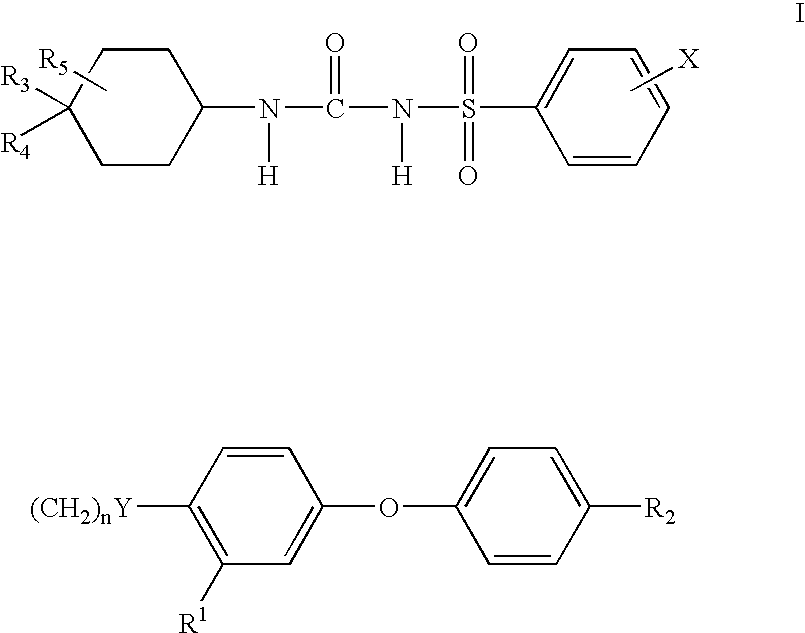
Figure 1 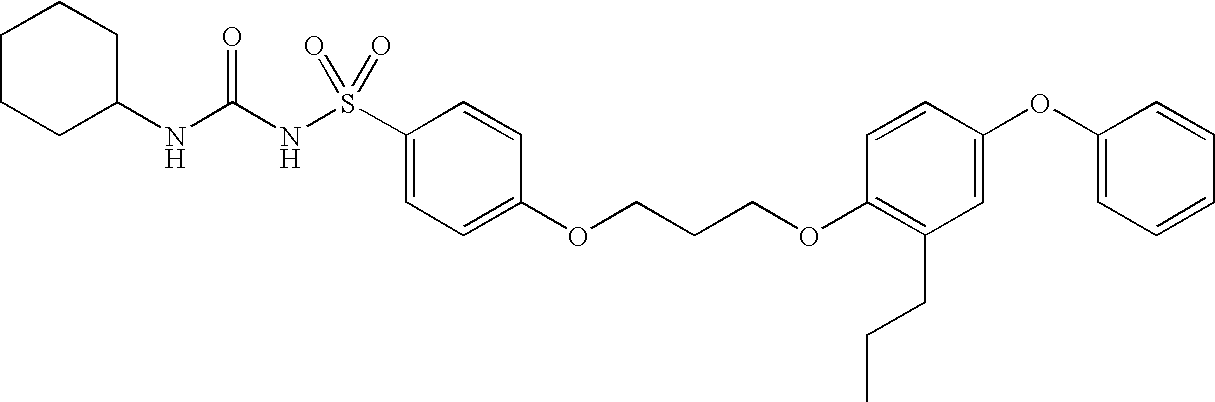
Figure 2 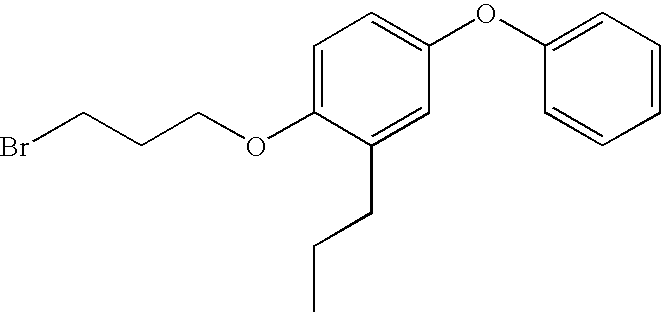
Figure 3
Abstract
Description
CROSS REFERENCE TO RELATED APPLICATIONS
[0001] This application is a U.S. National Phase application under 35 U.S.C. § 371 of PCT Application No. PCT / US2004 / 000689, filed Jan. 13, 2004, which claims priority under 35 U.S.C. § 119(e) from U.S. Provisional Application Ser. No. 60 / 440,761, filed Jan. 17, 2003.FIELD OF THE INVENTION
[0002] The instant invention is concerned with N-cyclohexylaminocarbonyl benzenesulfonamide derivatives which are useful as therapeutic compounds, particularly in the treatment of Type 2 diabetes mellitus, and of conditions that are often associated with this disease, including obesity and lipid disorders.BACKGROUND OF THE INVENTION
[0003] Diabetes is a disease derived from multiple causative factors and is characterized by elevated levels of plasma glucose (hyperglycemia) in the fasting state or after administration of glucose during an oral glucose tolerance test. There are two generally recognized forms of diabetes. In type 1 diabetes, or insulin-dependent diab...
Examples
example 1
N-[(cyclohexylamino)carbonyl]-4-[3-(4-phenoxy-2-propylphenoxy)propoxy]benzenesulfonamide
[0088]
Step A: Preparation of 1-(3-bromopropoxy)4-phenoxy-2-propylbenzene
[0089]
[0090]The title compound was prepared according to the method described in U.S. Pat. No. 6,008,237, Example 11, Step A.
Step B: Preparation of 4-[3-(4-phenoxy-2-propylphenoxy)propoxy]benzenesulfonamide
[0091]
[0092]To a solution of 1-(3-bromopropoxy)-4-phenoxy-2-propylbenzene (1.01 g, 2.9 mmol) and 4-hydroxybenzenesulfonamide (0.5 g, 2.9 mmol) in dry DMF (29 mL) was added cesium carbonate (1.04 g, 3.2 mmol). The resulting suspension was stirred in a 50° C. oil bath for 5 h. After cooling to room temperature, the reaction suspension was concentrated under vacuum to a residue, which was then partitioned between ethyl acetate and water. The ethyl acetate phase was dried over sodium sulfate, filtered, and concentrated to an oil. The oil was chromatographed over silica gel with hexanes / ethyl acetate (2:1) to isolate the title c...
example 2
N-[(cyclohexylamino)carbonyl]-3-[3-(4-phenoxy-2-propylphenoxy)propoxy]benzenesulfonamide
[0095]
Step A: Preparation of 3-hydroxybenzenesulfonamide
[0096]
[0097]To a solution of 3-aminobenzenesulfonamide (2.35 g, 13.6 mmol) in 30% sulfuric acid (18 mL) stirred in a 0° C. ice-water bath was added dropwise a solution of sodium nitrite (1.22 g, 17.7 mmol) in water (10 mL). The resulting reaction solution continued to stir in an ice-water bath for 30 min. The solution was then stirred in a 100° C. oil bath for 30 min. After cooling to room temperature, the reaction solution was partitioned between ethyl acetate and brine. After shaking, the aqueous phase was extracted with ethyl acetate. The combined ethyl acetate phases were dried over sodium sulfate, filtered, and concentrated to a yellow solid (2.11 g, 89% yield).
Step B: Preparation of 1-(3-bromopropoxy)-4-phenoxy-2-propylbenzene
[0098]
[0099]The title compound was prepared according to the method described in U.S. Pat. No. 6,008,237 Exampl...
examples 3-9
[0104]The compounds written below as Examples 3-9 were made using the methodology that was described in Examples 1 and 2, starting with chemical compounds that are readily made or readily available. The syntheses are readily accomplished by one of ordinary skill in the art.
Ex 3
N-[(cyclohexylamino)carbonyl]-4-{3-[4-(4-fluorophenoxy)-2-propylphenoxy]propoxy}benzenesulfonamide
[0105]
Ex 4
4-{3-[2-chloro-4-(4-fluorophenoxy)phenoxy]propoxy}-N-[(cyclohexylamino)carbonyl]benzenesulfonamide
[0106]
Ex 5
N-[(cyclohexylamino)carbonyl]-4-(3-{4-[4-(methylsulfonyl)phenoxy]-2-propylphenoxy}propoxy)benzenesulfonamide
[0107]