
Leadscrew assembly with a wire-wound leadscrew and a spring-pin engagement of a drive nut to the leadscrew
a technology of leadscrew and wire-wound, which is applied in the direction of gearing, gearing elements, hoisting equipment, etc., can solve the problems of excessive thread wear of the conventional leadscrew assembly, limited to relatively large-size devices and coarse thread pitches, and relatively expensive production of conventional leadscrew assemblies. , to achieve the effect of avoiding backlash and being inexpensive to produ
Patent Information
- Authority / Receiving Office
- US · United States
- Current Assignee / Owner
- Publication Date
- 2008-03-04
Smart Images
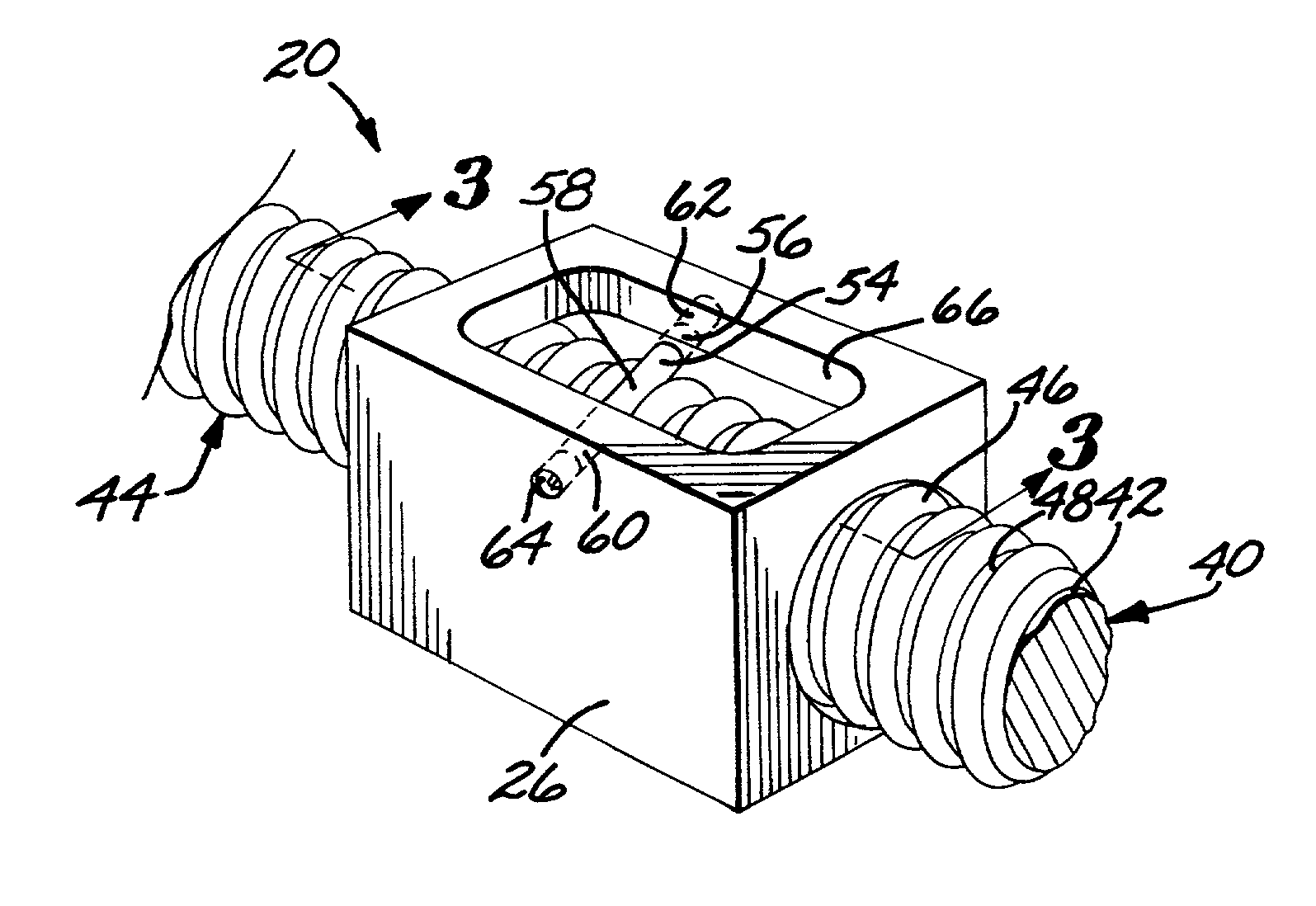
Figure 1 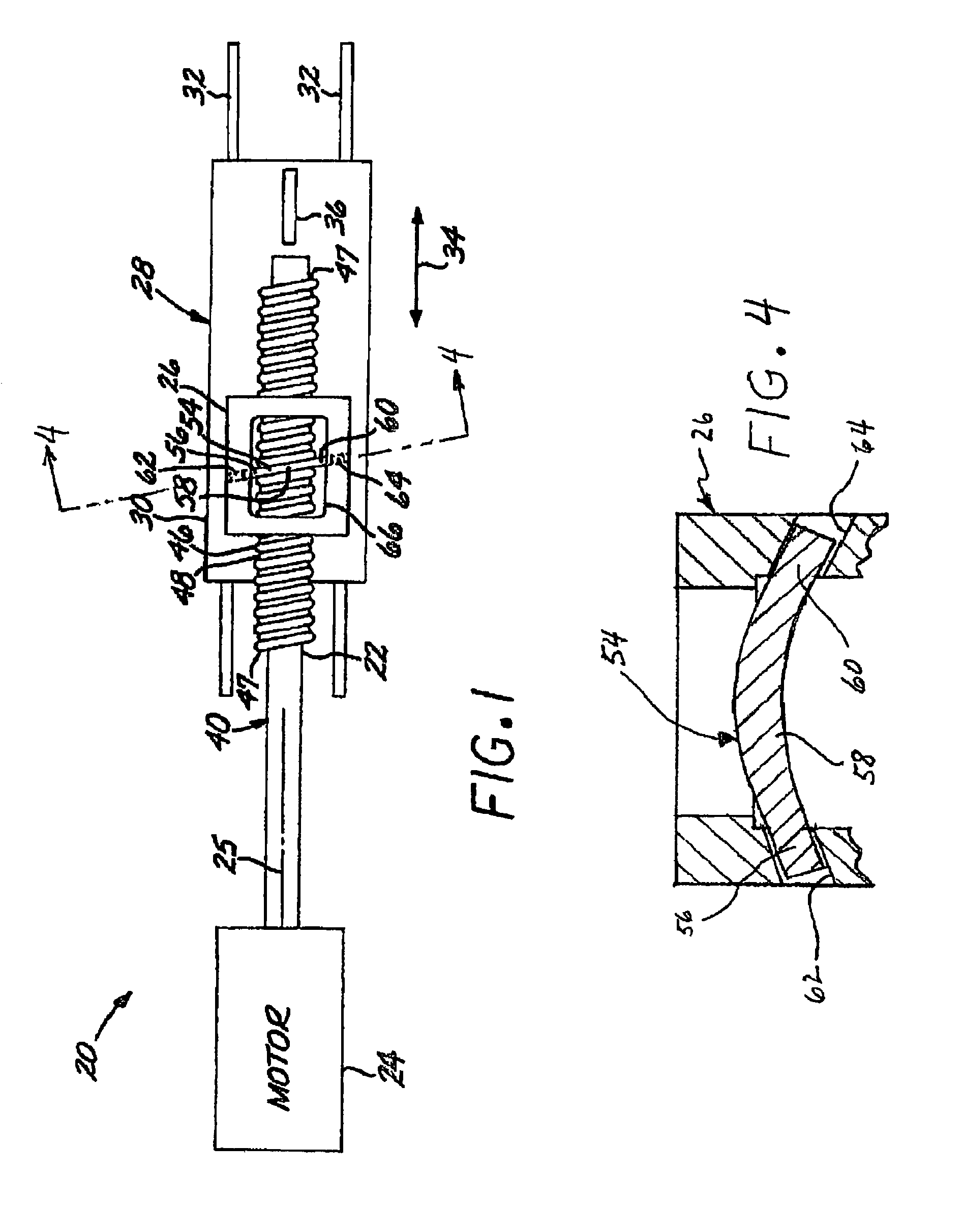
Figure 2 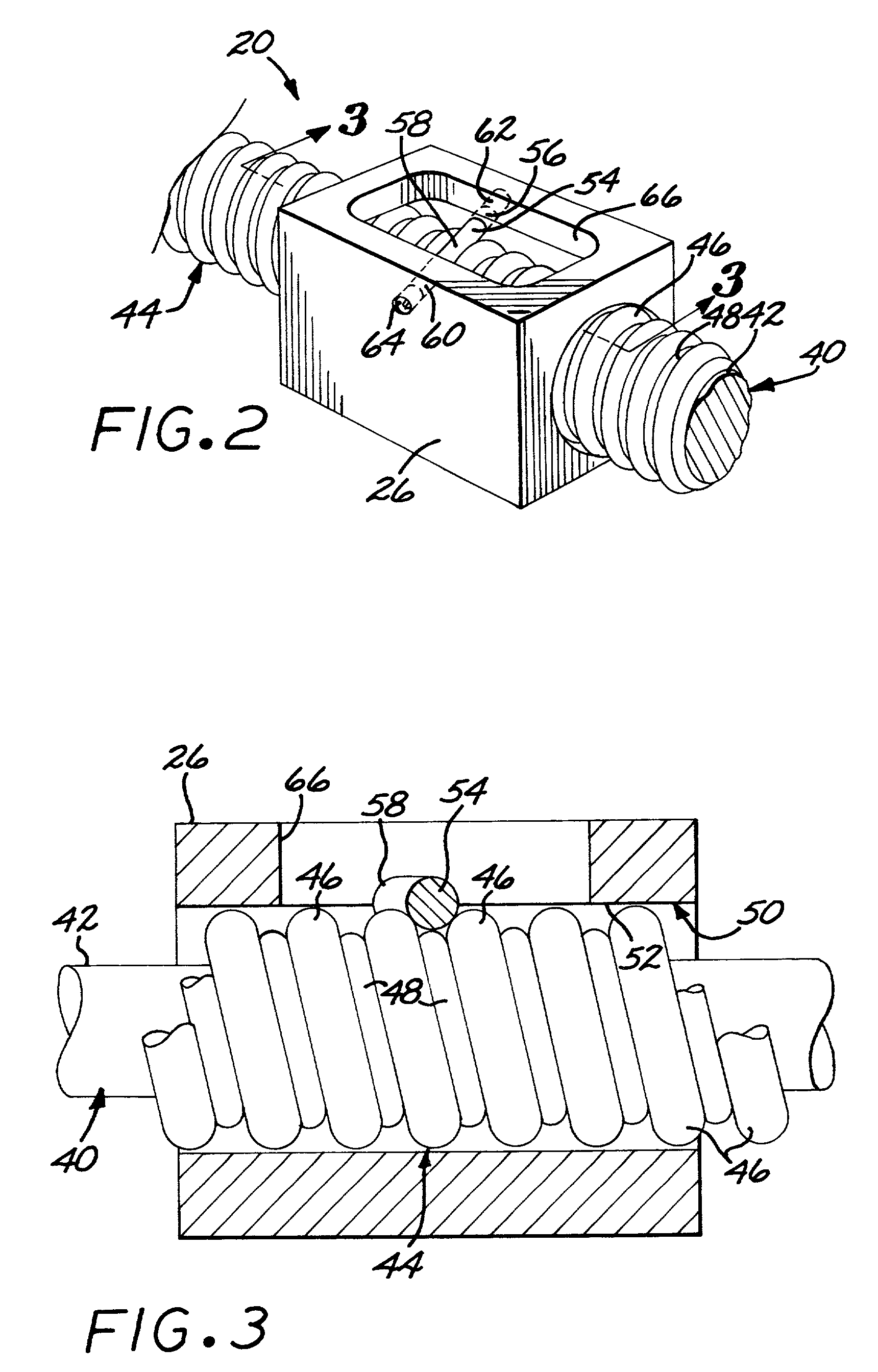
Figure 3
Abstract
Description
BACKGROUND OF THE INVENTION
[0001] This invention relates to a mechanical movement to translate rotational to linear motion and, more particularly, to an inexpensive leadscrew linear-movement assembly.
[0002] Electric motors commonly produce a rotational output, but many mechanisms require a linear movement driven by the motor. A leadscrew assembly is one approach for translating the rotational movement of the motor to the required linear movement. In the conventional leadscrew assembly, the thread of an externally threaded leadscrew engages a recirculating ball nut structure, which in turn is engaged to the structure to be driven linearly. As the leadscrew turns, the ball nut structure and the driven structure move linearly.
[0003] This conventional leadscrew assembly is relatively expensive to produce due to the precision machining required. It is also limited to relatively large-size devices and coarse thread pitches because of the size of the balls used in the recirculating ball nut s...
Examples
Embodiment Construction
[0017]FIG. 1 depicts a leadscrew assembly 20 including a leadscrew 22 driven by a motor 24, such as a miniature stepper motor, having a rotational power output about a rotational axis 25. The leadscrew 22 engages a hollow drive nut housing 26 that is affixed to a linear slide mechanism 28 so that the drive nut housing 26 does not rotate. The linear slide mechanism 28 includes a slider 30 mounted on rails 32 to move linearly parallel to a linear movement direction 34. A supported object, in the illustrated case an optical filter 36, is supported on the slider 30. Rotary motion of the power output of the motor 24 introduced into the leadscrew 22 is thereby translated into a linear movement of the optical filter 36 parallel to the linear movement direction 34.
[0018]FIGS. 2-3 illustrates the leadscrew 22 and drive nut housing 26 in greater detail. The leadscrew 22 comprises an elongated shaft 40 having an outer lateral surface 42 and the rotational axis 25. The shaft 40 is preferably cy...