
Methods and apparatus for efficient computation of one-way chains in cryptographic applications
Patent Information
- Authority / Receiving Office
- US · United States
- Current Assignee / Owner
- Publication Date
- 2008-07-22
Smart Images
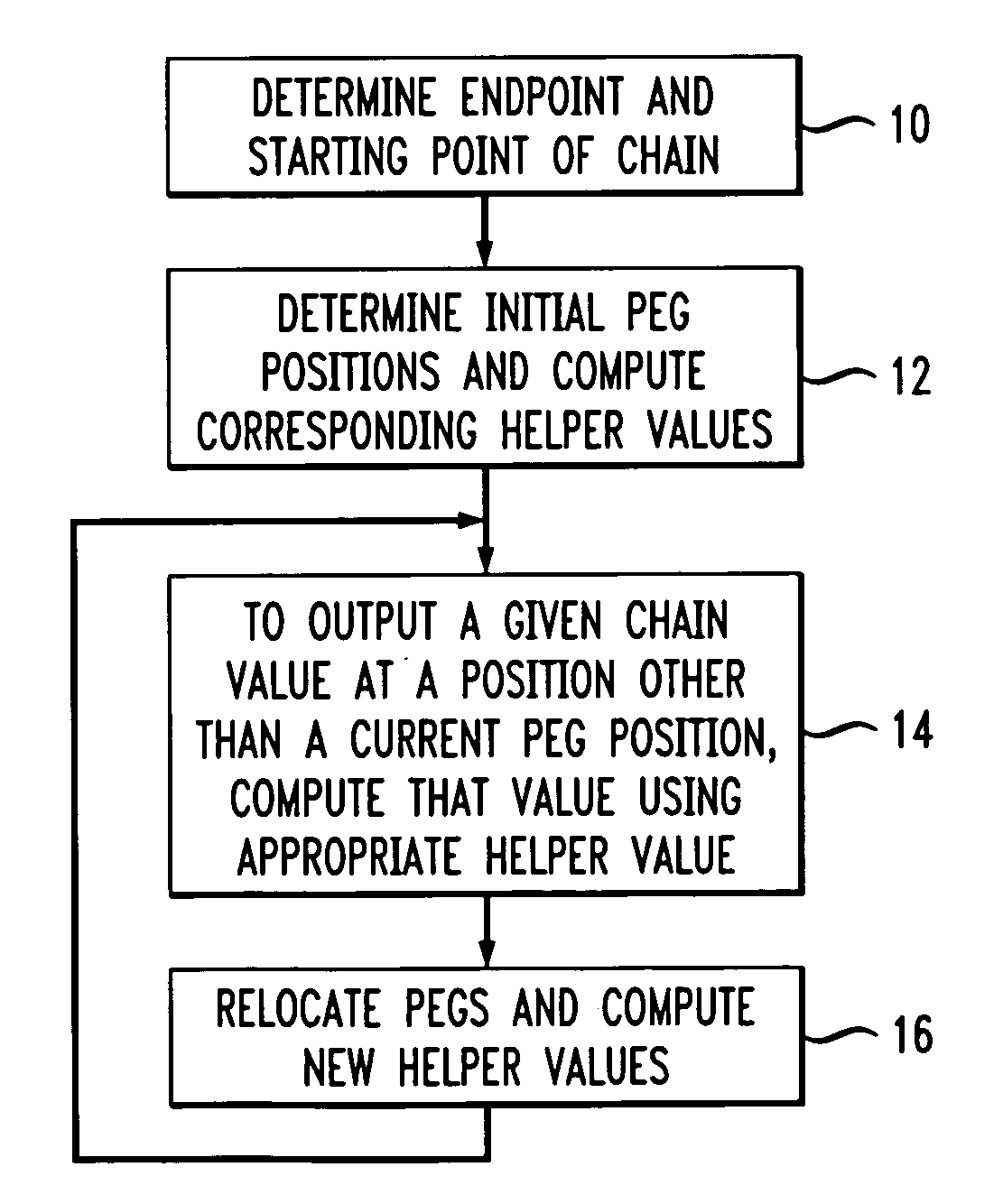
Figure 1 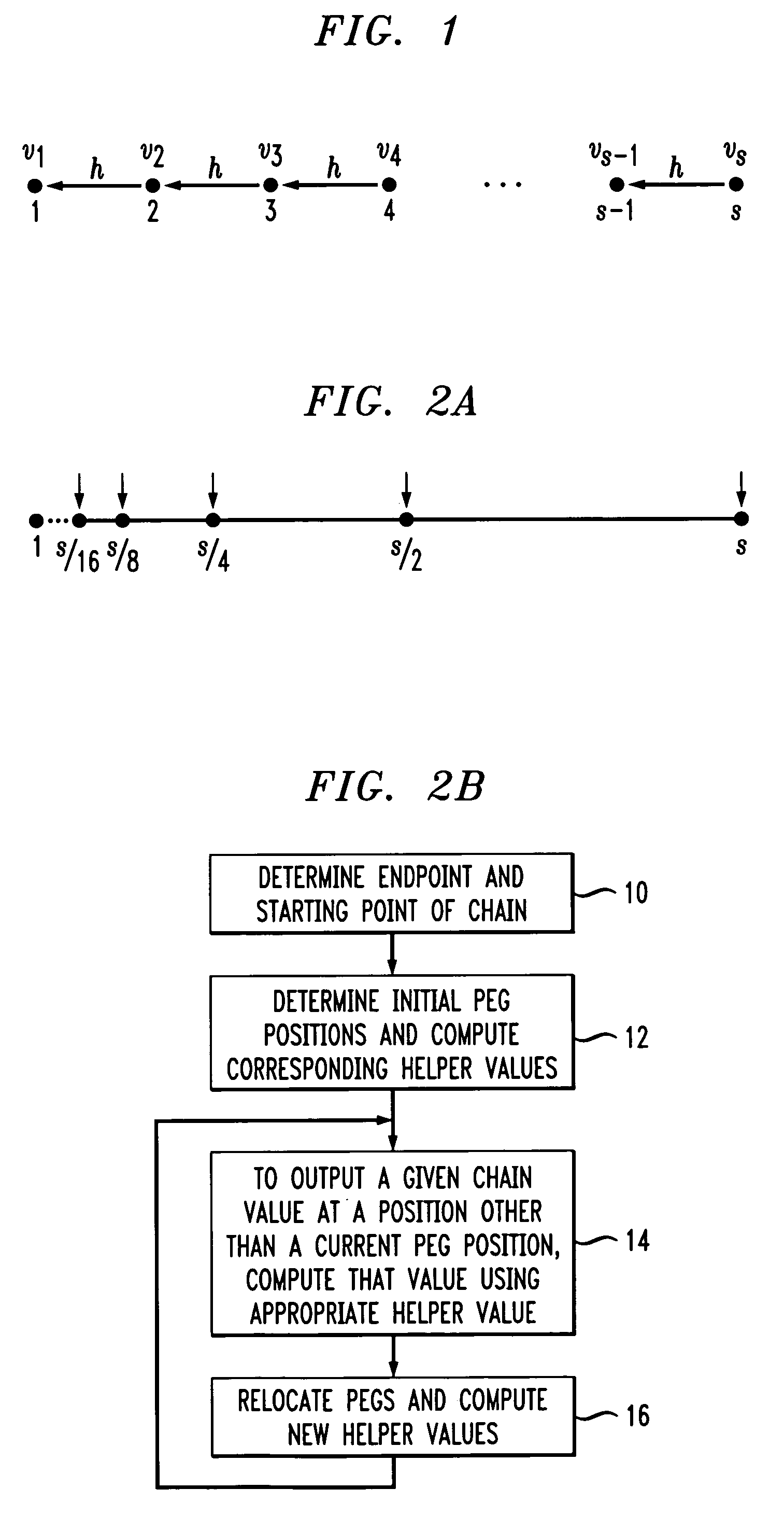
Figure 2 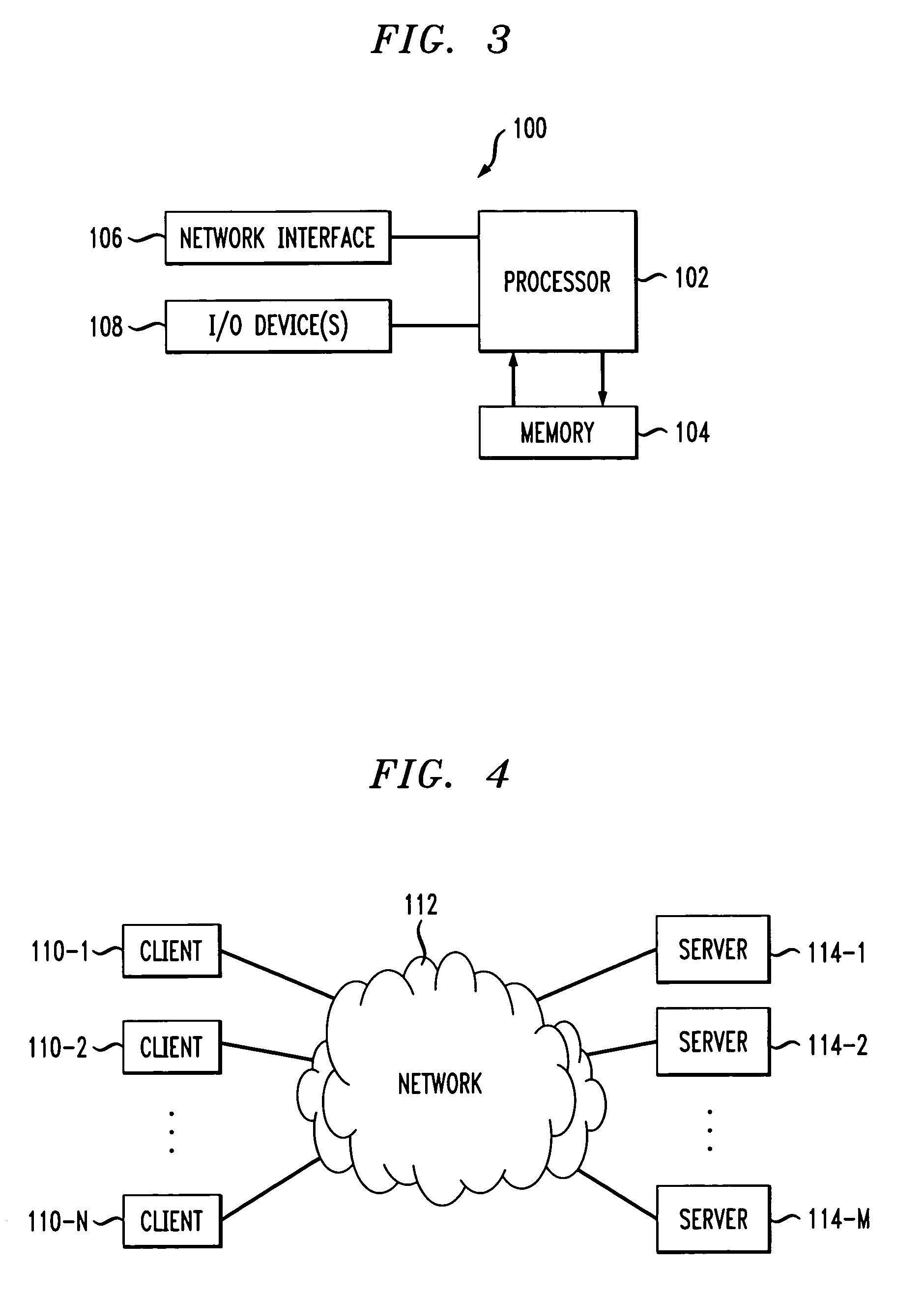
Figure 3
Abstract
Description
PRIORITY CLAIM
[0001] The present application claims the priority of U.S. Provisional Application Ser. No. 60 / 284,001, filed Apr. 16, 2001 in the name of inventor Bjorn Markus Jakobsson and entitled “Method and Apparatus for Efficiently Representing and Computing One-Way Chains,” the disclosure of which is hereby incorporated by reference herein.FIELD OF THE INVENTION
[0002] The present invention relates generally to the field of cryptography, and more particularly to techniques for computing consecutive values of one-way chains and other types of one-way graphs in cryptographic applications such as encryption, decryption, digital signatures, message authentication, user and device authentication, micro-payments, etc.BACKGROUND OF THE INVENTION
[0003] A one-way function is a function ƒ for which one can compute the value y=ƒ(x) given the value x, but for which it is computationally infeasible to compute the value x given y, unless a so-called “trap door” is known, where only particular on...
Examples
example 1
[0097]Tree structure. In such a structure, the endpoint value vs corresponds to the root node of the tree. For simplicity of notation, this node will be referred to as R. Let V1 and V2 be the two children of R, and V11 and V12 be the two children of V1. Similarly, one can name all the nodes in the tree. It will be clear to one skilled in the art that the invention relates not only to binary trees, as above, but to trees with any fan-out of the vertices. Let s be the height of the tree. The value associated with the root is R.val, and may be randomly chosen, and let Vx.val be the value associated with the node Vx, where x denotes a particular path, such as “1112.” Then, the value of the first child of Vx is Vx1.val=h(Vx.val,1), and the value of the second child of Vx is Vx2.val=h(Vx.val,2). Other assignments may be chosen as well, as will be appreciated by one skilled in the art. From this, it can be seen that given the value associated with a node Vx1 or Vx2, it is infeasible to det...
example 2
[0098]Two linked chains. Consider a situation in which there are two linked chains, each having its own endpoint, and where some fraction of the chain values are functions not only of the values of their corresponding chain, but also of values of the other chain. Note that the different chains may use different one-way functions, and may operate on different portions of the input. This situation therefore describes a particular form of a directed acyclic graph (DAG), and it will be appreciated by those skilled in the art that other such examples can be constructed. In a simple case, one can let every element at distance i from the endpoint of its chain be a function of both its predecessor (element i−1 of that chain) and of the other element at that distance from the endpoint of the other chain (element i−1 of the other chain). Let the lengths of each of the chains be s, and assume that pegs have been placed at distances s / 2, s / 4, s / 8, etc., from the starting point of one of the cha...