
Wireless LAN control over a wired network
Patent Information
- Authority / Receiving Office
- US · United States
- Current Assignee / Owner
- Publication Date
- 2010-04-13
Smart Images
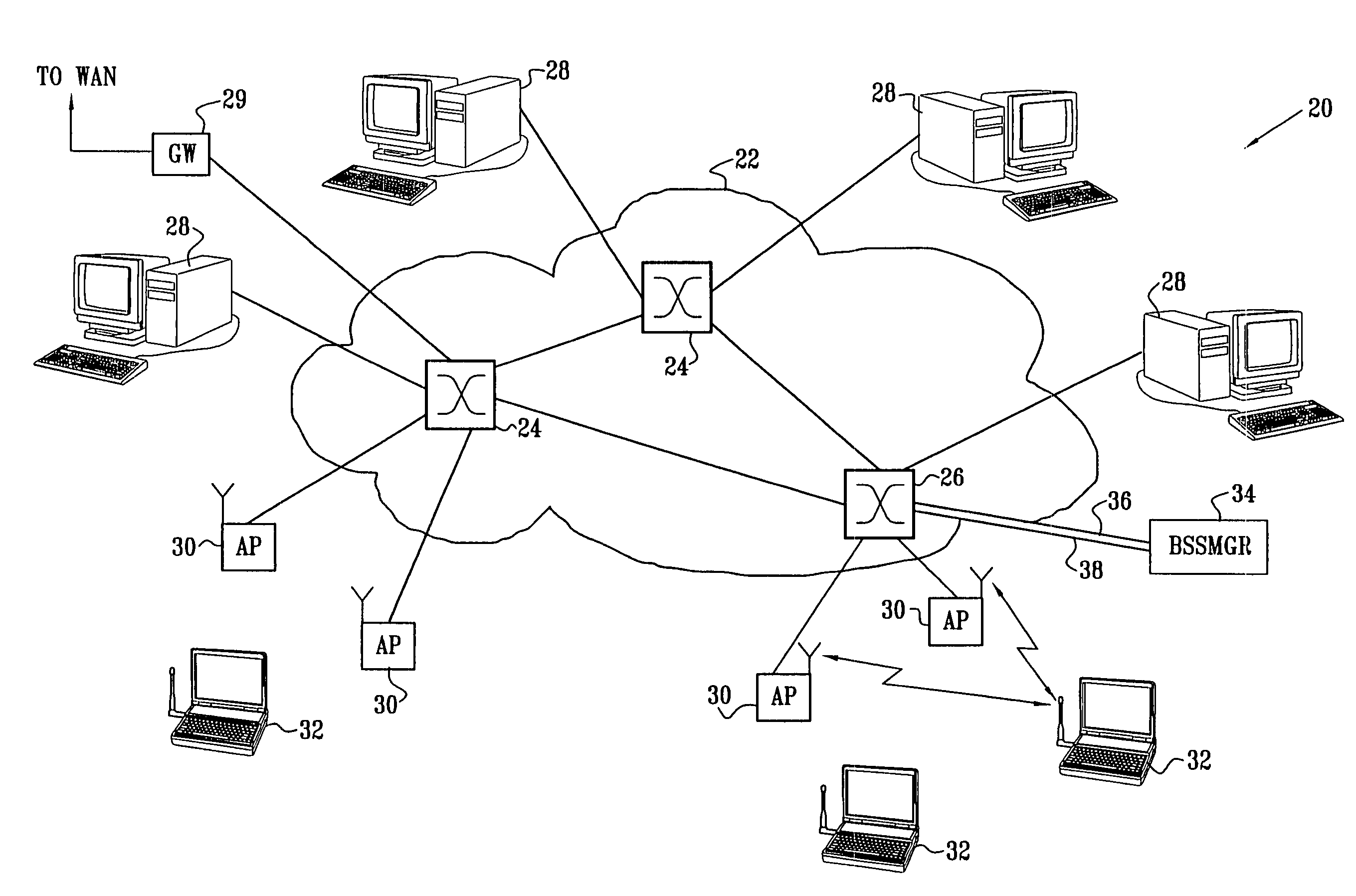
Figure 1 
Figure 2 
Figure 3
Abstract
Description
CROSS-REFERENCE TO RELATED APPLICATION
[0001] This application is a continuation-in-part of U.S. patent application Ser. No. 10 / 664,631, filed Sep. 19, 2003, which is a continuation-in-part of U.S. patent application Ser. No. 10 / 214,271, filed Aug. 7, 2002. Both of these related applications are assigned to the assignee of the present patent application, and their disclosures are incorporated herein by reference.FIELD OF THE INVENTION
[0002] The present invention relates generally to wireless communications, and specifically to methods and devices for improving the performance of wireless local area networks.BACKGROUND OF THE INVENTION
[0003] Wireless local area networks (WLANs) are gaining in popularity, and new wireless applications are being developed. The original WLAN standards, such as “Bluetooth” and IEEE 802.11, were designed to enable communications at 1-2 Mbps in a band around 2.4 GHz. More recently, IEEE working groups have defined the 802.11a, 802.11b and 802.11g extensions to...
Examples
Embodiment Construction
[0045]FIG. 1 is a block diagram that schematically illustrates a wireless LAN (WLAN) system 20, in accordance with an embodiment of the present invention. System 20 is built around a wired LAN 22, comprising LAN switches 24, 26. Although three switches are shown here by way of example, in practice LAN 22 may comprise a larger or smaller number of switches, in substantially any topology known in the art. Typically, LAN 22 comprises an Ethernet LAN, in accordance with one of the IEEE 802.3 standards. Preferably, for the purposes of the present embodiment, the LAN has a characteristic data rate of at least 1 Gbps, as provided, for instance, by Gigabit Ethernet LANs. Alternatively, system 20 may be built around a lower-speed LAN, such as a 100 Mbps Ethernet LAN. In either case, embodiments of the present invention provide novel methods for reducing latency of communication over LAN 22 between WLAN elements, as described below, in order to meet the tight timing requirements of the WLAN w...