
Collaboration between wireless LAN access points using wired LAN infrastructure
a wireless lan and infrastructure technology, applied in the field of local area network (lan) communications, can solve problems such as the inability to complete arbitration within this tight limit, and achieve the effect of enhancing the coverage and speed of wlan systems
Patent Information
- Authority / Receiving Office
- US · United States
- Patent Type
- Patents(United States)
- Current Assignee / Owner
- Publication Date
- 2008-02-12
- Estimated Expiration
- Not applicable · inactive patent
Smart Images
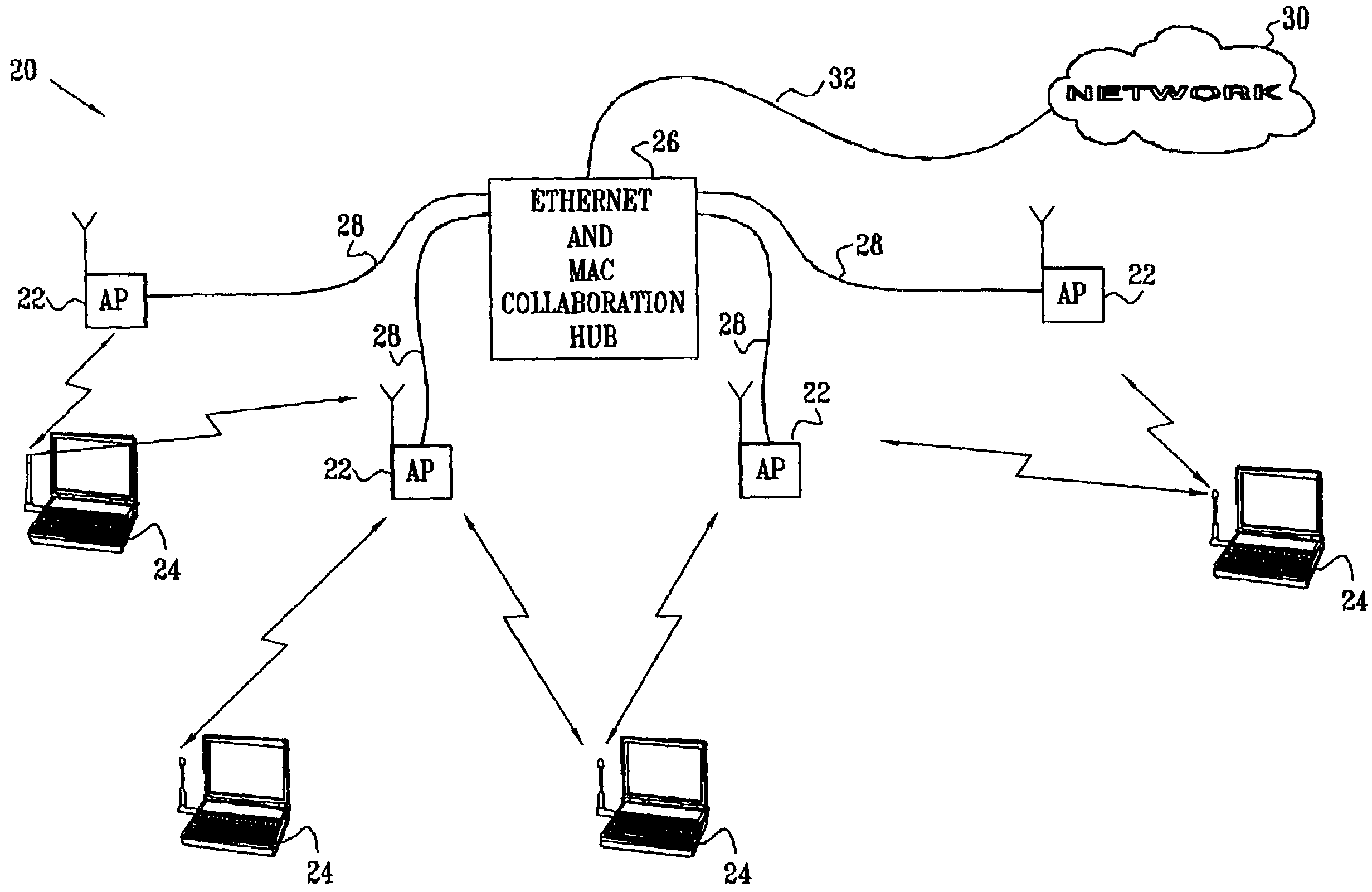
Figure 1 
Figure 2 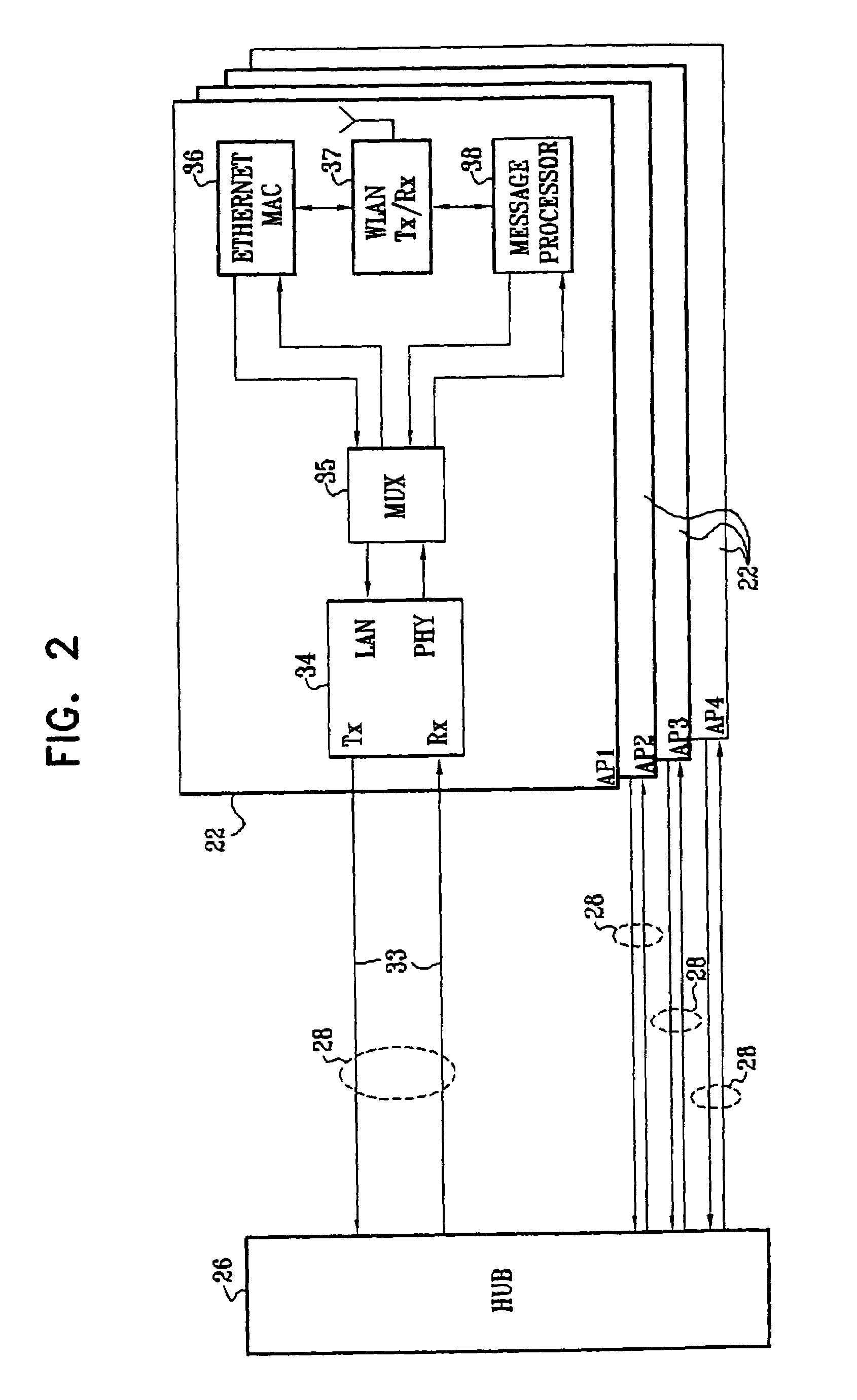
Figure 3
Abstract
Description
CROSS-REFERENCE TO RELATED APPLICATIONS
[0001] This application is a continuation of U.S. patent application Ser. No. 10 / 272,686, filed Oct. 17, 2002, which claims the benefit of U.S. Provisional Patent Application No. 60 / 377,650, filed May 6, 2002, and is a continuation-in-part of U.S. patent application Ser. No. 10 / 214,271, filed Aug. 7, 2002, whose disclosure is incorporated herein by reference.FIELD OF THE INVENTION
[0002] The present invention relates generally to local area network (LAN) communications, and specifically to methods and devices for improving the performance of wireless LANs.BACKGROUND OF THE INVENTION
[0003] Wireless local area networks (WLANs) are gaining in popularity, and new wireless applications are being developed. The original WLAN standards, such as “Bluetooth” and IEEE 802.11, were designed to enable communications at 1-2 Mbps in a band around 2.4 GHz. More recently, IEEE working groups have defined the 802.11a, 802.11b and 802.11g extensions to the original ...
Examples
Embodiment Construction
[0061]FIG. 1 is a block diagram that schematically illustrates a wireless LAN (WLAN) system 20, in accordance with a preferred embodiment of the present invention. System 20 comprises multiple access points 22, which are configured for data communication with mobile stations 24. The mobile stations typically comprise computing devices, such as desktop, portable or handheld devices, as shown in the figure. In the exemplary embodiments described hereinbelow, it is assumed that the access points and mobile stations communicate with one another in accordance with one of the standards in the IEEE 802.11 family and observe the 802.11 medium access control (MAC) layer conventions. Details of the 802.11 MAC layer are described in ANSI / IEEE Standard 801.11 (1999 Edition), and specifically in Part 11: Wireless LAN Medium Access Control (MAC) and Physical Layer (PHY) Specifications, which is incorporated herein by reference. The principles of the present invention, however, are not limited to ...