
Knitted tulle
Patent Information
- Authority / Receiving Office
- US · United States
- Current Assignee / Owner
- Publication Date
- 2011-11-08
- Estimated Expiration
- Not applicable · inactive patent
Smart Images
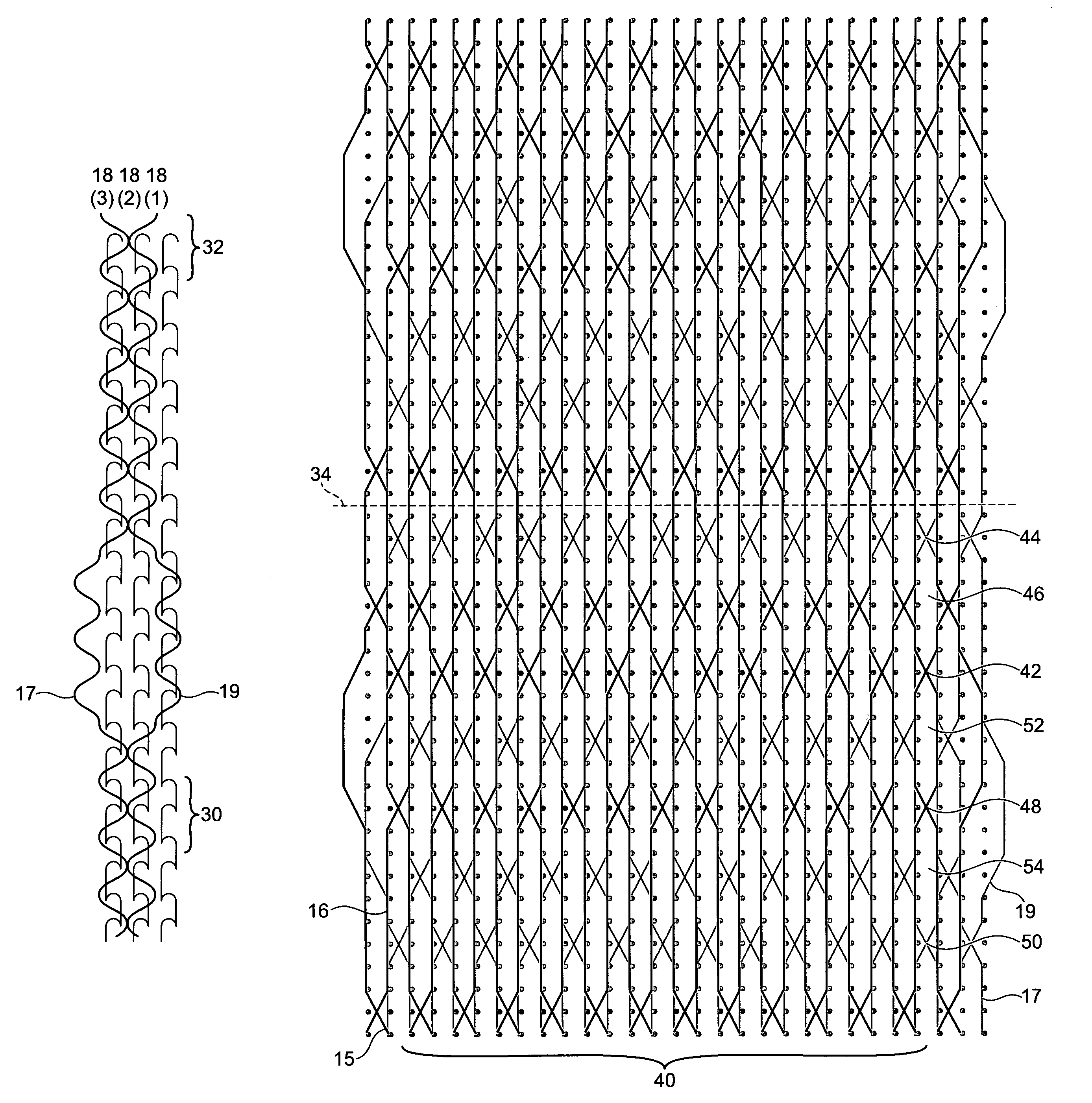
Figure 1 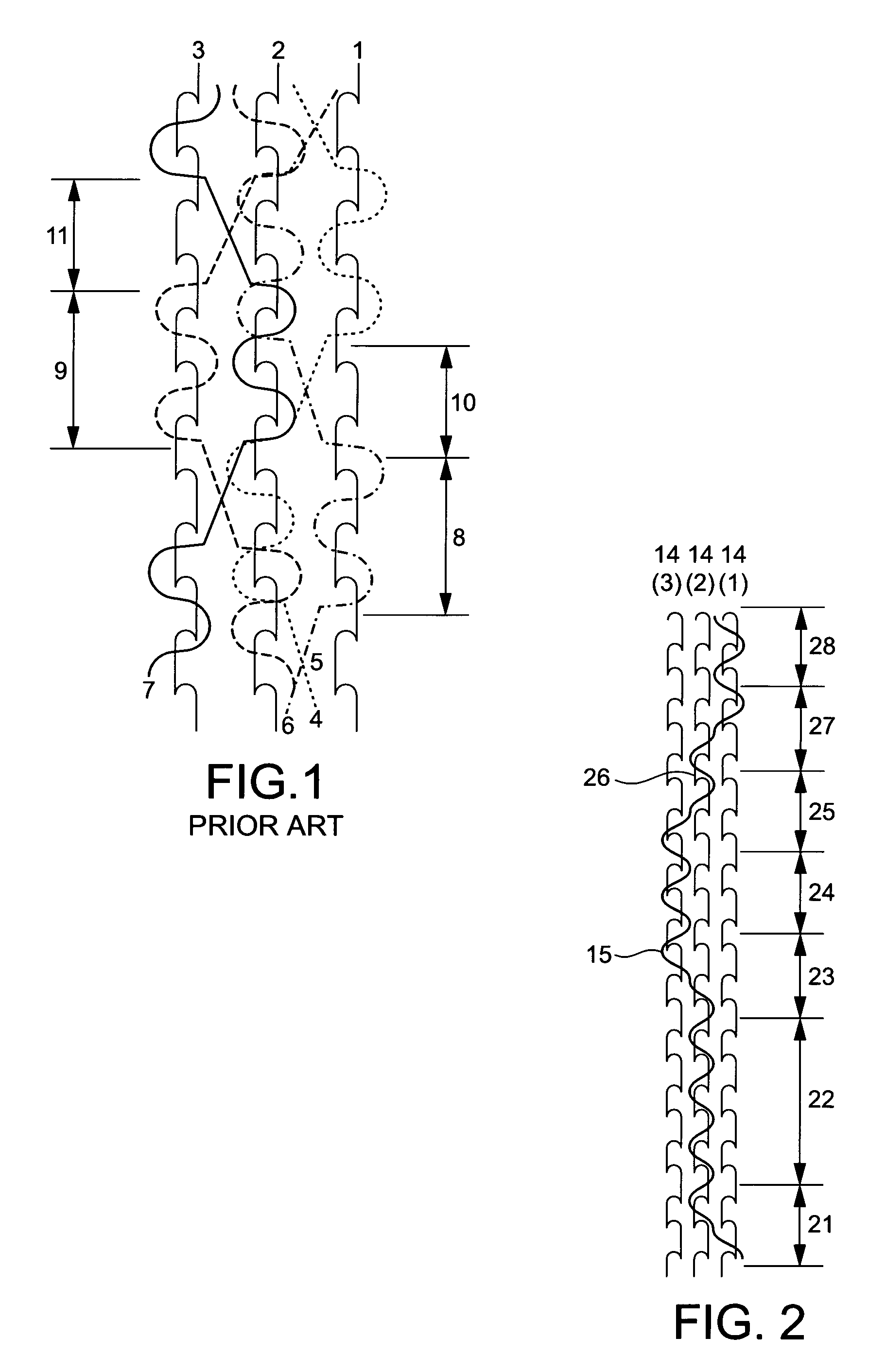
Figure 2 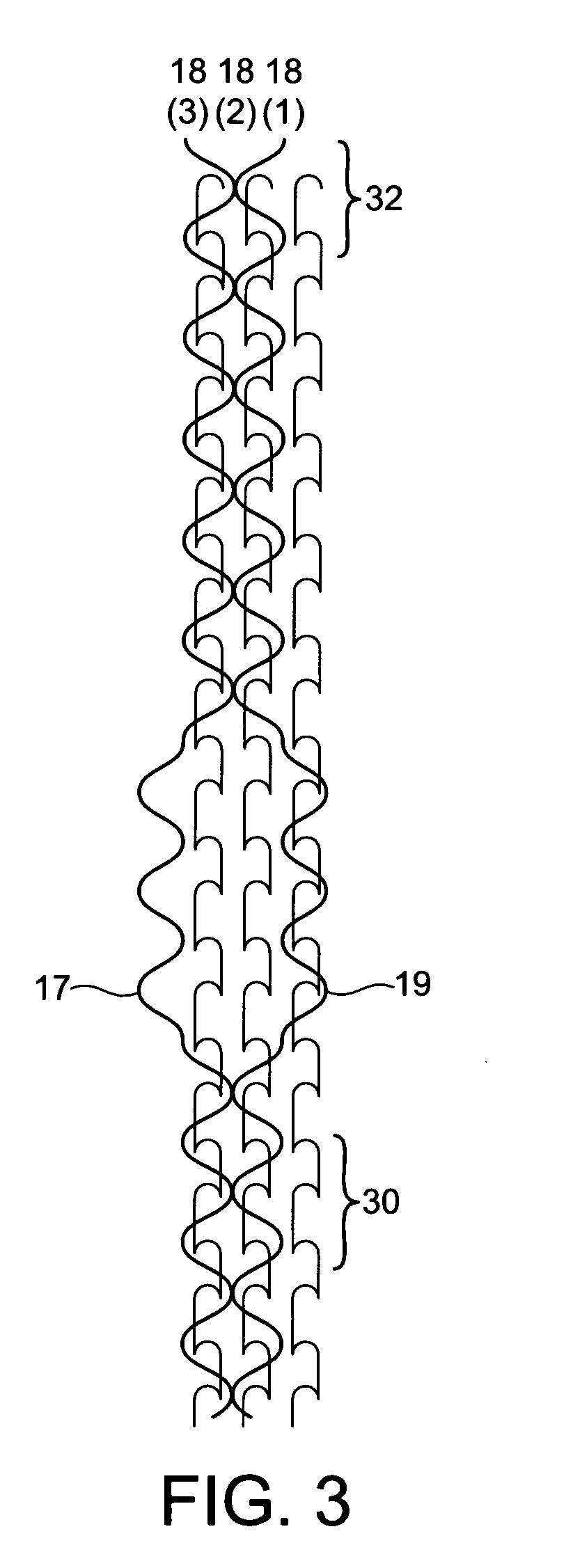
Figure 3
Abstract
Description
BACKGROUND OF THE INVENTION
[0001] The present invention relates to knitted tulles and methods of knitting tulles.
[0002] Tulle is a type of fine netting which has applications in embroidery, lingerie, bridal wear and haute couture as well as in technical areas where the durability and flexibility of netting are of particular importance. Such technical applications include military (e.g. radar reflective netting and parachute netting) and medical applications and as light diffusion fabrics in film and theatre applications.
[0003] Bobbinet tulle is a particular type of tulle which was first produced in the early 19th Century following the invention of the bobbinet machine in 1806 by John Heathcoat. The structure of bobbinet tulle provides advantageous properties of uniformity, strength and flexibility. One particularly advantageous property of bobbinet tulle in relation to embroidery is that it is flexible at the scale of the holes in the net structure which reduces the likelihood of yarn ...
Examples
Embodiment Construction
[0049]A prior art pattern, illustrated, in FIG. 1, is of a knitted cross-tulle consisting of single-needle wales 1, 2 and 3 which are formed singly and are interlaced only by weft threads. Weft threads 4, 5, 6 and 7 are shown. The weft threads 4 and 5 form one pair and the weft threads 6 and 7 another pair.
[0050]The weft threads 4 and 5, and 6 and 7, make three laps into the wales in three courses. Two of these adjoining runs of three laps are indicated by numerals 8 and 9. The weft threads then form a cross 10 and 11, respectively, between the wales 1 and 2, and between the wales 2 and 3, over three courses (described as two courses in the document but more properly considered as three). The weft threads 4 and 5 then effect, in the wales 1 and 2, and the weft threads 6 and 7 effect, in the wales 2 and 3, the three laps 8 and 9 respectively, whereupon they return to their initial wales by crossing over three courses.
[0051]The fabric produced using the pattern of FIG. 1 is very sensi...