
Cyclic polyphenylene ether ether ketone composition and method for producing the same
a technology of phenylene ether and ether ketone, which is applied in the field of composition comprising a cyclic poly (phenylene ether ether ketone), can solve the problems of difficult to say that the method can be industrially applicable, and the method can only yield a low-purity cyclic poly (phenylene ether ether ketone) containing a large amount, etc., and achieves low melting point, poor processability, and high melting poin
Patent Information
- Authority / Receiving Office
- US · United States
- Patent Type
- Patents(United States)
- Current Assignee / Owner
- Publication Date
- 2015-03-24
Smart Images
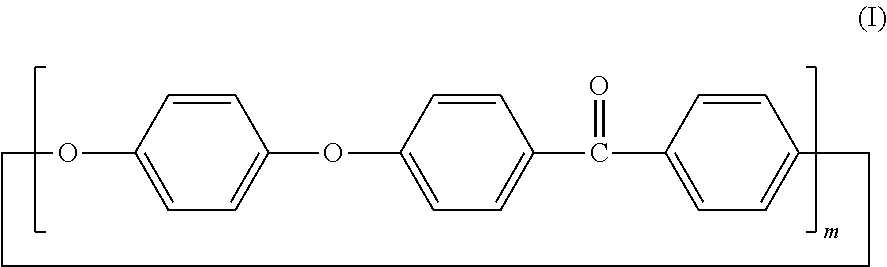
Figure 1 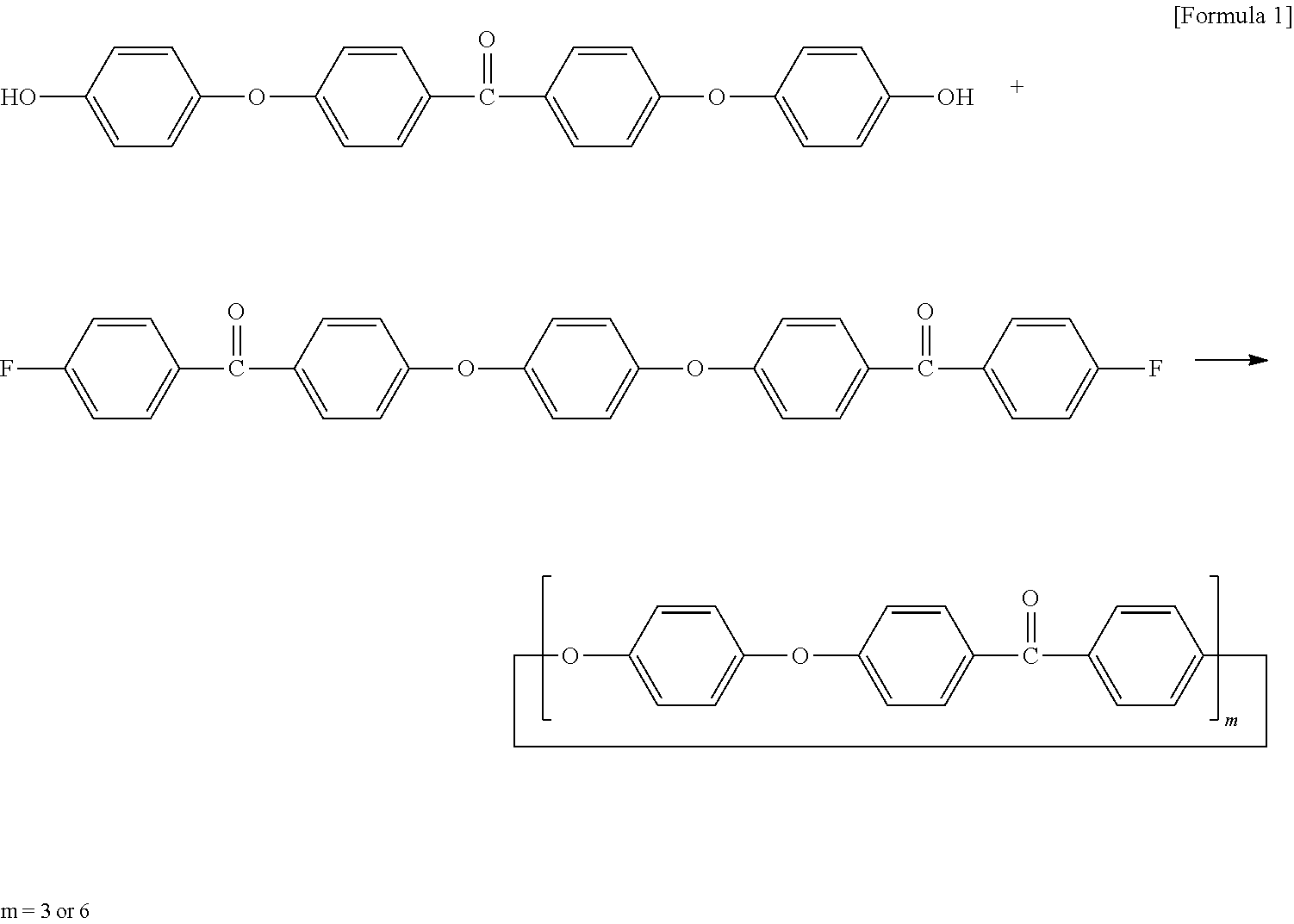
Figure 2 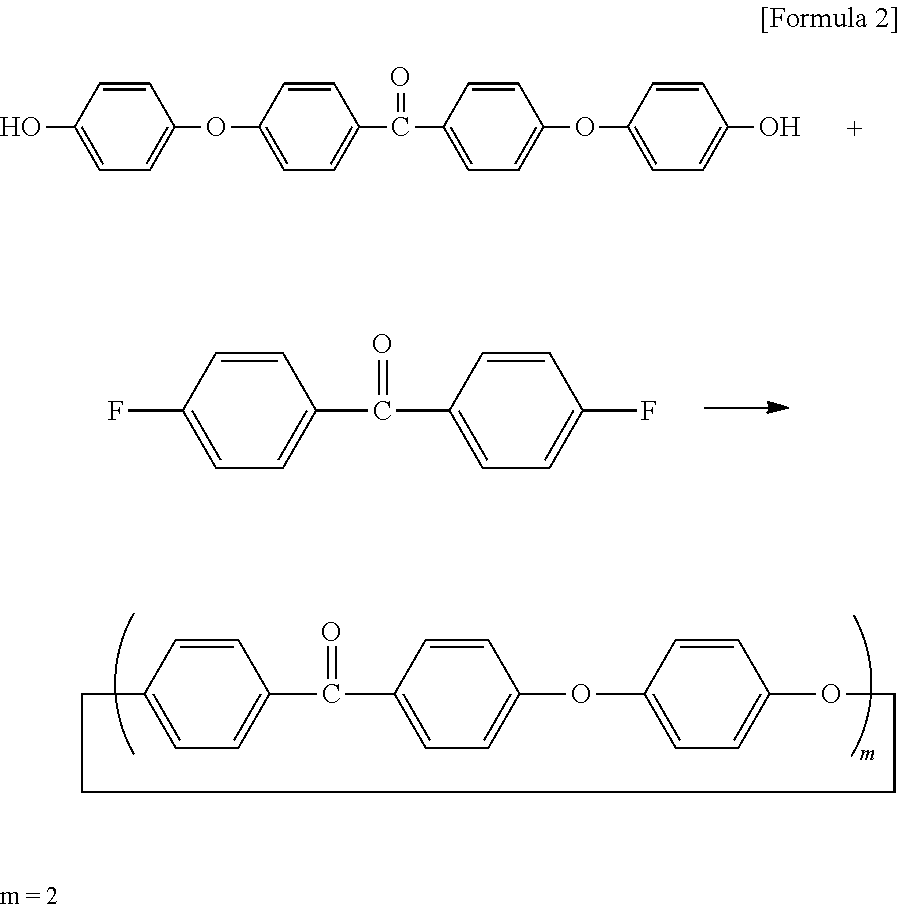
Figure 3
Abstract
Description
CROSS REFERENCE TO RELATED APPLICATIONS
[0001] This application is the U.S. National Phase application of PCT International Application No. PCT / JP2010 / 073268, filed Dec. 24, 2010, and claims priority to Japanese Patent Application Nos. 2009-297278, filed Dec. 28, 2009 and 2010-191971, filed Aug. 30, 2010, the disclosures of all of which are incorporated herein by reference in their entireties for all purposes.FIELD OF THE INVENTION
[0002] The present invention relates to a composition comprising a cyclic poly(phenylene ether ether ketone) and a production method thereof. More particularly, the present invention relates to a cyclic poly (phenylene ether ether ketone) composition comprising not less than 60% by weight of a cyclic poly (phenylene ether ether ketone), which is characterized by having a low melting point and excellent processability at a low temperature.BACKGROUND OF THE INVENTION
[0003] Recently, aromatic cyclic compounds are drawing attention its application / development pote...
Examples
example 1
Method (a) of Producing Cyclic Poly (Phenylene Ether Ether Ketone) Composition
[0114]To a four-necked flask equipped with a stirrer, nitrogen inlet tube, Dean-Stark apparatus, condenser tube and thermometer, 2.40 g (11 mmol) of 4,4′-difluorobenzophenone, 1.10 g (10 mmol) of hydroquinone, 1.52 g (11 mmol) of anhydrous potassium carbonate, 100 mL of dimethyl sulfoxide and 10 mL of toluene were loaded. The amount of the dimethyl sulfoxide with respect to 1.0 mol of the benzene ring component contained in the resulting mixture was 3.13 L. The temperature of the mixture was raised to 140° C. under nitrogen flow and maintained there for 1 hour. Then, the temperature was further raised to 160° C. and maintained there for 4 hours to allow the mixture to react. After completion of the reaction, the resultant was cooled to room temperature to prepare a reaction mixture.
[0115]About 0.2 g of the thus obtained reaction mixture was weighed and diluted with about 4.5 g of THF. Then, THF-insoluble c...
example 2
Method (a) of Producing Cyclic Poly (Phenylene Ether Ether Ketone) Composition
[0121]To a four-necked flask equipped with a stirrer, nitrogen inlet tube, Dean-Stark apparatus, condenser tube and thermometer, 2.76 g (11 mmol) of 4,4′-dichlorobenzophenone, 1.10 g (10 mmol) of hydroquinone, 1.52 g (11 mmol) of anhydrous potassium carbonate, 100 mL of dimethyl sulfoxide and 20 mL of toluene were loaded. The amount of the dimethyl sulfoxide with respect to 1.0 mol of the benzene ring component contained in the resulting mixture was 3.13 L. The temperature of the mixture was raised to 140° C. under nitrogen flow and maintained there for 1 hour. Then, the temperature was further raised to 160° C. and maintained there for 3 hours to allow the mixture to react. After completion of the reaction, the resultant was cooled to room temperature to prepare a reaction mixture.
[0122]About 0.2 g of the thus obtained reaction mixture was weighed and diluted with about 4.5 g of THF. Then, THF-insoluble c...
example 3
Method (a) of Producing Cyclic Poly (Phenylene Ether Ether Ketone) Composition
[0124]To a four-necked flask equipped with a stirrer, nitrogen inlet tube, Dean-Stark apparatus, condenser tube and thermometer, 2.18 g (10 mmol) of 4,4′-difluorobenzophenone, 1.10 g (10 mmol) of hydroquinone, 1.38 g (10 mmol) of anhydrous potassium carbonate, 100 mL of N-methyl-2-pyrrolidone and 20 mL of toluene were loaded. The amount of the N-methyl-2-pyrrolidone with respect to 1.0 mol of the benzene ring component contained in the resulting mixture was 3.33 L. The temperature of the mixture was raised to 140° C. under nitrogen flow and maintained there for 1 hour. Then, the temperature was raised to 160° C. and maintained there for 3 hours, and the temperature was further raised to 195° C. and maintained there for 2 hours to allow the mixture to react. After completion of the reaction, the resultant was cooled to room temperature to prepare a reaction mixture.
[0125]About 0.2 g of the thus obtained rea...