

Advancing Quantum Computing for Space Exploration Technologies
JUL 17, 20259 MIN READ
Generate Your Research Report Instantly with AI Agent
PatSnap Eureka helps you evaluate technical feasibility & market potential.
Quantum Space Tech Evolution and Objectives
Quantum computing has emerged as a revolutionary technology with the potential to transform space exploration. The evolution of quantum technologies in space applications has been marked by significant milestones and ambitious objectives. Initially, quantum principles were primarily applied in theoretical models for understanding cosmic phenomena. However, as quantum computing capabilities advanced, their potential for enhancing space missions became increasingly apparent.
The primary objective of integrating quantum computing into space exploration technologies is to overcome the limitations of classical computing systems in handling complex space-related calculations and simulations. This includes optimizing spacecraft trajectories, improving communication protocols, and enhancing data processing capabilities for space-based observations. Additionally, quantum sensors promise unprecedented precision in measuring gravitational fields, magnetic anomalies, and other space phenomena, potentially revolutionizing our understanding of the universe.
A key goal is to develop quantum computers capable of operating in the harsh space environment, withstanding radiation and extreme temperature fluctuations. This presents unique engineering challenges but offers the potential for on-board quantum processing, significantly reducing the need for Earth-based data relay and enabling real-time decision-making during space missions.
The evolution of quantum space technologies is closely tied to advancements in quantum error correction and the development of more stable qubits. Current objectives focus on increasing the number of qubits while maintaining coherence, a crucial factor for practical quantum computing applications in space. Researchers are also exploring hybrid quantum-classical systems that could bridge the gap between current capabilities and future full-scale quantum computers for space applications.
Another significant trend is the miniaturization of quantum devices, aligning with the growing interest in small satellite missions. This convergence of quantum technologies and nanosatellite platforms could democratize space exploration, enabling more countries and organizations to conduct advanced space research and missions.
Looking forward, the long-term objectives include developing quantum communication networks for secure, long-distance space communications, and utilizing quantum algorithms for complex space mission planning and execution. The ultimate vision is to create a quantum-enabled space infrastructure that can support advanced exploration of our solar system and beyond, potentially enabling breakthroughs in interplanetary travel and the search for extraterrestrial life.
The primary objective of integrating quantum computing into space exploration technologies is to overcome the limitations of classical computing systems in handling complex space-related calculations and simulations. This includes optimizing spacecraft trajectories, improving communication protocols, and enhancing data processing capabilities for space-based observations. Additionally, quantum sensors promise unprecedented precision in measuring gravitational fields, magnetic anomalies, and other space phenomena, potentially revolutionizing our understanding of the universe.
A key goal is to develop quantum computers capable of operating in the harsh space environment, withstanding radiation and extreme temperature fluctuations. This presents unique engineering challenges but offers the potential for on-board quantum processing, significantly reducing the need for Earth-based data relay and enabling real-time decision-making during space missions.
The evolution of quantum space technologies is closely tied to advancements in quantum error correction and the development of more stable qubits. Current objectives focus on increasing the number of qubits while maintaining coherence, a crucial factor for practical quantum computing applications in space. Researchers are also exploring hybrid quantum-classical systems that could bridge the gap between current capabilities and future full-scale quantum computers for space applications.
Another significant trend is the miniaturization of quantum devices, aligning with the growing interest in small satellite missions. This convergence of quantum technologies and nanosatellite platforms could democratize space exploration, enabling more countries and organizations to conduct advanced space research and missions.
Looking forward, the long-term objectives include developing quantum communication networks for secure, long-distance space communications, and utilizing quantum algorithms for complex space mission planning and execution. The ultimate vision is to create a quantum-enabled space infrastructure that can support advanced exploration of our solar system and beyond, potentially enabling breakthroughs in interplanetary travel and the search for extraterrestrial life.
Space Exploration Quantum Computing Demand
The demand for quantum computing in space exploration is rapidly growing as space agencies and private companies seek to overcome the limitations of classical computing in addressing complex challenges. Space exploration requires immense computational power for tasks such as simulating complex physical systems, optimizing mission planning, and processing vast amounts of data collected from space missions. Quantum computing, with its ability to perform certain calculations exponentially faster than classical computers, offers a promising solution to these challenges.
One of the primary drivers of quantum computing demand in space exploration is the need for more efficient mission planning and optimization. Space missions involve numerous variables and constraints, making it difficult for classical computers to find optimal solutions in a reasonable timeframe. Quantum algorithms, such as quantum annealing and quantum approximate optimization algorithms, have shown potential in solving complex optimization problems more efficiently, potentially leading to significant cost savings and improved mission success rates.
Another area driving demand is the simulation of complex physical systems. Space environments present unique challenges that are difficult to replicate on Earth, and accurate simulations are crucial for designing spacecraft and predicting mission outcomes. Quantum simulators could provide more accurate models of quantum systems encountered in space, such as those in extreme gravitational fields or high-energy particle interactions, enabling better understanding and prediction of space phenomena.
Data processing and analysis also contribute significantly to the demand for quantum computing in space exploration. As space missions generate increasingly large volumes of data, classical computing systems struggle to process and analyze this information efficiently. Quantum machine learning algorithms could potentially accelerate data analysis tasks, enabling faster and more accurate interpretation of astronomical observations, planetary data, and spacecraft telemetry.
The need for secure communication in space is another factor driving quantum computing demand. Quantum key distribution and other quantum cryptographic techniques offer the potential for unbreakable encryption, which is crucial for protecting sensitive data transmitted between Earth and space assets. As space exploration activities expand, the importance of secure communication will only increase, further fueling the demand for quantum computing solutions.
Lastly, the pursuit of new scientific discoveries in space exploration creates a demand for quantum computing. Quantum algorithms could potentially solve previously intractable problems in astrophysics, cosmology, and planetary science, leading to breakthroughs in our understanding of the universe. This potential for scientific advancement is a strong motivator for space agencies and researchers to invest in quantum computing technologies.
One of the primary drivers of quantum computing demand in space exploration is the need for more efficient mission planning and optimization. Space missions involve numerous variables and constraints, making it difficult for classical computers to find optimal solutions in a reasonable timeframe. Quantum algorithms, such as quantum annealing and quantum approximate optimization algorithms, have shown potential in solving complex optimization problems more efficiently, potentially leading to significant cost savings and improved mission success rates.
Another area driving demand is the simulation of complex physical systems. Space environments present unique challenges that are difficult to replicate on Earth, and accurate simulations are crucial for designing spacecraft and predicting mission outcomes. Quantum simulators could provide more accurate models of quantum systems encountered in space, such as those in extreme gravitational fields or high-energy particle interactions, enabling better understanding and prediction of space phenomena.
Data processing and analysis also contribute significantly to the demand for quantum computing in space exploration. As space missions generate increasingly large volumes of data, classical computing systems struggle to process and analyze this information efficiently. Quantum machine learning algorithms could potentially accelerate data analysis tasks, enabling faster and more accurate interpretation of astronomical observations, planetary data, and spacecraft telemetry.
The need for secure communication in space is another factor driving quantum computing demand. Quantum key distribution and other quantum cryptographic techniques offer the potential for unbreakable encryption, which is crucial for protecting sensitive data transmitted between Earth and space assets. As space exploration activities expand, the importance of secure communication will only increase, further fueling the demand for quantum computing solutions.
Lastly, the pursuit of new scientific discoveries in space exploration creates a demand for quantum computing. Quantum algorithms could potentially solve previously intractable problems in astrophysics, cosmology, and planetary science, leading to breakthroughs in our understanding of the universe. This potential for scientific advancement is a strong motivator for space agencies and researchers to invest in quantum computing technologies.
Quantum Computing in Space: Status and Hurdles
Quantum computing in space exploration represents a frontier where cutting-edge technology meets the vastness of the cosmos. The current status of quantum computing in space is characterized by a mix of promising advancements and significant challenges. On the forefront, space agencies and private companies are exploring the potential of quantum technologies to revolutionize space missions, from enhancing satellite communications to optimizing spacecraft navigation.
One of the primary hurdles in implementing quantum computing in space is the extreme environmental conditions. The harsh radiation, extreme temperatures, and microgravity present in space pose significant challenges to the delicate quantum systems. Maintaining quantum coherence, a crucial aspect of quantum computing, becomes increasingly difficult in these conditions. Engineers and scientists are working on developing robust quantum hardware that can withstand these extreme environments while maintaining operational integrity.
Another major obstacle is the size and power requirements of current quantum computing systems. Traditional quantum computers are large, complex machines that require extensive cooling and power infrastructure. Miniaturizing these systems for space applications without compromising their computational capabilities is a significant engineering challenge. Researchers are exploring novel approaches, such as trapped-ion quantum computers and superconducting circuits, to create more compact and space-suitable quantum computing platforms.
The integration of quantum technologies with existing space systems presents another hurdle. Space missions rely on well-established, reliable technologies, and introducing quantum systems requires careful consideration of compatibility and reliability issues. This integration challenge extends to both hardware and software aspects, necessitating the development of new protocols and interfaces that can bridge classical and quantum systems effectively.
Data transmission between Earth and space-based quantum systems is another critical challenge. Quantum information is inherently fragile, and transmitting it over long distances without loss or corruption is a complex task. Scientists are exploring quantum communication protocols and developing quantum repeaters to overcome this hurdle, potentially enabling secure, long-distance quantum networks that span from Earth to space.
Despite these challenges, progress is being made. Experimental quantum communication satellites have been launched, demonstrating the feasibility of space-based quantum technologies. These missions are paving the way for more advanced applications, such as quantum key distribution for ultra-secure communications and quantum sensing for enhanced navigation and Earth observation.
The road ahead for quantum computing in space is both exciting and daunting. As researchers continue to push the boundaries of what's possible, we can expect to see innovative solutions emerging to address these hurdles. The successful integration of quantum computing in space exploration has the potential to unlock new capabilities in space missions, from enhanced data processing and analysis to revolutionary propulsion systems and beyond.
One of the primary hurdles in implementing quantum computing in space is the extreme environmental conditions. The harsh radiation, extreme temperatures, and microgravity present in space pose significant challenges to the delicate quantum systems. Maintaining quantum coherence, a crucial aspect of quantum computing, becomes increasingly difficult in these conditions. Engineers and scientists are working on developing robust quantum hardware that can withstand these extreme environments while maintaining operational integrity.
Another major obstacle is the size and power requirements of current quantum computing systems. Traditional quantum computers are large, complex machines that require extensive cooling and power infrastructure. Miniaturizing these systems for space applications without compromising their computational capabilities is a significant engineering challenge. Researchers are exploring novel approaches, such as trapped-ion quantum computers and superconducting circuits, to create more compact and space-suitable quantum computing platforms.
The integration of quantum technologies with existing space systems presents another hurdle. Space missions rely on well-established, reliable technologies, and introducing quantum systems requires careful consideration of compatibility and reliability issues. This integration challenge extends to both hardware and software aspects, necessitating the development of new protocols and interfaces that can bridge classical and quantum systems effectively.
Data transmission between Earth and space-based quantum systems is another critical challenge. Quantum information is inherently fragile, and transmitting it over long distances without loss or corruption is a complex task. Scientists are exploring quantum communication protocols and developing quantum repeaters to overcome this hurdle, potentially enabling secure, long-distance quantum networks that span from Earth to space.
Despite these challenges, progress is being made. Experimental quantum communication satellites have been launched, demonstrating the feasibility of space-based quantum technologies. These missions are paving the way for more advanced applications, such as quantum key distribution for ultra-secure communications and quantum sensing for enhanced navigation and Earth observation.
The road ahead for quantum computing in space is both exciting and daunting. As researchers continue to push the boundaries of what's possible, we can expect to see innovative solutions emerging to address these hurdles. The successful integration of quantum computing in space exploration has the potential to unlock new capabilities in space missions, from enhanced data processing and analysis to revolutionary propulsion systems and beyond.
Current Quantum Solutions for Space Exploration
01 Quantum Circuit Design and Optimization
This area focuses on developing and optimizing quantum circuits for various applications. It involves creating efficient quantum gate sequences, reducing circuit depth, and improving qubit utilization. Techniques include circuit compression, gate decomposition, and noise-aware circuit design to enhance the performance of quantum algorithms on current and near-term quantum hardware.- Quantum Computing Architectures: This category focuses on the design and implementation of quantum computing systems. It includes innovations in qubit arrangements, circuit layouts, and overall system architectures to improve quantum computation efficiency and scalability.
- Error Correction and Fault Tolerance: This area addresses the challenges of maintaining quantum coherence and mitigating errors in quantum systems. It involves techniques for error detection, correction, and fault-tolerant quantum computation to enhance the reliability of quantum operations.
- Quantum Algorithms and Applications: This category covers the development of quantum algorithms for various applications, including optimization, machine learning, cryptography, and simulation of quantum systems. It focuses on leveraging quantum properties to solve complex problems more efficiently than classical computers.
- Quantum-Classical Hybrid Systems: This area explores the integration of quantum and classical computing technologies. It includes research on interfaces between quantum and classical systems, hybrid algorithms, and architectures that combine the strengths of both paradigms for practical applications.
- Quantum Hardware and Control Systems: This category focuses on the physical implementation of quantum computing hardware, including various qubit technologies, quantum gates, and control systems. It encompasses advancements in superconducting circuits, trapped ions, photonics, and other quantum hardware platforms.
02 Error Correction and Fault Tolerance
Error correction and fault tolerance are crucial for building reliable quantum computers. This field encompasses the development of quantum error correction codes, fault-tolerant quantum gate operations, and strategies to mitigate the effects of decoherence and noise in quantum systems. It aims to improve the stability and reliability of quantum computations.Expand Specific Solutions03 Quantum-Classical Hybrid Algorithms
Hybrid algorithms combine classical and quantum computing techniques to solve complex problems. This approach leverages the strengths of both classical and quantum systems, allowing for more efficient problem-solving in areas such as optimization, machine learning, and chemistry simulations. It includes variational quantum algorithms and quantum-inspired classical algorithms.Expand Specific Solutions04 Quantum Hardware Architecture
This area focuses on the physical implementation of quantum computers, including the design of qubits, quantum processors, and supporting infrastructure. It covers various qubit technologies such as superconducting circuits, trapped ions, and topological qubits, as well as the development of scalable quantum computer architectures and quantum-classical interfaces.Expand Specific Solutions05 Quantum Algorithms and Applications
This field involves the development and implementation of quantum algorithms for various applications. It includes quantum algorithms for cryptography, optimization, machine learning, and simulation of quantum systems. Research in this area aims to identify and exploit quantum advantages in solving computational problems that are intractable for classical computers.Expand Specific Solutions
Key Players in Quantum Space Computing
The quantum computing landscape for space exploration technologies is rapidly evolving, with the market in its early growth stage. The global quantum computing market is projected to expand significantly, driven by increasing investments and technological advancements. Key players like Google, IBM, and D-Wave Systems are at the forefront, developing quantum hardware and software solutions. Emerging companies such as Origin Quantum and Atom Computing are also making strides in quantum technology. The field is characterized by a mix of established tech giants and specialized quantum startups, each contributing to the advancement of quantum computing capabilities for space exploration applications. While the technology is still maturing, collaborations between industry leaders and research institutions are accelerating progress towards practical quantum solutions for complex space-related challenges.
D-Wave Systems, Inc.
Technical Solution: D-Wave specializes in quantum annealing technology, which is particularly suited for optimization problems in space exploration. Their latest Advantage system features over 5000 qubits[8], making it ideal for solving complex logistical challenges in space missions. D-Wave has developed quantum algorithms for optimizing satellite constellations, planning space debris cleanup, and improving space resource utilization. Their hybrid quantum-classical approach allows for the integration of quantum computing with existing space technologies. D-Wave is also exploring applications in space weather prediction and optimizing communication networks for deep space missions[9].
Strengths: Largest number of qubits available, specialized in optimization problems relevant to space logistics. Weaknesses: Limited to certain types of problems, not as versatile as gate-based quantum computers for general space applications.
Google LLC
Technical Solution: Google's quantum computing efforts for space exploration are centered around their Sycamore processor, which achieved quantum supremacy in 2019[5]. They are developing quantum algorithms for simulating complex space phenomena and optimizing spacecraft trajectories. Google's approach uses superconducting circuits and focuses on reducing error rates through improved qubit design and control systems. Their quantum neural networks show promise for analyzing vast amounts of space data and identifying patterns that classical computers might miss[6]. Google is also exploring quantum-enhanced machine learning for autonomous space systems and satellite image analysis[7].
Strengths: Demonstrated quantum supremacy, strong focus on quantum algorithms and machine learning applications. Weaknesses: Still working on scaling up qubit count for practical space applications.
Breakthrough Quantum Algorithms for Space Missions
Measurement reduction via orbital frames decompositions on quantum computers
PatentWO2020146794A1
Innovation
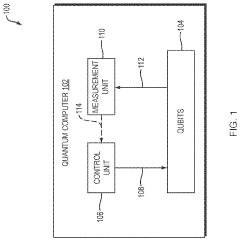
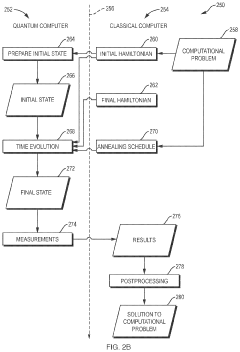
- A hybrid quantum-classical approach that applies orbital rotations to the quantum state during each shot instead of single-qubit context-selection gates, using orbital frames decomposition to reduce the number of shots required for expectation value estimation.




Quantum Computer with Improved Quantum Optimization by Exploiting Marginal Data
PatentPendingUS20230289636A1
Innovation
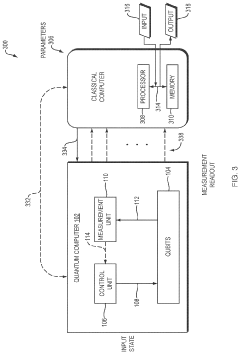
- A quantum optimization method that estimates the expectation value of a Hamiltonian on a classical computer and transforms either the Hamiltonian or the quantum state to reduce the expectation value, using techniques such as unitary transformations, fermionic rotations, and semidefinite programming, effectively increasing circuit depth without adding actual quantum gates, thereby improving the expressibility and coherence of quantum states.

Space Radiation Effects on Quantum Systems
Space radiation poses significant challenges to quantum systems in space exploration technologies. The harsh radiation environment in space, characterized by high-energy particles and cosmic rays, can severely impact the performance and reliability of quantum computing devices. These effects manifest in various forms, including decoherence, qubit state alterations, and hardware damage.
Decoherence, a primary concern in quantum computing, is exacerbated by space radiation. The interaction between high-energy particles and qubits can cause rapid loss of quantum information, reducing the coherence time and limiting the computational capabilities of quantum systems. This effect is particularly pronounced in superconducting qubits and trapped ion systems, which are sensitive to electromagnetic disturbances.
Radiation-induced single-event effects (SEEs) can also directly alter qubit states, leading to computational errors and reduced fidelity of quantum operations. These effects can range from temporary state flips to permanent damage in quantum circuits, potentially compromising the integrity of quantum algorithms and computations performed in space environments.
Hardware damage is another critical concern. Prolonged exposure to space radiation can cause cumulative damage to quantum computing components, including superconducting circuits, control electronics, and cryogenic systems. This damage may lead to degraded performance over time and shortened operational lifespans of quantum devices in space missions.
To address these challenges, several mitigation strategies are being explored. Radiation-hardened materials and shielding techniques are being developed to protect quantum hardware from direct radiation exposure. Advanced error correction codes and fault-tolerant quantum computing architectures are being designed to compensate for radiation-induced errors and maintain computational accuracy.
Novel qubit designs that are inherently more resistant to radiation effects are also under investigation. These include topological qubits and certain solid-state qubit implementations that demonstrate higher resilience to environmental disturbances, including those caused by space radiation.
Furthermore, adaptive quantum control techniques are being developed to dynamically adjust quantum operations in response to radiation-induced perturbations. These techniques aim to maintain qubit coherence and computational fidelity in the face of varying radiation conditions encountered during space missions.
As space exploration technologies continue to advance, addressing the effects of space radiation on quantum systems remains a critical area of research. The development of robust, radiation-tolerant quantum computing technologies will be essential for realizing the full potential of quantum computing in space exploration, enabling advanced data processing, secure communications, and complex simulations in deep space missions.
Decoherence, a primary concern in quantum computing, is exacerbated by space radiation. The interaction between high-energy particles and qubits can cause rapid loss of quantum information, reducing the coherence time and limiting the computational capabilities of quantum systems. This effect is particularly pronounced in superconducting qubits and trapped ion systems, which are sensitive to electromagnetic disturbances.
Radiation-induced single-event effects (SEEs) can also directly alter qubit states, leading to computational errors and reduced fidelity of quantum operations. These effects can range from temporary state flips to permanent damage in quantum circuits, potentially compromising the integrity of quantum algorithms and computations performed in space environments.
Hardware damage is another critical concern. Prolonged exposure to space radiation can cause cumulative damage to quantum computing components, including superconducting circuits, control electronics, and cryogenic systems. This damage may lead to degraded performance over time and shortened operational lifespans of quantum devices in space missions.
To address these challenges, several mitigation strategies are being explored. Radiation-hardened materials and shielding techniques are being developed to protect quantum hardware from direct radiation exposure. Advanced error correction codes and fault-tolerant quantum computing architectures are being designed to compensate for radiation-induced errors and maintain computational accuracy.
Novel qubit designs that are inherently more resistant to radiation effects are also under investigation. These include topological qubits and certain solid-state qubit implementations that demonstrate higher resilience to environmental disturbances, including those caused by space radiation.
Furthermore, adaptive quantum control techniques are being developed to dynamically adjust quantum operations in response to radiation-induced perturbations. These techniques aim to maintain qubit coherence and computational fidelity in the face of varying radiation conditions encountered during space missions.
As space exploration technologies continue to advance, addressing the effects of space radiation on quantum systems remains a critical area of research. The development of robust, radiation-tolerant quantum computing technologies will be essential for realizing the full potential of quantum computing in space exploration, enabling advanced data processing, secure communications, and complex simulations in deep space missions.
Quantum-Space Tech Integration Challenges
The integration of quantum computing technologies with space exploration presents a unique set of challenges that require innovative solutions and interdisciplinary approaches. One of the primary obstacles is the harsh space environment, characterized by extreme temperatures, radiation, and vacuum conditions. These factors can significantly impact the delicate quantum states necessary for quantum computing operations, potentially leading to decoherence and errors in quantum calculations.
Miniaturization and power efficiency are crucial considerations when adapting quantum computing systems for space applications. The limited payload capacity of spacecraft and the scarcity of power resources in space necessitate the development of compact, energy-efficient quantum processors and supporting hardware. This challenge is further compounded by the need for robust error correction mechanisms to maintain quantum coherence in the presence of space-induced disturbances.
The integration of quantum sensors with classical space systems poses another significant challenge. Quantum sensors, which leverage quantum entanglement and superposition principles, offer unprecedented precision in measurements of gravity, magnetic fields, and other physical phenomena. However, interfacing these quantum sensors with existing spacecraft systems and data processing pipelines requires the development of novel protocols and architectures to effectively translate quantum information into classical data formats.
Radiation hardening of quantum computing components is a critical area of focus for space applications. The increased exposure to cosmic rays and high-energy particles in space can cause bit flips and other errors in quantum circuits. Developing radiation-resistant quantum hardware and implementing fault-tolerant quantum error correction codes are essential steps in ensuring the reliability of quantum computations in space environments.
The long-distance transmission of quantum information between space-based quantum computers and ground stations presents unique challenges in quantum communication. Establishing and maintaining quantum entanglement over vast distances, while accounting for atmospheric interference and relativistic effects, requires advancements in quantum repeater technology and satellite-based quantum key distribution systems.
Addressing these integration challenges demands a collaborative effort between quantum physicists, aerospace engineers, and computer scientists. The development of space-compatible quantum materials, cryogenic systems for maintaining ultra-low temperatures in space, and adaptive quantum algorithms tailored for space exploration tasks are all critical areas of research. As these challenges are overcome, the potential for quantum computing to revolutionize space exploration, from enhanced navigation and communication to advanced data processing and simulation capabilities, will be realized.
Miniaturization and power efficiency are crucial considerations when adapting quantum computing systems for space applications. The limited payload capacity of spacecraft and the scarcity of power resources in space necessitate the development of compact, energy-efficient quantum processors and supporting hardware. This challenge is further compounded by the need for robust error correction mechanisms to maintain quantum coherence in the presence of space-induced disturbances.
The integration of quantum sensors with classical space systems poses another significant challenge. Quantum sensors, which leverage quantum entanglement and superposition principles, offer unprecedented precision in measurements of gravity, magnetic fields, and other physical phenomena. However, interfacing these quantum sensors with existing spacecraft systems and data processing pipelines requires the development of novel protocols and architectures to effectively translate quantum information into classical data formats.
Radiation hardening of quantum computing components is a critical area of focus for space applications. The increased exposure to cosmic rays and high-energy particles in space can cause bit flips and other errors in quantum circuits. Developing radiation-resistant quantum hardware and implementing fault-tolerant quantum error correction codes are essential steps in ensuring the reliability of quantum computations in space environments.
The long-distance transmission of quantum information between space-based quantum computers and ground stations presents unique challenges in quantum communication. Establishing and maintaining quantum entanglement over vast distances, while accounting for atmospheric interference and relativistic effects, requires advancements in quantum repeater technology and satellite-based quantum key distribution systems.
Addressing these integration challenges demands a collaborative effort between quantum physicists, aerospace engineers, and computer scientists. The development of space-compatible quantum materials, cryogenic systems for maintaining ultra-low temperatures in space, and adaptive quantum algorithms tailored for space exploration tasks are all critical areas of research. As these challenges are overcome, the potential for quantum computing to revolutionize space exploration, from enhanced navigation and communication to advanced data processing and simulation capabilities, will be realized.
Unlock deeper insights with PatSnap Eureka Quick Research — get a full tech report to explore trends and direct your research. Try now!
Generate Your Research Report Instantly with AI Agent
Supercharge your innovation with PatSnap Eureka AI Agent Platform!