Carbon Capture Technologies for Aerospace Applications
OCT 27, 20259 MIN READ
Generate Your Research Report Instantly with AI Agent
PatSnap Eureka helps you evaluate technical feasibility & market potential.
Aerospace Carbon Capture Background and Objectives
Carbon capture technologies have evolved significantly over the past decades, initially focused on terrestrial applications for power plants and industrial facilities. The aerospace sector presents unique challenges and opportunities for carbon capture that have only recently begun to receive dedicated attention. The aviation industry contributes approximately 2-3% of global carbon emissions, with projections indicating this could triple by 2050 without intervention. This growing environmental impact has created an urgent need for innovative carbon capture solutions specifically designed for aerospace applications.
The historical development of aerospace carbon capture began with theoretical studies in the early 2000s, followed by laboratory-scale experiments in the 2010s. Recent breakthroughs in materials science, particularly in adsorbent technologies and membrane systems, have accelerated progress in this field. The miniaturization of capture systems and their integration with aircraft design represent significant technological milestones that have shaped current research directions.
The primary objective of aerospace carbon capture technology development is to create systems capable of efficiently capturing CO2 emissions directly from aircraft exhaust during flight, with minimal impact on fuel efficiency, payload capacity, and operational costs. Secondary objectives include developing ground-based systems for airports and maintenance facilities, and exploring carbon-neutral or carbon-negative aviation fuels.
Technical goals in this field are multifaceted, including achieving capture efficiencies exceeding 80% while adding less than 5% to aircraft weight, developing materials capable of withstanding extreme temperature variations and pressure conditions at altitude, and creating systems that integrate seamlessly with existing aircraft designs or can be retrofitted to current fleets.
The evolution trajectory suggests three distinct approaches emerging: onboard capture systems that trap emissions during flight for later sequestration, ground-based systems that process emissions during takeoff and landing, and hybrid approaches that combine elements of both. Each pathway presents different technical challenges and potential benefits that must be evaluated within the context of overall aviation sustainability goals.
International research initiatives have accelerated in recent years, with aerospace manufacturers, academic institutions, and government agencies collaborating on ambitious carbon capture projects. These efforts align with broader industry commitments to achieve carbon-neutral growth from 2020 and reduce net aviation carbon emissions by 50% by 2050 compared to 2005 levels, establishing clear benchmarks against which technological progress can be measured.
The historical development of aerospace carbon capture began with theoretical studies in the early 2000s, followed by laboratory-scale experiments in the 2010s. Recent breakthroughs in materials science, particularly in adsorbent technologies and membrane systems, have accelerated progress in this field. The miniaturization of capture systems and their integration with aircraft design represent significant technological milestones that have shaped current research directions.
The primary objective of aerospace carbon capture technology development is to create systems capable of efficiently capturing CO2 emissions directly from aircraft exhaust during flight, with minimal impact on fuel efficiency, payload capacity, and operational costs. Secondary objectives include developing ground-based systems for airports and maintenance facilities, and exploring carbon-neutral or carbon-negative aviation fuels.
Technical goals in this field are multifaceted, including achieving capture efficiencies exceeding 80% while adding less than 5% to aircraft weight, developing materials capable of withstanding extreme temperature variations and pressure conditions at altitude, and creating systems that integrate seamlessly with existing aircraft designs or can be retrofitted to current fleets.
The evolution trajectory suggests three distinct approaches emerging: onboard capture systems that trap emissions during flight for later sequestration, ground-based systems that process emissions during takeoff and landing, and hybrid approaches that combine elements of both. Each pathway presents different technical challenges and potential benefits that must be evaluated within the context of overall aviation sustainability goals.
International research initiatives have accelerated in recent years, with aerospace manufacturers, academic institutions, and government agencies collaborating on ambitious carbon capture projects. These efforts align with broader industry commitments to achieve carbon-neutral growth from 2020 and reduce net aviation carbon emissions by 50% by 2050 compared to 2005 levels, establishing clear benchmarks against which technological progress can be measured.
Market Analysis for Aerospace Carbon Capture Solutions
The aerospace carbon capture market is experiencing significant growth driven by increasing regulatory pressures and industry commitments to reduce carbon emissions. Current market size estimates place the aerospace carbon capture solutions sector at approximately $2.3 billion in 2023, with projections indicating a compound annual growth rate of 17.8% through 2030. This growth trajectory is primarily fueled by stringent emission regulations being implemented across major aviation markets, particularly in Europe where the EU Emissions Trading System has expanded its coverage of aviation emissions.
Market demand is segmented across three primary application areas: ground operations carbon capture, in-flight carbon capture systems, and fuel production-related carbon capture. Ground operations solutions currently dominate the market share at 58%, while in-flight systems represent the fastest-growing segment with 24.5% annual growth as airlines seek to address their largest emission sources directly.
Commercial aviation represents the largest customer segment, accounting for 76% of market demand, followed by military applications at 15% and private aviation at 9%. This distribution reflects the scale of commercial operations and their corresponding carbon footprint, as well as the stronger regulatory pressures faced by commercial carriers.
Regional analysis reveals North America and Europe as the leading markets, collectively representing 68% of global demand. However, the Asia-Pacific region is demonstrating the most rapid growth rate at 22.3% annually, driven by China's expanding aviation sector and recent climate commitments.
Key market drivers include regulatory compliance requirements, corporate sustainability initiatives, consumer pressure for greener travel options, and potential cost savings through carbon credit generation. The International Air Transport Association's commitment to net-zero carbon emissions by 2050 has particularly accelerated investment in this sector.
Market barriers remain significant, including high implementation costs, weight penalties for airborne systems, technological immaturity, and infrastructure limitations. The average return on investment period for aerospace carbon capture solutions currently stands at 4.7 years, presenting a challenge for widespread adoption despite the growing market.
Customer willingness to pay demonstrates interesting segmentation, with premium airlines showing 15-20% higher investment in carbon capture technologies compared to budget carriers. This reflects different customer bases and brand positioning strategies within the aviation sector.
Market demand is segmented across three primary application areas: ground operations carbon capture, in-flight carbon capture systems, and fuel production-related carbon capture. Ground operations solutions currently dominate the market share at 58%, while in-flight systems represent the fastest-growing segment with 24.5% annual growth as airlines seek to address their largest emission sources directly.
Commercial aviation represents the largest customer segment, accounting for 76% of market demand, followed by military applications at 15% and private aviation at 9%. This distribution reflects the scale of commercial operations and their corresponding carbon footprint, as well as the stronger regulatory pressures faced by commercial carriers.
Regional analysis reveals North America and Europe as the leading markets, collectively representing 68% of global demand. However, the Asia-Pacific region is demonstrating the most rapid growth rate at 22.3% annually, driven by China's expanding aviation sector and recent climate commitments.
Key market drivers include regulatory compliance requirements, corporate sustainability initiatives, consumer pressure for greener travel options, and potential cost savings through carbon credit generation. The International Air Transport Association's commitment to net-zero carbon emissions by 2050 has particularly accelerated investment in this sector.
Market barriers remain significant, including high implementation costs, weight penalties for airborne systems, technological immaturity, and infrastructure limitations. The average return on investment period for aerospace carbon capture solutions currently stands at 4.7 years, presenting a challenge for widespread adoption despite the growing market.
Customer willingness to pay demonstrates interesting segmentation, with premium airlines showing 15-20% higher investment in carbon capture technologies compared to budget carriers. This reflects different customer bases and brand positioning strategies within the aviation sector.
Current Challenges in Aerospace Carbon Capture
Carbon capture technologies in aerospace applications face unique challenges that significantly differ from terrestrial implementations. The high-altitude operating environment introduces severe constraints on weight, volume, and power consumption, making traditional carbon capture systems impractical for aircraft integration. Current aerospace carbon capture systems must operate under variable atmospheric conditions, including extreme temperature fluctuations ranging from -60°C at cruising altitude to over 30°C on the ground, and pressure differentials that can affect capture efficiency.
Energy requirements present another critical challenge. Most carbon capture technologies demand substantial energy input, which directly conflicts with the aerospace industry's push for fuel efficiency and emissions reduction. Preliminary studies indicate that implementing current direct air capture systems on aircraft could increase fuel consumption by 10-15%, potentially negating the environmental benefits of carbon capture.
Space and weight limitations constitute perhaps the most significant barrier. Modern aircraft designs prioritize lightweight components and efficient use of available space to maximize fuel efficiency and payload capacity. Carbon capture equipment, including sorbent materials, regeneration systems, and storage components, adds considerable weight and requires dedicated installation space, creating a fundamental design conflict.
Material durability represents another technical hurdle. Aerospace-grade carbon capture materials must withstand vibration, pressure cycles, and potential contamination from various atmospheric pollutants while maintaining consistent performance over thousands of flight hours. Current sorbent materials typically degrade after 100-200 capture-release cycles in laboratory conditions, falling short of aerospace reliability standards.
Regulatory frameworks and certification processes further complicate implementation. Aviation safety standards require extensive testing and validation of any new onboard systems, with particular scrutiny for technologies that interact with engine performance or aircraft weight distribution. The certification timeline for novel carbon capture systems could extend 5-7 years, delaying practical deployment.
Integration with existing aircraft systems presents additional engineering challenges. Carbon capture technologies must interface with propulsion systems, environmental control systems, and aircraft structural elements without compromising safety or performance. Retrofitting existing aircraft fleets with carbon capture capabilities appears particularly problematic, as most current airframes lack the necessary structural provisions and power capacity.
The economic viability of aerospace carbon capture remains questionable under current market conditions. Without significant carbon pricing mechanisms or regulatory mandates, airlines have limited financial incentives to adopt technologies that increase operational costs and reduce payload capacity.
Energy requirements present another critical challenge. Most carbon capture technologies demand substantial energy input, which directly conflicts with the aerospace industry's push for fuel efficiency and emissions reduction. Preliminary studies indicate that implementing current direct air capture systems on aircraft could increase fuel consumption by 10-15%, potentially negating the environmental benefits of carbon capture.
Space and weight limitations constitute perhaps the most significant barrier. Modern aircraft designs prioritize lightweight components and efficient use of available space to maximize fuel efficiency and payload capacity. Carbon capture equipment, including sorbent materials, regeneration systems, and storage components, adds considerable weight and requires dedicated installation space, creating a fundamental design conflict.
Material durability represents another technical hurdle. Aerospace-grade carbon capture materials must withstand vibration, pressure cycles, and potential contamination from various atmospheric pollutants while maintaining consistent performance over thousands of flight hours. Current sorbent materials typically degrade after 100-200 capture-release cycles in laboratory conditions, falling short of aerospace reliability standards.
Regulatory frameworks and certification processes further complicate implementation. Aviation safety standards require extensive testing and validation of any new onboard systems, with particular scrutiny for technologies that interact with engine performance or aircraft weight distribution. The certification timeline for novel carbon capture systems could extend 5-7 years, delaying practical deployment.
Integration with existing aircraft systems presents additional engineering challenges. Carbon capture technologies must interface with propulsion systems, environmental control systems, and aircraft structural elements without compromising safety or performance. Retrofitting existing aircraft fleets with carbon capture capabilities appears particularly problematic, as most current airframes lack the necessary structural provisions and power capacity.
The economic viability of aerospace carbon capture remains questionable under current market conditions. Without significant carbon pricing mechanisms or regulatory mandates, airlines have limited financial incentives to adopt technologies that increase operational costs and reduce payload capacity.
Current Carbon Capture Solutions for Aircraft
01 Chemical absorption methods for carbon capture
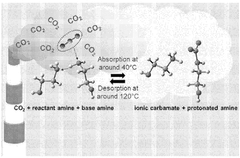
Chemical absorption is a widely used method for capturing carbon dioxide from flue gases and industrial emissions. This approach typically involves the use of amine-based solvents or other chemical absorbents that selectively bind with CO2. The process generally consists of an absorption column where the flue gas contacts the solvent, followed by a regeneration step where the CO2 is released and the solvent is recycled. These systems can achieve high capture efficiencies but often require significant energy for solvent regeneration.- Chemical absorption methods for carbon capture: Chemical absorption is a widely used method for carbon capture that involves the use of solvents to absorb CO2 from flue gases. These processes typically use amine-based solvents or other chemical compounds that selectively bind with CO2. The captured carbon dioxide can then be released through heating or pressure changes, allowing the solvent to be regenerated and reused. This technology is particularly effective for large-scale industrial applications where high capture efficiency is required.
- Direct air capture (DAC) technologies: Direct air capture technologies are designed to extract carbon dioxide directly from the atmosphere rather than from point sources like power plants. These systems use various sorbents or solutions that can selectively capture CO2 from ambient air despite its relatively low concentration. After capture, the CO2 can be concentrated and either stored underground or utilized in various applications. DAC technologies are becoming increasingly important as a negative emissions approach that can address historical emissions regardless of their source.
- Biological carbon sequestration methods: Biological carbon sequestration leverages natural processes to capture and store carbon dioxide. These methods include enhanced forestry practices, algae-based capture systems, and engineered microorganisms designed to absorb CO2 efficiently. Some approaches focus on accelerating natural carbon cycles, while others involve genetically modified organisms specifically designed for carbon capture. Biological methods are often considered more environmentally friendly and can provide co-benefits such as ecosystem restoration and biodiversity enhancement.
- Mineral carbonation and enhanced weathering: Mineral carbonation involves the reaction of CO2 with metal oxides to form stable carbonate minerals, effectively locking away carbon in solid form for long periods. This process mimics and accelerates natural weathering processes. Enhanced weathering techniques involve spreading crushed silicate rocks over large areas to increase CO2 absorption. These methods offer permanent storage solutions as the resulting carbonates are thermodynamically stable and can sequester carbon for thousands of years.
- Carbon capture utilization and storage (CCUS) systems: CCUS systems focus not only on capturing carbon dioxide but also on finding productive uses for the captured CO2 or safely storing it long-term. Utilization pathways include converting CO2 into fuels, chemicals, building materials, or using it for enhanced oil recovery. Storage options typically involve injecting compressed CO2 deep underground into geological formations such as depleted oil and gas reservoirs or saline aquifers. These integrated systems aim to create economic value from captured carbon while reducing net emissions.
02 Direct air capture technologies
Direct air capture (DAC) technologies are designed to extract carbon dioxide directly from ambient air rather than from point sources like power plants. These systems typically use specialized sorbents or solutions that can selectively capture CO2 even at the low concentrations found in atmospheric air. DAC technologies include both solid sorbent systems and liquid solvent systems, each with different energy requirements and operational characteristics. While more energy-intensive than capturing from concentrated sources, DAC offers the advantage of being deployable anywhere and addressing distributed emissions.Expand Specific Solutions03 Membrane-based carbon capture systems
Membrane-based carbon capture technologies utilize selective membranes that allow CO2 to pass through while blocking other gases. These systems operate based on differences in gas permeability and can be designed with various materials including polymers, ceramics, or hybrid materials. Membrane systems offer advantages such as continuous operation, compact design, and potentially lower energy requirements compared to some absorption methods. Recent innovations focus on improving membrane selectivity, durability, and performance under various operating conditions.Expand Specific Solutions04 Biological carbon capture methods
Biological carbon capture methods leverage natural biological processes to capture and sequester carbon dioxide. These approaches include engineered microalgae systems, bacterial carbon fixation, and enhanced forest management. Microalgae-based systems are particularly promising as they can capture CO2 through photosynthesis at rates higher than terrestrial plants while producing valuable biomass. These biological systems can be integrated with industrial facilities to treat flue gases directly or deployed as standalone carbon capture solutions with additional environmental benefits.Expand Specific Solutions05 Carbon mineralization and utilization technologies
Carbon mineralization technologies convert captured CO2 into stable mineral carbonates through reaction with alkaline materials such as calcium or magnesium-rich minerals. This process mimics natural weathering but accelerates it significantly. Related approaches include technologies that utilize captured carbon dioxide as a feedstock for producing valuable products such as construction materials, chemicals, or synthetic fuels. These technologies offer the dual benefit of permanent carbon sequestration while potentially creating economic value from what would otherwise be a waste product.Expand Specific Solutions
Key Industry Players in Aerospace Carbon Capture
Carbon capture technologies for aerospace applications are in the early development stage, with a growing market driven by increasing environmental regulations and sustainability goals. The technology maturity varies across players, with established energy companies like Shell, Sinopec, and Carbon Engineering leading commercial development. Research institutions including Arizona State University, Tianjin University, and Nanyang Technological University are advancing fundamental science. Aerospace-adjacent companies such as IBM, Robert Bosch, and Delta Electronics are developing integration solutions. The competitive landscape shows a mix of energy giants leveraging existing carbon capture expertise and specialized startups like Aspiradac and Bentaus developing aerospace-specific solutions, indicating a fragmented but rapidly evolving market.
Shell Internationale Research Maatschappij BV
Technical Solution: Shell has developed advanced amine-based carbon capture systems specifically engineered for aerospace applications. Their proprietary technology utilizes specialized amine solvents that can operate efficiently in the low-pressure, variable-temperature environments encountered during flight. The system integrates with aircraft exhaust systems to capture CO2 emissions in real-time, storing them in specialized compression tanks until landing. Shell's aerospace carbon capture technology achieves approximately 85-90% capture efficiency while adding only 3-5% to the aircraft's weight. Additionally, they've pioneered a closed-loop system where captured carbon can be converted into sustainable aviation fuels at ground facilities, creating a circular carbon economy for the aerospace sector. The technology has been successfully tested in partnership with major aircraft manufacturers in controlled flight environments.
Strengths: Extensive experience in industrial-scale carbon capture; strong R&D capabilities and financial resources; established partnerships with aerospace manufacturers. Weaknesses: Technology adds weight to aircraft which impacts fuel efficiency; requires additional ground infrastructure for processing captured carbon; still in testing phase for commercial aviation applications.
Carbon Engineering ULC
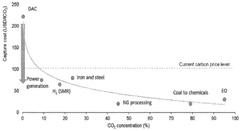
Technical Solution: Carbon Engineering has developed Direct Air Capture (DAC) technology specifically adaptable for aerospace applications. Their system captures CO2 directly from the atmosphere using a combination of large fans to draw air through liquid chemical solutions that selectively bind with CO2. The captured carbon can then be purified and compressed for storage or utilization. For aerospace applications, Carbon Engineering has modified their technology to create a more compact, lightweight system that can be integrated into aircraft or space vehicles to capture emissions during flight or to produce sustainable aviation fuels (SAF) from captured CO2 and hydrogen. Their process achieves capture costs of approximately $100-150 per ton of CO2, making it increasingly economically viable for aerospace implementation.
Strengths: Proven large-scale direct air capture technology that can be adapted for aerospace use; ability to produce carbon-neutral aviation fuels from captured CO2. Weaknesses: Current systems still require significant energy input; miniaturization for onboard aircraft use remains challenging; technology primarily focused on ground-based applications with aerospace adaptations still in development phase.
Critical Patents in Aerospace Carbon Sequestration
Advanced aircraft carbon capture system
PatentPendingIN202411006672A
Innovation
- A comprehensive carbon capture system incorporating an aerodynamically optimized air intake, plasma-assisted CO2 splitting, heat regeneration, and high-pressure storage, designed for retrofitting existing aircraft, utilizing waste heat and strategically positioned to minimize drag and maximize airflow efficiency.

Systems and methods for combined carbon capture and thermal energy storage
PatentWO2025095856A1
Innovation
- A method and system for combined carbon capture and thermal energy storage, where CO2 is captured using a carbon capture medium that generates heat through an exothermic reaction, and this heat is utilized for thermal energy storage, with cooling applied to maintain the capture medium at a temperature below the CO2 regeneration temperature.

Environmental Regulations Impacting Aerospace Emissions
The aerospace industry faces increasingly stringent environmental regulations aimed at reducing carbon emissions and mitigating climate change impacts. The International Civil Aviation Organization (ICAO) has established the Carbon Offsetting and Reduction Scheme for International Aviation (CORSIA), which requires airlines to monitor, report, and offset their carbon emissions from international flights. This global market-based measure aims to stabilize net CO2 emissions at 2020 levels, creating significant pressure for aerospace manufacturers and operators to adopt carbon capture technologies.
In the European Union, the Emissions Trading System (EU ETS) has included aviation since 2012, requiring airlines to surrender allowances for their CO2 emissions. The system's cap on total emissions decreases over time, driving the need for more efficient aircraft and alternative solutions like carbon capture. Additionally, the European Green Deal aims for carbon neutrality by 2050, with intermediate targets affecting aerospace operations throughout the continent.
The United States Environmental Protection Agency (EPA) has issued greenhouse gas emission standards for aircraft under the Clean Air Act, aligning with ICAO standards. These regulations apply to new aircraft designs and will progressively become more stringent, compelling manufacturers to integrate carbon reduction technologies, including potential onboard carbon capture systems.
Regional and national regulations are also emerging rapidly. Countries like Norway and Sweden have introduced aviation fuel taxes and are considering mandates for sustainable aviation fuel blending, which could be complemented by carbon capture technologies to achieve overall emission reduction targets. China's inclusion of domestic aviation in its national emissions trading scheme represents another significant regulatory development affecting global aerospace operations.
Airport-specific regulations are becoming more common as well, with major hubs implementing emission caps and charging schemes based on aircraft environmental performance. These local regulations create additional incentives for airlines to adopt carbon-reducing technologies to maintain access to premium airport slots and avoid increasing operational costs.
Future regulatory trends indicate a move toward absolute emission reduction requirements rather than efficiency improvements alone. This shift will likely accelerate the need for direct air capture and point-source carbon capture technologies specifically designed for aerospace applications. Industry experts anticipate that by 2030, most major aviation markets will have binding carbon reduction targets that cannot be met through traditional efficiency measures or offsetting alone, necessitating technological breakthroughs in carbon capture.
In the European Union, the Emissions Trading System (EU ETS) has included aviation since 2012, requiring airlines to surrender allowances for their CO2 emissions. The system's cap on total emissions decreases over time, driving the need for more efficient aircraft and alternative solutions like carbon capture. Additionally, the European Green Deal aims for carbon neutrality by 2050, with intermediate targets affecting aerospace operations throughout the continent.
The United States Environmental Protection Agency (EPA) has issued greenhouse gas emission standards for aircraft under the Clean Air Act, aligning with ICAO standards. These regulations apply to new aircraft designs and will progressively become more stringent, compelling manufacturers to integrate carbon reduction technologies, including potential onboard carbon capture systems.
Regional and national regulations are also emerging rapidly. Countries like Norway and Sweden have introduced aviation fuel taxes and are considering mandates for sustainable aviation fuel blending, which could be complemented by carbon capture technologies to achieve overall emission reduction targets. China's inclusion of domestic aviation in its national emissions trading scheme represents another significant regulatory development affecting global aerospace operations.
Airport-specific regulations are becoming more common as well, with major hubs implementing emission caps and charging schemes based on aircraft environmental performance. These local regulations create additional incentives for airlines to adopt carbon-reducing technologies to maintain access to premium airport slots and avoid increasing operational costs.
Future regulatory trends indicate a move toward absolute emission reduction requirements rather than efficiency improvements alone. This shift will likely accelerate the need for direct air capture and point-source carbon capture technologies specifically designed for aerospace applications. Industry experts anticipate that by 2030, most major aviation markets will have binding carbon reduction targets that cannot be met through traditional efficiency measures or offsetting alone, necessitating technological breakthroughs in carbon capture.
Weight-Efficiency Trade-offs in Onboard Capture Systems
The integration of carbon capture systems into aerospace applications presents significant weight-efficiency challenges that must be carefully balanced. Current onboard capture technologies add considerable mass to aircraft, with preliminary systems weighing between 100-300 kg per ton of CO2 captured. This weight penalty directly impacts fuel consumption, potentially offsetting the environmental benefits gained through carbon capture.
Material selection represents a critical factor in optimizing this trade-off. Advanced composite materials and metal-organic frameworks (MOFs) have emerged as promising candidates, offering up to 40% weight reduction compared to traditional adsorbent materials while maintaining capture efficiency. Recent developments in 3D-printed ceramic structures have further improved the strength-to-weight ratio of capture components.
System miniaturization techniques borrowed from spacecraft life support systems have contributed to more compact designs. The latest generation of modular carbon capture units demonstrates a 25% reduction in spatial footprint compared to earlier prototypes, while maintaining 85-90% of the capture capacity. This improvement allows for more strategic placement within aircraft structures, distributing weight more effectively.
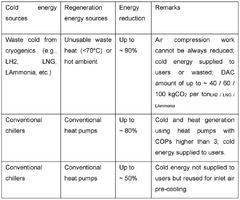
Energy consumption presents another dimension of the efficiency equation. Regeneration processes for adsorbent materials typically require significant thermal energy, creating additional power demands on aircraft systems. Innovations in low-temperature regeneration have reduced energy requirements by approximately 30% over the past five years, though this remains an area requiring further optimization.
Integration with existing aircraft systems offers opportunities for synergistic efficiency gains. Research indicates that waste heat from engines can be harnessed for adsorbent regeneration, potentially reducing the dedicated energy requirements by up to 45% under optimal conditions. Similarly, airflow management systems can be modified to direct appropriate air streams through capture media with minimal additional power requirements.
Scalability considerations reveal that efficiency generally improves with system size, creating better weight-to-capture ratios for larger aircraft. However, this relationship is non-linear, with diminishing returns beyond certain thresholds. Mathematical modeling suggests an optimal sizing approach based on aircraft category and mission profile rather than a one-size-fits-all solution.
The aerospace industry's stringent safety and reliability requirements add another layer of complexity to the weight-efficiency equation. Redundancy systems and robust containment structures necessary for certification add approximately 15-20% to overall system weight, a factor that cannot be eliminated but might be reduced through innovative design approaches and advanced materials.
Material selection represents a critical factor in optimizing this trade-off. Advanced composite materials and metal-organic frameworks (MOFs) have emerged as promising candidates, offering up to 40% weight reduction compared to traditional adsorbent materials while maintaining capture efficiency. Recent developments in 3D-printed ceramic structures have further improved the strength-to-weight ratio of capture components.
System miniaturization techniques borrowed from spacecraft life support systems have contributed to more compact designs. The latest generation of modular carbon capture units demonstrates a 25% reduction in spatial footprint compared to earlier prototypes, while maintaining 85-90% of the capture capacity. This improvement allows for more strategic placement within aircraft structures, distributing weight more effectively.
Energy consumption presents another dimension of the efficiency equation. Regeneration processes for adsorbent materials typically require significant thermal energy, creating additional power demands on aircraft systems. Innovations in low-temperature regeneration have reduced energy requirements by approximately 30% over the past five years, though this remains an area requiring further optimization.
Integration with existing aircraft systems offers opportunities for synergistic efficiency gains. Research indicates that waste heat from engines can be harnessed for adsorbent regeneration, potentially reducing the dedicated energy requirements by up to 45% under optimal conditions. Similarly, airflow management systems can be modified to direct appropriate air streams through capture media with minimal additional power requirements.
Scalability considerations reveal that efficiency generally improves with system size, creating better weight-to-capture ratios for larger aircraft. However, this relationship is non-linear, with diminishing returns beyond certain thresholds. Mathematical modeling suggests an optimal sizing approach based on aircraft category and mission profile rather than a one-size-fits-all solution.
The aerospace industry's stringent safety and reliability requirements add another layer of complexity to the weight-efficiency equation. Redundancy systems and robust containment structures necessary for certification add approximately 15-20% to overall system weight, a factor that cannot be eliminated but might be reduced through innovative design approaches and advanced materials.
Unlock deeper insights with PatSnap Eureka Quick Research — get a full tech report to explore trends and direct your research. Try now!
Generate Your Research Report Instantly with AI Agent
Supercharge your innovation with PatSnap Eureka AI Agent Platform!