Carbon Capture Technologies for Reducing Industrial Emissions
OCT 27, 20259 MIN READ
Generate Your Research Report Instantly with AI Agent
Patsnap Eureka helps you evaluate technical feasibility & market potential.
Carbon Capture Evolution and Objectives
Carbon capture technologies have evolved significantly over the past several decades, transitioning from theoretical concepts to practical industrial applications. The journey began in the 1970s with early experiments in capturing carbon dioxide from flue gases, primarily motivated by enhanced oil recovery rather than climate concerns. By the 1990s, as climate change gained scientific consensus, carbon capture research accelerated, leading to the first large-scale demonstration projects in the early 2000s.
The evolution of carbon capture technologies can be categorized into three distinct generations. First-generation technologies focused on post-combustion capture using amine-based solvents, which remain widely implemented despite their energy intensity. Second-generation approaches introduced pre-combustion capture and oxyfuel combustion, offering improved efficiency but requiring significant plant modifications. The emerging third generation encompasses direct air capture, novel materials like metal-organic frameworks, and biomimetic approaches that promise higher efficiency and lower energy penalties.
Current carbon capture objectives are multifaceted, addressing both technical and economic challenges. Primary technical goals include reducing the energy penalty of capture processes, which currently ranges from 20-30% of a power plant's output, developing more durable and selective capture materials, and scaling technologies to handle industrial volumes effectively. Economic objectives focus on bringing costs below the critical threshold of $50-100 per ton of CO₂, making widespread adoption economically viable without substantial subsidies.
Beyond power generation, carbon capture technologies are increasingly targeting hard-to-abate industrial sectors such as cement, steel, and chemical production, which collectively account for approximately 25% of global CO₂ emissions. These industries present unique challenges due to process-inherent emissions that cannot be eliminated through fuel switching alone.
The long-term strategic objective extends beyond mere capture to creating integrated carbon management systems that incorporate transportation infrastructure, utilization pathways, and permanent geological storage solutions. This holistic approach aims to establish closed carbon loops within industrial ecosystems, potentially transforming CO₂ from an environmental liability into a valuable feedstock for various applications including synthetic fuels, building materials, and chemical production.
As climate targets become increasingly stringent, carbon capture technologies are positioned as critical transition technologies that can enable continued use of existing infrastructure while dramatically reducing emissions, providing valuable time for the development of zero-carbon alternatives.
The evolution of carbon capture technologies can be categorized into three distinct generations. First-generation technologies focused on post-combustion capture using amine-based solvents, which remain widely implemented despite their energy intensity. Second-generation approaches introduced pre-combustion capture and oxyfuel combustion, offering improved efficiency but requiring significant plant modifications. The emerging third generation encompasses direct air capture, novel materials like metal-organic frameworks, and biomimetic approaches that promise higher efficiency and lower energy penalties.
Current carbon capture objectives are multifaceted, addressing both technical and economic challenges. Primary technical goals include reducing the energy penalty of capture processes, which currently ranges from 20-30% of a power plant's output, developing more durable and selective capture materials, and scaling technologies to handle industrial volumes effectively. Economic objectives focus on bringing costs below the critical threshold of $50-100 per ton of CO₂, making widespread adoption economically viable without substantial subsidies.
Beyond power generation, carbon capture technologies are increasingly targeting hard-to-abate industrial sectors such as cement, steel, and chemical production, which collectively account for approximately 25% of global CO₂ emissions. These industries present unique challenges due to process-inherent emissions that cannot be eliminated through fuel switching alone.
The long-term strategic objective extends beyond mere capture to creating integrated carbon management systems that incorporate transportation infrastructure, utilization pathways, and permanent geological storage solutions. This holistic approach aims to establish closed carbon loops within industrial ecosystems, potentially transforming CO₂ from an environmental liability into a valuable feedstock for various applications including synthetic fuels, building materials, and chemical production.
As climate targets become increasingly stringent, carbon capture technologies are positioned as critical transition technologies that can enable continued use of existing infrastructure while dramatically reducing emissions, providing valuable time for the development of zero-carbon alternatives.
Industrial Emission Reduction Market Analysis
The global market for industrial emission reduction technologies has experienced significant growth in recent years, driven by increasing regulatory pressures and corporate sustainability commitments. The carbon capture market specifically was valued at approximately $2.2 billion in 2021 and is projected to reach $7.0 billion by 2030, representing a compound annual growth rate (CAGR) of 13.8%. This growth trajectory reflects the urgent need for effective carbon management solutions across heavy-emitting industries.
Energy-intensive sectors including power generation, cement manufacturing, steel production, and chemical processing collectively account for over 70% of global industrial carbon emissions. These industries represent the primary target market for carbon capture technologies, with the power generation sector alone contributing nearly 40% of current market demand. The cement industry, responsible for roughly 8% of global CO2 emissions, has emerged as another critical market segment with substantial growth potential.
Regional analysis reveals varying market dynamics across different geographies. North America currently leads the industrial emission reduction market with approximately 35% market share, driven by favorable policy frameworks including tax incentives and carbon pricing mechanisms. The European market follows closely at 30%, bolstered by the EU Emissions Trading System and ambitious climate targets. The Asia-Pacific region, while currently representing about 25% of the market, is expected to demonstrate the fastest growth rate over the next decade due to rapid industrialization coupled with strengthening environmental regulations.
Customer segmentation within this market reveals three primary buyer categories: large industrial corporations implementing direct emission reduction strategies, utility companies seeking compliance with emissions standards, and government entities supporting demonstration projects. The willingness to pay varies significantly across these segments, with price sensitivity highest among industrial users operating in competitive global markets with thin profit margins.
Market barriers include high capital expenditure requirements, with typical industrial-scale carbon capture installations costing between $400-800 million, and operational expenses ranging from $40-120 per ton of CO2 captured. These economic challenges are compounded by technological uncertainties and the absence of comprehensive carbon pricing mechanisms in many regions.
Future market growth will be significantly influenced by policy developments, particularly carbon pricing mechanisms and regulatory frameworks. Market forecasts suggest that with supportive policies, the total addressable market for industrial emission reduction technologies could exceed $50 billion by 2035, with carbon capture technologies representing approximately 40% of this opportunity.
Energy-intensive sectors including power generation, cement manufacturing, steel production, and chemical processing collectively account for over 70% of global industrial carbon emissions. These industries represent the primary target market for carbon capture technologies, with the power generation sector alone contributing nearly 40% of current market demand. The cement industry, responsible for roughly 8% of global CO2 emissions, has emerged as another critical market segment with substantial growth potential.
Regional analysis reveals varying market dynamics across different geographies. North America currently leads the industrial emission reduction market with approximately 35% market share, driven by favorable policy frameworks including tax incentives and carbon pricing mechanisms. The European market follows closely at 30%, bolstered by the EU Emissions Trading System and ambitious climate targets. The Asia-Pacific region, while currently representing about 25% of the market, is expected to demonstrate the fastest growth rate over the next decade due to rapid industrialization coupled with strengthening environmental regulations.
Customer segmentation within this market reveals three primary buyer categories: large industrial corporations implementing direct emission reduction strategies, utility companies seeking compliance with emissions standards, and government entities supporting demonstration projects. The willingness to pay varies significantly across these segments, with price sensitivity highest among industrial users operating in competitive global markets with thin profit margins.
Market barriers include high capital expenditure requirements, with typical industrial-scale carbon capture installations costing between $400-800 million, and operational expenses ranging from $40-120 per ton of CO2 captured. These economic challenges are compounded by technological uncertainties and the absence of comprehensive carbon pricing mechanisms in many regions.
Future market growth will be significantly influenced by policy developments, particularly carbon pricing mechanisms and regulatory frameworks. Market forecasts suggest that with supportive policies, the total addressable market for industrial emission reduction technologies could exceed $50 billion by 2035, with carbon capture technologies representing approximately 40% of this opportunity.
Carbon Capture Technology Landscape and Barriers
Carbon capture technologies have evolved significantly over the past three decades, with three primary approaches dominating the landscape: post-combustion capture, pre-combustion capture, and oxy-fuel combustion. Post-combustion technologies, particularly amine-based absorption systems, represent the most mature solution with several commercial-scale implementations globally. However, these systems face substantial energy penalties, typically consuming 15-30% of a power plant's energy output for regeneration processes.
Pre-combustion capture, while offering higher CO2 concentration streams that facilitate more efficient capture, requires significant modifications to existing industrial facilities, limiting its application primarily to new installations. Oxy-fuel combustion provides high-purity CO2 streams but demands considerable energy for air separation units, creating efficiency challenges that have restricted widespread adoption.
The global carbon capture landscape reveals significant regional disparities. North America leads with approximately 65% of large-scale operational projects, followed by Europe with 20%, while Asia and other regions account for the remaining 15%. This distribution reflects not only technological capabilities but also regulatory frameworks and economic incentives that vary substantially across regions.
Technical barriers to widespread implementation remain formidable. Energy requirements for current technologies translate to operational cost increases of $40-100 per ton of CO2 captured, making economic viability challenging without substantial carbon pricing or incentives. Material limitations present another significant hurdle, as conventional amine solvents suffer from degradation, corrosion issues, and environmental concerns related to emissions of degradation products.
Scale-up challenges persist as laboratory successes often encounter unforeseen complications in industrial settings. The integration of capture systems with existing industrial infrastructure requires complex engineering solutions that must address space constraints, process interruptions, and system compatibility. These integration challenges are particularly acute in retrofit scenarios, where space limitations and operational continuity requirements create additional technical complexities.
Transportation infrastructure for captured CO2 remains underdeveloped in most regions, creating a bottleneck between capture and storage or utilization. The current global CO2 pipeline network spans approximately 8,000 kilometers, primarily in North America, which is insufficient for the scale required to make meaningful climate impact.
Monitoring and verification technologies for ensuring permanent storage face technical limitations in accuracy, cost-effectiveness, and long-term reliability. Current monitoring systems can detect large leakages but struggle with quantifying small, diffuse emissions that could undermine the climate benefits of storage projects.
Pre-combustion capture, while offering higher CO2 concentration streams that facilitate more efficient capture, requires significant modifications to existing industrial facilities, limiting its application primarily to new installations. Oxy-fuel combustion provides high-purity CO2 streams but demands considerable energy for air separation units, creating efficiency challenges that have restricted widespread adoption.
The global carbon capture landscape reveals significant regional disparities. North America leads with approximately 65% of large-scale operational projects, followed by Europe with 20%, while Asia and other regions account for the remaining 15%. This distribution reflects not only technological capabilities but also regulatory frameworks and economic incentives that vary substantially across regions.
Technical barriers to widespread implementation remain formidable. Energy requirements for current technologies translate to operational cost increases of $40-100 per ton of CO2 captured, making economic viability challenging without substantial carbon pricing or incentives. Material limitations present another significant hurdle, as conventional amine solvents suffer from degradation, corrosion issues, and environmental concerns related to emissions of degradation products.
Scale-up challenges persist as laboratory successes often encounter unforeseen complications in industrial settings. The integration of capture systems with existing industrial infrastructure requires complex engineering solutions that must address space constraints, process interruptions, and system compatibility. These integration challenges are particularly acute in retrofit scenarios, where space limitations and operational continuity requirements create additional technical complexities.
Transportation infrastructure for captured CO2 remains underdeveloped in most regions, creating a bottleneck between capture and storage or utilization. The current global CO2 pipeline network spans approximately 8,000 kilometers, primarily in North America, which is insufficient for the scale required to make meaningful climate impact.
Monitoring and verification technologies for ensuring permanent storage face technical limitations in accuracy, cost-effectiveness, and long-term reliability. Current monitoring systems can detect large leakages but struggle with quantifying small, diffuse emissions that could undermine the climate benefits of storage projects.
Current Carbon Capture Implementation Solutions
01 Chemical absorption methods for carbon capture
Chemical absorption is a widely used method for capturing carbon dioxide emissions. This approach involves the use of solvents such as amines that chemically react with CO2, allowing it to be separated from flue gases. The process typically includes an absorption column where the solvent contacts the gas stream, followed by a regeneration step where the CO2 is released and the solvent is recycled. These systems can achieve high capture efficiencies and are suitable for retrofitting existing power plants and industrial facilities.- Direct Air Capture (DAC) Technologies: Direct Air Capture technologies involve systems that extract carbon dioxide directly from the atmosphere. These technologies use various sorbents and chemical processes to capture CO2 from ambient air, which can then be stored or utilized. DAC systems can be deployed in various locations and operate independently of emission sources, making them versatile tools for carbon management and climate change mitigation.
- Post-Combustion Carbon Capture Systems: Post-combustion carbon capture technologies focus on removing CO2 from flue gases after the combustion process in power plants and industrial facilities. These systems typically employ chemical absorption, membrane separation, or adsorption techniques to separate CO2 from other exhaust gases. This approach allows for retrofitting existing infrastructure rather than requiring complete system redesigns, making it a practical solution for reducing emissions from established facilities.
- Biological Carbon Sequestration Methods: Biological carbon sequestration leverages natural processes to capture and store carbon dioxide. These methods include afforestation, reforestation, enhanced agricultural practices, and the use of algae or microorganisms to absorb CO2. Biological approaches often provide co-benefits such as improved soil health, biodiversity conservation, and ecosystem services while contributing to carbon emissions reduction goals.
- Carbon Capture Utilization and Storage (CCUS) Systems: CCUS systems integrate the capture of carbon dioxide with its subsequent utilization or permanent storage. Captured CO2 can be used in enhanced oil recovery, converted into valuable products like fuels or chemicals, or permanently sequestered in geological formations. These integrated systems create economic incentives for carbon capture by transforming a waste product into a resource, potentially making carbon capture more financially viable while reducing net emissions.
- Monitoring and Verification Technologies for Carbon Capture: Monitoring and verification technologies are essential components of carbon capture systems, ensuring their effectiveness and environmental integrity. These technologies include sensors, data analytics platforms, and reporting systems that track capture rates, leakage, energy consumption, and overall emissions reduction. Advanced monitoring tools provide real-time data on system performance, enabling optimization of operations and verification of climate benefits for regulatory compliance and carbon credit markets.
02 Direct air capture technologies
Direct air capture (DAC) technologies extract CO2 directly from ambient air rather than from point sources like power plant emissions. These systems typically use adsorbent materials or chemical solutions that selectively capture CO2 from the atmosphere. Once captured, the CO2 can be released through heating or pressure changes, then compressed for storage or utilization. DAC technologies are particularly valuable for addressing distributed emission sources and potentially achieving negative emissions by removing historical CO2 from the atmosphere.Expand Specific Solutions03 Carbon capture integration with industrial processes
Carbon capture technologies can be integrated directly into industrial processes to reduce emissions at the source. This approach includes modifications to existing manufacturing processes in cement, steel, and chemical production to facilitate easier CO2 separation. By capturing carbon during the production process, these integrated systems can significantly reduce the energy penalty associated with post-combustion capture. These technologies often involve process redesigns that optimize both production efficiency and carbon capture capability.Expand Specific Solutions04 Biological carbon sequestration methods
Biological approaches to carbon capture leverage natural processes such as photosynthesis to remove CO2 from the atmosphere. These methods include enhanced forestry practices, algae cultivation systems, and biochar production. Microalgae-based systems are particularly promising as they can capture CO2 at rates significantly higher than terrestrial plants while producing valuable biomass that can be used for biofuels or other products. These biological approaches often provide co-benefits such as improved soil health, biodiversity, and sustainable material production.Expand Specific Solutions05 Carbon capture utilization and storage systems
Carbon capture utilization and storage (CCUS) systems focus not only on capturing CO2 but also on its subsequent use or permanent storage. Utilization pathways include conversion to fuels, chemicals, building materials, or use in enhanced oil recovery. Storage options involve injecting captured CO2 into geological formations such as depleted oil and gas reservoirs or saline aquifers. These integrated systems aim to create economic value from captured carbon while ensuring long-term climate benefits through permanent sequestration of emissions.Expand Specific Solutions
Leading Carbon Capture Industry Stakeholders
Carbon capture technologies for reducing industrial emissions are evolving rapidly in a market transitioning from early development to commercial deployment. The global carbon capture market, valued at approximately $2 billion, is projected to grow significantly as industries face increasing pressure to decarbonize. Leading energy companies like Saudi Aramco and Sinopec are investing heavily in carbon capture solutions, while specialized technology providers such as 8 Rivers Capital, Daphne Technology, and CocoonCarbon are developing innovative approaches. Academic institutions including Zhejiang University, Rutgers, and Dalian University of Technology are advancing fundamental research. The competitive landscape features collaboration between established energy giants and technology startups, with increasing integration of carbon capture with renewable energy systems to create comprehensive industrial emission reduction solutions.
Saudi Arabian Oil Co.
Technical Solution: Saudi Aramco has developed a multi-faceted carbon capture technology portfolio focusing on both post-combustion and pre-combustion capture systems. Their flagship technology is the Converge® polyols system that utilizes captured CO2 as a feedstock to produce high-value polymers. They've also implemented large-scale carbon capture at their Hawiyah NGL facility, capable of capturing up to 500,000 tons of CO2 annually. Aramco's mobile carbon capture technology demonstrates their innovation in developing compact systems that can be retrofitted to vehicles, potentially reducing emissions from transportation sources. Their research extends to mineralization techniques that permanently convert CO2 into stable carbonate materials, offering permanent sequestration options for industrial emissions.
Strengths: Extensive financial resources for large-scale implementation; integration capabilities with existing oil and gas infrastructure; advanced polymer production from captured carbon. Weaknesses: Primary business remains in fossil fuels, creating potential conflicts of interest; technologies primarily developed for petroleum industry applications.
China Petroleum & Chemical Corp.
Technical Solution: Sinopec has pioneered an integrated carbon capture, utilization, and storage (CCUS) approach with their proprietary amine-based solvent technology that achieves capture rates exceeding 90% while reducing energy penalties by approximately 15% compared to conventional MEA systems. Their Qilu-Shengli CCUS project represents China's first million-tonne carbon capture initiative, capturing CO2 from petrochemical processing for enhanced oil recovery. Sinopec's technology portfolio includes membrane separation systems optimized for high-pressure industrial applications and innovative solid sorbents with rapid adsorption-desorption cycles. They've also developed catalytic conversion technologies that transform captured CO2 into methanol, formic acid, and other value-added chemicals, creating economic incentives for carbon capture implementation across their industrial operations.
Strengths: Extensive industrial infrastructure for testing and deployment; strong government backing for emissions reduction technologies; integrated approach combining capture with utilization pathways. Weaknesses: Technologies primarily focused on enhancing oil recovery rather than permanent sequestration; high capital costs for widespread implementation across diverse industrial facilities.
Key Carbon Capture Patents and Innovations
System and method for carbon capture
PatentWO2020225689A1
Innovation
- A system and method that integrates carbon capture with calcination processes, utilizing a reactor, separator, heat exchange unit, and CO2 separation unit to capture and purify CO2, while also producing industrially useful products like cement and steel, using a carbonator to recycle calcium oxide and integrate with power generation cycles.


Devices, systems, facilities and processes for carbon capture optimization in industrial facilities
PatentPendingUS20250186936A1
Innovation
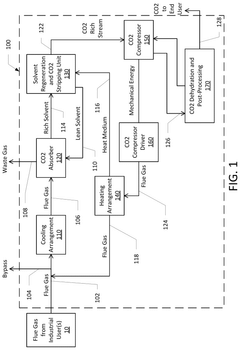
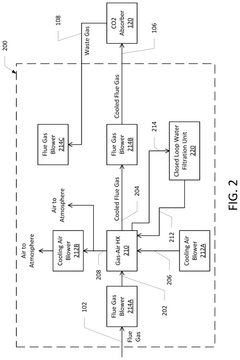
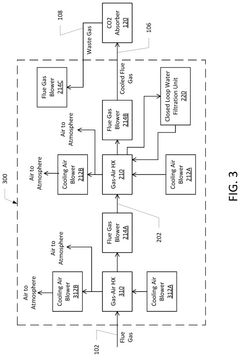
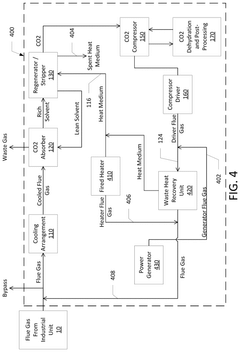
- The implementation of a carbon capture system that uses a gas-to-air heat exchanger to cool the flue gas stream before it enters the CO2 absorber, reducing the need for evaporative cooling water systems and minimizing water consumption.
Policy Frameworks for Carbon Capture Adoption
The global policy landscape for carbon capture technologies has evolved significantly over the past decade, reflecting growing recognition of their critical role in industrial decarbonization efforts. National governments have implemented various policy instruments to accelerate carbon capture adoption, with tax incentives emerging as a primary mechanism. The United States' 45Q tax credit program offers $50-85 per ton of CO₂ sequestered, while the EU's Innovation Fund provides substantial grants for demonstration projects. These financial incentives aim to bridge the commercial viability gap that has historically hindered widespread deployment.
Regulatory frameworks complement fiscal measures by establishing operational standards and compliance mechanisms. The EU Emissions Trading System (ETS) creates market-based incentives through carbon pricing, while several jurisdictions have implemented carbon intensity standards that indirectly favor carbon capture solutions. These regulatory approaches provide the certainty needed for long-term industrial investment decisions.
Public-private partnerships have emerged as effective policy vehicles for risk-sharing and knowledge transfer. The UK's CCUS Infrastructure Fund exemplifies this approach by supporting industrial clusters with shared carbon transport and storage infrastructure. Similarly, Norway's Longship project demonstrates how government backing can catalyze private investment in full-scale carbon capture value chains.
International cooperation frameworks facilitate technology transfer and harmonized standards development. The Clean Energy Ministerial's CCUS Initiative and Mission Innovation's Carbon Capture Challenge coordinate multinational efforts, while bilateral agreements between technology-leading and developing nations accelerate global deployment. These collaborative mechanisms help address the inherently transboundary nature of climate mitigation.
Policy effectiveness varies significantly across regions, with successful frameworks typically featuring policy stability, technology-neutral approaches, and integration with broader industrial strategies. Analysis of implementation challenges reveals common barriers including regulatory uncertainty, insufficient carbon pricing, and fragmented permitting processes. Leading jurisdictions have addressed these through streamlined regulatory pathways and coordinated policy portfolios that address both supply-push and demand-pull factors.
Future policy development trends point toward increased integration of carbon capture within broader climate policy frameworks, with growing emphasis on lifecycle carbon accounting and value chain approaches. The emergence of carbon border adjustment mechanisms may further incentivize industrial carbon capture adoption by internalizing carbon costs in international trade.
Regulatory frameworks complement fiscal measures by establishing operational standards and compliance mechanisms. The EU Emissions Trading System (ETS) creates market-based incentives through carbon pricing, while several jurisdictions have implemented carbon intensity standards that indirectly favor carbon capture solutions. These regulatory approaches provide the certainty needed for long-term industrial investment decisions.
Public-private partnerships have emerged as effective policy vehicles for risk-sharing and knowledge transfer. The UK's CCUS Infrastructure Fund exemplifies this approach by supporting industrial clusters with shared carbon transport and storage infrastructure. Similarly, Norway's Longship project demonstrates how government backing can catalyze private investment in full-scale carbon capture value chains.
International cooperation frameworks facilitate technology transfer and harmonized standards development. The Clean Energy Ministerial's CCUS Initiative and Mission Innovation's Carbon Capture Challenge coordinate multinational efforts, while bilateral agreements between technology-leading and developing nations accelerate global deployment. These collaborative mechanisms help address the inherently transboundary nature of climate mitigation.
Policy effectiveness varies significantly across regions, with successful frameworks typically featuring policy stability, technology-neutral approaches, and integration with broader industrial strategies. Analysis of implementation challenges reveals common barriers including regulatory uncertainty, insufficient carbon pricing, and fragmented permitting processes. Leading jurisdictions have addressed these through streamlined regulatory pathways and coordinated policy portfolios that address both supply-push and demand-pull factors.
Future policy development trends point toward increased integration of carbon capture within broader climate policy frameworks, with growing emphasis on lifecycle carbon accounting and value chain approaches. The emergence of carbon border adjustment mechanisms may further incentivize industrial carbon capture adoption by internalizing carbon costs in international trade.
Economic Viability of Carbon Capture Technologies
The economic viability of carbon capture technologies remains a critical factor determining their widespread adoption across industrial sectors. Current cost estimates for carbon capture range from $40 to $120 per ton of CO2 captured, with significant variations based on technology type, implementation scale, and industry application. Post-combustion capture technologies applied to existing facilities typically incur higher costs compared to pre-combustion or oxyfuel combustion systems integrated during facility design.
Capital expenditure represents a substantial barrier, with large-scale industrial carbon capture installations requiring investments between $400 million to $2 billion. These high upfront costs create significant financial hurdles, particularly for small and medium enterprises lacking access to substantial capital reserves or favorable financing terms.
Operational expenses further impact economic feasibility, with energy penalties ranging from 15% to 30% of a facility's output. This parasitic energy consumption directly affects production economics, as facilities must generate additional energy solely to power capture processes, effectively reducing net output and revenue potential.
Market mechanisms and policy frameworks significantly influence the economic equation. Carbon pricing schemes, currently ranging from $5 to $125 per ton globally, remain insufficient in many jurisdictions to offset capture costs. Tax incentives like the U.S. 45Q credit, offering up to $50 per ton for geological storage, have improved project economics but still leave gaps in many business cases.
Utilization pathways offer potential revenue streams to offset capture costs. Enhanced oil recovery currently provides $20-40 per ton of CO2, while emerging markets for carbon-neutral fuels and building materials show promise but remain nascent. The total addressable market for carbon utilization could reach $1 trillion by 2030, potentially transforming capture economics.
Economies of scale present significant opportunities for cost reduction. Analysis of learning curves suggests that doubling cumulative deployed capacity could reduce costs by 10-15%. Industry projections indicate potential cost reductions to $30-60 per ton by 2030 with sufficient deployment and continued technological advancement.
Regional economic factors create substantial variability in project viability. Labor costs, energy prices, regulatory compliance expenses, and proximity to storage or utilization infrastructure can shift project economics by 20-40%, explaining why identical technologies show dramatically different financial performance across global markets.
Capital expenditure represents a substantial barrier, with large-scale industrial carbon capture installations requiring investments between $400 million to $2 billion. These high upfront costs create significant financial hurdles, particularly for small and medium enterprises lacking access to substantial capital reserves or favorable financing terms.
Operational expenses further impact economic feasibility, with energy penalties ranging from 15% to 30% of a facility's output. This parasitic energy consumption directly affects production economics, as facilities must generate additional energy solely to power capture processes, effectively reducing net output and revenue potential.
Market mechanisms and policy frameworks significantly influence the economic equation. Carbon pricing schemes, currently ranging from $5 to $125 per ton globally, remain insufficient in many jurisdictions to offset capture costs. Tax incentives like the U.S. 45Q credit, offering up to $50 per ton for geological storage, have improved project economics but still leave gaps in many business cases.
Utilization pathways offer potential revenue streams to offset capture costs. Enhanced oil recovery currently provides $20-40 per ton of CO2, while emerging markets for carbon-neutral fuels and building materials show promise but remain nascent. The total addressable market for carbon utilization could reach $1 trillion by 2030, potentially transforming capture economics.
Economies of scale present significant opportunities for cost reduction. Analysis of learning curves suggests that doubling cumulative deployed capacity could reduce costs by 10-15%. Industry projections indicate potential cost reductions to $30-60 per ton by 2030 with sufficient deployment and continued technological advancement.
Regional economic factors create substantial variability in project viability. Labor costs, energy prices, regulatory compliance expenses, and proximity to storage or utilization infrastructure can shift project economics by 20-40%, explaining why identical technologies show dramatically different financial performance across global markets.
Unlock deeper insights with Patsnap Eureka Quick Research — get a full tech report to explore trends and direct your research. Try now!
Generate Your Research Report Instantly with AI Agent
Supercharge your innovation with Patsnap Eureka AI Agent Platform!