
Comparative Study: Plasma Versus Other Surface Treatments
OCT 14, 202510 MIN READ
Generate Your Research Report Instantly with AI Agent
Patsnap Eureka helps you evaluate technical feasibility & market potential.
Plasma Treatment Evolution and Objectives
Plasma surface treatment technology has evolved significantly over the past several decades, transforming from experimental laboratory techniques to essential industrial processes. The journey began in the 1960s with rudimentary plasma applications primarily focused on semiconductor manufacturing. By the 1980s, plasma treatment expanded into polymer modification, and the 1990s witnessed its integration into mainstream manufacturing processes across multiple industries.
The evolution of plasma technology has been characterized by continuous improvements in control precision, energy efficiency, and process stability. Early plasma systems required high vacuum conditions and consumed substantial energy, limiting their practical applications. Modern atmospheric plasma systems operate at ambient pressure, dramatically reducing operational costs and expanding potential use cases across industries from medical device manufacturing to automotive components.
Recent technological advancements have focused on developing selective treatment capabilities, allowing for precise modification of specific surface properties without affecting others. This granular control represents a significant leap forward from earlier generations of plasma technology that offered limited selectivity and often altered multiple surface characteristics simultaneously.
The primary objective of plasma treatment technology is to modify surface properties without altering bulk material characteristics. This includes enhancing adhesion properties, improving wettability, increasing surface energy, and creating functional groups on surfaces to enable subsequent chemical reactions or bonding. These modifications are achieved through mechanisms including surface cleaning, activation, etching, and deposition of thin films.
When comparing plasma to alternative surface treatment methods, several objectives drive technological development. These include reducing environmental impact by eliminating hazardous chemicals used in conventional wet chemical processes, improving treatment uniformity across complex geometries, enhancing process repeatability, and developing systems capable of treating heat-sensitive materials without thermal damage.
Another critical objective is integration capability with existing manufacturing lines, particularly for high-throughput production environments. This has led to the development of in-line plasma systems that can operate continuously rather than in batch processes, significantly improving production efficiency while maintaining treatment quality.
The future trajectory of plasma treatment technology aims to address several challenges, including further reduction of energy consumption, development of more compact systems for space-constrained manufacturing environments, and creation of intelligent plasma systems with real-time monitoring and adjustment capabilities. These advancements will likely position plasma treatment as an increasingly dominant surface modification technology compared to traditional chemical and mechanical alternatives.
The evolution of plasma technology has been characterized by continuous improvements in control precision, energy efficiency, and process stability. Early plasma systems required high vacuum conditions and consumed substantial energy, limiting their practical applications. Modern atmospheric plasma systems operate at ambient pressure, dramatically reducing operational costs and expanding potential use cases across industries from medical device manufacturing to automotive components.
Recent technological advancements have focused on developing selective treatment capabilities, allowing for precise modification of specific surface properties without affecting others. This granular control represents a significant leap forward from earlier generations of plasma technology that offered limited selectivity and often altered multiple surface characteristics simultaneously.
The primary objective of plasma treatment technology is to modify surface properties without altering bulk material characteristics. This includes enhancing adhesion properties, improving wettability, increasing surface energy, and creating functional groups on surfaces to enable subsequent chemical reactions or bonding. These modifications are achieved through mechanisms including surface cleaning, activation, etching, and deposition of thin films.
When comparing plasma to alternative surface treatment methods, several objectives drive technological development. These include reducing environmental impact by eliminating hazardous chemicals used in conventional wet chemical processes, improving treatment uniformity across complex geometries, enhancing process repeatability, and developing systems capable of treating heat-sensitive materials without thermal damage.
Another critical objective is integration capability with existing manufacturing lines, particularly for high-throughput production environments. This has led to the development of in-line plasma systems that can operate continuously rather than in batch processes, significantly improving production efficiency while maintaining treatment quality.
The future trajectory of plasma treatment technology aims to address several challenges, including further reduction of energy consumption, development of more compact systems for space-constrained manufacturing environments, and creation of intelligent plasma systems with real-time monitoring and adjustment capabilities. These advancements will likely position plasma treatment as an increasingly dominant surface modification technology compared to traditional chemical and mechanical alternatives.
Industrial Applications and Market Demand Analysis
The global surface treatment market has witnessed substantial growth, reaching approximately $10.5 billion in 2022, with plasma treatments accounting for nearly 18% of this market share. This segment is projected to grow at a CAGR of 6.8% through 2028, outpacing traditional chemical and mechanical treatment methods. The increasing demand for plasma surface treatments is primarily driven by industries requiring high-precision surface modifications with minimal environmental impact.
Automotive manufacturing represents one of the largest application sectors, where plasma treatments are extensively used for enhancing adhesion properties of polymeric components, improving paint adhesion, and creating hydrophobic or hydrophilic surfaces as needed. The sector's shift toward lightweight materials has further accelerated plasma treatment adoption, as these advanced materials often require specialized surface preparation techniques.
Electronics manufacturing constitutes another significant market segment, with plasma treatments being essential for semiconductor fabrication, printed circuit board preparation, and microelectronic component assembly. The miniaturization trend in electronics has intensified the need for precise, contamination-free surface modification methods that plasma uniquely provides compared to chemical alternatives.
Medical device manufacturing has emerged as the fastest-growing application sector, registering a 9.2% annual growth rate for plasma treatment implementation. The stringent regulatory requirements for biocompatibility, sterilization, and surface functionalization make plasma treatments particularly valuable in this industry. Unlike chemical treatments, plasma processes can modify surface properties without altering bulk material characteristics, a critical advantage for implantable devices.
Geographically, Asia-Pacific dominates the market with 42% share, followed by North America (28%) and Europe (24%). China and South Korea have become manufacturing hubs for plasma equipment, while specialized applications continue to be developed in Germany, the United States, and Japan.
Market analysis indicates a clear shift from conventional wet chemical processes toward dry plasma treatments, driven by environmental regulations limiting the use of hazardous chemicals and solvents. Companies are increasingly willing to invest in plasma technology despite higher initial capital costs, recognizing the long-term operational savings and quality improvements.
Customer demand patterns show growing interest in integrated inline plasma systems that can be seamlessly incorporated into existing production lines, reducing handling steps and increasing throughput. Additionally, there is rising demand for flexible plasma systems capable of treating multiple substrate types, reflecting the diversification of materials used in modern manufacturing.
Automotive manufacturing represents one of the largest application sectors, where plasma treatments are extensively used for enhancing adhesion properties of polymeric components, improving paint adhesion, and creating hydrophobic or hydrophilic surfaces as needed. The sector's shift toward lightweight materials has further accelerated plasma treatment adoption, as these advanced materials often require specialized surface preparation techniques.
Electronics manufacturing constitutes another significant market segment, with plasma treatments being essential for semiconductor fabrication, printed circuit board preparation, and microelectronic component assembly. The miniaturization trend in electronics has intensified the need for precise, contamination-free surface modification methods that plasma uniquely provides compared to chemical alternatives.
Medical device manufacturing has emerged as the fastest-growing application sector, registering a 9.2% annual growth rate for plasma treatment implementation. The stringent regulatory requirements for biocompatibility, sterilization, and surface functionalization make plasma treatments particularly valuable in this industry. Unlike chemical treatments, plasma processes can modify surface properties without altering bulk material characteristics, a critical advantage for implantable devices.
Geographically, Asia-Pacific dominates the market with 42% share, followed by North America (28%) and Europe (24%). China and South Korea have become manufacturing hubs for plasma equipment, while specialized applications continue to be developed in Germany, the United States, and Japan.
Market analysis indicates a clear shift from conventional wet chemical processes toward dry plasma treatments, driven by environmental regulations limiting the use of hazardous chemicals and solvents. Companies are increasingly willing to invest in plasma technology despite higher initial capital costs, recognizing the long-term operational savings and quality improvements.
Customer demand patterns show growing interest in integrated inline plasma systems that can be seamlessly incorporated into existing production lines, reducing handling steps and increasing throughput. Additionally, there is rising demand for flexible plasma systems capable of treating multiple substrate types, reflecting the diversification of materials used in modern manufacturing.
Current Plasma Technology Limitations and Challenges
Despite significant advancements in plasma technology for surface treatment applications, several critical limitations and challenges persist that hinder its broader industrial adoption. The primary technical constraint involves achieving uniform plasma distribution across complex three-dimensional surfaces. Current plasma systems struggle to maintain consistent treatment quality on intricate geometries, resulting in uneven surface modifications that compromise product performance and reliability.
Energy efficiency remains a significant challenge for plasma treatment systems. Conventional plasma generators typically convert only 10-30% of input power into useful plasma energy, with the remainder dissipated as heat. This inefficiency translates to higher operational costs and environmental impact compared to some alternative surface treatment methods, particularly for large-scale industrial applications.
Process control and reproducibility present ongoing difficulties in plasma technology implementation. Plasma behavior is influenced by numerous parameters including gas composition, pressure, power input, and treatment duration. The complex interdependence of these variables makes precise control challenging, often requiring sophisticated monitoring systems and expertise that smaller manufacturers may lack.
Material compatibility limitations restrict plasma treatment applicability across diverse substrates. While plasma processes work effectively on many polymers and metals, certain heat-sensitive materials can suffer degradation or structural damage during treatment. Additionally, some high-performance composites and specialized alloys exhibit unpredictable responses to plasma exposure, necessitating extensive case-by-case optimization.
Scalability issues affect plasma technology adoption in high-volume manufacturing environments. Current plasma systems face throughput constraints when processing large components or handling high production volumes. The batch-processing nature of many plasma treatments creates production bottlenecks that alternative continuous-flow surface modification methods can avoid.
Economic barriers further complicate plasma technology implementation. The initial capital investment for advanced plasma equipment remains substantially higher than conventional chemical treatment alternatives. Additionally, specialized maintenance requirements and the need for technical expertise increase the total cost of ownership, making the technology less accessible to small and medium enterprises.
Environmental and safety considerations also present challenges. While plasma treatments generally produce fewer hazardous wastes than chemical processes, they still generate potentially harmful byproducts depending on the process gases used. Proper ventilation systems and safety protocols are essential but add complexity and cost to implementation.
Energy efficiency remains a significant challenge for plasma treatment systems. Conventional plasma generators typically convert only 10-30% of input power into useful plasma energy, with the remainder dissipated as heat. This inefficiency translates to higher operational costs and environmental impact compared to some alternative surface treatment methods, particularly for large-scale industrial applications.
Process control and reproducibility present ongoing difficulties in plasma technology implementation. Plasma behavior is influenced by numerous parameters including gas composition, pressure, power input, and treatment duration. The complex interdependence of these variables makes precise control challenging, often requiring sophisticated monitoring systems and expertise that smaller manufacturers may lack.
Material compatibility limitations restrict plasma treatment applicability across diverse substrates. While plasma processes work effectively on many polymers and metals, certain heat-sensitive materials can suffer degradation or structural damage during treatment. Additionally, some high-performance composites and specialized alloys exhibit unpredictable responses to plasma exposure, necessitating extensive case-by-case optimization.
Scalability issues affect plasma technology adoption in high-volume manufacturing environments. Current plasma systems face throughput constraints when processing large components or handling high production volumes. The batch-processing nature of many plasma treatments creates production bottlenecks that alternative continuous-flow surface modification methods can avoid.
Economic barriers further complicate plasma technology implementation. The initial capital investment for advanced plasma equipment remains substantially higher than conventional chemical treatment alternatives. Additionally, specialized maintenance requirements and the need for technical expertise increase the total cost of ownership, making the technology less accessible to small and medium enterprises.
Environmental and safety considerations also present challenges. While plasma treatments generally produce fewer hazardous wastes than chemical processes, they still generate potentially harmful byproducts depending on the process gases used. Proper ventilation systems and safety protocols are essential but add complexity and cost to implementation.
Comparative Analysis of Surface Treatment Methods
01 Surface treatment methods for metal components
Various methods for treating metal surfaces to enhance their properties such as corrosion resistance, durability, and appearance. These treatments include chemical processes, mechanical finishing, and coating applications that modify the surface characteristics of metal components. The treatments can be applied to various industries including automotive, aerospace, and consumer products manufacturing.- Metal surface treatment technologies: Various methods for treating metal surfaces to enhance properties such as corrosion resistance, adhesion, and durability. These treatments include chemical processes, electroplating, anodizing, and application of protective coatings. The treatments modify the surface characteristics of metals to improve their performance in specific applications while maintaining the bulk properties of the material.
- Polymer and composite surface modifications: Techniques for modifying the surface properties of polymers and composite materials to enhance characteristics such as wettability, adhesion, and biocompatibility. These modifications include plasma treatment, chemical etching, UV irradiation, and application of functional coatings. Surface treatments can significantly alter the interaction of these materials with their environment without changing their bulk properties.
- Packaging and container surface treatments: Surface treatments specifically designed for packaging materials and containers to improve barrier properties, printability, and product protection. These treatments include corona discharge, flame treatment, and application of specialized coatings. The treatments enhance the functionality of packaging materials while ensuring compatibility with the contained products and compliance with safety regulations.
- Digital and computational surface treatment methods: Computer-aided techniques for surface treatment design, simulation, and optimization. These methods include 3D modeling, finite element analysis, and machine learning approaches to predict treatment outcomes. Digital tools enable more precise control over surface properties and can significantly reduce development time and costs for new surface treatment processes.
- Biomedical surface treatments: Specialized surface treatments for medical devices and implants to enhance biocompatibility, reduce infection risk, and improve integration with biological tissues. These treatments include antimicrobial coatings, protein-resistant surfaces, and bioactive modifications. Surface treatments in this field must meet strict regulatory requirements while providing the desired therapeutic or diagnostic functionality.
02 Coating technologies for surface protection
Advanced coating technologies that provide protective layers on various surfaces. These coatings can offer benefits such as increased wear resistance, chemical protection, and improved aesthetic qualities. The technologies include specialized polymers, composite materials, and multi-layer systems designed to adhere to different substrate materials while providing specific functional properties.Expand Specific Solutions03 Surface treatment processes for electronic components
Specialized surface treatment processes designed specifically for electronic components and semiconductor devices. These treatments enhance electrical conductivity, thermal management, and reliability of electronic systems. The processes include precision cleaning, plasma treatment, and selective metallization techniques that are critical for modern electronics manufacturing.Expand Specific Solutions04 Environmentally friendly surface treatment solutions
Surface treatment technologies that focus on environmental sustainability and reduced ecological impact. These solutions eliminate or minimize the use of hazardous chemicals, reduce energy consumption, and decrease waste generation. The approaches include water-based treatments, solvent-free processes, and biodegradable treatment agents that comply with increasingly stringent environmental regulations.Expand Specific Solutions05 Automated surface treatment systems
Automated and robotic systems designed for efficient and consistent surface treatment applications. These systems incorporate advanced control technologies, precision application equipment, and integrated quality monitoring capabilities. The automation solutions improve process repeatability, reduce labor costs, and enable high-volume production while maintaining strict quality standards across various industrial applications.Expand Specific Solutions
Leading Manufacturers and Research Institutions
The plasma surface treatment market is currently in a growth phase, with increasing adoption across industries like electronics, medical, and automotive. The market size is expanding due to plasma technology's versatility compared to traditional surface treatments, offering superior precision and environmental benefits. Technologically, the field shows varying maturity levels, with established players like Tokyo Electron and Nordson providing advanced commercial solutions, while research institutions (University of Sydney, Fraunhofer-Gesellschaft) continue pushing boundaries. Companies like Plasmapp and CINOGY represent specialized innovators developing niche applications. The competitive landscape features diversified industrial giants (Robert Bosch, Sekisui Chemical) alongside specialized plasma technology providers, creating a dynamic ecosystem where collaboration between academic research and industrial implementation drives continuous innovation.
Plasmapp Co. Ltd.
Technical Solution: Plasmapp has developed advanced atmospheric pressure plasma (APP) technology for surface treatment that operates at room temperature without vacuum requirements. Their proprietary STERWAVE® platform utilizes a unique electrode configuration to generate uniform plasma across large surface areas. The technology employs a combination of reactive oxygen and nitrogen species (RONS) that effectively modify surface properties while maintaining bulk material integrity. Plasmapp's systems can achieve hydrophilicity improvements with water contact angles below 10° on polymer surfaces, compared to untreated surfaces with angles of 70-90°. Their plasma treatment demonstrates superior penetration into complex 3D structures compared to conventional methods, reaching recessed areas with modification depths of up to 10μm. The company has particularly focused on medical device applications, where their plasma treatment has shown to improve biocompatibility while reducing bacterial adhesion by over 99% compared to untreated surfaces.
Strengths: Operates at atmospheric pressure eliminating vacuum chamber requirements; enables continuous processing for industrial scale applications; achieves uniform treatment across complex geometries; environmentally friendly with no chemical waste. Weaknesses: May require higher power consumption than some competing technologies; potential for thermal damage with certain sensitive materials; treatment effects may have limited durability on some substrates requiring additional stabilization steps.
CINOGY GmbH
Technical Solution: CINOGY GmbH has developed specialized cold atmospheric plasma (CAP) technology primarily focused on medical and biomedical applications as an alternative to conventional surface treatments. Their proprietary PlasmaDerm® technology utilizes dielectric barrier discharge to generate non-thermal plasma directly on treatment surfaces without vacuum requirements. CINOGY's comparative studies have demonstrated significant advantages over traditional antiseptic treatments, with their plasma technology achieving microbial reduction rates exceeding 99.999% against multi-resistant pathogens while preserving tissue viability. Their plasma systems generate a controlled mixture of reactive oxygen and nitrogen species (RONS) that effectively modify surface properties of medical devices, improving biocompatibility with cell adhesion rates increased by up to 300% compared to untreated surfaces. For polymer modification, CINOGY's technology achieves surface energy increases from typical 30-40 mJ/m² to over 72 mJ/m² within seconds of treatment, outperforming chemical primers that require minutes to hours of processing time. Their comparative analysis has shown that plasma treatment provides superior uniformity on complex 3D structures compared to wet chemical processes, with consistent surface modification even in recessed areas and microchannels down to 50μm diameter.
Strengths: Exceptional biocompatibility profile making it suitable for direct medical applications; compact and portable systems allowing point-of-use treatment; precise control over treatment parameters; environmentally friendly with no chemical waste or harmful byproducts. Weaknesses: More limited treatment area compared to some industrial-scale plasma systems; higher unit cost for treatment compared to mass chemical processing; potential for incomplete treatment of highly complex geometries; requires careful parameter optimization for different substrate materials.
Key Patents and Innovations in Plasma Technology
Method and apparatus for precision coating of molecules on the surfaces of materials and devices
PatentInactiveUS20070034156A1
Innovation
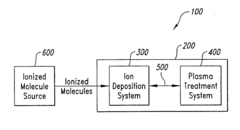
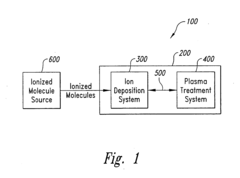
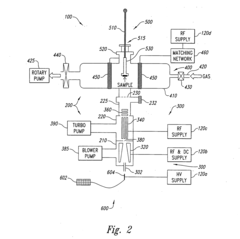
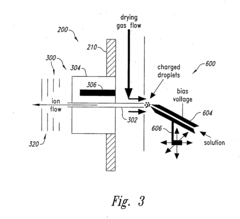
- A method and apparatus that combines a vacuum system with plasma treatment and ion deposition, utilizing ion guiding optics to control the deposition of ionized molecules onto a plasma-treated surface, allowing for precise control and patterning of ionized molecules like hyaluronic acid and enzymes.
Plasma surface treatment method, quartz member, plasma processing apparatus and plasma processing method
PatentInactiveUS20080025899A1
Innovation
- A plasma surface treatment method is applied to quartz members using a plasma with ion energy greater than 5.3 eV and electron temperature higher than 2 eV, under specific conditions, to suppress particle generation by removing the fragmental layer on the quartz surfaces.


Environmental Impact and Sustainability Considerations
The environmental impact of surface treatment technologies has become a critical consideration in industrial applications, with increasing regulatory pressure and corporate sustainability goals driving innovation in this field. Plasma treatment stands out among surface modification methods for its relatively low environmental footprint compared to conventional chemical processes. Unlike wet chemical treatments that often involve hazardous substances and generate significant waste streams, plasma processes typically operate using inert gases or air, substantially reducing the use of environmentally harmful chemicals.
Energy consumption represents a key sustainability metric when comparing surface treatment technologies. Traditional thermal or chemical treatments often require high temperatures or energy-intensive processes maintained over extended periods. In contrast, plasma treatments generally operate at ambient or near-ambient temperatures with significantly shorter processing times, resulting in lower overall energy consumption. However, it should be noted that the generation of plasma itself requires electrical energy, and the efficiency of this conversion varies considerably between different plasma system designs.
Water usage presents another important environmental consideration. Conventional surface treatments frequently consume substantial volumes of water for processing and rinsing steps. Plasma treatment, being a dry process, eliminates water consumption entirely during the treatment phase. This characteristic is particularly valuable in regions facing water scarcity challenges and for industries seeking to reduce their water footprint.
Waste generation and management differ dramatically between treatment methods. Chemical etching and cleaning processes produce contaminated wastewater requiring extensive treatment before discharge. Conversely, plasma treatments generate minimal waste products, with most byproducts being gaseous and relatively benign. The reduction in hazardous waste handling, treatment, and disposal represents both an environmental and economic advantage for plasma-based approaches.
Life cycle assessment (LCA) studies comparing plasma with alternative surface treatments have generally favored plasma technologies when considering comprehensive environmental impacts. These assessments typically evaluate factors including raw material extraction, manufacturing processes, use phase, and end-of-life scenarios. While plasma equipment may have higher initial embodied energy, the operational benefits throughout the product lifecycle often outweigh these initial environmental costs.
Emerging sustainability trends are further enhancing plasma treatment's environmental profile. Recent developments include plasma systems powered by renewable energy sources, more efficient power supplies, and process optimizations that reduce treatment times. Additionally, research into atmospheric pressure plasma technologies is eliminating the need for vacuum systems, further reducing energy requirements and expanding the potential applications of this environmentally preferable surface treatment option.
Energy consumption represents a key sustainability metric when comparing surface treatment technologies. Traditional thermal or chemical treatments often require high temperatures or energy-intensive processes maintained over extended periods. In contrast, plasma treatments generally operate at ambient or near-ambient temperatures with significantly shorter processing times, resulting in lower overall energy consumption. However, it should be noted that the generation of plasma itself requires electrical energy, and the efficiency of this conversion varies considerably between different plasma system designs.
Water usage presents another important environmental consideration. Conventional surface treatments frequently consume substantial volumes of water for processing and rinsing steps. Plasma treatment, being a dry process, eliminates water consumption entirely during the treatment phase. This characteristic is particularly valuable in regions facing water scarcity challenges and for industries seeking to reduce their water footprint.
Waste generation and management differ dramatically between treatment methods. Chemical etching and cleaning processes produce contaminated wastewater requiring extensive treatment before discharge. Conversely, plasma treatments generate minimal waste products, with most byproducts being gaseous and relatively benign. The reduction in hazardous waste handling, treatment, and disposal represents both an environmental and economic advantage for plasma-based approaches.
Life cycle assessment (LCA) studies comparing plasma with alternative surface treatments have generally favored plasma technologies when considering comprehensive environmental impacts. These assessments typically evaluate factors including raw material extraction, manufacturing processes, use phase, and end-of-life scenarios. While plasma equipment may have higher initial embodied energy, the operational benefits throughout the product lifecycle often outweigh these initial environmental costs.
Emerging sustainability trends are further enhancing plasma treatment's environmental profile. Recent developments include plasma systems powered by renewable energy sources, more efficient power supplies, and process optimizations that reduce treatment times. Additionally, research into atmospheric pressure plasma technologies is eliminating the need for vacuum systems, further reducing energy requirements and expanding the potential applications of this environmentally preferable surface treatment option.
Cost-Benefit Analysis of Different Treatment Methods
When evaluating surface treatment technologies, cost-benefit analysis provides critical insights for decision-making in manufacturing and product development. Plasma treatment, while offering superior performance in many applications, must be assessed against alternative methods through comprehensive economic analysis.
Initial investment costs vary significantly across treatment technologies. Plasma systems typically require higher capital expenditure ($50,000-$200,000) compared to chemical treatments ($10,000-$50,000) or mechanical abrasion systems ($5,000-$30,000). However, this higher initial investment must be considered alongside operational expenses and long-term returns.
Operational costs reveal plasma's competitive advantage in several scenarios. While plasma systems consume electricity (approximately $0.10-$0.30 per kWh), they eliminate the recurring expenses of chemical consumables ($2-$10 per liter) and waste disposal costs ($5-$20 per gallon) associated with wet chemical processes. Additionally, plasma treatments typically achieve 30-50% faster processing times than chemical alternatives, enhancing throughput capacity.
Environmental compliance represents another significant cost factor. Chemical treatments often require extensive waste management systems ($15,000-$50,000) and ongoing regulatory compliance costs ($5,000-$20,000 annually). Plasma systems, being environmentally cleaner, substantially reduce these expenses, with some manufacturers reporting 60-80% reduction in environmental compliance costs.
Product quality improvements directly impact revenue potential. Studies across industries indicate plasma-treated products demonstrate 15-25% higher bond strength, 20-30% improved coating adhesion, and 10-15% enhanced product durability compared to mechanical or chemical alternatives. These quality improvements translate to reduced warranty claims and higher customer satisfaction, with potential revenue increases of 5-15%.
Process integration efficiency varies between technologies. Plasma systems offer superior automation compatibility and can be seamlessly integrated into production lines, reducing labor costs by 20-40% compared to manual chemical application processes. This integration advantage becomes particularly significant in high-volume manufacturing environments.
Return on investment (ROI) calculations indicate plasma treatment systems typically achieve breakeven within 12-24 months in medium to high-volume applications, compared to 6-12 months for chemical systems. However, the extended equipment lifespan (8-12 years for plasma versus 3-5 years for chemical systems) and lower maintenance requirements ($2,000-$5,000 annually versus $5,000-$15,000) favor plasma in long-term cost analyses.
Industry-specific considerations reveal plasma treatments offer particularly favorable cost-benefit ratios in medical device manufacturing, aerospace components, and advanced electronics, where quality requirements justify premium treatment methods and regulatory compliance costs are especially significant.
Initial investment costs vary significantly across treatment technologies. Plasma systems typically require higher capital expenditure ($50,000-$200,000) compared to chemical treatments ($10,000-$50,000) or mechanical abrasion systems ($5,000-$30,000). However, this higher initial investment must be considered alongside operational expenses and long-term returns.
Operational costs reveal plasma's competitive advantage in several scenarios. While plasma systems consume electricity (approximately $0.10-$0.30 per kWh), they eliminate the recurring expenses of chemical consumables ($2-$10 per liter) and waste disposal costs ($5-$20 per gallon) associated with wet chemical processes. Additionally, plasma treatments typically achieve 30-50% faster processing times than chemical alternatives, enhancing throughput capacity.
Environmental compliance represents another significant cost factor. Chemical treatments often require extensive waste management systems ($15,000-$50,000) and ongoing regulatory compliance costs ($5,000-$20,000 annually). Plasma systems, being environmentally cleaner, substantially reduce these expenses, with some manufacturers reporting 60-80% reduction in environmental compliance costs.
Product quality improvements directly impact revenue potential. Studies across industries indicate plasma-treated products demonstrate 15-25% higher bond strength, 20-30% improved coating adhesion, and 10-15% enhanced product durability compared to mechanical or chemical alternatives. These quality improvements translate to reduced warranty claims and higher customer satisfaction, with potential revenue increases of 5-15%.
Process integration efficiency varies between technologies. Plasma systems offer superior automation compatibility and can be seamlessly integrated into production lines, reducing labor costs by 20-40% compared to manual chemical application processes. This integration advantage becomes particularly significant in high-volume manufacturing environments.
Return on investment (ROI) calculations indicate plasma treatment systems typically achieve breakeven within 12-24 months in medium to high-volume applications, compared to 6-12 months for chemical systems. However, the extended equipment lifespan (8-12 years for plasma versus 3-5 years for chemical systems) and lower maintenance requirements ($2,000-$5,000 annually versus $5,000-$15,000) favor plasma in long-term cost analyses.
Industry-specific considerations reveal plasma treatments offer particularly favorable cost-benefit ratios in medical device manufacturing, aerospace components, and advanced electronics, where quality requirements justify premium treatment methods and regulatory compliance costs are especially significant.
Unlock deeper insights with Patsnap Eureka Quick Research — get a full tech report to explore trends and direct your research. Try now!
Generate Your Research Report Instantly with AI Agent
Supercharge your innovation with Patsnap Eureka AI Agent Platform!