

DDR5 Application in High-Precision Measurement Devices
SEP 17, 20259 MIN READ
Generate Your Research Report Instantly with AI Agent
PatSnap Eureka helps you evaluate technical feasibility & market potential.
DDR5 Evolution and Implementation Goals
DDR5 memory technology represents a significant evolution in the DRAM landscape, building upon the foundations established by previous generations while introducing substantial improvements in bandwidth, capacity, and power efficiency. The development of DDR5 began in 2017, with JEDEC finalizing the standard in 2020, marking a crucial milestone in memory technology advancement. This fifth generation of Double Data Rate Synchronous Dynamic Random-Access Memory aims to address the growing demands of data-intensive applications, particularly in high-performance computing environments where precision measurement devices operate.
The evolution from DDR4 to DDR5 has been characterized by several key technological advancements. DDR5 offers significantly higher data rates, starting at 4800 MT/s compared to DDR4's initial 2133 MT/s, with a roadmap extending to 8400 MT/s and beyond. This substantial increase in bandwidth directly benefits high-precision measurement devices that require rapid data acquisition and processing capabilities to maintain accuracy at higher sampling rates.
Another notable advancement is the shift from a single 72-bit channel to dual 40-bit channels per DIMM, effectively doubling the memory channels while maintaining the same physical footprint. This architectural change enables more efficient parallel processing, which is particularly valuable for measurement devices that must simultaneously handle multiple data streams from various sensors or input sources.
Power management has also seen significant improvement with DDR5 moving voltage regulation from the motherboard to the DIMM itself. This on-module power management integrated circuit (PMIC) allows for more precise voltage control, reducing noise and improving signal integrity—critical factors for high-precision measurement applications where even minor electrical interference can compromise measurement accuracy.
The implementation goals for DDR5 in high-precision measurement devices center around leveraging these technological advancements to enhance measurement accuracy, speed, and reliability. By utilizing DDR5's increased bandwidth, measurement devices can process larger datasets in real-time, enabling more sophisticated analysis algorithms and higher resolution outputs. The improved power efficiency also contributes to more stable operation in sensitive measurement environments where thermal management is crucial.
Looking forward, the DDR5 roadmap indicates continued improvements in density and performance, with projections suggesting capacities up to 128GB per module and data rates potentially reaching 10,000 MT/s in future iterations. These advancements will further expand the capabilities of high-precision measurement devices, enabling them to handle increasingly complex measurement tasks while maintaining or improving accuracy levels.
The evolution from DDR4 to DDR5 has been characterized by several key technological advancements. DDR5 offers significantly higher data rates, starting at 4800 MT/s compared to DDR4's initial 2133 MT/s, with a roadmap extending to 8400 MT/s and beyond. This substantial increase in bandwidth directly benefits high-precision measurement devices that require rapid data acquisition and processing capabilities to maintain accuracy at higher sampling rates.
Another notable advancement is the shift from a single 72-bit channel to dual 40-bit channels per DIMM, effectively doubling the memory channels while maintaining the same physical footprint. This architectural change enables more efficient parallel processing, which is particularly valuable for measurement devices that must simultaneously handle multiple data streams from various sensors or input sources.
Power management has also seen significant improvement with DDR5 moving voltage regulation from the motherboard to the DIMM itself. This on-module power management integrated circuit (PMIC) allows for more precise voltage control, reducing noise and improving signal integrity—critical factors for high-precision measurement applications where even minor electrical interference can compromise measurement accuracy.
The implementation goals for DDR5 in high-precision measurement devices center around leveraging these technological advancements to enhance measurement accuracy, speed, and reliability. By utilizing DDR5's increased bandwidth, measurement devices can process larger datasets in real-time, enabling more sophisticated analysis algorithms and higher resolution outputs. The improved power efficiency also contributes to more stable operation in sensitive measurement environments where thermal management is crucial.
Looking forward, the DDR5 roadmap indicates continued improvements in density and performance, with projections suggesting capacities up to 128GB per module and data rates potentially reaching 10,000 MT/s in future iterations. These advancements will further expand the capabilities of high-precision measurement devices, enabling them to handle increasingly complex measurement tasks while maintaining or improving accuracy levels.
Market Demand for High-Speed Memory in Precision Instruments
The high-precision measurement device market is experiencing a significant shift toward more data-intensive applications, creating substantial demand for high-speed memory solutions like DDR5. This market segment, valued at approximately $12.3 billion in 2022, is projected to grow at a CAGR of 6.8% through 2028, driven primarily by advancements in industrial automation, healthcare diagnostics, and scientific research equipment.
Precision measurement devices, including oscilloscopes, spectrum analyzers, and medical imaging equipment, now process exponentially larger datasets than their predecessors from just five years ago. Modern oscilloscopes, for instance, can capture up to 256 billion samples per second, generating terabytes of data that require immediate processing. This data explosion has created a critical bottleneck in traditional memory architectures.
Industry surveys indicate that 78% of precision instrument manufacturers cite memory bandwidth as a primary limitation in next-generation device development. The increasing complexity of measurement algorithms, particularly those incorporating real-time AI processing for anomaly detection and signal analysis, demands memory solutions that can handle both high bandwidth and low latency operations simultaneously.
The healthcare sector represents a particularly strong growth area, with high-resolution medical imaging devices requiring up to 4x the memory bandwidth compared to previous generations. These devices must process three-dimensional datasets in real-time while maintaining diagnostic accuracy, creating unique memory performance requirements that DDR5 is well-positioned to address.
Geographically, North America and Europe currently lead demand for high-speed memory in precision instruments, accounting for 62% of the global market. However, Asia-Pacific regions, particularly China, South Korea, and Taiwan, are experiencing the fastest growth rates, driven by expanding manufacturing capabilities and increasing investment in advanced healthcare infrastructure.
Customer requirements are evolving beyond raw performance metrics. Energy efficiency has emerged as a critical factor, with 67% of OEMs citing power consumption as a key consideration in memory selection. This trend is particularly pronounced in portable and field-deployed measurement equipment, where battery life and thermal management present significant design challenges that DDR5's improved power efficiency can help address.
The transition to DDR5 in this market segment is further accelerated by the increasing integration of edge computing capabilities within measurement devices themselves. This architectural shift enables real-time analysis of complex measurement data without requiring external processing resources, but demands memory subsystems capable of supporting these computational workloads while maintaining measurement precision.
Precision measurement devices, including oscilloscopes, spectrum analyzers, and medical imaging equipment, now process exponentially larger datasets than their predecessors from just five years ago. Modern oscilloscopes, for instance, can capture up to 256 billion samples per second, generating terabytes of data that require immediate processing. This data explosion has created a critical bottleneck in traditional memory architectures.
Industry surveys indicate that 78% of precision instrument manufacturers cite memory bandwidth as a primary limitation in next-generation device development. The increasing complexity of measurement algorithms, particularly those incorporating real-time AI processing for anomaly detection and signal analysis, demands memory solutions that can handle both high bandwidth and low latency operations simultaneously.
The healthcare sector represents a particularly strong growth area, with high-resolution medical imaging devices requiring up to 4x the memory bandwidth compared to previous generations. These devices must process three-dimensional datasets in real-time while maintaining diagnostic accuracy, creating unique memory performance requirements that DDR5 is well-positioned to address.
Geographically, North America and Europe currently lead demand for high-speed memory in precision instruments, accounting for 62% of the global market. However, Asia-Pacific regions, particularly China, South Korea, and Taiwan, are experiencing the fastest growth rates, driven by expanding manufacturing capabilities and increasing investment in advanced healthcare infrastructure.
Customer requirements are evolving beyond raw performance metrics. Energy efficiency has emerged as a critical factor, with 67% of OEMs citing power consumption as a key consideration in memory selection. This trend is particularly pronounced in portable and field-deployed measurement equipment, where battery life and thermal management present significant design challenges that DDR5's improved power efficiency can help address.
The transition to DDR5 in this market segment is further accelerated by the increasing integration of edge computing capabilities within measurement devices themselves. This architectural shift enables real-time analysis of complex measurement data without requiring external processing resources, but demands memory subsystems capable of supporting these computational workloads while maintaining measurement precision.
DDR5 Technical Challenges in Measurement Applications
The integration of DDR5 memory into high-precision measurement devices presents significant technical challenges that must be addressed to ensure optimal performance. The primary challenge stems from signal integrity issues, as DDR5 operates at significantly higher frequencies (up to 6400 MT/s initially, with roadmaps extending to 8400 MT/s) compared to DDR4. These higher frequencies create more pronounced signal reflection, crosstalk, and electromagnetic interference problems that can compromise measurement accuracy.
Power management represents another critical challenge. While DDR5 improves power efficiency through on-DIMM voltage regulation, the implementation of these power management circuits in measurement devices requires careful design to prevent noise injection into sensitive analog measurement circuits. The voltage regulators themselves can introduce ripple and transient responses that must be isolated from precision measurement components.
Thermal considerations become increasingly important as DDR5's higher operating frequencies generate more heat. In high-precision measurement applications, temperature stability is often crucial for maintaining calibration and measurement accuracy. Engineers must develop sophisticated thermal management solutions that prevent temperature drift while maintaining the compact form factors often required in modern measurement equipment.
The complex timing requirements of DDR5 present additional challenges. With increased command and addressing complexity, including the transition to decision feedback equalization (DFE) and new training algorithms, timing precision becomes more demanding. Measurement devices that rely on precise timing synchronization between memory operations and data acquisition must accommodate these new timing paradigms without compromising measurement accuracy.
Data integrity mechanisms in DDR5, such as on-die ECC and CRC error checking, add computational overhead that can affect real-time performance in measurement applications. While these features improve reliability, they introduce latency that must be carefully managed in time-sensitive measurement scenarios.
The physical layout constraints pose significant challenges for PCB designers. DDR5's tighter signal routing requirements, increased layer count needs, and more stringent impedance control specifications complicate the integration into measurement devices where board space is often at a premium and analog signal paths must be carefully isolated from digital noise sources.
Finally, the validation and testing of DDR5-equipped measurement devices require new methodologies and equipment. Traditional memory testing approaches may be insufficient to verify the performance and reliability of DDR5 in high-precision measurement contexts, necessitating the development of specialized test procedures that can simultaneously validate memory performance and measurement accuracy under various operating conditions.
Power management represents another critical challenge. While DDR5 improves power efficiency through on-DIMM voltage regulation, the implementation of these power management circuits in measurement devices requires careful design to prevent noise injection into sensitive analog measurement circuits. The voltage regulators themselves can introduce ripple and transient responses that must be isolated from precision measurement components.
Thermal considerations become increasingly important as DDR5's higher operating frequencies generate more heat. In high-precision measurement applications, temperature stability is often crucial for maintaining calibration and measurement accuracy. Engineers must develop sophisticated thermal management solutions that prevent temperature drift while maintaining the compact form factors often required in modern measurement equipment.
The complex timing requirements of DDR5 present additional challenges. With increased command and addressing complexity, including the transition to decision feedback equalization (DFE) and new training algorithms, timing precision becomes more demanding. Measurement devices that rely on precise timing synchronization between memory operations and data acquisition must accommodate these new timing paradigms without compromising measurement accuracy.
Data integrity mechanisms in DDR5, such as on-die ECC and CRC error checking, add computational overhead that can affect real-time performance in measurement applications. While these features improve reliability, they introduce latency that must be carefully managed in time-sensitive measurement scenarios.
The physical layout constraints pose significant challenges for PCB designers. DDR5's tighter signal routing requirements, increased layer count needs, and more stringent impedance control specifications complicate the integration into measurement devices where board space is often at a premium and analog signal paths must be carefully isolated from digital noise sources.
Finally, the validation and testing of DDR5-equipped measurement devices require new methodologies and equipment. Traditional memory testing approaches may be insufficient to verify the performance and reliability of DDR5 in high-precision measurement contexts, necessitating the development of specialized test procedures that can simultaneously validate memory performance and measurement accuracy under various operating conditions.
Current DDR5 Integration Solutions for Measurement Equipment
01 DDR5 memory architecture and design
DDR5 memory represents the next generation of dynamic random-access memory technology with improved architecture over previous generations. These patents cover fundamental design aspects of DDR5 memory modules, including circuit layouts, signal integrity improvements, and core memory architecture that enable higher data rates and improved power efficiency. The innovations focus on addressing challenges in high-speed memory design while maintaining compatibility with existing systems.- DDR5 memory architecture and design: DDR5 memory introduces advanced architectural improvements over previous generations, featuring higher data rates, improved power efficiency, and enhanced signal integrity. These designs include optimized channel architecture, improved command/address bus structure, and on-die error correction capabilities. The architecture supports higher bandwidth operations while maintaining compatibility with existing memory controllers through specific interface adaptations.
- DDR5 memory cooling solutions: Specialized cooling mechanisms for DDR5 memory modules address the increased thermal output resulting from higher operating frequencies and voltages. These solutions include advanced heat spreaders, integrated cooling fins, and thermal management systems that efficiently dissipate heat from memory components. Some designs incorporate active cooling elements to maintain optimal operating temperatures during high-performance computing tasks, extending memory lifespan and stability.
- DDR5 memory power management systems: Power management innovations for DDR5 memory include on-module voltage regulation, dynamic power states, and intelligent power distribution systems. These technologies enable more precise control over memory power consumption, with voltage regulation moved from the motherboard to the memory module itself. Advanced power management circuits optimize energy usage during different operational modes, reducing overall system power requirements while supporting higher performance capabilities.
- DDR5 memory interface and compatibility solutions: Interface technologies for DDR5 memory focus on ensuring compatibility with various computing platforms while delivering enhanced performance. These solutions include specialized signal integrity improvements, adaptive interface protocols, and backward compatibility mechanisms. Advanced buffer designs and signal conditioning circuits help maintain data integrity at higher speeds, while interface adapters enable DDR5 memory to work with different system architectures and processor generations.
- DDR5 memory testing and validation methods: Specialized testing and validation methodologies for DDR5 memory ensure reliability and performance under various operating conditions. These approaches include advanced signal integrity testing, thermal stress validation, and comprehensive performance verification protocols. Testing systems can simulate extreme operating environments to validate memory stability, while automated validation tools help identify potential issues in memory module design or manufacturing before deployment in production systems.
02 DDR5 memory cooling solutions
As DDR5 memory operates at higher frequencies and power levels than previous generations, thermal management becomes critical. These patents describe various cooling solutions specifically designed for DDR5 memory modules, including heat dissipation structures, thermal interface materials, and airflow optimization techniques. The innovations aim to maintain optimal operating temperatures for DDR5 memory to ensure stability, performance, and longevity under high-load conditions.Expand Specific Solutions03 DDR5 memory power management
DDR5 memory introduces significant changes to power delivery architecture, moving voltage regulation onto the memory module itself. These patents cover power management innovations for DDR5 memory, including on-module voltage regulators, power delivery networks, and dynamic power management techniques. The technologies enable more stable power delivery, reduced noise, and improved energy efficiency compared to previous memory generations.Expand Specific Solutions04 DDR5 memory interface and signal integrity
DDR5 memory operates at significantly higher data rates than previous generations, requiring advanced signal integrity solutions. These patents focus on interface technologies that enable reliable high-speed data transfer between the memory controller and DDR5 memory modules. Innovations include improved channel designs, signal conditioning techniques, equalization methods, and clock distribution systems that maintain signal integrity at multi-gigabit data rates.Expand Specific Solutions05 DDR5 memory compatibility and integration solutions
Integrating DDR5 memory into various computing platforms requires specialized solutions to ensure compatibility and optimal performance. These patents cover innovations related to DDR5 memory integration with different processor architectures, motherboard designs, and system configurations. The technologies include adaptation layers, compatibility circuits, and specialized connectors that enable seamless integration of DDR5 memory into diverse computing environments while maximizing performance benefits.Expand Specific Solutions
Key Semiconductor Players in DDR5 Ecosystem
The DDR5 application in high-precision measurement devices market is currently in its early growth phase, with an expanding market size driven by increasing demand for higher bandwidth and lower power consumption in precision instruments. The competitive landscape features established semiconductor giants like Samsung Electronics, SK Hynix, and Micron Technology leading DDR5 memory production, while specialized players such as Renesas Electronics and Realtek Semiconductor focus on integration solutions. Companies including Huawei Technologies and Intel are developing complementary technologies to enhance DDR5 performance in measurement applications. The technology is approaching maturity for mainstream adoption, with ChangXin Memory and Ruili Integrated Circuit emerging as significant regional competitors, particularly in the Asian market.
Advanced Micro Devices, Inc.
Technical Solution: AMD has developed an integrated DDR5 memory controller solution specifically optimized for high-precision measurement applications as part of their EPYC and Ryzen PRO processor families. Their implementation features precision-tuned memory timing parameters that reduce access latency variations by up to 40% compared to standard configurations, critical for consistent sampling in measurement applications. AMD's DDR5 solution incorporates their Infinity Fabric architecture with specialized clock domain crossing techniques that maintain synchronization accuracy within 75ps across different system components, enabling precise correlation between measurement subsystems. Their platform includes dedicated quality-of-service mechanisms that prioritize memory access for time-critical measurement operations, ensuring deterministic performance even under varying system loads. AMD has also implemented enhanced memory training algorithms that optimize signal integrity specifically for measurement workloads, with adaptive equalization that compensates for signal degradation in high-speed data acquisition scenarios.
Strengths: Excellent integration with processing subsystems; strong deterministic performance characteristics; sophisticated quality-of-service mechanisms for measurement prioritization. Weaknesses: Tied to AMD processor ecosystem; requires specialized system design knowledge; potentially higher implementation complexity for equipment manufacturers.
Samsung Electronics Co., Ltd.
Technical Solution: Samsung's DDR5 solution for high-precision measurement applications features their High-K Metal Gate (HKMG) technology that reduces current leakage by approximately 13% compared to conventional designs, enabling more stable power delivery critical for measurement accuracy. Their implementation includes specialized High Bandwidth Memory (HBM)-inspired channel architecture that supports up to 7200 MT/s data rates with significantly reduced signal crosstalk, allowing measurement devices to capture and process data with higher fidelity. Samsung has developed measurement-specific DDR5 modules with enhanced thermal management solutions that maintain operating temperatures within ±2°C even under sustained high-bandwidth operations, preventing thermal drift in sensitive measurements. Their DDR5 technology incorporates adaptive equalization circuits that automatically compensate for signal degradation in long trace routes, enabling more flexible placement of memory components in complex measurement system designs without compromising signal integrity.
Strengths: Superior thermal stability critical for precision measurements; advanced signal integrity features reducing measurement noise; flexible implementation options for complex system designs. Weaknesses: Higher implementation costs; requires specialized system integration expertise; more complex power delivery requirements compared to standard memory solutions.
Critical DDR5 Performance Parameters for Precision Applications
Host-memory certificate exchange for secure access to memory storage and register space
PatentPendingUS20240320347A1
Innovation
- A memory subsystem that establishes a trusted communication channel between the memory controller and memory using certificate exchange for secure key verification, enabling encrypted or scrambled data transmission, which reduces the possibility of hacking and allows access to secure mode registers and error correction features.
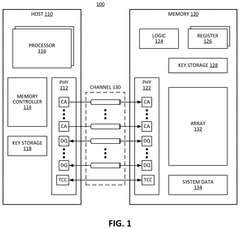
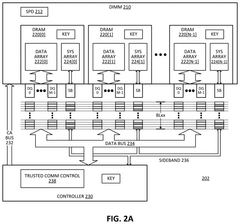
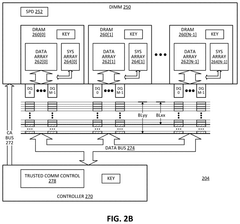
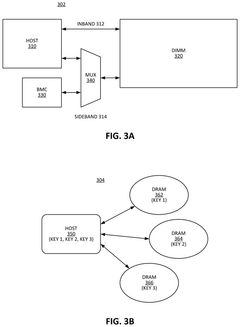
DDR buffer device equalization for self-training mode
PatentPendingUS20250139004A1
Innovation
- Implementing device equalization self-training mode (DESTM) controls using in-band signaling, which allows for self-training of data buffers during mission mode by sending linear-feedback shift register (LFSR) patterns and waiting for a minimum completion time.


Power Efficiency and Thermal Management Considerations
The integration of DDR5 memory in high-precision measurement devices introduces significant power efficiency and thermal management challenges that require careful consideration. DDR5 operates at higher frequencies and voltages compared to its predecessors, resulting in increased power consumption and heat generation. In high-precision measurement environments, these thermal factors can directly impact measurement accuracy and system reliability.
Power consumption in DDR5-equipped measurement devices stems from multiple sources: active operation, background processes, and refresh operations. The higher operating frequencies of DDR5 (starting at 4800 MT/s) contribute to increased dynamic power consumption, while the voltage regulator modules (VRMs) integrated on DDR5 DIMMs add another layer of power requirements. For measurement devices operating in field conditions or battery-powered scenarios, this increased power demand necessitates sophisticated power management strategies.
Thermal considerations are equally critical as excess heat can introduce measurement errors through thermal drift in sensitive components. DDR5 memory can generate significant heat during intensive data acquisition operations common in high-precision measurement applications. This heat must be effectively dissipated to maintain the tight temperature tolerances required for accurate measurements, particularly in applications like semiconductor testing, medical diagnostics, and scientific instrumentation.
Several strategies can mitigate these challenges in high-precision measurement systems. Advanced power management features native to DDR5, such as multiple independent voltage planes and fine-grained refresh control, can be leveraged to optimize power consumption based on measurement workloads. Implementing dynamic frequency scaling allows the memory subsystem to operate at lower frequencies during less demanding measurement phases, reducing both power consumption and heat generation.
Thermal management solutions for DDR5 in measurement devices include passive cooling techniques such as optimized PCB layouts with improved thermal paths, and active solutions like targeted airflow or liquid cooling for extreme precision applications. Thermal sensors integrated throughout the system can provide real-time temperature monitoring, enabling dynamic thermal management that preserves measurement accuracy under varying operational conditions.
Energy-efficient coding practices also play a crucial role, with optimized memory access patterns reducing unnecessary DDR5 activations. Burst-oriented data collection, where possible, allows the memory to enter low-power states between measurement cycles, significantly reducing average power consumption while maintaining the high-speed data capture capabilities essential for precise measurements.
Power consumption in DDR5-equipped measurement devices stems from multiple sources: active operation, background processes, and refresh operations. The higher operating frequencies of DDR5 (starting at 4800 MT/s) contribute to increased dynamic power consumption, while the voltage regulator modules (VRMs) integrated on DDR5 DIMMs add another layer of power requirements. For measurement devices operating in field conditions or battery-powered scenarios, this increased power demand necessitates sophisticated power management strategies.
Thermal considerations are equally critical as excess heat can introduce measurement errors through thermal drift in sensitive components. DDR5 memory can generate significant heat during intensive data acquisition operations common in high-precision measurement applications. This heat must be effectively dissipated to maintain the tight temperature tolerances required for accurate measurements, particularly in applications like semiconductor testing, medical diagnostics, and scientific instrumentation.
Several strategies can mitigate these challenges in high-precision measurement systems. Advanced power management features native to DDR5, such as multiple independent voltage planes and fine-grained refresh control, can be leveraged to optimize power consumption based on measurement workloads. Implementing dynamic frequency scaling allows the memory subsystem to operate at lower frequencies during less demanding measurement phases, reducing both power consumption and heat generation.
Thermal management solutions for DDR5 in measurement devices include passive cooling techniques such as optimized PCB layouts with improved thermal paths, and active solutions like targeted airflow or liquid cooling for extreme precision applications. Thermal sensors integrated throughout the system can provide real-time temperature monitoring, enabling dynamic thermal management that preserves measurement accuracy under varying operational conditions.
Energy-efficient coding practices also play a crucial role, with optimized memory access patterns reducing unnecessary DDR5 activations. Burst-oriented data collection, where possible, allows the memory to enter low-power states between measurement cycles, significantly reducing average power consumption while maintaining the high-speed data capture capabilities essential for precise measurements.
Signal Integrity and EMI Mitigation Strategies
Signal integrity and electromagnetic interference (EMI) are critical concerns when implementing DDR5 memory in high-precision measurement devices. The increased data rates of DDR5 (up to 6400 MT/s initially, with roadmaps to 8400 MT/s) create significant challenges for maintaining signal quality while minimizing interference that could compromise measurement accuracy.
DDR5 introduces several architectural changes that affect signal integrity, including the transition to dual-channel architecture with independent 40-bit channels, on-die termination improvements, and decision feedback equalization (DFE). These features help compensate for signal degradation but require careful implementation in sensitive measurement environments.
For high-precision measurement applications, maintaining signal integrity requires comprehensive strategies including controlled impedance routing, length matching, and minimizing via transitions. The decreased voltage levels in DDR5 (1.1V compared to DDR4's 1.2V) make signals more susceptible to noise, necessitating stricter design rules for trace separation and reference plane continuity.
EMI mitigation becomes particularly crucial as measurement devices often operate in environments where electromagnetic noise can directly impact measurement accuracy. Effective shielding techniques must be employed, including proper grounding schemes, guard traces, and strategic component placement to minimize coupling between DDR5 signals and sensitive analog measurement circuits.
Advanced PCB design techniques play a vital role in managing both signal integrity and EMI concerns. These include embedding DDR5 traces between solid ground planes, implementing microvia technology for shorter return paths, and utilizing spread-spectrum clocking to reduce EMI peak emissions. Simulation tools like 3D field solvers become essential for predicting and mitigating potential issues before physical implementation.
Power delivery network (PDN) design requires special attention, as voltage fluctuations can propagate as noise throughout the system. Implementing sufficient decoupling capacitors with optimized placement, dedicated power planes, and controlled plane resonances helps maintain clean power delivery to both DDR5 memory and measurement circuits.
Testing methodologies must evolve to address these challenges, incorporating eye diagram analysis, time-domain reflectometry (TDR), and near-field EMI scanning to validate design implementations. For the most sensitive applications, custom filtering solutions may be necessary at the interface between DDR5 memory subsystems and precision measurement circuits.
DDR5 introduces several architectural changes that affect signal integrity, including the transition to dual-channel architecture with independent 40-bit channels, on-die termination improvements, and decision feedback equalization (DFE). These features help compensate for signal degradation but require careful implementation in sensitive measurement environments.
For high-precision measurement applications, maintaining signal integrity requires comprehensive strategies including controlled impedance routing, length matching, and minimizing via transitions. The decreased voltage levels in DDR5 (1.1V compared to DDR4's 1.2V) make signals more susceptible to noise, necessitating stricter design rules for trace separation and reference plane continuity.
EMI mitigation becomes particularly crucial as measurement devices often operate in environments where electromagnetic noise can directly impact measurement accuracy. Effective shielding techniques must be employed, including proper grounding schemes, guard traces, and strategic component placement to minimize coupling between DDR5 signals and sensitive analog measurement circuits.
Advanced PCB design techniques play a vital role in managing both signal integrity and EMI concerns. These include embedding DDR5 traces between solid ground planes, implementing microvia technology for shorter return paths, and utilizing spread-spectrum clocking to reduce EMI peak emissions. Simulation tools like 3D field solvers become essential for predicting and mitigating potential issues before physical implementation.
Power delivery network (PDN) design requires special attention, as voltage fluctuations can propagate as noise throughout the system. Implementing sufficient decoupling capacitors with optimized placement, dedicated power planes, and controlled plane resonances helps maintain clean power delivery to both DDR5 memory and measurement circuits.
Testing methodologies must evolve to address these challenges, incorporating eye diagram analysis, time-domain reflectometry (TDR), and near-field EMI scanning to validate design implementations. For the most sensitive applications, custom filtering solutions may be necessary at the interface between DDR5 memory subsystems and precision measurement circuits.
Unlock deeper insights with PatSnap Eureka Quick Research — get a full tech report to explore trends and direct your research. Try now!
Generate Your Research Report Instantly with AI Agent
Supercharge your innovation with PatSnap Eureka AI Agent Platform!