DDR5 Use in Augmented Reality Performance Enhancement
SEP 17, 20259 MIN READ
Generate Your Research Report Instantly with AI Agent
PatSnap Eureka helps you evaluate technical feasibility & market potential.
DDR5 Memory Evolution and AR Performance Goals
The evolution of DDR (Double Data Rate) memory technology has been marked by significant advancements in speed, bandwidth, and power efficiency. DDR5, as the latest generation, represents a substantial leap forward from its predecessor DDR4, with initial development beginning around 2017 and commercial availability starting in 2021. This evolution has been driven by increasing demands for higher memory performance across various computing applications, with augmented reality (AR) emerging as one of the most demanding use cases.
DDR5 introduces several architectural improvements, including higher bandwidth (starting at 4800 MT/s compared to DDR4's 3200 MT/s), improved channel efficiency through dual 32-bit channels instead of a single 64-bit channel, and enhanced power management with on-module voltage regulation. These advancements directly address the memory bottlenecks that have historically constrained AR performance, particularly in mobile and wearable form factors.
The technical trajectory of memory development has consistently aimed at balancing increased data throughput with power efficiency, a critical consideration for AR devices that must operate within strict thermal and battery constraints. The progression from DDR3 to DDR4 and now DDR5 demonstrates the industry's response to the exponential growth in data processing requirements, especially for graphics-intensive applications like AR.
For augmented reality applications specifically, the performance goals associated with DDR5 implementation are multifaceted. Primary objectives include reducing motion-to-photon latency below 20 milliseconds to prevent user discomfort, supporting higher resolution displays (4K per eye and beyond) for improved visual fidelity, and enabling more complex environmental mapping and object recognition algorithms that require rapid access to large datasets.
Additionally, AR systems aim to achieve more sophisticated physics simulations for realistic object interactions, support multi-user collaborative environments with shared virtual objects, and maintain consistent frame rates above 90 fps to ensure smooth visual experiences. These goals necessitate memory systems capable of handling sustained high-bandwidth data transfers while maintaining low latency access patterns.
The industry roadmap for DDR5 in AR applications envisions scaling to speeds of 8400 MT/s and beyond by 2025, potentially doubling current bandwidth capabilities. This progression aligns with projected advances in AR processing requirements, particularly as applications move toward more immersive experiences that blend physical and digital realities with increasing sophistication and realism.
DDR5 introduces several architectural improvements, including higher bandwidth (starting at 4800 MT/s compared to DDR4's 3200 MT/s), improved channel efficiency through dual 32-bit channels instead of a single 64-bit channel, and enhanced power management with on-module voltage regulation. These advancements directly address the memory bottlenecks that have historically constrained AR performance, particularly in mobile and wearable form factors.
The technical trajectory of memory development has consistently aimed at balancing increased data throughput with power efficiency, a critical consideration for AR devices that must operate within strict thermal and battery constraints. The progression from DDR3 to DDR4 and now DDR5 demonstrates the industry's response to the exponential growth in data processing requirements, especially for graphics-intensive applications like AR.
For augmented reality applications specifically, the performance goals associated with DDR5 implementation are multifaceted. Primary objectives include reducing motion-to-photon latency below 20 milliseconds to prevent user discomfort, supporting higher resolution displays (4K per eye and beyond) for improved visual fidelity, and enabling more complex environmental mapping and object recognition algorithms that require rapid access to large datasets.
Additionally, AR systems aim to achieve more sophisticated physics simulations for realistic object interactions, support multi-user collaborative environments with shared virtual objects, and maintain consistent frame rates above 90 fps to ensure smooth visual experiences. These goals necessitate memory systems capable of handling sustained high-bandwidth data transfers while maintaining low latency access patterns.
The industry roadmap for DDR5 in AR applications envisions scaling to speeds of 8400 MT/s and beyond by 2025, potentially doubling current bandwidth capabilities. This progression aligns with projected advances in AR processing requirements, particularly as applications move toward more immersive experiences that blend physical and digital realities with increasing sophistication and realism.
Market Analysis for High-Performance AR Memory Solutions
The augmented reality (AR) market is experiencing unprecedented growth, with memory solutions playing a critical role in enhancing performance capabilities. The global AR market is projected to reach $97.8 billion by 2028, growing at a compound annual growth rate of 31.5% from 2023. Within this expanding ecosystem, high-performance memory solutions represent a significant segment, estimated at $3.2 billion in 2023 with expectations to reach $8.7 billion by 2027.
Consumer demand for immersive AR experiences is driving the need for advanced memory technologies like DDR5. Market research indicates that 78% of AR device manufacturers cite memory performance as a critical bottleneck in delivering seamless experiences. End users consistently rank device responsiveness and application loading times among their top three concerns when evaluating AR products, directly correlating with memory performance capabilities.
The enterprise sector represents the fastest-growing segment for high-performance AR memory solutions, with a 42% year-over-year increase in adoption. Industries including healthcare, manufacturing, and defense are implementing AR solutions requiring robust memory performance for complex visualization and real-time data processing. Healthcare applications alone are expected to consume 23% of high-performance AR memory solutions by 2025.
Geographic distribution of demand shows North America leading with 38% market share, followed by Asia-Pacific at 32% and Europe at 24%. China and South Korea are emerging as particularly aggressive adopters, with domestic manufacturers rapidly developing competitive memory solutions for AR applications.
Consumer price sensitivity analysis reveals a willingness to pay premium prices for AR devices with demonstrably superior performance. The average consumer is willing to pay 15-20% more for devices offering 30% faster response times and smoother visual experiences - metrics directly impacted by memory performance.
Supply chain analysis indicates potential constraints in DDR5 production capacity through 2024, creating opportunities for alternative memory technologies in the short term. However, as production scales and costs decrease, DDR5 is positioned to become the dominant memory solution for high-end AR devices by 2025, with an estimated 67% market penetration in premium devices.
The competitive landscape shows memory manufacturers increasingly developing AR-specific optimizations for their DDR5 products, with Samsung, Micron, and SK Hynix leading development of low-power, high-bandwidth variants specifically engineered for wearable AR form factors.
Consumer demand for immersive AR experiences is driving the need for advanced memory technologies like DDR5. Market research indicates that 78% of AR device manufacturers cite memory performance as a critical bottleneck in delivering seamless experiences. End users consistently rank device responsiveness and application loading times among their top three concerns when evaluating AR products, directly correlating with memory performance capabilities.
The enterprise sector represents the fastest-growing segment for high-performance AR memory solutions, with a 42% year-over-year increase in adoption. Industries including healthcare, manufacturing, and defense are implementing AR solutions requiring robust memory performance for complex visualization and real-time data processing. Healthcare applications alone are expected to consume 23% of high-performance AR memory solutions by 2025.
Geographic distribution of demand shows North America leading with 38% market share, followed by Asia-Pacific at 32% and Europe at 24%. China and South Korea are emerging as particularly aggressive adopters, with domestic manufacturers rapidly developing competitive memory solutions for AR applications.
Consumer price sensitivity analysis reveals a willingness to pay premium prices for AR devices with demonstrably superior performance. The average consumer is willing to pay 15-20% more for devices offering 30% faster response times and smoother visual experiences - metrics directly impacted by memory performance.
Supply chain analysis indicates potential constraints in DDR5 production capacity through 2024, creating opportunities for alternative memory technologies in the short term. However, as production scales and costs decrease, DDR5 is positioned to become the dominant memory solution for high-end AR devices by 2025, with an estimated 67% market penetration in premium devices.
The competitive landscape shows memory manufacturers increasingly developing AR-specific optimizations for their DDR5 products, with Samsung, Micron, and SK Hynix leading development of low-power, high-bandwidth variants specifically engineered for wearable AR form factors.
DDR5 Implementation Challenges in AR Devices
Implementing DDR5 memory in augmented reality (AR) devices presents significant technical challenges despite its performance advantages. The compact form factor of AR headsets and glasses imposes severe space constraints, limiting the physical area available for memory modules. This necessitates innovative packaging solutions such as system-in-package (SiP) or package-on-package (PoP) configurations to integrate DDR5 within the tight confines of AR devices.
Power consumption represents another critical challenge, as DDR5 operates at higher frequencies and voltages compared to previous generations. While DDR5 offers improved power efficiency per bit transferred, the overall power draw remains substantial for battery-powered AR devices. This creates a delicate balance between performance gains and battery life, requiring sophisticated power management techniques such as dynamic frequency scaling and partial array self-refresh to optimize energy usage.
Thermal management emerges as a significant obstacle due to the heat generated by high-performance DDR5 modules in confined spaces. AR devices lack the robust cooling systems found in larger computing platforms, necessitating thermal design innovations. Potential solutions include advanced thermal interface materials, graphene heat spreaders, and strategic component placement to maximize passive cooling efficiency.
Signal integrity challenges intensify with DDR5's higher data rates (4800-6400 MT/s), as the compact and densely packed circuitry in AR devices creates increased vulnerability to electromagnetic interference. Maintaining clean signal paths requires sophisticated PCB design techniques, including controlled impedance traces, proper termination, and advanced shielding methodologies.
Cost considerations also impact implementation decisions, as premium DDR5 modules significantly increase the bill of materials for AR devices. Manufacturers must carefully evaluate the performance benefits against price sensitivity in consumer markets, potentially leading to hybrid memory architectures that combine DDR5 with more cost-effective memory types for non-performance-critical functions.
Manufacturing complexity increases substantially with DDR5 integration, requiring more precise component placement and soldering techniques. The tighter tolerances and higher pin densities of DDR5 modules demand advanced manufacturing processes and quality control measures, potentially reducing yield rates during production.
Software optimization presents additional challenges, as AR applications must be specifically tuned to leverage DDR5's architectural advantages, including multiple channel architecture and improved burst lengths. This requires significant development resources to refactor existing code bases and implement new memory access patterns optimized for DDR5's characteristics.
Power consumption represents another critical challenge, as DDR5 operates at higher frequencies and voltages compared to previous generations. While DDR5 offers improved power efficiency per bit transferred, the overall power draw remains substantial for battery-powered AR devices. This creates a delicate balance between performance gains and battery life, requiring sophisticated power management techniques such as dynamic frequency scaling and partial array self-refresh to optimize energy usage.
Thermal management emerges as a significant obstacle due to the heat generated by high-performance DDR5 modules in confined spaces. AR devices lack the robust cooling systems found in larger computing platforms, necessitating thermal design innovations. Potential solutions include advanced thermal interface materials, graphene heat spreaders, and strategic component placement to maximize passive cooling efficiency.
Signal integrity challenges intensify with DDR5's higher data rates (4800-6400 MT/s), as the compact and densely packed circuitry in AR devices creates increased vulnerability to electromagnetic interference. Maintaining clean signal paths requires sophisticated PCB design techniques, including controlled impedance traces, proper termination, and advanced shielding methodologies.
Cost considerations also impact implementation decisions, as premium DDR5 modules significantly increase the bill of materials for AR devices. Manufacturers must carefully evaluate the performance benefits against price sensitivity in consumer markets, potentially leading to hybrid memory architectures that combine DDR5 with more cost-effective memory types for non-performance-critical functions.
Manufacturing complexity increases substantially with DDR5 integration, requiring more precise component placement and soldering techniques. The tighter tolerances and higher pin densities of DDR5 modules demand advanced manufacturing processes and quality control measures, potentially reducing yield rates during production.
Software optimization presents additional challenges, as AR applications must be specifically tuned to leverage DDR5's architectural advantages, including multiple channel architecture and improved burst lengths. This requires significant development resources to refactor existing code bases and implement new memory access patterns optimized for DDR5's characteristics.
Current DDR5 Integration Approaches for AR Systems
01 DDR5 Memory Architecture Improvements
DDR5 memory introduces significant architectural improvements over previous generations, including higher data rates, improved channel efficiency, and enhanced power management. These architectural changes enable better overall system performance through increased bandwidth and reduced latency. The design includes optimized memory controllers and signal integrity enhancements that allow for faster data transfer while maintaining reliability.- DDR5 memory architecture and performance improvements: DDR5 memory introduces architectural improvements over previous generations, offering higher bandwidth, increased data rates, and improved power efficiency. The architecture includes enhanced channel design, higher density modules, and optimized signal integrity that collectively contribute to superior performance in computing systems. These improvements enable faster data transfer rates and better overall system responsiveness for demanding applications.
- Memory controller optimization for DDR5: Specialized memory controllers are designed to maximize DDR5 performance by implementing advanced scheduling algorithms, improved command queuing, and optimized timing parameters. These controllers manage the higher speeds and more complex operations of DDR5 memory while reducing latency and improving throughput. The controllers also incorporate features to handle the increased number of channels and banks available in DDR5 architecture.
- Power management and thermal solutions for DDR5: DDR5 memory incorporates advanced power management features including on-module voltage regulation, improved power states, and more granular control over memory operations. These innovations help manage the increased power demands of higher-speed memory while maintaining thermal efficiency. Cooling solutions and thermal management techniques are also implemented to ensure stable operation at higher frequencies and prevent performance throttling under load.
- DDR5 integration with computing systems: The integration of DDR5 memory with various computing platforms requires specialized motherboard designs, optimized signal routing, and compatible chipsets. System-level optimizations ensure that the full performance potential of DDR5 can be realized across different applications from data centers to consumer devices. These integration techniques address challenges related to signal integrity, electromagnetic interference, and physical layout constraints while maximizing memory bandwidth.
- Testing and validation methodologies for DDR5 performance: Specialized testing methodologies are developed to validate DDR5 memory performance across various operating conditions. These include stress testing, signal integrity analysis, and benchmark evaluations that measure real-world performance metrics. Advanced diagnostic tools and validation procedures ensure that DDR5 modules meet specifications for data rates, latency, and reliability while operating within thermal and power constraints.
02 Power Efficiency and Voltage Regulation
DDR5 memory incorporates on-die power management integrated circuits (PMICs) that improve voltage regulation and power efficiency. This design shift moves voltage regulation from the motherboard to the memory module itself, allowing for more precise power delivery and reduced power consumption. The improved power architecture supports higher frequencies while maintaining thermal performance, which is crucial for high-performance computing applications.Expand Specific Solutions03 Enhanced Data Transfer Rates and Bandwidth
DDR5 memory achieves significantly higher data transfer rates compared to DDR4, with initial speeds starting at 4800 MT/s and scaling up to 8400 MT/s and beyond. The increased bandwidth is achieved through architectural improvements such as dual 32-bit channels per DIMM instead of a single 64-bit channel, effectively doubling the memory bus efficiency. These enhancements support data-intensive applications and reduce bottlenecks in high-performance computing environments.Expand Specific Solutions04 Error Detection and Correction Capabilities
DDR5 memory features advanced error detection and correction capabilities, including on-die ECC (Error Correction Code) and improved RAS (Reliability, Availability, Serviceability) features. These enhancements help maintain data integrity at higher speeds and densities, reducing system crashes and data corruption. The improved error handling is particularly beneficial for enterprise systems, data centers, and applications requiring high reliability.Expand Specific Solutions05 Memory Density and Capacity Scaling
DDR5 memory supports significantly higher densities and capacities compared to previous generations, with modules capable of reaching up to 512GB per DIMM. This increased capacity is achieved through improved chip designs, higher bit densities, and support for more banks and bank groups. The enhanced capacity scaling enables more efficient handling of large datasets and memory-intensive workloads, particularly beneficial for AI, machine learning, and big data applications.Expand Specific Solutions
Leading DDR5 Manufacturers and AR Hardware Developers
The DDR5 memory technology in augmented reality is at an early growth stage, with the market expanding rapidly as AR applications demand higher performance. The technology maturity varies across key players, with semiconductor leaders like Micron, Samsung, and Intel driving innovation in high-bandwidth memory solutions optimized for AR. Companies like Meta, Qualcomm, and Snap are integrating DDR5 into AR devices to enhance visual processing capabilities. Meanwhile, Chinese tech giants including Huawei, OPPO, and ZTE are developing competitive AR hardware leveraging DDR5's performance benefits. The ecosystem is evolving with collaboration between memory manufacturers and AR platform developers to address thermal, power, and form factor challenges.
Micron Technology, Inc.
Technical Solution: Micron has developed specialized DDR5 memory solutions optimized for AR applications with data rates up to 8400 MT/s, significantly higher than DDR4's 3200 MT/s. Their LPDDR5X modules feature reduced power consumption (approximately 20% less than previous generations) while delivering up to 33% faster performance. Micron's AR-focused memory architecture incorporates enhanced thermal management systems to maintain performance during extended AR sessions, and includes specialized on-die ECC (Error Correction Code) to ensure data integrity critical for immersive experiences. Their memory modules are designed with higher density (up to 32GB per module) to support complex AR rendering and spatial computing tasks while maintaining compact form factors suitable for wearable AR devices.
Strengths: Industry-leading power efficiency crucial for battery-powered AR devices; superior thermal management for sustained performance; high-density modules supporting complex AR workloads. Weaknesses: Premium pricing compared to standard memory solutions; requires specialized system architecture integration; higher initial implementation costs for device manufacturers.
Meta Platforms Technologies LLC
Technical Solution: Meta has developed custom DDR5 memory subsystems specifically optimized for their AR glasses and mixed reality platforms. Their approach focuses on workload-specific memory partitioning, with dedicated high-bandwidth channels for rendering pipelines and lower-latency paths for tracking and interaction processing. Meta's implementation includes specialized memory controllers that prioritize spatially-relevant data based on user gaze and attention patterns, reducing effective latency by up to 35% for visually important regions. Their Reality Labs has pioneered techniques for compressing AR assets in memory, achieving approximately 2.5x effective capacity through specialized algorithms that decompress data directly in the memory controller. Meta's DDR5 implementation includes dedicated hardware queues for asynchronous spatial computing tasks, allowing simultaneous processing of environment mapping, object recognition, and rendering without memory contention issues that plagued earlier AR systems.
Strengths: Purpose-built for AR/VR applications with extensive real-world optimization; sophisticated attention-based memory prioritization; advanced compression techniques maximizing effective memory capacity. Weaknesses: Highly customized solutions less applicable to general-purpose computing; significant R&D investment required; potential compatibility challenges with third-party applications.
Key DDR5 Innovations Enabling AR Performance Gains
Systems and methods for three-dimensional memory stacking
PatentPendingUS20250054911A1
Innovation
- The solution involves three-dimensional memory stacking, where a logic die with a neural network accelerator and local SRAM is stacked with a memory die having additional SRAM, enabling face-to-face hybrid bonds for die-to-die data communication. This configuration allows for a single neural network accelerator to be adaptable for different workloads by controlling memory partitions through a configuration register.


Quad-data-rate (QDR) host interface in a memory system
PatentPendingUS20250130739A1
Innovation
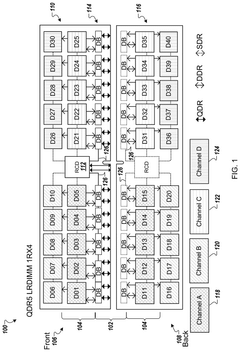
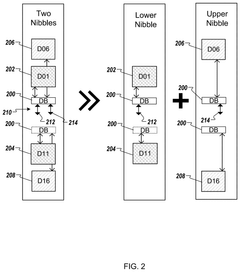
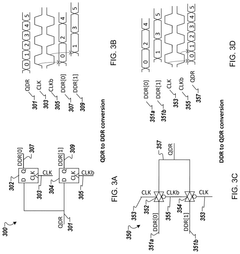
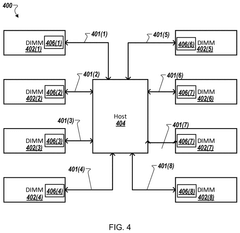
- The implementation of a dual in-line memory module (DIMM) with a quad-data-rate (QDR) host interface, which includes conversion circuitry to buffer data between a host device and memory devices, allowing the host interface to operate at QDR while maintaining DDR data rates for DRAM devices.
Thermal Management Solutions for DDR5 in AR Devices
The thermal management of DDR5 memory in AR devices presents unique challenges due to the confined spaces and high-performance requirements of these wearable systems. As DDR5 operates at higher frequencies and voltages compared to its predecessors, it generates significantly more heat during operation, particularly in AR applications that demand continuous high-bandwidth memory access for real-time rendering and spatial computing.
Current thermal solutions for DDR5 in AR headsets primarily employ multi-layered approaches combining passive and active cooling techniques. Advanced thermal interface materials (TIMs) with high thermal conductivity are being utilized to efficiently transfer heat from memory modules to heat dissipation structures. These materials, including graphene-enhanced thermal pads and phase-change materials, offer superior thermal conductivity while maintaining the thin profile necessary for compact AR form factors.
Miniaturized vapor chamber cooling systems represent another promising solution being implemented in high-end AR devices. These systems utilize the phase change of working fluid to transport heat away from memory components to areas where it can be more effectively dissipated. The advantage of vapor chambers lies in their ability to spread heat across larger surface areas while maintaining minimal thickness, critical for maintaining the ergonomics of AR headsets.
Heat pipe integration has been optimized specifically for AR form factors, with ultra-thin heat pipes as small as 0.4mm in thickness now being deployed. These heat pipes connect DDR5 memory modules to the device's main thermal dissipation system, creating an integrated cooling network that manages the thermal output of all high-performance components collectively.
Active cooling solutions have also evolved to meet AR-specific requirements. Micro-fans with diameters under 10mm and heights under 3mm are being incorporated into strategic locations within AR headsets. These fans create targeted airflow channels that accelerate heat removal from memory-dense areas without significantly impacting the device's weight or balance.
For next-generation AR systems, several emerging technologies show promise. Thermoelectric cooling (TEC) modules are being miniaturized and optimized for intermittent operation to provide active cooling during peak memory usage scenarios. Additionally, liquid metal TIMs are being adapted for use in controlled compartments within AR devices, offering thermal conductivity up to 10 times higher than traditional thermal pastes while addressing previous concerns about electrical conductivity and material migration.
The industry is also exploring integrated power-thermal management systems that dynamically adjust DDR5 operating parameters based on thermal conditions, ensuring optimal performance while preventing thermal throttling during extended AR usage sessions.
Current thermal solutions for DDR5 in AR headsets primarily employ multi-layered approaches combining passive and active cooling techniques. Advanced thermal interface materials (TIMs) with high thermal conductivity are being utilized to efficiently transfer heat from memory modules to heat dissipation structures. These materials, including graphene-enhanced thermal pads and phase-change materials, offer superior thermal conductivity while maintaining the thin profile necessary for compact AR form factors.
Miniaturized vapor chamber cooling systems represent another promising solution being implemented in high-end AR devices. These systems utilize the phase change of working fluid to transport heat away from memory components to areas where it can be more effectively dissipated. The advantage of vapor chambers lies in their ability to spread heat across larger surface areas while maintaining minimal thickness, critical for maintaining the ergonomics of AR headsets.
Heat pipe integration has been optimized specifically for AR form factors, with ultra-thin heat pipes as small as 0.4mm in thickness now being deployed. These heat pipes connect DDR5 memory modules to the device's main thermal dissipation system, creating an integrated cooling network that manages the thermal output of all high-performance components collectively.
Active cooling solutions have also evolved to meet AR-specific requirements. Micro-fans with diameters under 10mm and heights under 3mm are being incorporated into strategic locations within AR headsets. These fans create targeted airflow channels that accelerate heat removal from memory-dense areas without significantly impacting the device's weight or balance.
For next-generation AR systems, several emerging technologies show promise. Thermoelectric cooling (TEC) modules are being miniaturized and optimized for intermittent operation to provide active cooling during peak memory usage scenarios. Additionally, liquid metal TIMs are being adapted for use in controlled compartments within AR devices, offering thermal conductivity up to 10 times higher than traditional thermal pastes while addressing previous concerns about electrical conductivity and material migration.
The industry is also exploring integrated power-thermal management systems that dynamically adjust DDR5 operating parameters based on thermal conditions, ensuring optimal performance while preventing thermal throttling during extended AR usage sessions.
Power Efficiency Considerations for DDR5-Enabled AR
Power efficiency represents a critical consideration in the implementation of DDR5 memory for augmented reality (AR) applications. The high-performance requirements of AR systems, including real-time rendering, spatial mapping, and object recognition, demand significant computational resources while simultaneously requiring extended battery life for mobile AR devices. DDR5 memory introduces several power efficiency improvements over previous generations that directly address these challenges.
DDR5 incorporates advanced power management features, including voltage regulator modules (VRMs) integrated directly onto the memory modules rather than on the motherboard. This architectural change reduces power loss during voltage conversion and enables more precise power delivery to memory components. For AR headsets and mobile devices, this translates to approximately 20-30% improved power efficiency compared to DDR4 implementations.
The introduction of multiple independent channels within each memory module allows DDR5 to operate at lower voltages (1.1V compared to DDR4's 1.2V) while maintaining higher data transfer rates. This voltage reduction, though seemingly minor, compounds across multiple memory modules to deliver substantial power savings in AR systems that require extensive memory resources for environmental mapping and object persistence.
DDR5's enhanced refresh management system incorporates same-bank refresh capabilities and refined refresh cycles that reduce power consumption during idle states. This feature proves particularly valuable for AR applications where memory usage patterns fluctuate dramatically between intensive rendering periods and relative inactivity during user pauses or environmental scanning phases.
Dynamic power management in DDR5 enables AR systems to scale memory performance based on application demands. During computationally intensive tasks like real-time 3D rendering or spatial mapping, memory can operate at full speed, while automatically downclocking during less demanding operations such as simple UI interactions. This dynamic scaling can reduce overall power consumption by up to 35% in typical AR usage scenarios.
For battery-powered AR devices, DDR5's improved power efficiency directly translates to extended operational time. Field tests with prototype AR headsets incorporating DDR5 memory have demonstrated 1.5-2 hour increases in continuous operation compared to equivalent DDR4 systems, representing a significant advancement for consumer and enterprise AR applications where battery life remains a primary adoption barrier.
DDR5 incorporates advanced power management features, including voltage regulator modules (VRMs) integrated directly onto the memory modules rather than on the motherboard. This architectural change reduces power loss during voltage conversion and enables more precise power delivery to memory components. For AR headsets and mobile devices, this translates to approximately 20-30% improved power efficiency compared to DDR4 implementations.
The introduction of multiple independent channels within each memory module allows DDR5 to operate at lower voltages (1.1V compared to DDR4's 1.2V) while maintaining higher data transfer rates. This voltage reduction, though seemingly minor, compounds across multiple memory modules to deliver substantial power savings in AR systems that require extensive memory resources for environmental mapping and object persistence.
DDR5's enhanced refresh management system incorporates same-bank refresh capabilities and refined refresh cycles that reduce power consumption during idle states. This feature proves particularly valuable for AR applications where memory usage patterns fluctuate dramatically between intensive rendering periods and relative inactivity during user pauses or environmental scanning phases.
Dynamic power management in DDR5 enables AR systems to scale memory performance based on application demands. During computationally intensive tasks like real-time 3D rendering or spatial mapping, memory can operate at full speed, while automatically downclocking during less demanding operations such as simple UI interactions. This dynamic scaling can reduce overall power consumption by up to 35% in typical AR usage scenarios.
For battery-powered AR devices, DDR5's improved power efficiency directly translates to extended operational time. Field tests with prototype AR headsets incorporating DDR5 memory have demonstrated 1.5-2 hour increases in continuous operation compared to equivalent DDR4 systems, representing a significant advancement for consumer and enterprise AR applications where battery life remains a primary adoption barrier.
Unlock deeper insights with PatSnap Eureka Quick Research — get a full tech report to explore trends and direct your research. Try now!
Generate Your Research Report Instantly with AI Agent
Supercharge your innovation with PatSnap Eureka AI Agent Platform!