

Flexible Microdisplay Innovation in Augmented Reality Hardware
OCT 21, 20259 MIN READ
Generate Your Research Report Instantly with AI Agent
PatSnap Eureka helps you evaluate technical feasibility & market potential.
Flexible Microdisplay Evolution and Objectives
Flexible microdisplay technology has undergone significant evolution since its inception in the early 2000s. Initially, these displays were characterized by limited flexibility, poor resolution, and inadequate brightness for augmented reality (AR) applications. The first generation of flexible displays primarily utilized organic light-emitting diode (OLED) technology, which offered basic bendability but lacked the durability and performance metrics required for immersive AR experiences.
By the mid-2010s, technological advancements led to the development of more robust flexible display solutions incorporating thin-film transistor (TFT) backplanes on plastic substrates. This milestone enabled displays with improved flexibility while maintaining acceptable visual performance. However, these displays still faced challenges in achieving the high pixel density and brightness necessary for near-eye AR applications.
The current generation of flexible microdisplays represents a convergence of multiple technological innovations, including microLED, quantum dot, and advanced OLED architectures. These technologies have collectively pushed the boundaries of what's possible in AR hardware, enabling displays that can conform to complex optical paths while delivering high resolution, brightness, and color accuracy.
Looking at the technological trajectory, we observe a clear trend toward increasingly sophisticated materials science solutions. The integration of novel semiconductor materials, advanced manufacturing processes like roll-to-roll fabrication, and nanoscale optical structures has been instrumental in overcoming previous limitations in flexible display technology.
The primary objectives for flexible microdisplay technology in AR applications center around several key performance indicators. First, achieving ultra-high pixel density (>2000 PPI) is essential for eliminating the "screen door effect" in near-eye applications. Second, displays must maintain consistent performance metrics when flexed or conformed to non-planar surfaces. Third, power efficiency must be dramatically improved to enable all-day wearable AR devices.
Additional objectives include reducing manufacturing costs through scalable production methods, enhancing durability to withstand thousands of flex cycles, and developing environmentally sustainable materials and processes. The ultimate goal is to create microdisplays that can be seamlessly integrated into lightweight, comfortable AR glasses that resemble conventional eyewear rather than bulky headsets.
The convergence of these technological advancements and clear objectives is expected to drive the next wave of innovation in AR hardware, potentially leading to mainstream adoption of AR glasses within the next 3-5 years. This timeline aligns with market forecasts predicting significant growth in consumer AR adoption beginning in 2025.
By the mid-2010s, technological advancements led to the development of more robust flexible display solutions incorporating thin-film transistor (TFT) backplanes on plastic substrates. This milestone enabled displays with improved flexibility while maintaining acceptable visual performance. However, these displays still faced challenges in achieving the high pixel density and brightness necessary for near-eye AR applications.
The current generation of flexible microdisplays represents a convergence of multiple technological innovations, including microLED, quantum dot, and advanced OLED architectures. These technologies have collectively pushed the boundaries of what's possible in AR hardware, enabling displays that can conform to complex optical paths while delivering high resolution, brightness, and color accuracy.
Looking at the technological trajectory, we observe a clear trend toward increasingly sophisticated materials science solutions. The integration of novel semiconductor materials, advanced manufacturing processes like roll-to-roll fabrication, and nanoscale optical structures has been instrumental in overcoming previous limitations in flexible display technology.
The primary objectives for flexible microdisplay technology in AR applications center around several key performance indicators. First, achieving ultra-high pixel density (>2000 PPI) is essential for eliminating the "screen door effect" in near-eye applications. Second, displays must maintain consistent performance metrics when flexed or conformed to non-planar surfaces. Third, power efficiency must be dramatically improved to enable all-day wearable AR devices.
Additional objectives include reducing manufacturing costs through scalable production methods, enhancing durability to withstand thousands of flex cycles, and developing environmentally sustainable materials and processes. The ultimate goal is to create microdisplays that can be seamlessly integrated into lightweight, comfortable AR glasses that resemble conventional eyewear rather than bulky headsets.
The convergence of these technological advancements and clear objectives is expected to drive the next wave of innovation in AR hardware, potentially leading to mainstream adoption of AR glasses within the next 3-5 years. This timeline aligns with market forecasts predicting significant growth in consumer AR adoption beginning in 2025.
AR Market Demand Analysis
The augmented reality (AR) market has experienced significant growth in recent years, driven by increasing consumer interest and enterprise adoption. The global AR market size was valued at approximately $17.5 billion in 2020 and is projected to reach $184.6 billion by 2026, growing at a CAGR of 48.6% during the forecast period. This remarkable growth trajectory underscores the expanding demand for AR technologies across various sectors.
Consumer applications represent a substantial segment of the AR market, with gaming and entertainment leading adoption rates. However, enterprise applications are rapidly gaining traction, particularly in manufacturing, healthcare, education, and retail sectors. In manufacturing alone, AR implementation has demonstrated productivity improvements of up to 40% in complex assembly tasks, highlighting the technology's practical value beyond consumer novelty.
The demand for flexible microdisplay technology in AR hardware stems from several key market requirements. First, user comfort remains paramount - current AR headsets are often criticized for their bulkiness and weight, with 68% of users citing comfort as a primary concern. Flexible displays enable lighter, more ergonomic form factors that can significantly enhance user experience and extend usage duration.
Second, field of view (FOV) limitations continue to constrain AR adoption. Current commercial AR headsets typically offer FOVs between 30-52 degrees, substantially narrower than the human visual field of approximately 210 degrees. Flexible microdisplays present opportunities to create curved optical paths that could potentially expand FOV without proportionally increasing device size.
Third, market research indicates that 74% of potential AR users consider aesthetics important in their purchasing decisions. Traditional rigid display components necessitate bulky headsets that create social barriers to adoption. Flexible microdisplay technology enables more discreet, stylish form factors that resemble conventional eyewear.
Battery life represents another critical market demand, with surveys showing users expect minimum 4-hour continuous operation. The energy efficiency advantages of flexible display technologies could help address this requirement while maintaining performance standards.
Regional market analysis reveals varying adoption patterns, with North America leading in enterprise applications while Asia-Pacific demonstrates stronger consumer market growth. Both segments would benefit from flexible microdisplay innovations that address current hardware limitations.
Industry forecasts suggest that AR eyewear shipments could reach 22.8 million units by 2025, contingent upon significant hardware improvements. Flexible microdisplay technology represents a potential catalyst for this market expansion by addressing the fundamental form factor, comfort, and performance limitations that currently restrict mainstream adoption.
Consumer applications represent a substantial segment of the AR market, with gaming and entertainment leading adoption rates. However, enterprise applications are rapidly gaining traction, particularly in manufacturing, healthcare, education, and retail sectors. In manufacturing alone, AR implementation has demonstrated productivity improvements of up to 40% in complex assembly tasks, highlighting the technology's practical value beyond consumer novelty.
The demand for flexible microdisplay technology in AR hardware stems from several key market requirements. First, user comfort remains paramount - current AR headsets are often criticized for their bulkiness and weight, with 68% of users citing comfort as a primary concern. Flexible displays enable lighter, more ergonomic form factors that can significantly enhance user experience and extend usage duration.
Second, field of view (FOV) limitations continue to constrain AR adoption. Current commercial AR headsets typically offer FOVs between 30-52 degrees, substantially narrower than the human visual field of approximately 210 degrees. Flexible microdisplays present opportunities to create curved optical paths that could potentially expand FOV without proportionally increasing device size.
Third, market research indicates that 74% of potential AR users consider aesthetics important in their purchasing decisions. Traditional rigid display components necessitate bulky headsets that create social barriers to adoption. Flexible microdisplay technology enables more discreet, stylish form factors that resemble conventional eyewear.
Battery life represents another critical market demand, with surveys showing users expect minimum 4-hour continuous operation. The energy efficiency advantages of flexible display technologies could help address this requirement while maintaining performance standards.
Regional market analysis reveals varying adoption patterns, with North America leading in enterprise applications while Asia-Pacific demonstrates stronger consumer market growth. Both segments would benefit from flexible microdisplay innovations that address current hardware limitations.
Industry forecasts suggest that AR eyewear shipments could reach 22.8 million units by 2025, contingent upon significant hardware improvements. Flexible microdisplay technology represents a potential catalyst for this market expansion by addressing the fundamental form factor, comfort, and performance limitations that currently restrict mainstream adoption.
Current Challenges in Flexible Display Technology
Despite significant advancements in flexible display technology, several critical challenges continue to impede the widespread adoption of flexible microdisplays in augmented reality (AR) hardware. The foremost challenge lies in achieving sufficient pixel density while maintaining flexibility. Current flexible displays typically offer resolutions between 200-300 PPI, whereas AR applications demand at least 1000 PPI for immersive experiences without visible pixelation at close viewing distances. This resolution gap represents a fundamental technical barrier that requires innovative materials science approaches.
Material durability presents another significant obstacle. Flexible displays must withstand thousands of bending cycles without performance degradation, yet current materials show visible creasing and reduced luminance after repeated flexing. The organic light-emitting materials in OLED-based flexible displays are particularly susceptible to oxygen and moisture, necessitating advanced encapsulation techniques that don't compromise flexibility.
Power efficiency remains problematic for AR implementations. Flexible displays typically consume 20-30% more power than their rigid counterparts due to additional layers and less efficient electron transport in flexible substrates. This increased power consumption directly impacts the form factor of AR devices by requiring larger batteries, contradicting the goal of creating lightweight, unobtrusive wearables.
Manufacturing scalability continues to challenge mass production. Current yield rates for high-quality flexible displays hover around 65-70%, significantly lower than the 85-90% achieved with rigid displays. The complex multi-layer deposition processes required for flexible displays involve precise temperature and pressure control that becomes increasingly difficult to maintain at scale.
Integration challenges with other AR components further complicate implementation. Flexible displays must interface with rigid electronics, sensors, and optical elements, creating stress points that can lead to premature failure. The thermal management of these junction points presents particular difficulties as heat dissipation pathways are limited in flexible architectures.
Color accuracy and brightness uniformity across the bent surface area remain inconsistent. Curvature creates varying optical paths that affect color perception and brightness, with up to 15% variation in luminance observed across highly curved displays. This non-uniformity is particularly problematic for AR applications where precise overlay of virtual content on real-world environments is essential.
Finally, the cost factor remains prohibitive for mass-market adoption. Current manufacturing processes for high-quality flexible microdisplays result in unit costs approximately 2.5-3 times higher than comparable rigid displays, placing significant pressure on the overall bill of materials for AR hardware developers.
Material durability presents another significant obstacle. Flexible displays must withstand thousands of bending cycles without performance degradation, yet current materials show visible creasing and reduced luminance after repeated flexing. The organic light-emitting materials in OLED-based flexible displays are particularly susceptible to oxygen and moisture, necessitating advanced encapsulation techniques that don't compromise flexibility.
Power efficiency remains problematic for AR implementations. Flexible displays typically consume 20-30% more power than their rigid counterparts due to additional layers and less efficient electron transport in flexible substrates. This increased power consumption directly impacts the form factor of AR devices by requiring larger batteries, contradicting the goal of creating lightweight, unobtrusive wearables.
Manufacturing scalability continues to challenge mass production. Current yield rates for high-quality flexible displays hover around 65-70%, significantly lower than the 85-90% achieved with rigid displays. The complex multi-layer deposition processes required for flexible displays involve precise temperature and pressure control that becomes increasingly difficult to maintain at scale.
Integration challenges with other AR components further complicate implementation. Flexible displays must interface with rigid electronics, sensors, and optical elements, creating stress points that can lead to premature failure. The thermal management of these junction points presents particular difficulties as heat dissipation pathways are limited in flexible architectures.
Color accuracy and brightness uniformity across the bent surface area remain inconsistent. Curvature creates varying optical paths that affect color perception and brightness, with up to 15% variation in luminance observed across highly curved displays. This non-uniformity is particularly problematic for AR applications where precise overlay of virtual content on real-world environments is essential.
Finally, the cost factor remains prohibitive for mass-market adoption. Current manufacturing processes for high-quality flexible microdisplays result in unit costs approximately 2.5-3 times higher than comparable rigid displays, placing significant pressure on the overall bill of materials for AR hardware developers.
Current Flexible Microdisplay Solutions
01 Flexible substrate technologies for microdisplays
Flexible substrates are essential components for creating bendable microdisplays. These substrates can be made from various materials such as polymers, thin glass, or metal foils that provide the necessary flexibility while maintaining structural integrity. The substrate technology enables the display to be bent, folded, or conformed to non-flat surfaces without compromising display performance. Advanced manufacturing techniques ensure proper adhesion of display elements to these flexible bases while maintaining electrical connectivity throughout bending cycles.- Flexible display substrate technologies: Various substrate technologies enable the creation of flexible microdisplays. These include thin-film transistor (TFT) arrays on flexible polymeric substrates, bendable glass technologies, and specialized flexible semiconductor materials. These substrates provide the foundation for creating displays that can bend, fold, or conform to curved surfaces while maintaining display functionality and optical performance.
- OLED-based flexible microdisplay systems: Organic Light Emitting Diode (OLED) technology is particularly suitable for flexible microdisplays due to its inherently thin structure and ability to function without rigid backlighting. These systems incorporate specialized pixel architectures, flexible encapsulation methods, and strain-resistant electrode designs to maintain display performance during bending or flexing operations.
- Testing and quality control for flexible displays: Specialized testing methodologies have been developed for flexible microdisplays to evaluate performance under mechanical stress. These include optical measurement systems for assessing display quality during bending, reliability testing protocols for repeated flexing operations, and defect detection systems specifically designed for flexible display manufacturing processes.
- Flexible display driving and control systems: Specialized electronic driving circuits and control systems are essential for flexible microdisplays. These include flexible printed circuit boards, strain-resistant interconnects between rigid and flexible components, and compensation algorithms that adjust display parameters based on the current bending state of the display to maintain image quality regardless of display conformation.
- Optical components for flexible microdisplays: Specialized optical components have been developed for flexible microdisplay applications. These include flexible light guide plates, bendable polarizers, deformable lens arrays, and specialized optical films that maintain their optical properties when bent or flexed. These components work together with the display elements to ensure consistent image quality across the curved or bent display surface.
02 OLED technology for flexible displays
Organic Light Emitting Diode (OLED) technology is particularly suitable for flexible microdisplays due to its inherently thin and flexible structure. OLED displays consist of organic compounds that emit light when electricity is applied, eliminating the need for rigid backlighting systems required in traditional LCD displays. This technology allows for ultra-thin display constructions that can bend without affecting light emission properties. The self-emissive nature of OLEDs also contributes to better contrast ratios and viewing angles in flexible display applications.Expand Specific Solutions03 Flexible electronic circuits and interconnects
Specialized electronic circuits and interconnects are critical for flexible microdisplays to maintain functionality during bending. These include stretchable conductive materials, serpentine circuit patterns, and novel bonding techniques that can withstand repeated flexing without breaking electrical connections. The interconnect technologies enable reliable signal transmission across bendable surfaces while minimizing stress points. Advanced thin-film transistor designs specifically engineered for flexibility provide the necessary electronic control while accommodating the mechanical deformation of the display.Expand Specific Solutions04 Protective encapsulation for flexible displays
Protective encapsulation technologies shield the sensitive electronic components of flexible microdisplays from environmental factors while maintaining flexibility. These include thin-film barrier layers that prevent moisture and oxygen penetration, which are particularly damaging to organic display materials. Multi-layer encapsulation approaches combine inorganic and organic materials to achieve both flexibility and protection. Edge sealing techniques prevent delamination during bending, while still allowing the display to flex without compromising the protective barrier properties.Expand Specific Solutions05 Display driving methods for flexible microdisplays
Specialized driving methods and compensation algorithms are developed for flexible microdisplays to maintain image quality during and after bending. These techniques address issues such as non-uniform pixel performance when the display is flexed, compensating for electrical and optical variations caused by mechanical stress. Adaptive brightness and contrast controls respond to the changing geometry of the display surface. Advanced scanning and addressing schemes ensure consistent image rendering regardless of the display's physical configuration, while minimizing power consumption for mobile applications.Expand Specific Solutions
Leading AR Display Manufacturers
The flexible microdisplay market for augmented reality hardware is currently in a growth phase, with increasing adoption across consumer and enterprise sectors. Market size is expanding rapidly, projected to reach significant value as AR applications proliferate. Technologically, the field shows varying maturity levels among key players. Samsung Display and LG Display lead with advanced OLED microdisplay technologies, while BOE Technology and China Star Optoelectronics are rapidly closing the gap with substantial R&D investments. Western companies like Magic Leap and Intel are focusing on specialized applications, while Royole Technologies pioneers ultra-flexible display solutions. The competitive landscape features established electronics giants competing with specialized display manufacturers and emerging startups, creating a dynamic innovation environment.
BOE Technology Group Co., Ltd.
Technical Solution: BOE has developed a comprehensive flexible microdisplay solution for AR hardware centered around their advanced Micro-OLED technology. Their AR-focused displays feature pixel densities of 5,000+ PPI and utilize a silicon-based active matrix backplane that enables high refresh rates while maintaining flexibility. BOE's proprietary "Ultra-Flex" technology incorporates a specialized neutral plane design that minimizes stress on active display components during bending, significantly improving durability. The company has pioneered a unique transparent flexible substrate that achieves over 80% light transmittance, critical for see-through AR applications[2]. Their displays incorporate quantum dot color conversion layers to achieve 150% DCI-P3 color gamut while maintaining flexibility. BOE has also developed specialized optical waveguide integration techniques that allow their flexible displays to work seamlessly with AR optical systems, reducing overall system thickness by approximately 30% compared to conventional rigid display solutions. Recent prototypes demonstrate sub-5ms response times even when flexed.
Strengths: Comprehensive vertical integration from substrate to finished display; specialized AR-focused color optimization technology; advanced manufacturing capabilities for mass production. Weaknesses: Current technology still faces challenges with long-term reliability under repeated flexing; power consumption remains higher than ideal for all-day AR wearable applications; optical clarity in bright environments needs further improvement.
LG Display Co., Ltd.
Technical Solution: LG Display has developed flexible microdisplay technology specifically for AR applications through their P-OLED (Plastic OLED) platform. Their solution features ultra-thin flexible displays with pixel densities reaching 3,000+ PPI in sizes appropriate for AR glasses. LG's approach utilizes a proprietary flexible encapsulation technology that provides superior moisture and oxygen barrier properties while maintaining flexibility. Their AR microdisplays incorporate a specialized compensation layer that adjusts for color and brightness variations when the display is bent, ensuring consistent visual quality. LG has pioneered a unique flexible transparent electrode material that achieves over 90% transparency while maintaining conductivity when flexed[4]. Their displays feature a specialized optical design that reduces internal reflections, critical for AR applications where display clarity is paramount. LG has also developed a proprietary flexible color filter technology that maintains color accuracy even when the display is curved or bent, addressing a common challenge in flexible display implementations for AR.
Strengths: Extensive experience with flexible display mass production; superior color accuracy and consistency during flexing; advanced barrier technology provides excellent reliability. Weaknesses: Current pixel density still lags behind some competitors; brightness levels need improvement for outdoor AR applications; manufacturing yield rates for the highest resolution versions remain challenging.
Key Patents in Flexible AR Display Technology
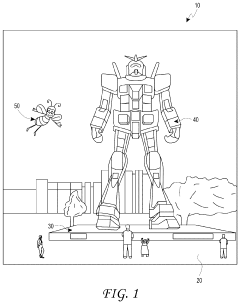
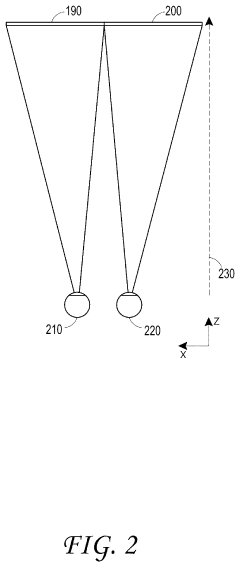
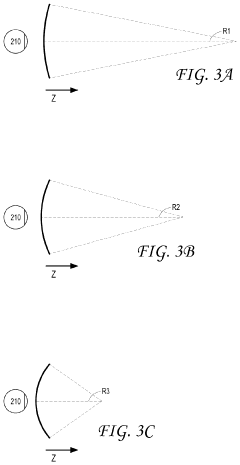
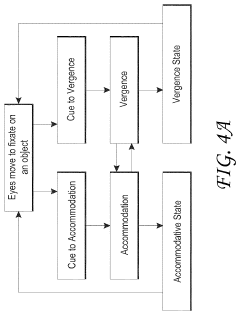
Augmented reality display having liquid crystal variable focus element and roll-to-roll method and apparatus for forming the same
PatentActiveUS11921290B2
Innovation
- The implementation of adaptive lens assemblies comprising waveplate lenses and switchable waveplate assemblies with liquid crystal layers, which can modify optical power and polarization to simulate multiple depth planes with fewer physical components, reducing the thickness and weight of the display system, and utilizing a roll-to-roll manufacturing process for efficient production.
Display device, method of manufacturing the display device, and electronic device including the display device
PatentPendingUS20250291391A1
Innovation
- The display device incorporates a plate below the display panel with openings defined in the folding area, where the openings are continuously extended and have specific width and separation distance ratios to enhance impact resistance and folding reliability.


Material Science Advancements for Flexible Displays
Recent advancements in material science have revolutionized the development of flexible displays, creating unprecedented opportunities for augmented reality (AR) hardware innovation. Traditional rigid display technologies have limited the form factor and user experience of AR devices, but flexible microdisplays are now emerging as a transformative solution.
The foundation of these advances lies in the development of novel substrate materials that can maintain optical performance while enabling flexibility. Polyimide films have emerged as leading candidates, offering excellent thermal stability and mechanical durability while allowing for bend radii below 1mm. These materials can withstand repeated flexing cycles exceeding 200,000 bends without significant degradation in performance.
Transparent conductive materials represent another critical advancement area. Indium tin oxide (ITO), the industry standard for rigid displays, becomes brittle when flexed. Alternatives such as silver nanowires, graphene, and PEDOT:PSS (poly(3,4-ethylenedioxythiophene) polystyrene sulfonate) now provide conductivity comparable to ITO while maintaining flexibility. Silver nanowire networks, in particular, have demonstrated conductivity of 10-20 ohms/square with over 90% transparency.
Organic light-emitting diodes (OLEDs) and micro-LEDs have been adapted for flexible applications through innovative manufacturing processes. Solution-processed OLEDs can now be deposited on flexible substrates at temperatures below 120°C, preserving substrate integrity. Meanwhile, transfer printing techniques enable the placement of inorganic micro-LEDs onto flexible backplanes with positioning accuracy below 1μm.
Encapsulation technologies have also evolved significantly, with multi-layer barrier films achieving water vapor transmission rates below 10^-6 g/m²/day. These barriers protect sensitive organic materials from environmental degradation while maintaining flexibility, extending device lifetimes from months to years.
Stretchable electronics represent the frontier of flexible display materials, incorporating elastomeric substrates and serpentine interconnect designs that can accommodate strains exceeding 50% while maintaining electrical connectivity. This enables displays that can conform to complex three-dimensional surfaces, critical for next-generation AR eyewear that mimics conventional glasses.
Self-healing materials are beginning to appear in research prototypes, incorporating microcapsules of healing agents that automatically repair minor scratches and defects. These materials could significantly enhance the durability of flexible AR displays in real-world usage scenarios.
The convergence of these material science breakthroughs is enabling AR displays with form factors, weight, and comfort levels previously impossible with conventional technologies, paving the way for mainstream adoption of augmented reality eyewear.
The foundation of these advances lies in the development of novel substrate materials that can maintain optical performance while enabling flexibility. Polyimide films have emerged as leading candidates, offering excellent thermal stability and mechanical durability while allowing for bend radii below 1mm. These materials can withstand repeated flexing cycles exceeding 200,000 bends without significant degradation in performance.
Transparent conductive materials represent another critical advancement area. Indium tin oxide (ITO), the industry standard for rigid displays, becomes brittle when flexed. Alternatives such as silver nanowires, graphene, and PEDOT:PSS (poly(3,4-ethylenedioxythiophene) polystyrene sulfonate) now provide conductivity comparable to ITO while maintaining flexibility. Silver nanowire networks, in particular, have demonstrated conductivity of 10-20 ohms/square with over 90% transparency.
Organic light-emitting diodes (OLEDs) and micro-LEDs have been adapted for flexible applications through innovative manufacturing processes. Solution-processed OLEDs can now be deposited on flexible substrates at temperatures below 120°C, preserving substrate integrity. Meanwhile, transfer printing techniques enable the placement of inorganic micro-LEDs onto flexible backplanes with positioning accuracy below 1μm.
Encapsulation technologies have also evolved significantly, with multi-layer barrier films achieving water vapor transmission rates below 10^-6 g/m²/day. These barriers protect sensitive organic materials from environmental degradation while maintaining flexibility, extending device lifetimes from months to years.
Stretchable electronics represent the frontier of flexible display materials, incorporating elastomeric substrates and serpentine interconnect designs that can accommodate strains exceeding 50% while maintaining electrical connectivity. This enables displays that can conform to complex three-dimensional surfaces, critical for next-generation AR eyewear that mimics conventional glasses.
Self-healing materials are beginning to appear in research prototypes, incorporating microcapsules of healing agents that automatically repair minor scratches and defects. These materials could significantly enhance the durability of flexible AR displays in real-world usage scenarios.
The convergence of these material science breakthroughs is enabling AR displays with form factors, weight, and comfort levels previously impossible with conventional technologies, paving the way for mainstream adoption of augmented reality eyewear.
Power Efficiency and Thermal Management
Power efficiency and thermal management represent critical challenges in the development of flexible microdisplays for augmented reality (AR) hardware. Traditional rigid display technologies already struggle with power consumption issues, but these challenges are amplified in flexible form factors where battery capacity is often more constrained and heat dissipation pathways are limited by the non-rigid structure.
Current flexible microdisplay technologies, particularly those based on OLED (Organic Light Emitting Diode) and microLED architectures, demonstrate varying levels of power efficiency. OLED displays offer advantages in power consumption when displaying darker content due to their emissive nature, while microLED displays provide superior brightness-to-power ratios for high-luminance applications. However, both technologies still require significant power optimization to meet the demanding requirements of all-day AR usage scenarios.
Thermal management presents a particularly complex challenge for flexible displays in AR applications. Unlike rigid displays that can utilize conventional heat sinks and thermal conduction paths, flexible displays require novel approaches to heat dissipation. Excessive heat not only accelerates device degradation but also creates user comfort issues when devices are worn close to the face. Current solutions include the integration of thermally conductive flexible materials, strategic component placement, and dynamic thermal management systems.
Power management innovations are emerging through several technological approaches. Advanced display driving schemes that reduce refresh rates for static content can significantly decrease power consumption. Pixel-level local dimming technologies allow for precise control of brightness only where needed. Additionally, AI-driven content adaptation is being explored to optimize displayed information based on power availability and usage conditions.
Battery technology integration represents another frontier in power management for flexible AR displays. Thin-film batteries that can themselves be flexible are being developed to complement the form factor of flexible displays. Energy harvesting technologies, including photovoltaic elements integrated into unused display areas, are also being investigated as supplementary power sources.
The industry is witnessing a shift toward system-level power optimization approaches. This includes distributing computing loads between the display unit and connected devices, implementing aggressive sleep modes, and developing specialized low-power display processors. Companies like Apple, Google, and Samsung are investing heavily in custom silicon designed specifically to manage the unique power requirements of AR display systems.
Future developments will likely focus on materials innovation, including more efficient emissive materials with lower power requirements and novel substrate materials with better thermal conductivity while maintaining flexibility. Advancements in micro-battery technology and wireless power transfer may also play crucial roles in addressing the power challenges of next-generation flexible AR displays.
Current flexible microdisplay technologies, particularly those based on OLED (Organic Light Emitting Diode) and microLED architectures, demonstrate varying levels of power efficiency. OLED displays offer advantages in power consumption when displaying darker content due to their emissive nature, while microLED displays provide superior brightness-to-power ratios for high-luminance applications. However, both technologies still require significant power optimization to meet the demanding requirements of all-day AR usage scenarios.
Thermal management presents a particularly complex challenge for flexible displays in AR applications. Unlike rigid displays that can utilize conventional heat sinks and thermal conduction paths, flexible displays require novel approaches to heat dissipation. Excessive heat not only accelerates device degradation but also creates user comfort issues when devices are worn close to the face. Current solutions include the integration of thermally conductive flexible materials, strategic component placement, and dynamic thermal management systems.
Power management innovations are emerging through several technological approaches. Advanced display driving schemes that reduce refresh rates for static content can significantly decrease power consumption. Pixel-level local dimming technologies allow for precise control of brightness only where needed. Additionally, AI-driven content adaptation is being explored to optimize displayed information based on power availability and usage conditions.
Battery technology integration represents another frontier in power management for flexible AR displays. Thin-film batteries that can themselves be flexible are being developed to complement the form factor of flexible displays. Energy harvesting technologies, including photovoltaic elements integrated into unused display areas, are also being investigated as supplementary power sources.
The industry is witnessing a shift toward system-level power optimization approaches. This includes distributing computing loads between the display unit and connected devices, implementing aggressive sleep modes, and developing specialized low-power display processors. Companies like Apple, Google, and Samsung are investing heavily in custom silicon designed specifically to manage the unique power requirements of AR display systems.
Future developments will likely focus on materials innovation, including more efficient emissive materials with lower power requirements and novel substrate materials with better thermal conductivity while maintaining flexibility. Advancements in micro-battery technology and wireless power transfer may also play crucial roles in addressing the power challenges of next-generation flexible AR displays.
Unlock deeper insights with PatSnap Eureka Quick Research — get a full tech report to explore trends and direct your research. Try now!
Generate Your Research Report Instantly with AI Agent
Supercharge your innovation with PatSnap Eureka AI Agent Platform!