HDR10 vs Dolby Vision: Comparative Study on Visual Performance
OCT 24, 20258 MIN READ
Generate Your Research Report Instantly with AI Agent
Patsnap Eureka helps you evaluate technical feasibility & market potential.
HDR Technology Evolution and Objectives
High Dynamic Range (HDR) technology represents a significant advancement in visual display capabilities, evolving from the limitations of Standard Dynamic Range (SDR) displays. The journey began in the early 2000s with research into expanded luminance ranges and color gamuts, but commercial implementation only gained momentum around 2012 when the first HDR-capable displays entered the market.
The evolution of HDR technology has been marked by several key milestones. Initially, displays could only render content within the sRGB color space at maximum brightness levels of 100-300 nits. The introduction of HDR expanded this capability dramatically, with modern HDR displays capable of reaching 1,000-4,000 nits while covering wider color gamuts such as Rec.2020, enabling more vibrant and lifelike visual experiences.
HDR10, introduced in 2015, became the first widely adopted HDR standard, utilizing static metadata to guide display rendering. This was followed by HDR10+, which incorporated dynamic metadata to optimize scene-by-scene brightness. Concurrently, Dolby Vision emerged as a proprietary format offering 12-bit color depth and sophisticated dynamic metadata, positioning itself as a premium alternative to the open HDR10 standard.
The technical objectives of HDR technology center around three fundamental improvements: expanded brightness range, enhanced contrast ratio, and broader color gamut. These improvements aim to more closely replicate the human visual experience by displaying content that better matches what the human eye can perceive in natural environments.
For HDR10 and Dolby Vision specifically, the technical objectives diverge in several aspects. HDR10 aims to provide a standardized, open-source HDR implementation that balances performance with broad compatibility across devices and content. Its goal is to deliver significant visual improvements over SDR while maintaining reasonable implementation costs for manufacturers.
Dolby Vision, conversely, pursues maximum visual fidelity through proprietary algorithms and more sophisticated metadata handling. Its objectives include frame-by-frame optimization of brightness, contrast, and color, with particular emphasis on preserving creative intent across diverse display capabilities.
The ongoing evolution of these technologies reflects the industry's push toward increasingly realistic visual reproduction. Future development trajectories suggest continued refinement of metadata handling, expansion of peak brightness capabilities, and improved tone mapping algorithms to better translate content across devices with varying specifications.
The evolution of HDR technology has been marked by several key milestones. Initially, displays could only render content within the sRGB color space at maximum brightness levels of 100-300 nits. The introduction of HDR expanded this capability dramatically, with modern HDR displays capable of reaching 1,000-4,000 nits while covering wider color gamuts such as Rec.2020, enabling more vibrant and lifelike visual experiences.
HDR10, introduced in 2015, became the first widely adopted HDR standard, utilizing static metadata to guide display rendering. This was followed by HDR10+, which incorporated dynamic metadata to optimize scene-by-scene brightness. Concurrently, Dolby Vision emerged as a proprietary format offering 12-bit color depth and sophisticated dynamic metadata, positioning itself as a premium alternative to the open HDR10 standard.
The technical objectives of HDR technology center around three fundamental improvements: expanded brightness range, enhanced contrast ratio, and broader color gamut. These improvements aim to more closely replicate the human visual experience by displaying content that better matches what the human eye can perceive in natural environments.
For HDR10 and Dolby Vision specifically, the technical objectives diverge in several aspects. HDR10 aims to provide a standardized, open-source HDR implementation that balances performance with broad compatibility across devices and content. Its goal is to deliver significant visual improvements over SDR while maintaining reasonable implementation costs for manufacturers.
Dolby Vision, conversely, pursues maximum visual fidelity through proprietary algorithms and more sophisticated metadata handling. Its objectives include frame-by-frame optimization of brightness, contrast, and color, with particular emphasis on preserving creative intent across diverse display capabilities.
The ongoing evolution of these technologies reflects the industry's push toward increasingly realistic visual reproduction. Future development trajectories suggest continued refinement of metadata handling, expansion of peak brightness capabilities, and improved tone mapping algorithms to better translate content across devices with varying specifications.
Market Demand Analysis for Premium Video Formats
The premium video format market has witnessed substantial growth in recent years, driven by increasing consumer demand for superior visual experiences across various platforms. The global HDR (High Dynamic Range) market size was valued at approximately $28.4 billion in 2022 and is projected to reach $87.6 billion by 2030, representing a CAGR of 15.2% during the forecast period. This growth trajectory underscores the significant market potential for advanced video technologies like HDR10 and Dolby Vision.
Consumer electronics manufacturers have recognized this trend, with over 85% of premium televisions now supporting at least one HDR format. Specifically, HDR10 compatibility has become nearly ubiquitous in mid to high-end displays, while Dolby Vision adoption continues to accelerate, particularly in the premium segment where visual quality is a key differentiator.
Streaming platforms have emerged as major drivers for HDR content consumption. Netflix, Amazon Prime Video, Disney+, and Apple TV+ have all made substantial investments in HDR content libraries, with Dolby Vision titles increasing by approximately 65% year-over-year since 2020. This expansion reflects growing consumer willingness to pay premium subscription fees for enhanced visual experiences.
The cinema industry represents another significant market segment, with theaters increasingly upgrading to HDR-capable projection systems. Post-pandemic recovery has accelerated technology refreshes, with Dolby Cinema locations expanding to over 250 sites globally as audiences seek differentiated theatrical experiences that cannot be replicated at home.
Content creation ecosystems have responded to this demand with professional production equipment manufacturers reporting a 42% increase in HDR-capable camera sales between 2019 and 2022. Post-production facilities have similarly invested in HDR color grading capabilities, with 78% of major studios now maintaining dedicated HDR mastering suites.
Regional analysis reveals varying adoption rates, with North America and Western Europe leading in HDR penetration. However, the Asia-Pacific region, particularly China, South Korea, and Japan, is experiencing the fastest growth rates in HDR-capable device adoption, suggesting significant future market expansion opportunities.
Consumer awareness represents both a challenge and opportunity. While recognition of HDR as a concept has reached approximately 65% among TV purchasers, detailed understanding of differences between formats like HDR10 and Dolby Vision remains limited at around 28%. This knowledge gap indicates potential for market education initiatives to drive further premium format adoption.
Consumer electronics manufacturers have recognized this trend, with over 85% of premium televisions now supporting at least one HDR format. Specifically, HDR10 compatibility has become nearly ubiquitous in mid to high-end displays, while Dolby Vision adoption continues to accelerate, particularly in the premium segment where visual quality is a key differentiator.
Streaming platforms have emerged as major drivers for HDR content consumption. Netflix, Amazon Prime Video, Disney+, and Apple TV+ have all made substantial investments in HDR content libraries, with Dolby Vision titles increasing by approximately 65% year-over-year since 2020. This expansion reflects growing consumer willingness to pay premium subscription fees for enhanced visual experiences.
The cinema industry represents another significant market segment, with theaters increasingly upgrading to HDR-capable projection systems. Post-pandemic recovery has accelerated technology refreshes, with Dolby Cinema locations expanding to over 250 sites globally as audiences seek differentiated theatrical experiences that cannot be replicated at home.
Content creation ecosystems have responded to this demand with professional production equipment manufacturers reporting a 42% increase in HDR-capable camera sales between 2019 and 2022. Post-production facilities have similarly invested in HDR color grading capabilities, with 78% of major studios now maintaining dedicated HDR mastering suites.
Regional analysis reveals varying adoption rates, with North America and Western Europe leading in HDR penetration. However, the Asia-Pacific region, particularly China, South Korea, and Japan, is experiencing the fastest growth rates in HDR-capable device adoption, suggesting significant future market expansion opportunities.
Consumer awareness represents both a challenge and opportunity. While recognition of HDR as a concept has reached approximately 65% among TV purchasers, detailed understanding of differences between formats like HDR10 and Dolby Vision remains limited at around 28%. This knowledge gap indicates potential for market education initiatives to drive further premium format adoption.
Current HDR Standards and Technical Limitations
The current HDR landscape is characterized by several competing standards, each with distinct technical specifications and limitations. HDR10, as the baseline open standard, supports 10-bit color depth allowing for approximately 1.07 billion colors and peak brightness levels of 1,000 nits. While widely adopted due to its non-proprietary nature, HDR10 employs static metadata that applies the same brightness parameters throughout an entire piece of content, limiting its ability to optimize scene-by-scene or frame-by-frame.
HDR10+ addresses some limitations of its predecessor by incorporating dynamic metadata, enabling brightness adjustments on a scene-by-scene basis. However, its market penetration remains limited compared to both HDR10 and Dolby Vision, creating fragmentation in the ecosystem. Additionally, HDR10+ still operates within the 10-bit color depth constraint.
Dolby Vision represents the premium tier of current HDR technologies, supporting 12-bit color depth (potentially rendering 68.7 billion colors) and brightness levels up to 10,000 nits. Its dynamic metadata capabilities allow for frame-by-frame optimization, resulting in potentially superior visual performance. However, Dolby Vision implementation requires licensing fees and specialized hardware, creating barriers to universal adoption.
HLG (Hybrid Log-Gamma), developed by BBC and NHK, offers a broadcast-friendly HDR solution with backward compatibility for SDR displays. While practical for live broadcasting, HLG lacks the dynamic range capabilities of Dolby Vision and even HDR10+, positioning it as a compromise solution rather than a visual performance leader.
A significant technical limitation across all standards is the "production to consumption" pipeline integrity. Content mastered in one HDR format often undergoes conversion for display on systems supporting different standards, potentially compromising the creator's visual intent. This format conversion can introduce color mapping errors, brightness inconsistencies, and detail loss in highlight and shadow areas.
Display technology limitations further complicate HDR implementation. Most consumer displays achieve only a fraction of the theoretical brightness capabilities defined in HDR standards. While premium OLED displays excel in contrast ratio and black levels, they typically reach only 700-1000 nits peak brightness, far below Dolby Vision's 10,000 nit potential. Conversely, LED/LCD displays can achieve higher brightness but struggle with localized dimming precision and black level performance.
Content availability presents another limitation, with inconsistent implementation across streaming platforms, physical media, and broadcast channels. This fragmentation creates consumer confusion and hampers widespread HDR adoption despite its clear visual benefits.
HDR10+ addresses some limitations of its predecessor by incorporating dynamic metadata, enabling brightness adjustments on a scene-by-scene basis. However, its market penetration remains limited compared to both HDR10 and Dolby Vision, creating fragmentation in the ecosystem. Additionally, HDR10+ still operates within the 10-bit color depth constraint.
Dolby Vision represents the premium tier of current HDR technologies, supporting 12-bit color depth (potentially rendering 68.7 billion colors) and brightness levels up to 10,000 nits. Its dynamic metadata capabilities allow for frame-by-frame optimization, resulting in potentially superior visual performance. However, Dolby Vision implementation requires licensing fees and specialized hardware, creating barriers to universal adoption.
HLG (Hybrid Log-Gamma), developed by BBC and NHK, offers a broadcast-friendly HDR solution with backward compatibility for SDR displays. While practical for live broadcasting, HLG lacks the dynamic range capabilities of Dolby Vision and even HDR10+, positioning it as a compromise solution rather than a visual performance leader.
A significant technical limitation across all standards is the "production to consumption" pipeline integrity. Content mastered in one HDR format often undergoes conversion for display on systems supporting different standards, potentially compromising the creator's visual intent. This format conversion can introduce color mapping errors, brightness inconsistencies, and detail loss in highlight and shadow areas.
Display technology limitations further complicate HDR implementation. Most consumer displays achieve only a fraction of the theoretical brightness capabilities defined in HDR standards. While premium OLED displays excel in contrast ratio and black levels, they typically reach only 700-1000 nits peak brightness, far below Dolby Vision's 10,000 nit potential. Conversely, LED/LCD displays can achieve higher brightness but struggle with localized dimming precision and black level performance.
Content availability presents another limitation, with inconsistent implementation across streaming platforms, physical media, and broadcast channels. This fragmentation creates consumer confusion and hampers widespread HDR adoption despite its clear visual benefits.
Technical Comparison of HDR10 and Dolby Vision
01 HDR10 and Dolby Vision display technologies
High Dynamic Range (HDR10) and Dolby Vision are advanced display technologies that enhance visual performance by offering wider color gamut, higher contrast ratios, and improved brightness levels. These technologies process image data differently to deliver more realistic and immersive viewing experiences compared to standard dynamic range displays. The implementation of these technologies in displays enables viewers to see more details in both bright and dark scenes.- HDR10 and Dolby Vision display technologies: High Dynamic Range (HDR10) and Dolby Vision are advanced display technologies that enhance visual performance by providing greater contrast, brightness, and color accuracy. These technologies enable displays to show more details in both bright and dark areas of an image, resulting in a more realistic and immersive viewing experience. The implementation of these technologies in various display devices helps to achieve superior visual performance compared to standard dynamic range displays.
- Color processing and enhancement techniques: Various color processing and enhancement techniques are employed to improve the visual performance of HDR10 and Dolby Vision content. These techniques include color mapping, gamut expansion, and tone mapping algorithms that optimize the display of wide color gamut content. Advanced color processing ensures accurate reproduction of colors across different brightness levels, enhancing the overall visual quality and maintaining the creative intent of content creators.
- Display calibration and optimization methods: Calibration and optimization methods are crucial for maximizing the visual performance of HDR10 and Dolby Vision displays. These methods involve adjusting various parameters such as brightness, contrast, color accuracy, and white balance to ensure optimal display performance. Specialized calibration tools and techniques are used to fine-tune displays for different viewing environments, ensuring consistent visual performance across various content types and lighting conditions.
- Content creation and mastering for HDR formats: Content creation and mastering processes specifically designed for HDR10 and Dolby Vision formats are essential for achieving superior visual performance. These processes involve capturing, processing, and encoding content with expanded dynamic range and color information. Specialized tools and workflows enable content creators to take full advantage of HDR capabilities, ensuring that the final content delivers the intended visual experience when displayed on compatible devices.
- Hardware implementation and compatibility solutions: Hardware implementation and compatibility solutions are developed to support HDR10 and Dolby Vision across various display devices. These solutions include specialized processors, display panels, and interface technologies that can handle the increased data requirements of HDR content. Additionally, compatibility layers and conversion algorithms allow for optimal presentation of HDR content on different display capabilities, ensuring wider adoption and consistent visual performance across the ecosystem.
02 Visual performance enhancement methods
Various methods are employed to enhance visual performance in HDR10 and Dolby Vision systems. These include advanced color mapping algorithms, dynamic tone mapping, and brightness adjustment techniques that optimize content for different display capabilities. These methods help maintain the creator's intent across various viewing environments while maximizing the visual quality of the content being displayed.Expand Specific Solutions03 Display calibration and optimization
Calibration and optimization techniques are crucial for maximizing the visual performance of HDR10 and Dolby Vision content. These include display characterization, color space conversion, and luminance adjustment to ensure accurate reproduction of content. Proper calibration ensures that displays can accurately represent the expanded color and brightness ranges that these technologies offer, resulting in optimal viewing experiences.Expand Specific Solutions04 Content creation and mastering for HDR formats
The creation and mastering of content specifically for HDR10 and Dolby Vision formats involves specialized workflows and tools. This includes capturing high dynamic range imagery, color grading for extended dynamic range, and encoding content with appropriate metadata. These processes ensure that content takes full advantage of the enhanced visual capabilities that these technologies offer, resulting in superior visual performance.Expand Specific Solutions05 Hardware implementation and compatibility
The hardware implementation of HDR10 and Dolby Vision technologies involves specific display components and processing capabilities. This includes specialized backlighting systems, enhanced panel technologies, and dedicated processing chips that can handle the increased data requirements. Compatibility between content sources and displays is also addressed through standardized interfaces and protocols to ensure consistent visual performance across different devices.Expand Specific Solutions
Key Industry Players in HDR Ecosystem
The HDR10 vs Dolby Vision competitive landscape is currently in a mature growth phase, with the global HDR market expected to reach $36.7 billion by 2025. Dolby Laboratories leads with its proprietary Dolby Vision technology offering dynamic metadata and superior color depth, while Samsung champions the open-source HDR10+ standard. Other key players including Sony, LG, and OPPO have strategically aligned with either technology, creating a bifurcated ecosystem. The technology maturity varies, with Dolby Vision demonstrating more advanced capabilities through scene-by-scene optimization, while HDR10 benefits from broader adoption due to its royalty-free nature. Content providers and streaming platforms increasingly support both formats, indicating market consolidation around these two dominant standards.
Dolby Laboratories Licensing Corp.
Technical Solution: Dolby Vision implements a dynamic metadata approach that optimizes HDR content on a scene-by-scene or even frame-by-frame basis. The technology supports up to 12-bit color depth, enabling a potential 68.7 billion colors, significantly more than HDR10's 10-bit capability (1.07 billion colors). Dolby Vision's perceptual color volume mapping algorithm dynamically adjusts brightness, contrast, and color saturation based on the display's capabilities and ambient lighting conditions. The technology incorporates Dolby's proprietary IPQ (Intelligent Picture Quality) engine that analyzes content characteristics to deliver optimal picture quality across various viewing environments. Dolby Vision also supports peak brightness levels up to 10,000 nits, though current consumer displays typically max out at 1,000-4,000 nits, providing significant headroom for future display technologies.
Strengths: Superior dynamic range with frame-by-frame optimization; better color accuracy with 12-bit depth; adaptive mapping for different display capabilities; consistent viewing experience across devices. Weaknesses: Requires licensing fees increasing product costs; more processing power needed; limited content availability compared to open standards; requires compatible hardware throughout the chain.
Samsung Electronics Co., Ltd.
Technical Solution: Samsung has been a primary developer and advocate for HDR10+, an enhanced version of the HDR10 standard that incorporates dynamic metadata similar to Dolby Vision but remains royalty-free. Samsung's implementation focuses on optimizing brightness levels up to 4,000 nits while maintaining a 10-bit color depth. Their approach includes advanced tone mapping algorithms that adjust content based on the specific capabilities of their display panels, particularly their QLED technology. Samsung's HDR processing incorporates AI-enhanced upscaling to improve non-HDR content and employs local dimming technology in their high-end displays to achieve deeper blacks and better contrast ratios. Their Quantum Processor uses machine learning to analyze scenes and optimize HDR rendering in real-time, addressing one of the key limitations of static metadata in standard HDR10.
Strengths: Royalty-free HDR10+ technology reduces implementation costs; strong hardware integration with their display technologies; AI-enhanced processing improves overall visual performance; wide industry adoption. Weaknesses: Limited to 10-bit color depth compared to Dolby Vision's 12-bit; peak brightness capabilities generally lower than Dolby Vision's theoretical maximum; less consistent performance across different display types.
Core Patents and Innovations in HDR Technology
Colour conversion within a hierarchical coding scheme
PatentActiveUS12120305B2
Innovation
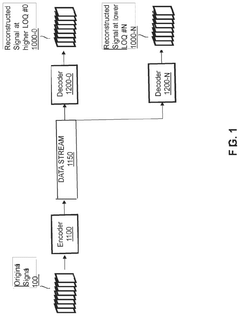
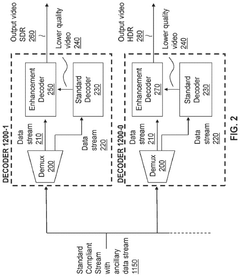
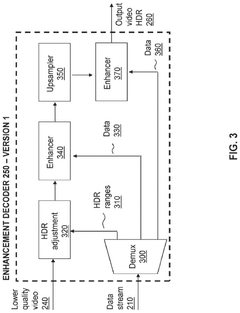
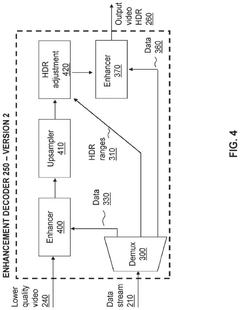
- A hierarchical coding scheme that allows for the encoding and decoding of HDR-type signals in a way that enables compatibility with both HDR and SDR displays, using a method that involves converting input signals between color spaces, down-sampling, and adding ancillary data for reconstruction, thereby providing backwards compatibility and reduced bandwidth requirements.
Dynamic range support within a multi-layer hierarchical coding scheme
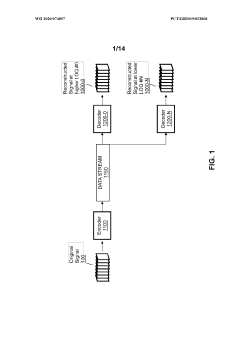
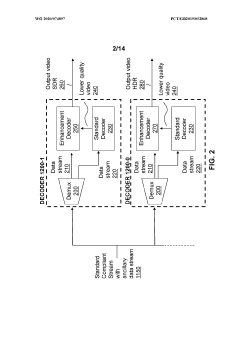
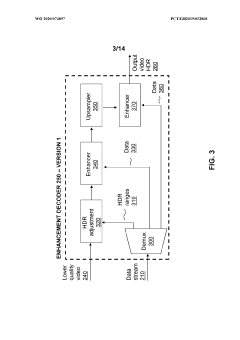
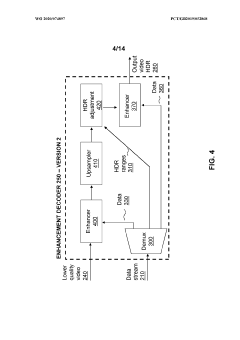
PatentWO2020074897A1
Innovation
- A method for encoding and decoding that converts HDR signals to Standard Dynamic Range (SDR) and back, allowing for flexible streaming of HDR information and mitigating codec inaccuracies and artefacts, while ensuring backwards compatibility and reducing bandwidth requirements through hierarchical coding schemes.
Content Creation Pipeline for HDR Formats
The HDR content creation pipeline represents a critical workflow that differs significantly between HDR10 and Dolby Vision formats. Understanding these differences is essential for content creators and technology implementers seeking optimal visual performance.
For HDR10 content creation, the process begins with capturing or generating high dynamic range source material, typically with a minimum of 10-bit color depth. Color grading is performed using static metadata that establishes fixed parameters for the entire content, including MaxCLL (Maximum Content Light Level) and MaxFALL (Maximum Frame Average Light Level). This static approach simplifies the workflow but limits creative flexibility as brightness values remain constant throughout the content.
Dolby Vision's pipeline, by contrast, incorporates a more sophisticated approach utilizing dynamic metadata. Content creators work with frame-by-frame or scene-by-scene color grading capabilities, allowing precise control over brightness, contrast, and color throughout the content. This process employs specialized tools like the Dolby Vision Content Mapping Unit (CMU) that enables simultaneous SDR and HDR monitoring during production.
The mastering process also differs substantially between formats. HDR10 content is typically mastered at 1,000 nits peak brightness with PQ (Perceptual Quantizer) EOTF (Electro-Optical Transfer Function), while Dolby Vision supports mastering at up to 10,000 nits. Dolby Vision's mastering tools include proprietary algorithms that analyze each frame to optimize tone mapping for various display capabilities.
Quality control procedures vary as well. HDR10 requires standard QC checks for color accuracy and brightness levels against fixed parameters. Dolby Vision demands more rigorous verification processes to ensure dynamic metadata correctly adapts content across different display capabilities, requiring specialized monitoring equipment and certification procedures.
Distribution considerations further differentiate these formats. HDR10 content requires less bandwidth and storage due to its simpler metadata structure, while Dolby Vision's dynamic metadata increases file sizes slightly but enables more sophisticated display mapping. Content delivery networks must account for these differences when optimizing streaming bitrates and quality levels.
The technical infrastructure requirements also diverge significantly. HDR10 implementation requires standard HDR-capable equipment, while Dolby Vision necessitates licensed encoding tools, certified monitoring displays, and specialized quality control systems, representing a more substantial investment in the production pipeline.
For HDR10 content creation, the process begins with capturing or generating high dynamic range source material, typically with a minimum of 10-bit color depth. Color grading is performed using static metadata that establishes fixed parameters for the entire content, including MaxCLL (Maximum Content Light Level) and MaxFALL (Maximum Frame Average Light Level). This static approach simplifies the workflow but limits creative flexibility as brightness values remain constant throughout the content.
Dolby Vision's pipeline, by contrast, incorporates a more sophisticated approach utilizing dynamic metadata. Content creators work with frame-by-frame or scene-by-scene color grading capabilities, allowing precise control over brightness, contrast, and color throughout the content. This process employs specialized tools like the Dolby Vision Content Mapping Unit (CMU) that enables simultaneous SDR and HDR monitoring during production.
The mastering process also differs substantially between formats. HDR10 content is typically mastered at 1,000 nits peak brightness with PQ (Perceptual Quantizer) EOTF (Electro-Optical Transfer Function), while Dolby Vision supports mastering at up to 10,000 nits. Dolby Vision's mastering tools include proprietary algorithms that analyze each frame to optimize tone mapping for various display capabilities.
Quality control procedures vary as well. HDR10 requires standard QC checks for color accuracy and brightness levels against fixed parameters. Dolby Vision demands more rigorous verification processes to ensure dynamic metadata correctly adapts content across different display capabilities, requiring specialized monitoring equipment and certification procedures.
Distribution considerations further differentiate these formats. HDR10 content requires less bandwidth and storage due to its simpler metadata structure, while Dolby Vision's dynamic metadata increases file sizes slightly but enables more sophisticated display mapping. Content delivery networks must account for these differences when optimizing streaming bitrates and quality levels.
The technical infrastructure requirements also diverge significantly. HDR10 implementation requires standard HDR-capable equipment, while Dolby Vision necessitates licensed encoding tools, certified monitoring displays, and specialized quality control systems, representing a more substantial investment in the production pipeline.
Consumer Device Compatibility Assessment
The compatibility of consumer devices with HDR10 and Dolby Vision technologies varies significantly across the market, creating a complex landscape for consumers and manufacturers alike. Currently, HDR10 enjoys broader compatibility due to its open-source nature and earlier market entry. Approximately 85% of HDR-capable displays support HDR10, making it the de facto standard across most consumer electronics categories.
Television manufacturers have widely embraced both technologies, with premium models from Sony, LG, Samsung, and TCL supporting HDR10, while Dolby Vision support remains more selective. Notably, Samsung has consistently avoided Dolby Vision implementation in favor of their proprietary HDR10+ format, creating a significant market segment where Dolby Vision content cannot be natively displayed.
Mobile devices present a different adoption pattern. Apple's iPhone and iPad Pro lines have incorporated Dolby Vision since 2020, while Android manufacturers show mixed implementation. High-end Android devices typically support HDR10, with Dolby Vision appearing primarily on premium models from manufacturers like OnePlus, Xiaomi, and Sony.
The streaming device market demonstrates similar fragmentation. Apple TV 4K, Google Chromecast Ultra, and NVIDIA Shield TV support both formats, while Amazon's Fire TV devices primarily focus on HDR10 and HDR10+. This creates inconsistent viewing experiences depending on the consumer's chosen ecosystem.
Gaming consoles represent another critical segment, with both Xbox Series X/S supporting Dolby Vision for gaming and streaming, while PlayStation 5 currently limits support to HDR10. This distinction impacts visual quality in gaming experiences across competing platforms.
Content availability compounds these compatibility challenges. While streaming services like Netflix, Amazon Prime, and Disney+ offer content in both formats, the actual viewing experience depends on the end-user device capabilities. This creates situations where consumers may be unaware that they are not experiencing optimal visual quality due to device limitations.
The firmware update landscape further complicates matters, as some manufacturers have retroactively added Dolby Vision support to previously HDR10-only devices. This creates consumer confusion regarding whether their existing hardware can access newer visual enhancement technologies through software updates.
Television manufacturers have widely embraced both technologies, with premium models from Sony, LG, Samsung, and TCL supporting HDR10, while Dolby Vision support remains more selective. Notably, Samsung has consistently avoided Dolby Vision implementation in favor of their proprietary HDR10+ format, creating a significant market segment where Dolby Vision content cannot be natively displayed.
Mobile devices present a different adoption pattern. Apple's iPhone and iPad Pro lines have incorporated Dolby Vision since 2020, while Android manufacturers show mixed implementation. High-end Android devices typically support HDR10, with Dolby Vision appearing primarily on premium models from manufacturers like OnePlus, Xiaomi, and Sony.
The streaming device market demonstrates similar fragmentation. Apple TV 4K, Google Chromecast Ultra, and NVIDIA Shield TV support both formats, while Amazon's Fire TV devices primarily focus on HDR10 and HDR10+. This creates inconsistent viewing experiences depending on the consumer's chosen ecosystem.
Gaming consoles represent another critical segment, with both Xbox Series X/S supporting Dolby Vision for gaming and streaming, while PlayStation 5 currently limits support to HDR10. This distinction impacts visual quality in gaming experiences across competing platforms.
Content availability compounds these compatibility challenges. While streaming services like Netflix, Amazon Prime, and Disney+ offer content in both formats, the actual viewing experience depends on the end-user device capabilities. This creates situations where consumers may be unaware that they are not experiencing optimal visual quality due to device limitations.
The firmware update landscape further complicates matters, as some manufacturers have retroactively added Dolby Vision support to previously HDR10-only devices. This creates consumer confusion regarding whether their existing hardware can access newer visual enhancement technologies through software updates.
Unlock deeper insights with Patsnap Eureka Quick Research — get a full tech report to explore trends and direct your research. Try now!
Generate Your Research Report Instantly with AI Agent
Supercharge your innovation with Patsnap Eureka AI Agent Platform!