HDR10 vs Dolby Vision: Technical Mechanisms Decoded
OCT 24, 20259 MIN READ
Generate Your Research Report Instantly with AI Agent
Patsnap Eureka helps you evaluate technical feasibility & market potential.
HDR Technology Evolution and Objectives
High Dynamic Range (HDR) technology represents a significant advancement in visual display capabilities, evolving from the limitations of Standard Dynamic Range (SDR) that dominated displays for decades. The journey began in the early 2000s with research into expanded luminance ranges and color gamuts, but commercial implementation only gained momentum around 2012-2014 when display hardware capabilities caught up with theoretical concepts.
The evolution of HDR technology has been marked by several key milestones. Initially, the focus was on increasing peak brightness levels beyond the traditional 100 nits of SDR content. This was followed by the development of wider color gamuts that could represent more colors than the conventional Rec.709 standard. The establishment of the Rec.2020 color space in 2012 provided a standardized target for expanded color reproduction in next-generation displays.
HDR10, introduced in 2015, emerged as the first widely adopted HDR standard, utilizing static metadata to guide displays in content rendering. This was soon followed by HDR10+, which incorporated dynamic metadata to allow frame-by-frame optimization. Concurrently, Dolby Vision was developed as a proprietary solution offering enhanced capabilities through more sophisticated metadata handling and processing requirements.
The primary objective of HDR technology is to deliver a more realistic visual experience by more closely matching human visual perception capabilities. The human eye can perceive approximately 14 stops of dynamic range simultaneously, while traditional SDR content was limited to about 6-8 stops. HDR aims to bridge this gap by supporting higher peak brightness (up to 10,000 nits in some standards), deeper blacks, and more nuanced gradation between extremes.
Another critical objective is the preservation of creative intent across different display devices. Both HDR10 and Dolby Vision seek to ensure that content appears as creators intended, regardless of the specific capabilities of the viewing device, though they employ different technical approaches to achieve this goal.
The technology continues to evolve toward supporting even wider color gamuts, higher bit depths for smoother gradients, and more sophisticated tone mapping algorithms. Future development paths include improved compatibility with varying ambient viewing conditions and more efficient compression methods to deliver HDR content within practical bandwidth constraints.
As display technology advances, the ultimate goal remains creating a viewing experience that more faithfully reproduces the full range of visual information present in the real world, effectively narrowing the gap between human visual perception and electronic display capabilities.
The evolution of HDR technology has been marked by several key milestones. Initially, the focus was on increasing peak brightness levels beyond the traditional 100 nits of SDR content. This was followed by the development of wider color gamuts that could represent more colors than the conventional Rec.709 standard. The establishment of the Rec.2020 color space in 2012 provided a standardized target for expanded color reproduction in next-generation displays.
HDR10, introduced in 2015, emerged as the first widely adopted HDR standard, utilizing static metadata to guide displays in content rendering. This was soon followed by HDR10+, which incorporated dynamic metadata to allow frame-by-frame optimization. Concurrently, Dolby Vision was developed as a proprietary solution offering enhanced capabilities through more sophisticated metadata handling and processing requirements.
The primary objective of HDR technology is to deliver a more realistic visual experience by more closely matching human visual perception capabilities. The human eye can perceive approximately 14 stops of dynamic range simultaneously, while traditional SDR content was limited to about 6-8 stops. HDR aims to bridge this gap by supporting higher peak brightness (up to 10,000 nits in some standards), deeper blacks, and more nuanced gradation between extremes.
Another critical objective is the preservation of creative intent across different display devices. Both HDR10 and Dolby Vision seek to ensure that content appears as creators intended, regardless of the specific capabilities of the viewing device, though they employ different technical approaches to achieve this goal.
The technology continues to evolve toward supporting even wider color gamuts, higher bit depths for smoother gradients, and more sophisticated tone mapping algorithms. Future development paths include improved compatibility with varying ambient viewing conditions and more efficient compression methods to deliver HDR content within practical bandwidth constraints.
As display technology advances, the ultimate goal remains creating a viewing experience that more faithfully reproduces the full range of visual information present in the real world, effectively narrowing the gap between human visual perception and electronic display capabilities.
Market Demand Analysis for Premium Video Formats
The premium video format market has witnessed substantial growth driven by consumer demand for enhanced visual experiences. As of 2023, the global HDR (High Dynamic Range) content market is valued at approximately $13.8 billion and projected to grow at a CAGR of 14.3% through 2028. This growth is primarily fueled by increasing adoption of 4K and 8K televisions, with over 70% of new TV purchases featuring HDR compatibility.
Consumer research indicates that visual quality has become a decisive factor in content subscription choices, with 64% of consumers citing picture quality as "very important" when selecting streaming services. This trend has prompted major streaming platforms including Netflix, Amazon Prime, Disney+, and Apple TV+ to expand their HDR content libraries significantly, with HDR titles increasing by 215% between 2020 and 2023.
The premium format market demonstrates clear segmentation between consumer preferences. While Dolby Vision enjoys strong brand recognition with 73% awareness among home theater enthusiasts, HDR10 maintains broader compatibility across device ecosystems. Market penetration data shows that approximately 85% of HDR-capable displays support HDR10, while Dolby Vision compatibility exists in roughly 45% of premium displays.
Regional analysis reveals varying adoption patterns, with North America leading premium format consumption at 38% market share, followed by Europe (27%), Asia-Pacific (24%), and other regions (11%). China represents the fastest-growing market with 22% year-over-year growth in HDR content consumption, driven by rapid adoption of advanced display technologies in urban centers.
Content production trends indicate accelerating investment in HDR formats, with major studios allocating 35% more budget to HDR production workflows in 2023 compared to 2021. The gaming industry has emerged as a significant driver, with 78% of AAA game titles now supporting HDR rendering, creating additional demand for compatible display technologies.
Consumer willingness to pay premiums for enhanced visual experiences remains strong, with surveys indicating that viewers will pay an average of 15% more for subscription services offering extensive HDR libraries. This price elasticity has encouraged content providers to use premium formats as competitive differentiators in an increasingly crowded streaming marketplace.
The forecasted growth trajectory suggests HDR formats will achieve mainstream status by 2025, with an estimated 65% of all digital video content expected to be available in at least one HDR format, representing a critical inflection point for market dynamics and technology adoption.
Consumer research indicates that visual quality has become a decisive factor in content subscription choices, with 64% of consumers citing picture quality as "very important" when selecting streaming services. This trend has prompted major streaming platforms including Netflix, Amazon Prime, Disney+, and Apple TV+ to expand their HDR content libraries significantly, with HDR titles increasing by 215% between 2020 and 2023.
The premium format market demonstrates clear segmentation between consumer preferences. While Dolby Vision enjoys strong brand recognition with 73% awareness among home theater enthusiasts, HDR10 maintains broader compatibility across device ecosystems. Market penetration data shows that approximately 85% of HDR-capable displays support HDR10, while Dolby Vision compatibility exists in roughly 45% of premium displays.
Regional analysis reveals varying adoption patterns, with North America leading premium format consumption at 38% market share, followed by Europe (27%), Asia-Pacific (24%), and other regions (11%). China represents the fastest-growing market with 22% year-over-year growth in HDR content consumption, driven by rapid adoption of advanced display technologies in urban centers.
Content production trends indicate accelerating investment in HDR formats, with major studios allocating 35% more budget to HDR production workflows in 2023 compared to 2021. The gaming industry has emerged as a significant driver, with 78% of AAA game titles now supporting HDR rendering, creating additional demand for compatible display technologies.
Consumer willingness to pay premiums for enhanced visual experiences remains strong, with surveys indicating that viewers will pay an average of 15% more for subscription services offering extensive HDR libraries. This price elasticity has encouraged content providers to use premium formats as competitive differentiators in an increasingly crowded streaming marketplace.
The forecasted growth trajectory suggests HDR formats will achieve mainstream status by 2025, with an estimated 65% of all digital video content expected to be available in at least one HDR format, representing a critical inflection point for market dynamics and technology adoption.
Current HDR Standards and Technical Limitations
The current HDR landscape is dominated by several competing standards, each with distinct technical approaches and limitations. HDR10, as the baseline open standard, utilizes static metadata that remains constant throughout content playback. This static approach employs a single set of parameters for an entire piece of content, including maximum brightness, color primaries, and tone mapping information. While widely adopted due to its royalty-free nature, HDR10's static metadata creates significant limitations when content brightness levels vary dramatically between scenes, potentially resulting in compromised image quality during particularly bright or dark sequences.
Dolby Vision addresses these limitations through its dynamic metadata implementation, allowing frame-by-frame or scene-by-scene optimization. This dynamic approach enables more precise control over how each frame is displayed, resulting in potentially superior image quality across varying content brightness levels. However, Dolby Vision's proprietary nature requires licensing fees and specialized hardware implementation, limiting its adoption compared to open standards.
HDR10+ emerged as a royalty-free alternative to Dolby Vision, also offering dynamic metadata capabilities. Despite its technical improvements over HDR10, it faces adoption challenges due to market fragmentation and lacks the comprehensive ecosystem support that Dolby has established.
HLG (Hybrid Log-Gamma) stands apart with its backward compatibility focus, designed specifically for broadcast applications. While offering seamless integration with existing SDR infrastructure, HLG sacrifices some peak brightness capabilities and precision in extreme highlight handling compared to metadata-driven standards.
A significant technical limitation across all HDR standards is the substantial variation in display capabilities. Consumer displays range from budget models barely meeting minimum HDR specifications (often 400-600 nits peak brightness) to premium devices exceeding 2,000 nits. This hardware disparity creates significant challenges for content creators attempting to optimize for diverse viewing experiences.
Content mastering presents another critical limitation, as studios must decide which HDR format to prioritize during production. Multi-format mastering increases production costs substantially, while single-format mastering risks suboptimal presentation on non-native displays. The tone mapping algorithms that translate HDR content to specific display capabilities vary significantly in quality and approach across manufacturers.
Bandwidth requirements also constrain HDR implementation, particularly for streaming services and broadcast applications. The additional data needed for enhanced color depth and dynamic metadata can increase bitrate requirements by 10-30% compared to SDR content, creating distribution challenges in bandwidth-limited environments.
Dolby Vision addresses these limitations through its dynamic metadata implementation, allowing frame-by-frame or scene-by-scene optimization. This dynamic approach enables more precise control over how each frame is displayed, resulting in potentially superior image quality across varying content brightness levels. However, Dolby Vision's proprietary nature requires licensing fees and specialized hardware implementation, limiting its adoption compared to open standards.
HDR10+ emerged as a royalty-free alternative to Dolby Vision, also offering dynamic metadata capabilities. Despite its technical improvements over HDR10, it faces adoption challenges due to market fragmentation and lacks the comprehensive ecosystem support that Dolby has established.
HLG (Hybrid Log-Gamma) stands apart with its backward compatibility focus, designed specifically for broadcast applications. While offering seamless integration with existing SDR infrastructure, HLG sacrifices some peak brightness capabilities and precision in extreme highlight handling compared to metadata-driven standards.
A significant technical limitation across all HDR standards is the substantial variation in display capabilities. Consumer displays range from budget models barely meeting minimum HDR specifications (often 400-600 nits peak brightness) to premium devices exceeding 2,000 nits. This hardware disparity creates significant challenges for content creators attempting to optimize for diverse viewing experiences.
Content mastering presents another critical limitation, as studios must decide which HDR format to prioritize during production. Multi-format mastering increases production costs substantially, while single-format mastering risks suboptimal presentation on non-native displays. The tone mapping algorithms that translate HDR content to specific display capabilities vary significantly in quality and approach across manufacturers.
Bandwidth requirements also constrain HDR implementation, particularly for streaming services and broadcast applications. The additional data needed for enhanced color depth and dynamic metadata can increase bitrate requirements by 10-30% compared to SDR content, creating distribution challenges in bandwidth-limited environments.
Technical Comparison of HDR10 and Dolby Vision
01 HDR10 metadata processing and encoding mechanisms
HDR10 technology employs static metadata processing where brightness parameters are set once for the entire content. The encoding mechanism involves 10-bit color depth processing, allowing for a wider color gamut and higher brightness levels compared to standard dynamic range content. This technology utilizes PQ (Perceptual Quantizer) EOTF (Electro-Optical Transfer Function) to map the digital signal to display brightness, supporting peak brightness levels up to 1000 nits.- HDR10 metadata processing and implementation: HDR10 technology uses static metadata to enhance image quality by expanding the dynamic range and color gamut of video content. The technical mechanism involves processing metadata that defines parameters such as maximum brightness, color primaries, and transfer functions. This static metadata approach provides a standardized way to deliver high dynamic range content across compatible displays, enabling more realistic and vibrant visual experiences compared to standard dynamic range.
- Dolby Vision dynamic metadata framework: Dolby Vision employs a dynamic metadata framework that allows frame-by-frame optimization of brightness, contrast, and color. Unlike static metadata systems, this dynamic approach enables content to be optimized for each scene or even individual frames. The technical mechanism includes specialized algorithms for tone mapping and color volume transformation that adapt to different display capabilities, ensuring consistent visual quality across various devices with different specifications.
- Color gamut expansion and bit depth processing: Both HDR10 and Dolby Vision technologies implement expanded color gamut and increased bit depth processing. These mechanisms involve sophisticated color space transformations and bit depth expansion from standard 8-bit to 10-bit or 12-bit color depth. This allows for smoother gradients and more precise color reproduction, particularly in highlights and shadows, resulting in more natural-looking images with reduced banding artifacts.
- Display adaptation and tone mapping algorithms: Advanced tone mapping algorithms are central to both HDR technologies, enabling content to be optimized for displays with varying capabilities. These algorithms dynamically adjust brightness, contrast, and color saturation based on the display's specifications and the content being shown. The technical mechanisms include perceptual quality modeling that considers human visual perception to deliver optimal image quality while preserving creative intent across different viewing environments.
- Hardware implementation and compatibility solutions: The implementation of HDR10 and Dolby Vision requires specific hardware architectures and compatibility solutions. These include specialized processing units for real-time metadata analysis, enhanced display drivers, and interface protocols that support higher bandwidth requirements. The technical mechanisms involve signal processing pipelines that can handle the increased data requirements of HDR content while maintaining compatibility with existing infrastructure through adaptive processing and backward compatibility layers.
02 Dolby Vision dynamic metadata implementation
Dolby Vision implements a dynamic metadata approach where brightness and color parameters can be adjusted scene-by-scene or even frame-by-frame. This technology utilizes a 12-bit color depth processing pipeline, enabling more precise color gradation and higher potential brightness levels up to 10,000 nits. The dynamic metadata allows displays to optimize content rendering based on the specific capabilities of each display device.Expand Specific Solutions03 Display device adaptation for HDR content
HDR display technologies incorporate specialized hardware and software mechanisms to adapt high dynamic range content to the specific capabilities of the display. This includes tone mapping algorithms that adjust brightness and contrast levels to match the display's peak luminance capabilities while preserving detail in both highlight and shadow areas. Advanced display processors analyze incoming HDR signals and apply appropriate color volume transformations to optimize visual quality.Expand Specific Solutions04 Color volume transformation and tone mapping
Both HDR10 and Dolby Vision employ sophisticated color volume transformation techniques to map the wide color gamut and high dynamic range of the source content to the capabilities of the display device. These transformations involve complex algorithms that preserve creative intent while adapting to display limitations. Tone mapping processes ensure that highlights and shadows retain detail even when the display cannot reproduce the full brightness range of the original content.Expand Specific Solutions05 Signal processing and transmission protocols
HDR technologies utilize specialized signal processing and transmission protocols to maintain content quality throughout the distribution chain. These include specific encoding parameters, compression techniques optimized for high dynamic range content, and metadata signaling methods that communicate display requirements to receiving devices. The transmission systems ensure compatibility with existing infrastructure while delivering enhanced visual quality through efficient bandwidth utilization and robust error correction mechanisms.Expand Specific Solutions
Key Industry Players in HDR Technology Ecosystem
The HDR10 vs Dolby Vision competitive landscape is currently in a mature growth phase, with the global HDR market expected to reach $36.7 billion by 2028. Dolby Laboratories leads with its proprietary Dolby Vision technology offering dynamic metadata and scene-by-scene optimization, while Samsung champions the open-source HDR10+ standard. Other significant players include MediaTek, QUALCOMM, and NVIDIA providing chipset support, while content ecosystem development involves Adobe and Microsoft. Consumer electronics manufacturers like Philips, TCL, and Skyworth are implementing both standards, with adoption decisions influenced by licensing costs and technical requirements. The ecosystem continues to evolve with streaming platforms and content creators increasingly supporting both formats.
Samsung Electronics Co., Ltd.
Technical Solution: Samsung has been a primary developer and advocate of HDR10+, an evolution of the HDR10 standard that incorporates dynamic metadata similar to Dolby Vision but in an open, royalty-free format. Samsung's implementation utilizes dynamic tone mapping that adjusts brightness levels on a scene-by-scene or frame-by-frame basis, significantly improving upon HDR10's static metadata limitations. Their technical approach incorporates the ST.2084 PQ (Perceptual Quantizer) EOTF for luminance mapping and BT.2020 color space for wider color gamut. Samsung's HDR processing engines employ advanced local dimming algorithms that divide the backlight into numerous independently controlled zones, allowing for precise contrast control between bright and dark areas within the same frame. Additionally, Samsung has developed AI-enhanced upscaling technology that can convert standard content to near-HDR quality through real-time scene analysis and enhancement.
Strengths: Open standard with no licensing fees; backward compatibility with HDR10 content; dynamic metadata provides improved performance over basic HDR10; strong industry adoption across multiple manufacturers. Weaknesses: Peak brightness capabilities typically lower than Dolby Vision; less granular frame-by-frame control; more limited color depth (10-bit versus Dolby Vision's 12-bit); ecosystem still developing compared to more established standards.
Dolby Laboratories Licensing Corp.
Technical Solution: Dolby Vision implements a dynamic metadata approach that allows frame-by-frame optimization of HDR content. The technology supports up to 12-bit color depth (versus HDR10's 10-bit), enabling a potential palette of 68.7 billion colors. Dolby Vision's proprietary algorithm analyzes each frame and adjusts brightness, contrast, and color mapping dynamically throughout content playback. The system utilizes dual-layer encoding that separates base layer (compatible with standard displays) from enhancement layer (containing HDR information), allowing backward compatibility while maintaining premium quality on supported displays. Dolby Vision also incorporates perceptual quantization (PQ) EOTF (Electro-Optical Transfer Function) that more closely matches human visual perception than traditional gamma curves, enabling more accurate representation of both very bright highlights and shadow details simultaneously.
Strengths: Superior dynamic range (up to 10,000 nits peak brightness versus HDR10's typical 1,000 nits); frame-by-frame optimization provides more precise image control; wider color gamut support; better handling of content across different display capabilities. Weaknesses: Proprietary technology requiring licensing fees; higher processing requirements; limited content availability compared to more open standards.
Core Patents and Innovations in Dynamic Metadata
Dynamic range support within a multi-layer hierarchical coding scheme
PatentWO2020074897A1
Innovation
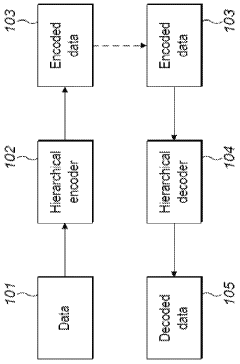
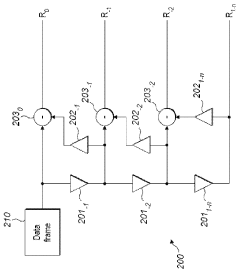
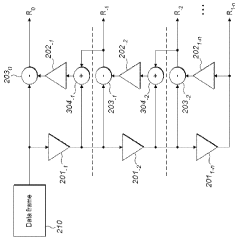
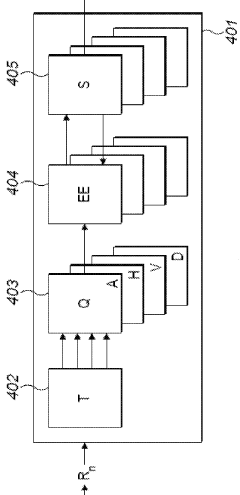
- A method for encoding and decoding that converts HDR signals to Standard Dynamic Range (SDR) and back, allowing for flexible streaming of HDR information and mitigating codec inaccuracies and artefacts, while ensuring backwards compatibility and reducing bandwidth requirements through hierarchical coding schemes.
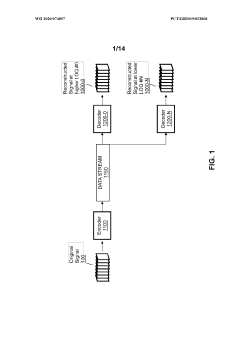
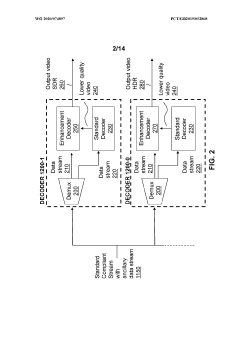
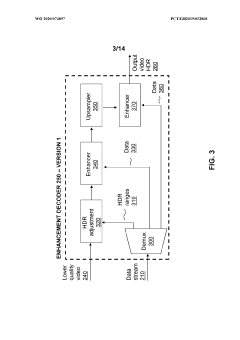
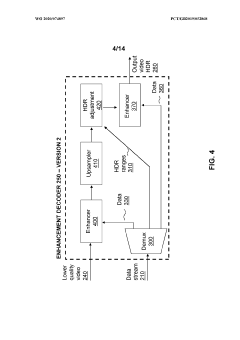
Signal processing with overlay regions
PatentWO2023187307A1
Innovation
- A hierarchical coding scheme that uses residual data to efficiently encode and decode signals, allowing for the overlay of HDR content onto SDR content by generating residuals indicative of differences between HDR and SDR signals, which are then encoded using a method like LCEVC, enabling flexible and efficient distribution across various devices.
Content Creation Pipeline for HDR Technologies
The HDR content creation pipeline represents a complex workflow that differs significantly between HDR10 and Dolby Vision technologies. Both formats require specialized equipment and processes, but their approaches to content mastering diverge in fundamental ways.
For HDR10 content creation, the workflow typically begins with capture using cameras capable of high dynamic range recording, generally with at least 10-bit color depth. The footage then undergoes color grading on HDR-capable monitors, where colorists set static metadata including MaxCLL (Maximum Content Light Level) and MaxFALL (Maximum Frame Average Light Level). These static parameters establish fixed brightness boundaries that remain constant throughout the entire content.
Dolby Vision employs a more sophisticated pipeline that begins with similar high-quality capture but extends to 12-bit color depth processing. The distinguishing feature of Dolby Vision's creation process is the generation of dynamic metadata through frame-by-frame analysis. This process utilizes specialized Dolby Vision tools that allow colorists to create content-aware brightness mapping that can adapt to each scene's specific requirements.
A critical component in both pipelines is the mastering display. HDR10 content is typically mastered on displays meeting the basic HDR specification, while Dolby Vision requires Dolby-certified mastering monitors capable of interpreting and displaying the format's enhanced color and brightness information. These monitors must accurately represent the expanded color volume that HDR technologies enable.
The encoding stage also differs substantially between formats. HDR10 utilizes standard HEVC encoding with PQ (Perceptual Quantizer) transfer function and static metadata embedded at the content level. Dolby Vision encoding is more complex, creating a base HDR10 layer plus an enhancement layer containing the dynamic metadata and additional color information.
Quality control processes for Dolby Vision are more rigorous, requiring certification and verification using Dolby's proprietary tools to ensure the dynamic metadata correctly maps content across different display capabilities. HDR10 quality control focuses primarily on ensuring the static metadata accurately represents the content's maximum brightness values.
The final deliverable formats also differ, with HDR10 typically delivered as a single master file, while Dolby Vision productions often include both a Dolby Vision master and an HDR10 fallback version for compatibility with non-Dolby Vision displays.
For HDR10 content creation, the workflow typically begins with capture using cameras capable of high dynamic range recording, generally with at least 10-bit color depth. The footage then undergoes color grading on HDR-capable monitors, where colorists set static metadata including MaxCLL (Maximum Content Light Level) and MaxFALL (Maximum Frame Average Light Level). These static parameters establish fixed brightness boundaries that remain constant throughout the entire content.
Dolby Vision employs a more sophisticated pipeline that begins with similar high-quality capture but extends to 12-bit color depth processing. The distinguishing feature of Dolby Vision's creation process is the generation of dynamic metadata through frame-by-frame analysis. This process utilizes specialized Dolby Vision tools that allow colorists to create content-aware brightness mapping that can adapt to each scene's specific requirements.
A critical component in both pipelines is the mastering display. HDR10 content is typically mastered on displays meeting the basic HDR specification, while Dolby Vision requires Dolby-certified mastering monitors capable of interpreting and displaying the format's enhanced color and brightness information. These monitors must accurately represent the expanded color volume that HDR technologies enable.
The encoding stage also differs substantially between formats. HDR10 utilizes standard HEVC encoding with PQ (Perceptual Quantizer) transfer function and static metadata embedded at the content level. Dolby Vision encoding is more complex, creating a base HDR10 layer plus an enhancement layer containing the dynamic metadata and additional color information.
Quality control processes for Dolby Vision are more rigorous, requiring certification and verification using Dolby's proprietary tools to ensure the dynamic metadata correctly maps content across different display capabilities. HDR10 quality control focuses primarily on ensuring the static metadata accurately represents the content's maximum brightness values.
The final deliverable formats also differ, with HDR10 typically delivered as a single master file, while Dolby Vision productions often include both a Dolby Vision master and an HDR10 fallback version for compatibility with non-Dolby Vision displays.
Display Hardware Requirements and Compatibility
The implementation of HDR technologies requires specific hardware capabilities to properly display the enhanced dynamic range and color gamut. For HDR10, displays must support a minimum of 10-bit color depth, enabling the representation of over 1 billion colors compared to the 16.7 million colors in standard 8-bit displays. This increased bit depth is essential for smooth color gradients and preventing banding artifacts in high-contrast scenes.
Display brightness capabilities represent a critical differentiator between HDR standards. HDR10-compatible displays typically require a minimum peak brightness of 1,000 nits, though many consumer-grade displays achieve only 600-700 nits. In contrast, Dolby Vision was designed with a technical ceiling of 10,000 nits, though current consumer displays rarely exceed 2,000-4,000 nits.
Color gamut support presents another hardware requirement, with both technologies mandating at least 90% coverage of the DCI-P3 color space. Premium displays often aim for BT.2020 (Rec. 2020) compatibility, representing a significantly wider color gamut than traditional sRGB standards. This expanded color reproduction capability necessitates advanced panel technologies such as quantum dot or OLED.
The processing architecture differs significantly between the two standards. HDR10 requires relatively straightforward decoding capabilities as it employs static metadata. Conversely, Dolby Vision demands more sophisticated processing hardware with dedicated chipsets to handle its dynamic metadata processing on a scene-by-scene or even frame-by-frame basis.
Backward compatibility considerations also influence hardware requirements. Most HDR10 displays can downconvert content to SDR, though with quality limitations. Dolby Vision implements a more sophisticated backward compatibility layer, requiring additional processing capabilities to properly map content to lower-capability displays while preserving creative intent.
Connection interfaces present another hardware consideration. Both technologies require HDMI 2.0a or newer for full functionality, with HDMI 2.1 providing additional bandwidth for 4K HDR content at higher frame rates. DisplayPort 1.4 and newer also support both standards, though with varying levels of implementation across device ecosystems.
For manufacturers, Dolby Vision implementation requires certification and licensing from Dolby Laboratories, necessitating compliance with specific hardware specifications and quality control measures. This certification process ensures consistent performance across the Dolby Vision ecosystem but adds cost and complexity compared to the more open HDR10 standard.
Display brightness capabilities represent a critical differentiator between HDR standards. HDR10-compatible displays typically require a minimum peak brightness of 1,000 nits, though many consumer-grade displays achieve only 600-700 nits. In contrast, Dolby Vision was designed with a technical ceiling of 10,000 nits, though current consumer displays rarely exceed 2,000-4,000 nits.
Color gamut support presents another hardware requirement, with both technologies mandating at least 90% coverage of the DCI-P3 color space. Premium displays often aim for BT.2020 (Rec. 2020) compatibility, representing a significantly wider color gamut than traditional sRGB standards. This expanded color reproduction capability necessitates advanced panel technologies such as quantum dot or OLED.
The processing architecture differs significantly between the two standards. HDR10 requires relatively straightforward decoding capabilities as it employs static metadata. Conversely, Dolby Vision demands more sophisticated processing hardware with dedicated chipsets to handle its dynamic metadata processing on a scene-by-scene or even frame-by-frame basis.
Backward compatibility considerations also influence hardware requirements. Most HDR10 displays can downconvert content to SDR, though with quality limitations. Dolby Vision implements a more sophisticated backward compatibility layer, requiring additional processing capabilities to properly map content to lower-capability displays while preserving creative intent.
Connection interfaces present another hardware consideration. Both technologies require HDMI 2.0a or newer for full functionality, with HDMI 2.1 providing additional bandwidth for 4K HDR content at higher frame rates. DisplayPort 1.4 and newer also support both standards, though with varying levels of implementation across device ecosystems.
For manufacturers, Dolby Vision implementation requires certification and licensing from Dolby Laboratories, necessitating compliance with specific hardware specifications and quality control measures. This certification process ensures consistent performance across the Dolby Vision ecosystem but adds cost and complexity compared to the more open HDR10 standard.
Unlock deeper insights with Patsnap Eureka Quick Research — get a full tech report to explore trends and direct your research. Try now!
Generate Your Research Report Instantly with AI Agent
Supercharge your innovation with Patsnap Eureka AI Agent Platform!