

How Gas Welding Advances Precision Component Assembly Processes
AUG 7, 20259 MIN READ
Generate Your Research Report Instantly with AI Agent
PatSnap Eureka helps you evaluate technical feasibility & market potential.
Gas Welding Evolution and Objectives
Gas welding has been a cornerstone of precision component assembly processes for over a century, evolving from its rudimentary beginnings to become a sophisticated and indispensable technique in modern manufacturing. The journey of gas welding began in the early 1900s with the development of oxyacetylene welding, which revolutionized metal joining capabilities across various industries.
Throughout its evolution, gas welding has consistently aimed to enhance the accuracy, strength, and efficiency of component assembly. The primary objective has been to create seamless, high-quality joints that can withstand the rigors of industrial applications while maintaining the structural integrity of the assembled components. This goal has driven continuous improvements in welding equipment, techniques, and materials.
As industries progressed, the demands on gas welding technology increased exponentially. The aerospace, automotive, and precision manufacturing sectors, in particular, required ever-more precise and reliable welding solutions. This led to the development of advanced gas mixtures, refined torch designs, and improved control systems, all aimed at achieving greater precision in the welding process.
The evolution of gas welding has been marked by several key milestones. The introduction of inert gas shielding in the 1940s, for instance, significantly reduced oxidation and improved weld quality. The development of micro-welding techniques in the 1960s and 1970s enabled the joining of extremely small components, opening new possibilities in electronics and medical device manufacturing.
In recent decades, the integration of computer-controlled systems and robotics has further advanced gas welding capabilities. These technological advancements have allowed for unprecedented levels of precision, repeatability, and automation in welding processes. The ability to precisely control heat input, gas flow, and torch movement has resulted in welds of exceptional quality and consistency.
Today, the objectives of gas welding in precision component assembly are multifaceted. They include achieving micron-level accuracy in joint placement, minimizing heat-affected zones to preserve material properties, and ensuring the long-term reliability of welded assemblies. Additionally, there is a growing focus on enhancing energy efficiency and reducing environmental impact, driving research into more sustainable welding practices and materials.
Looking forward, the gas welding industry continues to pursue advancements that will further refine precision assembly processes. This includes the development of smart welding systems that can adapt in real-time to changing conditions, the exploration of new gas mixtures for specialized applications, and the integration of advanced sensors and machine learning algorithms to optimize welding parameters automatically.
Throughout its evolution, gas welding has consistently aimed to enhance the accuracy, strength, and efficiency of component assembly. The primary objective has been to create seamless, high-quality joints that can withstand the rigors of industrial applications while maintaining the structural integrity of the assembled components. This goal has driven continuous improvements in welding equipment, techniques, and materials.
As industries progressed, the demands on gas welding technology increased exponentially. The aerospace, automotive, and precision manufacturing sectors, in particular, required ever-more precise and reliable welding solutions. This led to the development of advanced gas mixtures, refined torch designs, and improved control systems, all aimed at achieving greater precision in the welding process.
The evolution of gas welding has been marked by several key milestones. The introduction of inert gas shielding in the 1940s, for instance, significantly reduced oxidation and improved weld quality. The development of micro-welding techniques in the 1960s and 1970s enabled the joining of extremely small components, opening new possibilities in electronics and medical device manufacturing.
In recent decades, the integration of computer-controlled systems and robotics has further advanced gas welding capabilities. These technological advancements have allowed for unprecedented levels of precision, repeatability, and automation in welding processes. The ability to precisely control heat input, gas flow, and torch movement has resulted in welds of exceptional quality and consistency.
Today, the objectives of gas welding in precision component assembly are multifaceted. They include achieving micron-level accuracy in joint placement, minimizing heat-affected zones to preserve material properties, and ensuring the long-term reliability of welded assemblies. Additionally, there is a growing focus on enhancing energy efficiency and reducing environmental impact, driving research into more sustainable welding practices and materials.
Looking forward, the gas welding industry continues to pursue advancements that will further refine precision assembly processes. This includes the development of smart welding systems that can adapt in real-time to changing conditions, the exploration of new gas mixtures for specialized applications, and the integration of advanced sensors and machine learning algorithms to optimize welding parameters automatically.
Precision Assembly Market Analysis
The precision assembly market has experienced significant growth in recent years, driven by increasing demand for high-quality, miniaturized components across various industries. This market segment is particularly crucial in sectors such as electronics, automotive, aerospace, and medical devices, where the accuracy and reliability of assembled components directly impact product performance and safety.
Gas welding, as a precision assembly technique, has played a pivotal role in advancing the capabilities of manufacturers to meet the stringent requirements of these industries. The global precision assembly market size was valued at approximately $44 billion in 2020 and is projected to grow at a compound annual growth rate (CAGR) of 6.8% from 2021 to 2028. This growth is attributed to the rising adoption of automation and robotics in manufacturing processes, which has significantly enhanced the precision and efficiency of assembly operations.
The electronics industry remains the largest consumer of precision assembly technologies, accounting for over 40% of the market share. The increasing complexity of electronic devices, coupled with the trend towards miniaturization, has driven the demand for advanced assembly techniques like gas welding. The automotive sector follows closely, with a market share of around 30%, as vehicle manufacturers increasingly incorporate sophisticated electronic systems and lightweight materials that require precise assembly.
Geographically, Asia-Pacific dominates the precision assembly market, holding approximately 45% of the global market share. This dominance is primarily due to the region's strong presence in electronics manufacturing and the rapid industrialization of countries like China and India. North America and Europe follow, each accounting for about 25% of the market, with their focus on high-value industries such as aerospace and medical devices.
The market is characterized by intense competition among key players, including Panasonic Corporation, Hitachi High-Technologies Corporation, and Mycronic AB. These companies are continuously investing in research and development to enhance their precision assembly technologies, with a particular focus on improving the accuracy and speed of gas welding processes for component assembly.
Looking ahead, the precision assembly market is expected to witness further growth, driven by emerging technologies such as 5G, Internet of Things (IoT), and electric vehicles. These technologies require increasingly complex and precise assembly processes, presenting both challenges and opportunities for gas welding advancements. As manufacturers strive to meet the evolving demands of these industries, the role of gas welding in precision component assembly is likely to become even more critical, fostering innovation and technological progress in the field.
Gas welding, as a precision assembly technique, has played a pivotal role in advancing the capabilities of manufacturers to meet the stringent requirements of these industries. The global precision assembly market size was valued at approximately $44 billion in 2020 and is projected to grow at a compound annual growth rate (CAGR) of 6.8% from 2021 to 2028. This growth is attributed to the rising adoption of automation and robotics in manufacturing processes, which has significantly enhanced the precision and efficiency of assembly operations.
The electronics industry remains the largest consumer of precision assembly technologies, accounting for over 40% of the market share. The increasing complexity of electronic devices, coupled with the trend towards miniaturization, has driven the demand for advanced assembly techniques like gas welding. The automotive sector follows closely, with a market share of around 30%, as vehicle manufacturers increasingly incorporate sophisticated electronic systems and lightweight materials that require precise assembly.
Geographically, Asia-Pacific dominates the precision assembly market, holding approximately 45% of the global market share. This dominance is primarily due to the region's strong presence in electronics manufacturing and the rapid industrialization of countries like China and India. North America and Europe follow, each accounting for about 25% of the market, with their focus on high-value industries such as aerospace and medical devices.
The market is characterized by intense competition among key players, including Panasonic Corporation, Hitachi High-Technologies Corporation, and Mycronic AB. These companies are continuously investing in research and development to enhance their precision assembly technologies, with a particular focus on improving the accuracy and speed of gas welding processes for component assembly.
Looking ahead, the precision assembly market is expected to witness further growth, driven by emerging technologies such as 5G, Internet of Things (IoT), and electric vehicles. These technologies require increasingly complex and precise assembly processes, presenting both challenges and opportunities for gas welding advancements. As manufacturers strive to meet the evolving demands of these industries, the role of gas welding in precision component assembly is likely to become even more critical, fostering innovation and technological progress in the field.
Gas Welding Challenges in Component Assembly
Gas welding, while a traditional joining technique, faces several challenges in precision component assembly processes. One of the primary issues is temperature control. The high heat input required for gas welding can lead to thermal distortion and residual stresses in the assembled components, potentially compromising the structural integrity and dimensional accuracy of the final product. This is particularly problematic when working with heat-sensitive materials or components with tight tolerances.
Another significant challenge is the difficulty in achieving consistent weld quality across multiple joints. The manual nature of gas welding introduces variability in the process, as the skill and experience of the welder play a crucial role in determining the outcome. This human factor can lead to inconsistencies in weld penetration, bead profile, and overall joint strength, which are critical factors in precision assembly.
The limited automation potential of gas welding poses a challenge in high-volume production environments. Unlike more modern welding techniques, gas welding is less amenable to robotic implementation, making it challenging to integrate into automated assembly lines. This limitation can result in slower production rates and increased labor costs, potentially impacting the overall efficiency of the assembly process.
Precision control of the weld pool is another area of concern. The relatively large and diffuse heat source in gas welding makes it difficult to achieve the fine control necessary for joining small or intricate components. This can lead to issues such as excessive heat-affected zones, which may alter the material properties of the joined components and affect their performance.
Environmental and safety considerations also present challenges in gas welding applications. The process generates fumes and requires the handling of combustible gases, necessitating robust ventilation systems and safety protocols. These requirements can add complexity and cost to the assembly process, particularly in confined spaces or when working with sensitive electronic components.
The limited range of materials suitable for gas welding is another constraint. While effective for many ferrous metals, gas welding is less suitable for joining advanced alloys, composites, or dissimilar materials often used in modern precision components. This limitation can restrict design options and material choices in complex assembly projects.
Lastly, the relatively slow welding speeds associated with gas welding can be a bottleneck in high-throughput assembly operations. This slower pace not only affects production rates but also increases the time components are exposed to high temperatures, potentially exacerbating issues related to thermal distortion and material property changes.
Another significant challenge is the difficulty in achieving consistent weld quality across multiple joints. The manual nature of gas welding introduces variability in the process, as the skill and experience of the welder play a crucial role in determining the outcome. This human factor can lead to inconsistencies in weld penetration, bead profile, and overall joint strength, which are critical factors in precision assembly.
The limited automation potential of gas welding poses a challenge in high-volume production environments. Unlike more modern welding techniques, gas welding is less amenable to robotic implementation, making it challenging to integrate into automated assembly lines. This limitation can result in slower production rates and increased labor costs, potentially impacting the overall efficiency of the assembly process.
Precision control of the weld pool is another area of concern. The relatively large and diffuse heat source in gas welding makes it difficult to achieve the fine control necessary for joining small or intricate components. This can lead to issues such as excessive heat-affected zones, which may alter the material properties of the joined components and affect their performance.
Environmental and safety considerations also present challenges in gas welding applications. The process generates fumes and requires the handling of combustible gases, necessitating robust ventilation systems and safety protocols. These requirements can add complexity and cost to the assembly process, particularly in confined spaces or when working with sensitive electronic components.
The limited range of materials suitable for gas welding is another constraint. While effective for many ferrous metals, gas welding is less suitable for joining advanced alloys, composites, or dissimilar materials often used in modern precision components. This limitation can restrict design options and material choices in complex assembly projects.
Lastly, the relatively slow welding speeds associated with gas welding can be a bottleneck in high-throughput assembly operations. This slower pace not only affects production rates but also increases the time components are exposed to high temperatures, potentially exacerbating issues related to thermal distortion and material property changes.
Current Gas Welding Techniques for Precision Assembly
01 Precision control systems for gas welding
Advanced control systems are implemented to enhance the precision of gas welding processes. These systems may include computerized monitoring of gas flow rates, temperature, and pressure to maintain consistent welding conditions. Real-time adjustments can be made to optimize the welding parameters, resulting in higher quality and more precise welds.- Precision control systems for gas welding: Advanced control systems are implemented to enhance the precision of gas welding processes. These systems may include computerized controls, sensors, and feedback mechanisms to regulate gas flow, temperature, and torch positioning. Such precision control allows for more accurate and consistent welds, particularly in applications requiring high precision.
- Specialized gas welding torches for precision work: Innovative torch designs are developed specifically for precision gas welding. These torches may feature fine-tip nozzles, adjustable flame settings, and ergonomic designs to allow welders greater control and accuracy. Some designs may incorporate cooling systems or heat shields to maintain stability during delicate operations.
- Automated gas welding systems for enhanced precision: Robotic and automated gas welding systems are utilized to achieve high levels of precision. These systems can be programmed to perform complex welding patterns with consistent accuracy, minimizing human error. They often incorporate advanced vision systems and real-time monitoring to ensure weld quality and precision.
- Precision gas mixture and flow control: Techniques and devices for precise control of gas mixtures and flow rates in welding applications are developed. These may include digital flow meters, programmable gas mixing units, and pressure regulators. Accurate gas control ensures optimal flame characteristics and contributes to weld quality and precision.
- Micro-welding techniques for high-precision applications: Specialized micro-welding techniques using gas welding are developed for applications requiring extremely high precision, such as in electronics or medical device manufacturing. These techniques may involve miniaturized torches, ultra-fine flame control, and specialized fixturing to achieve welds on a microscopic scale.
02 Specialized nozzle designs for improved gas welding accuracy
Innovative nozzle designs are developed to improve the accuracy of gas welding. These nozzles may feature precise gas flow control, optimized mixing chambers, or adjustable flame shapes. The enhanced nozzle designs contribute to better heat distribution and more focused flame control, leading to increased welding precision.Expand Specific Solutions03 Integration of sensors and feedback mechanisms
Gas welding equipment is equipped with advanced sensors and feedback mechanisms to enhance precision. These sensors may monitor factors such as joint alignment, weld pool temperature, and material thickness. The feedback systems allow for real-time adjustments to welding parameters, ensuring consistent and accurate welds across various materials and conditions.Expand Specific Solutions04 Automated positioning and movement systems
Precision in gas welding is improved through the use of automated positioning and movement systems. These may include robotic arms, CNC-controlled welding tables, or automated torch positioning devices. By minimizing human error and ensuring consistent torch movement and positioning, these systems contribute to higher precision in gas welding applications.Expand Specific Solutions05 Advanced gas mixture control and regulation
Precision gas welding is enhanced through advanced gas mixture control and regulation systems. These systems may employ digital flow meters, precise mixing valves, or computerized gas composition analyzers. By ensuring optimal gas ratios and consistent flow rates, these technologies contribute to more stable and precise welding conditions, resulting in higher quality welds.Expand Specific Solutions
Key Gas Welding Equipment Manufacturers
The gas welding industry is in a mature stage, with a stable market size driven by ongoing demand in precision component assembly across various sectors. The technology's maturity is evident from the involvement of established players like MTU Aero Engines AG and Toyota Motor Corp., who leverage gas welding for high-precision applications. Companies such as Rolls-Royce Deutschland Ltd. & Co. KG and General Electric Company are at the forefront of innovation, continually refining gas welding techniques for aerospace and industrial applications. The competitive landscape is characterized by a mix of large conglomerates and specialized firms like Spinduction Weld, Inc., which focuses on advanced welding technologies, indicating a market that values both scale and niche expertise.
Siemens AG
Technical Solution: Siemens has contributed to advancing gas welding in precision component assembly through its integrated digital manufacturing solutions[17]. Their approach combines advanced gas welding equipment with IoT and data analytics to create a connected welding ecosystem[18]. This system provides real-time monitoring of welding parameters, including gas flow and composition, enabling immediate adjustments to maintain optimal weld quality[19]. Siemens has also developed AI-driven predictive maintenance algorithms for gas welding equipment, ensuring consistent performance in high-precision assembly operations[20]. Additionally, their virtual commissioning technology allows for the simulation and optimization of gas welding processes before physical implementation, reducing setup time and improving overall assembly efficiency[21].
Strengths: Integrated digital solutions, IoT and data analytics integration, AI-driven maintenance, virtual commissioning capabilities. Weaknesses: May require significant infrastructure upgrades, potential cybersecurity concerns with connected systems.
Edison Welding Institute, Inc.
Technical Solution: Edison Welding Institute (EWI) has developed advanced gas welding techniques for precision component assembly. Their approach utilizes controlled heat input and precise gas mixture ratios to achieve high-quality welds in complex geometries[1]. EWI's gas welding process incorporates real-time monitoring and adaptive control systems to maintain optimal welding parameters throughout the assembly process[2]. This technology allows for the joining of dissimilar materials with minimal distortion, which is crucial in industries such as aerospace and automotive manufacturing[3]. EWI has also implemented automated gas welding systems that integrate with robotic assembly lines, enhancing repeatability and reducing human error in precision component assembly[4].
Strengths: Expertise in advanced welding techniques, ability to join dissimilar materials, integration with automated systems. Weaknesses: May require significant initial investment, potential limitations in very high-temperature applications.
Innovative Gas Welding Patents for Component Joining
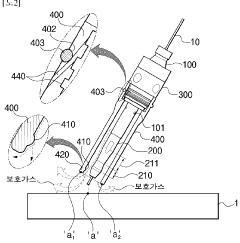
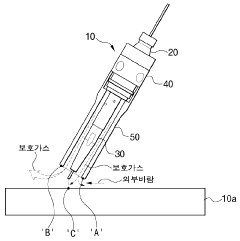
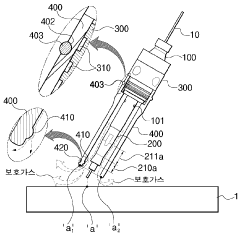
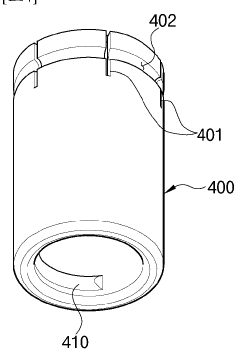
Torch head for gas welding
PatentWO2023128175A1
Innovation
- The torch head incorporates a gas spreading guide on the welding tip and a protective gas concentration guide on the nozzle, directing shielding gas flow towards the welding area and increasing its velocity vector, even when the nozzle is inclined, to effectively block external air and reduce gas consumption.
Method and device for welding plastic parts
PatentWO2022063982A1
Innovation
- A method and device where the joining surfaces are heated using a hot gas stream directed through a channel-shaped recess in a gas guide block, with multiple feed channels opening at an angle into the recess, allowing for concentrated heating and reduced heating times, even for complex shapes.


Safety Standards in Gas Welding Processes
Safety standards in gas welding processes are paramount to ensure the well-being of workers and the integrity of precision component assembly. These standards encompass a wide range of protocols and guidelines designed to mitigate risks associated with the use of flammable gases, high temperatures, and potentially hazardous materials.
One of the primary safety considerations in gas welding is the proper handling and storage of gas cylinders. Strict regulations govern the transportation, storage, and usage of these pressurized containers to prevent accidents and explosions. Welders must be trained in the correct procedures for securing cylinders, inspecting valves, and detecting leaks. Additionally, proper ventilation is crucial to prevent the accumulation of potentially explosive gases in confined spaces.
Personal protective equipment (PPE) plays a vital role in gas welding safety. Welders are required to wear appropriate eye protection, such as welding helmets with the correct shade of lens, to shield their eyes from intense light and harmful radiation. Heat-resistant gloves, flame-retardant clothing, and safety boots are essential to protect against burns and sparks. Respiratory protection may also be necessary when working with certain materials or in poorly ventilated areas.
Fire prevention is another critical aspect of gas welding safety standards. Welding areas must be cleared of flammable materials, and fire extinguishers should be readily accessible. Some standards mandate the presence of a fire watch during and after welding operations to monitor for potential fire outbreaks. Proper housekeeping practices, such as regular cleaning and maintenance of welding equipment, also contribute to fire prevention efforts.
Gas detection systems are increasingly being incorporated into welding safety protocols. These systems can alert workers to the presence of dangerous gas concentrations, allowing for timely evacuation and ventilation. Regular calibration and maintenance of these detection systems are essential to ensure their reliability.
Training and certification programs form an integral part of gas welding safety standards. Welders must undergo comprehensive training on equipment operation, hazard recognition, emergency procedures, and first aid. Many jurisdictions require welders to obtain and maintain certifications that demonstrate their competence in safe welding practices.
Lastly, safety standards in gas welding emphasize the importance of regular equipment inspections and maintenance. This includes checking hoses, regulators, and torches for wear or damage, as well as ensuring that all safety features, such as flashback arrestors, are in place and functioning correctly. Proper documentation of these inspections and any maintenance performed is often required to demonstrate compliance with safety regulations.
One of the primary safety considerations in gas welding is the proper handling and storage of gas cylinders. Strict regulations govern the transportation, storage, and usage of these pressurized containers to prevent accidents and explosions. Welders must be trained in the correct procedures for securing cylinders, inspecting valves, and detecting leaks. Additionally, proper ventilation is crucial to prevent the accumulation of potentially explosive gases in confined spaces.
Personal protective equipment (PPE) plays a vital role in gas welding safety. Welders are required to wear appropriate eye protection, such as welding helmets with the correct shade of lens, to shield their eyes from intense light and harmful radiation. Heat-resistant gloves, flame-retardant clothing, and safety boots are essential to protect against burns and sparks. Respiratory protection may also be necessary when working with certain materials or in poorly ventilated areas.
Fire prevention is another critical aspect of gas welding safety standards. Welding areas must be cleared of flammable materials, and fire extinguishers should be readily accessible. Some standards mandate the presence of a fire watch during and after welding operations to monitor for potential fire outbreaks. Proper housekeeping practices, such as regular cleaning and maintenance of welding equipment, also contribute to fire prevention efforts.
Gas detection systems are increasingly being incorporated into welding safety protocols. These systems can alert workers to the presence of dangerous gas concentrations, allowing for timely evacuation and ventilation. Regular calibration and maintenance of these detection systems are essential to ensure their reliability.
Training and certification programs form an integral part of gas welding safety standards. Welders must undergo comprehensive training on equipment operation, hazard recognition, emergency procedures, and first aid. Many jurisdictions require welders to obtain and maintain certifications that demonstrate their competence in safe welding practices.
Lastly, safety standards in gas welding emphasize the importance of regular equipment inspections and maintenance. This includes checking hoses, regulators, and torches for wear or damage, as well as ensuring that all safety features, such as flashback arrestors, are in place and functioning correctly. Proper documentation of these inspections and any maintenance performed is often required to demonstrate compliance with safety regulations.
Environmental Impact of Gas Welding Methods
Gas welding, while an effective method for precision component assembly, has significant environmental implications that warrant careful consideration. The process involves the combustion of fuel gases, typically acetylene or propane, which releases various pollutants into the atmosphere. These emissions primarily consist of carbon dioxide (CO2), carbon monoxide (CO), and nitrogen oxides (NOx), all of which contribute to air pollution and climate change.
The production of greenhouse gases, particularly CO2, is a major concern associated with gas welding. The combustion process directly releases CO2, a primary driver of global warming. Additionally, the manufacturing and transportation of fuel gases used in welding contribute to the overall carbon footprint of the process. This indirect environmental impact extends the ecological consequences beyond the immediate welding site.
Nitrogen oxides, formed during the high-temperature welding process, pose another environmental challenge. These compounds can lead to the formation of ground-level ozone and contribute to acid rain, negatively affecting both air quality and ecosystems. In urban areas, where welding activities are often concentrated, the cumulative effect of NOx emissions can exacerbate existing air pollution problems.
The generation of particulate matter during gas welding is another environmental concern. These fine particles, often containing metal oxides and other potentially harmful substances, can remain suspended in the air for extended periods. Inhalation of these particles poses health risks to workers and nearby populations, while their deposition can contaminate soil and water resources.
Water pollution is an often-overlooked aspect of gas welding's environmental impact. Cooling processes and cleaning of welded components can introduce contaminants into water systems. These may include heavy metals, oils, and other chemicals used in the welding process, potentially harming aquatic ecosystems and compromising water quality.
Energy consumption associated with gas welding also contributes to its environmental footprint. The production, compression, and storage of fuel gases require significant energy inputs, often derived from fossil fuel sources. This energy demand indirectly increases the overall environmental impact of gas welding operations, particularly when considering large-scale industrial applications.
To mitigate these environmental impacts, the welding industry is exploring several avenues. These include the development of more efficient burners to reduce fuel consumption and emissions, the use of alternative, cleaner fuel gases, and the implementation of advanced filtration systems to capture and treat pollutants. Additionally, there is a growing emphasis on optimizing welding processes to minimize material waste and energy consumption, thereby reducing the overall environmental footprint of precision component assembly operations.
The production of greenhouse gases, particularly CO2, is a major concern associated with gas welding. The combustion process directly releases CO2, a primary driver of global warming. Additionally, the manufacturing and transportation of fuel gases used in welding contribute to the overall carbon footprint of the process. This indirect environmental impact extends the ecological consequences beyond the immediate welding site.
Nitrogen oxides, formed during the high-temperature welding process, pose another environmental challenge. These compounds can lead to the formation of ground-level ozone and contribute to acid rain, negatively affecting both air quality and ecosystems. In urban areas, where welding activities are often concentrated, the cumulative effect of NOx emissions can exacerbate existing air pollution problems.
The generation of particulate matter during gas welding is another environmental concern. These fine particles, often containing metal oxides and other potentially harmful substances, can remain suspended in the air for extended periods. Inhalation of these particles poses health risks to workers and nearby populations, while their deposition can contaminate soil and water resources.
Water pollution is an often-overlooked aspect of gas welding's environmental impact. Cooling processes and cleaning of welded components can introduce contaminants into water systems. These may include heavy metals, oils, and other chemicals used in the welding process, potentially harming aquatic ecosystems and compromising water quality.
Energy consumption associated with gas welding also contributes to its environmental footprint. The production, compression, and storage of fuel gases require significant energy inputs, often derived from fossil fuel sources. This energy demand indirectly increases the overall environmental impact of gas welding operations, particularly when considering large-scale industrial applications.
To mitigate these environmental impacts, the welding industry is exploring several avenues. These include the development of more efficient burners to reduce fuel consumption and emissions, the use of alternative, cleaner fuel gases, and the implementation of advanced filtration systems to capture and treat pollutants. Additionally, there is a growing emphasis on optimizing welding processes to minimize material waste and energy consumption, thereby reducing the overall environmental footprint of precision component assembly operations.
Unlock deeper insights with PatSnap Eureka Quick Research — get a full tech report to explore trends and direct your research. Try now!
Generate Your Research Report Instantly with AI Agent
Supercharge your innovation with PatSnap Eureka AI Agent Platform!