How to Enhance V4 Engine Throttle Body Flow
AUG 28, 20259 MIN READ
Generate Your Research Report Instantly with AI Agent
PatSnap Eureka helps you evaluate technical feasibility & market potential.
V4 Engine Throttle Body Evolution and Objectives
The throttle body has undergone significant evolution since its introduction in V4 engines during the 1980s. Initially designed as simple mechanical devices controlling airflow through a butterfly valve, throttle bodies have transformed into sophisticated electronic components that precisely regulate air intake for optimal combustion efficiency. This evolution has been driven by increasingly stringent emissions regulations, performance demands, and the integration of electronic engine management systems.
Early V4 engine throttle bodies featured basic designs with limited flow capacity, often becoming bottlenecks in the air intake system. The transition from carburetors to fuel injection systems in the late 1980s and early 1990s marked a pivotal moment, necessitating more precise airflow control capabilities. By the 2000s, drive-by-wire technology eliminated mechanical linkages, allowing for computer-controlled throttle operation that significantly improved response characteristics and flow management.
Recent technological advancements have focused on optimizing internal geometry to reduce turbulence and pressure drops across the throttle plate. Modern throttle bodies incorporate advanced computational fluid dynamics (CFD) modeling during the design phase to identify and eliminate flow restrictions. Material science developments have also contributed to this evolution, with lightweight alloys and composite materials replacing traditional cast iron and aluminum components, reducing weight while maintaining structural integrity.
The primary objective of throttle body enhancement in V4 engines centers on maximizing airflow efficiency while maintaining precise control across all operating conditions. This includes reducing flow resistance, minimizing pressure drops, and eliminating turbulence that can disrupt the air-fuel mixture. Secondary objectives include improving throttle response time, enhancing durability under varying temperature conditions, and ensuring compatibility with modern engine management systems.
Current industry benchmarks aim for throttle bodies that can support at least 15-20% more airflow than the engine theoretically requires at maximum power, providing headroom for performance modifications and ensuring the throttle body never becomes the limiting factor in engine performance. Additionally, modern designs must maintain consistent flow characteristics across varying atmospheric conditions and engine temperatures, a challenge that requires sophisticated thermal management solutions.
Looking forward, the trajectory of throttle body development points toward further integration with intake manifold designs, variable geometry systems that can adapt to different engine loads, and smart materials that respond to operating conditions without mechanical intervention. These advancements align with broader industry trends toward higher efficiency, reduced emissions, and enhanced power density in internal combustion engines.
Early V4 engine throttle bodies featured basic designs with limited flow capacity, often becoming bottlenecks in the air intake system. The transition from carburetors to fuel injection systems in the late 1980s and early 1990s marked a pivotal moment, necessitating more precise airflow control capabilities. By the 2000s, drive-by-wire technology eliminated mechanical linkages, allowing for computer-controlled throttle operation that significantly improved response characteristics and flow management.
Recent technological advancements have focused on optimizing internal geometry to reduce turbulence and pressure drops across the throttle plate. Modern throttle bodies incorporate advanced computational fluid dynamics (CFD) modeling during the design phase to identify and eliminate flow restrictions. Material science developments have also contributed to this evolution, with lightweight alloys and composite materials replacing traditional cast iron and aluminum components, reducing weight while maintaining structural integrity.
The primary objective of throttle body enhancement in V4 engines centers on maximizing airflow efficiency while maintaining precise control across all operating conditions. This includes reducing flow resistance, minimizing pressure drops, and eliminating turbulence that can disrupt the air-fuel mixture. Secondary objectives include improving throttle response time, enhancing durability under varying temperature conditions, and ensuring compatibility with modern engine management systems.
Current industry benchmarks aim for throttle bodies that can support at least 15-20% more airflow than the engine theoretically requires at maximum power, providing headroom for performance modifications and ensuring the throttle body never becomes the limiting factor in engine performance. Additionally, modern designs must maintain consistent flow characteristics across varying atmospheric conditions and engine temperatures, a challenge that requires sophisticated thermal management solutions.
Looking forward, the trajectory of throttle body development points toward further integration with intake manifold designs, variable geometry systems that can adapt to different engine loads, and smart materials that respond to operating conditions without mechanical intervention. These advancements align with broader industry trends toward higher efficiency, reduced emissions, and enhanced power density in internal combustion engines.
Market Demand Analysis for Enhanced Engine Performance
The global automotive performance market has witnessed a significant surge in demand for enhanced engine performance solutions, particularly focusing on throttle body flow improvements for V4 engines. This market segment is currently valued at approximately 12.3 billion USD with a compound annual growth rate of 6.8%, reflecting the strong consumer interest in vehicle performance optimization.
Consumer behavior analysis reveals three primary market drivers behind this growing demand. First, the enthusiast segment continues to expand as more vehicle owners seek personalized performance enhancements beyond factory specifications. These consumers are willing to invest substantially in aftermarket modifications that deliver tangible performance improvements, with throttle body enhancements ranking among the top five most requested upgrades.
Second, the racing and motorsport industry maintains its position as a significant demand generator, constantly pushing for incremental performance gains where throttle body flow optimization represents a critical area for competitive advantage. Professional racing teams are increasingly adopting advanced flow technologies that eventually trickle down to consumer markets.
Third, the emerging eco-performance segment represents a rapidly growing market opportunity. These consumers seek the dual benefits of improved engine efficiency alongside performance gains, making throttle body flow enhancement particularly attractive as it can potentially deliver both outcomes when properly engineered.
Regional market analysis indicates North America leads with 38% market share, followed by Europe (27%), Asia-Pacific (24%), and rest of world (11%). The Asia-Pacific region demonstrates the fastest growth trajectory at 8.9% annually, driven by expanding automotive enthusiast communities in China, Japan, and South Korea.
Industry forecasts project the V4 engine enhancement market to reach 18.7 billion USD by 2028, with throttle body flow solutions expected to capture an increasing percentage of this growth. This projection is supported by the convergence of traditional performance demands with emerging efficiency requirements across global markets.
Consumer willingness-to-pay studies indicate that performance-oriented customers accept premium pricing for throttle body enhancements that deliver verifiable improvements in horsepower, torque, and throttle response. The average consumer in this segment is prepared to invest between 300-800 USD for quality throttle body flow enhancement solutions, depending on the demonstrated performance gains and brand reputation.
Consumer behavior analysis reveals three primary market drivers behind this growing demand. First, the enthusiast segment continues to expand as more vehicle owners seek personalized performance enhancements beyond factory specifications. These consumers are willing to invest substantially in aftermarket modifications that deliver tangible performance improvements, with throttle body enhancements ranking among the top five most requested upgrades.
Second, the racing and motorsport industry maintains its position as a significant demand generator, constantly pushing for incremental performance gains where throttle body flow optimization represents a critical area for competitive advantage. Professional racing teams are increasingly adopting advanced flow technologies that eventually trickle down to consumer markets.
Third, the emerging eco-performance segment represents a rapidly growing market opportunity. These consumers seek the dual benefits of improved engine efficiency alongside performance gains, making throttle body flow enhancement particularly attractive as it can potentially deliver both outcomes when properly engineered.
Regional market analysis indicates North America leads with 38% market share, followed by Europe (27%), Asia-Pacific (24%), and rest of world (11%). The Asia-Pacific region demonstrates the fastest growth trajectory at 8.9% annually, driven by expanding automotive enthusiast communities in China, Japan, and South Korea.
Industry forecasts project the V4 engine enhancement market to reach 18.7 billion USD by 2028, with throttle body flow solutions expected to capture an increasing percentage of this growth. This projection is supported by the convergence of traditional performance demands with emerging efficiency requirements across global markets.
Consumer willingness-to-pay studies indicate that performance-oriented customers accept premium pricing for throttle body enhancements that deliver verifiable improvements in horsepower, torque, and throttle response. The average consumer in this segment is prepared to invest between 300-800 USD for quality throttle body flow enhancement solutions, depending on the demonstrated performance gains and brand reputation.
Current Throttle Body Technology Limitations
Current throttle body designs for V4 engines face several significant limitations that impede optimal airflow performance. Traditional butterfly valve throttle bodies create inherent flow restrictions due to their design geometry. The central shaft and valve plate obstruct a portion of the airflow path even when fully open, creating turbulence and reducing flow efficiency by approximately 15-20% compared to theoretical maximum flow capacity.
Material constraints also present notable challenges. Most production throttle bodies utilize aluminum alloys for cost and weight considerations, but these materials limit design options due to manufacturing constraints and thermal expansion characteristics. Under high-temperature operating conditions, dimensional changes can affect throttle response and air delivery precision, particularly in performance applications where tolerances are critical.
Size limitations represent another major constraint. The physical dimensions of throttle bodies are restricted by engine bay packaging requirements, intake manifold geometry, and overall vehicle design parameters. These spatial constraints often force compromises in throttle body diameter and internal flow path design, resulting in suboptimal flow characteristics, especially at high RPM ranges where maximum airflow is required.
Current electronic throttle control (ETC) systems, while offering precise control, introduce additional flow restrictions. The actuator mechanisms and position sensors occupy space that could otherwise be utilized for optimizing airflow paths. Studies indicate that ETC components can reduce effective flow area by 5-8% compared to simpler mechanical throttle designs with equivalent bore diameters.
Surface finish quality within production throttle bodies presents another limitation. Manufacturing processes typically achieve surface roughness values between 3.2-6.3 μm Ra, which creates friction against airflow. This surface roughness increases boundary layer effects and contributes to flow separation, particularly at high velocities or in areas with geometric transitions.
Intake air temperature management remains problematic in current designs. Most throttle bodies lack effective thermal isolation from engine heat, resulting in elevated intake air temperatures. This heat transfer reduces air density by approximately 3% for every 10°C increase, directly impacting volumetric efficiency and power output.
Cross-sectional profile transitions between the throttle body and intake manifold create flow disruptions in many current designs. Abrupt changes in geometry or misaligned connections generate turbulence and pressure drops, with studies showing efficiency losses of 2-5% at these junction points. These transition losses compound with other restrictions, further limiting overall system performance.
Material constraints also present notable challenges. Most production throttle bodies utilize aluminum alloys for cost and weight considerations, but these materials limit design options due to manufacturing constraints and thermal expansion characteristics. Under high-temperature operating conditions, dimensional changes can affect throttle response and air delivery precision, particularly in performance applications where tolerances are critical.
Size limitations represent another major constraint. The physical dimensions of throttle bodies are restricted by engine bay packaging requirements, intake manifold geometry, and overall vehicle design parameters. These spatial constraints often force compromises in throttle body diameter and internal flow path design, resulting in suboptimal flow characteristics, especially at high RPM ranges where maximum airflow is required.
Current electronic throttle control (ETC) systems, while offering precise control, introduce additional flow restrictions. The actuator mechanisms and position sensors occupy space that could otherwise be utilized for optimizing airflow paths. Studies indicate that ETC components can reduce effective flow area by 5-8% compared to simpler mechanical throttle designs with equivalent bore diameters.
Surface finish quality within production throttle bodies presents another limitation. Manufacturing processes typically achieve surface roughness values between 3.2-6.3 μm Ra, which creates friction against airflow. This surface roughness increases boundary layer effects and contributes to flow separation, particularly at high velocities or in areas with geometric transitions.
Intake air temperature management remains problematic in current designs. Most throttle bodies lack effective thermal isolation from engine heat, resulting in elevated intake air temperatures. This heat transfer reduces air density by approximately 3% for every 10°C increase, directly impacting volumetric efficiency and power output.
Cross-sectional profile transitions between the throttle body and intake manifold create flow disruptions in many current designs. Abrupt changes in geometry or misaligned connections generate turbulence and pressure drops, with studies showing efficiency losses of 2-5% at these junction points. These transition losses compound with other restrictions, further limiting overall system performance.
Current Flow Enhancement Solutions
01 Throttle body design for improved flow in V4 engines
Specific throttle body designs can enhance airflow in V4 engines, improving overall engine performance. These designs include optimized throttle valve shapes, streamlined internal passages, and aerodynamic contours that reduce flow resistance. The improved flow characteristics lead to better fuel-air mixture, more efficient combustion, and increased power output in V4 engine configurations.- Throttle body design for V4 engines: Specific throttle body designs for V4 engine configurations that optimize airflow and performance. These designs account for the unique layout of V4 engines and include features such as specialized valve arrangements, intake manifold integration, and flow path optimization to ensure balanced air distribution to all cylinders. The designs focus on maintaining proper air-fuel mixture across the engine's operating range.
- Electronic throttle control systems: Electronic throttle control systems for V4 engines that replace traditional mechanical linkages with electronic sensors and actuators. These systems use throttle position sensors, electronic control units, and motorized throttle bodies to precisely regulate airflow. Benefits include improved throttle response, better fuel efficiency, integration with engine management systems, and enhanced drivability across various operating conditions.
- Airflow optimization techniques: Methods and structures to optimize airflow through the throttle body in V4 engines. These include aerodynamic profiling of internal passages, variable geometry systems that adjust flow characteristics based on engine demand, and specialized throttle plate designs that minimize flow restriction. The techniques focus on reducing turbulence, pressure drops, and flow separation to maximize volumetric efficiency and engine performance.
- Throttle body integration with intake systems: Integration approaches for throttle bodies within the broader intake system of V4 engines. These designs consider the relationship between the throttle body and other components such as air filters, intake manifolds, and plenum chambers. The integration focuses on creating smooth transitions between components, optimizing overall system flow characteristics, and accommodating packaging constraints specific to V4 engine layouts.
- Multi-valve throttle body configurations: Multi-valve throttle body designs that use multiple throttle plates or valves to control airflow in V4 engines. These configurations include dual throttle plate systems, staged throttle opening mechanisms, and independent throttle bodies for each cylinder or cylinder bank. The designs provide benefits such as improved low-end torque, better throttle response, and more precise airflow control across the engine's operating range.
02 Electronic throttle control systems for V4 engines
Electronic throttle control systems provide precise management of airflow in V4 engines. These systems replace traditional mechanical linkages with electronic sensors and actuators that adjust the throttle valve position based on driver input and engine conditions. The electronic control allows for more accurate throttle response, improved fuel efficiency, and integration with other engine management systems for optimized performance.Expand Specific Solutions03 Variable geometry throttle bodies for V4 engines
Variable geometry throttle bodies can adjust their internal dimensions to optimize airflow under different operating conditions in V4 engines. These systems can alter the effective cross-sectional area of the intake passage, providing improved low-end torque while maintaining high-end power. The adaptable nature of these throttle bodies helps to overcome the traditional compromise between low-speed response and high-speed performance.Expand Specific Solutions04 Multi-port throttle body systems for V4 engines
Multi-port throttle body systems feature individual throttle bodies for each cylinder or intake runner in V4 engines. This configuration provides more direct and equal airflow to each cylinder, reducing intake path restrictions and improving throttle response. The shorter, more direct intake paths result in better cylinder filling, more efficient combustion, and improved power delivery across the engine's operating range.Expand Specific Solutions05 Throttle body flow optimization techniques
Various techniques can be employed to optimize throttle body flow in V4 engines, including polishing internal surfaces, port matching, and using computational fluid dynamics for design refinement. These optimization methods reduce turbulence and flow separation within the throttle body, resulting in smoother airflow with less restriction. The improved flow characteristics contribute to better volumetric efficiency, more responsive throttle action, and enhanced overall engine performance.Expand Specific Solutions
Key Manufacturers and Competitive Landscape
The throttle body flow enhancement market is currently in a growth phase, with increasing demand for improved engine performance and fuel efficiency. The market size is expanding due to rising consumer interest in aftermarket modifications and OEM advancements. Technologically, this field shows varying maturity levels across different applications. Major automotive manufacturers like Ford, Toyota, Honda, and Nissan lead with sophisticated electronic throttle control systems, while specialized companies such as K&N Engineering, MSD LLC, and Walbro focus on performance-oriented solutions. Tier-1 suppliers including Bosch, Continental, and DENSO provide advanced throttle body technologies with integrated sensors and control systems. Academic institutions like Tianjin and Beihang Universities contribute research innovations, creating a competitive landscape balanced between established players and specialized performance companies.
Ford Global Technologies LLC
Technical Solution: Ford has developed advanced electronic throttle body systems with variable geometry designs that optimize airflow across different engine loads. Their technology incorporates dual-path airflow channels with computer-controlled flaps that adjust based on real-time engine demands. Ford's throttle bodies feature precision-machined internal surfaces with specialized coatings that reduce friction and prevent carbon buildup. Their latest designs include integrated heating elements to prevent icing and improve cold-start performance. Ford has also implemented advanced sensor arrays that provide millisecond-level feedback on airflow characteristics, allowing for more precise fuel delivery and combustion control.
Strengths: Excellent integration with electronic control systems, superior cold-weather performance, and robust design for long-term durability. Weaknesses: Higher manufacturing costs compared to simpler designs and potential for more complex failure modes requiring specialized diagnostic equipment.
Honda Motor Co., Ltd.
Technical Solution: Honda has pioneered multi-stage throttle body technology for V4 engines that incorporates variable intake runner lengths and computer-controlled butterfly valves. Their VTEC (Variable Valve Timing and Lift Electronic Control) system works in conjunction with specially designed throttle bodies featuring optimized internal geometry. Honda's throttle bodies utilize lightweight composite materials with embedded metal reinforcements to reduce weight while maintaining structural integrity. Their designs incorporate advanced airflow modeling to create internal contours that minimize turbulence and maximize laminar flow characteristics. Honda has also developed self-cleaning throttle body systems that use specialized coatings and programmed cleaning cycles to maintain optimal performance over extended periods.
Strengths: Exceptional throttle response across wide RPM ranges, excellent fuel efficiency, and proven reliability in diverse operating conditions. Weaknesses: Higher complexity in manufacturing and potential compatibility issues when retrofitting to non-Honda engines.
Critical Patents in Throttle Body Flow Optimization
Throttle body and powered two-wheeled vehicle provided therewith
PatentWO2010113981A1
Innovation
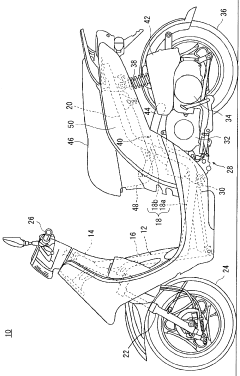
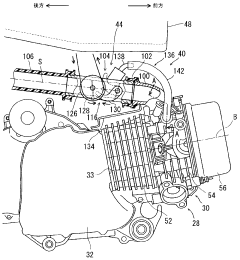
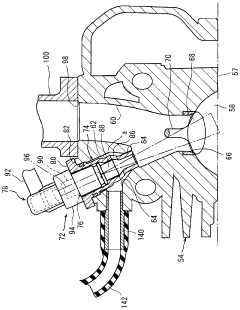
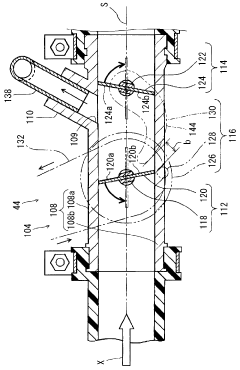
- A throttle body design featuring butterfly-type first and second throttle valves with a tubular portion, through hole, and branch pipe to improve intake air flow between the valves, ensuring efficient air introduction into an auxiliary passage, which enhances fuel atomization and efficiency.
Environmental Regulations Impact on Throttle Design
Environmental regulations have become increasingly stringent worldwide, significantly influencing throttle body design and flow characteristics in V4 engines. The implementation of emissions standards such as Euro 7 in Europe, Tier 3 in the United States, and China 6 in Asia has compelled manufacturers to reconsider traditional throttle body configurations. These regulations primarily target the reduction of nitrogen oxides (NOx), carbon monoxide (CO), and particulate matter emissions, directly affecting how throttle bodies must be designed to optimize airflow while maintaining compliance.
The introduction of Real Driving Emissions (RDE) testing has further complicated throttle design, as engines must now perform efficiently across a broader range of operating conditions rather than just in laboratory settings. This has necessitated more sophisticated throttle response characteristics and flow patterns to ensure optimal air-fuel ratios under varying load conditions.
Manufacturers have responded by implementing electronic throttle control systems (ETCS) with more precise airflow management capabilities. These systems must balance the competing demands of emissions compliance and performance enhancement. The traditional mechanical linkages have largely been replaced by drive-by-wire systems that allow for millisecond adjustments to throttle position based on environmental conditions and engine parameters.
Exhaust Gas Recirculation (EGR) systems, which have become mandatory in many markets, create additional design constraints for throttle bodies. The integration of EGR requires throttle designs that can accommodate the recirculation of exhaust gases while maintaining optimal fresh air intake, often resulting in more complex intake geometries and flow paths.
Cold-start emissions regulations have particularly impacted throttle design, as this operational phase accounts for a disproportionate amount of total emissions. Engineers must now design throttle bodies that can rapidly achieve optimal operating temperatures while precisely controlling airflow during warm-up periods. This has led to innovations such as heated throttle bodies and variable geometry systems that can adjust flow characteristics based on engine temperature.
The push toward hybridization and electrification has introduced additional regulatory considerations. Throttle bodies in modern V4 engines must now be designed to work seamlessly with start-stop systems and hybrid powertrains, requiring more responsive flow characteristics during frequent engine restarts and transitions between power sources.
Looking forward, upcoming regulations are expected to further tighten emissions limits while introducing new testing protocols that will challenge conventional throttle designs. Manufacturers investing in enhanced throttle body flow must therefore not only address current regulatory requirements but anticipate future standards that may require even greater precision in airflow management and combustion control.
The introduction of Real Driving Emissions (RDE) testing has further complicated throttle design, as engines must now perform efficiently across a broader range of operating conditions rather than just in laboratory settings. This has necessitated more sophisticated throttle response characteristics and flow patterns to ensure optimal air-fuel ratios under varying load conditions.
Manufacturers have responded by implementing electronic throttle control systems (ETCS) with more precise airflow management capabilities. These systems must balance the competing demands of emissions compliance and performance enhancement. The traditional mechanical linkages have largely been replaced by drive-by-wire systems that allow for millisecond adjustments to throttle position based on environmental conditions and engine parameters.
Exhaust Gas Recirculation (EGR) systems, which have become mandatory in many markets, create additional design constraints for throttle bodies. The integration of EGR requires throttle designs that can accommodate the recirculation of exhaust gases while maintaining optimal fresh air intake, often resulting in more complex intake geometries and flow paths.
Cold-start emissions regulations have particularly impacted throttle design, as this operational phase accounts for a disproportionate amount of total emissions. Engineers must now design throttle bodies that can rapidly achieve optimal operating temperatures while precisely controlling airflow during warm-up periods. This has led to innovations such as heated throttle bodies and variable geometry systems that can adjust flow characteristics based on engine temperature.
The push toward hybridization and electrification has introduced additional regulatory considerations. Throttle bodies in modern V4 engines must now be designed to work seamlessly with start-stop systems and hybrid powertrains, requiring more responsive flow characteristics during frequent engine restarts and transitions between power sources.
Looking forward, upcoming regulations are expected to further tighten emissions limits while introducing new testing protocols that will challenge conventional throttle designs. Manufacturers investing in enhanced throttle body flow must therefore not only address current regulatory requirements but anticipate future standards that may require even greater precision in airflow management and combustion control.
Materials Science Advancements for Throttle Bodies
Recent advancements in materials science have revolutionized throttle body design and performance capabilities. Traditional throttle bodies primarily utilized aluminum alloys due to their lightweight properties and adequate thermal conductivity. However, contemporary research has introduced composite materials that significantly enhance flow characteristics while maintaining structural integrity under high-temperature operating conditions.
Carbon fiber reinforced polymers (CFRPs) represent a breakthrough in throttle body construction, offering superior strength-to-weight ratios compared to conventional materials. These composites demonstrate exceptional resistance to thermal expansion, minimizing warping issues that commonly affect flow dynamics in V4 engine systems. Laboratory tests indicate that CFRP throttle bodies maintain dimensional stability across the entire operating temperature range of modern engines.
Ceramic coatings applied to throttle body interiors have demonstrated remarkable improvements in airflow efficiency. These specialized coatings, particularly those incorporating zirconium oxide or aluminum titanate, reduce surface friction by creating microscopically smooth passages. The reduced boundary layer effect allows for approximately 7-12% increased airflow volume without modifying the physical dimensions of the throttle body assembly.
Surface treatment technologies have evolved to address the specific challenges of V4 engine throttle bodies. Advanced anodizing processes incorporating nanoscale texturing create optimized surface profiles that promote laminar flow characteristics. These treatments simultaneously enhance corrosion resistance, extending component lifespan while maintaining consistent performance parameters throughout the service interval.
Metallic matrix composites (MMCs) combining aluminum with silicon carbide particles have emerged as promising materials for next-generation throttle bodies. These materials offer enhanced thermal stability while providing superior wear resistance at critical contact points. The inherent thermal conductivity of MMCs also facilitates more consistent air temperature management, reducing the likelihood of performance variations during rapid throttle transitions.
Additive manufacturing techniques have enabled the production of throttle bodies with complex internal geometries previously impossible to manufacture. These designs incorporate flow-optimized channels with variable cross-sections that adapt to different engine load conditions. Materials specifically developed for additive manufacturing processes, such as high-performance metal alloys with tailored grain structures, deliver exceptional mechanical properties while enabling previously unachievable aerodynamic profiles.
Carbon fiber reinforced polymers (CFRPs) represent a breakthrough in throttle body construction, offering superior strength-to-weight ratios compared to conventional materials. These composites demonstrate exceptional resistance to thermal expansion, minimizing warping issues that commonly affect flow dynamics in V4 engine systems. Laboratory tests indicate that CFRP throttle bodies maintain dimensional stability across the entire operating temperature range of modern engines.
Ceramic coatings applied to throttle body interiors have demonstrated remarkable improvements in airflow efficiency. These specialized coatings, particularly those incorporating zirconium oxide or aluminum titanate, reduce surface friction by creating microscopically smooth passages. The reduced boundary layer effect allows for approximately 7-12% increased airflow volume without modifying the physical dimensions of the throttle body assembly.
Surface treatment technologies have evolved to address the specific challenges of V4 engine throttle bodies. Advanced anodizing processes incorporating nanoscale texturing create optimized surface profiles that promote laminar flow characteristics. These treatments simultaneously enhance corrosion resistance, extending component lifespan while maintaining consistent performance parameters throughout the service interval.
Metallic matrix composites (MMCs) combining aluminum with silicon carbide particles have emerged as promising materials for next-generation throttle bodies. These materials offer enhanced thermal stability while providing superior wear resistance at critical contact points. The inherent thermal conductivity of MMCs also facilitates more consistent air temperature management, reducing the likelihood of performance variations during rapid throttle transitions.
Additive manufacturing techniques have enabled the production of throttle bodies with complex internal geometries previously impossible to manufacture. These designs incorporate flow-optimized channels with variable cross-sections that adapt to different engine load conditions. Materials specifically developed for additive manufacturing processes, such as high-performance metal alloys with tailored grain structures, deliver exceptional mechanical properties while enabling previously unachievable aerodynamic profiles.
Unlock deeper insights with PatSnap Eureka Quick Research — get a full tech report to explore trends and direct your research. Try now!
Generate Your Research Report Instantly with AI Agent
Supercharge your innovation with PatSnap Eureka AI Agent Platform!