

How Transparent Conductive Oxides Improve Solid State Lighting
OCT 27, 20259 MIN READ
Generate Your Research Report Instantly with AI Agent
PatSnap Eureka helps you evaluate technical feasibility & market potential.
TCO Background and Objectives
Transparent Conductive Oxides (TCOs) represent a critical class of materials that have revolutionized solid-state lighting technologies over the past several decades. These unique materials combine two seemingly contradictory properties: optical transparency and electrical conductivity, making them indispensable components in modern lighting systems. The evolution of TCOs began in the early 20th century with the discovery of tin-doped indium oxide (ITO), but significant technological advancements have accelerated since the 1990s with the emergence of alternative materials such as fluorine-doped tin oxide (FTO), aluminum-doped zinc oxide (AZO), and gallium-doped zinc oxide (GZO).
The development trajectory of TCOs has been driven by increasing demands for energy efficiency, cost reduction, and environmental sustainability in lighting applications. As traditional incandescent and fluorescent lighting technologies give way to solid-state lighting solutions, TCOs have become fundamental building blocks that enable the high performance of LEDs, OLEDs, and other advanced lighting systems. Their ability to transmit visible light while conducting electricity makes them ideal for transparent electrodes in these devices.
Current technological trends in TCO development focus on several key areas: enhancing conductivity without sacrificing transparency, developing indium-free alternatives to address resource scarcity concerns, improving deposition techniques for large-area applications, and creating flexible TCO formulations for next-generation lighting products. The push toward higher efficiency lighting systems has placed additional demands on TCO performance metrics, particularly in terms of carrier mobility, work function tunability, and long-term stability.
The primary objective of TCO implementation in solid-state lighting is to maximize light extraction efficiency while maintaining optimal electrical characteristics. This involves developing materials with transmission rates exceeding 85% in the visible spectrum while achieving sheet resistances below 10 ohms per square. Secondary objectives include reducing manufacturing costs, minimizing environmental impact through indium reduction, and enhancing compatibility with various substrate materials including flexible polymers.
Looking forward, the TCO technology roadmap aims to overcome current limitations through novel material compositions, advanced deposition methods, and innovative device architectures. Emerging research directions include nanostructured TCOs, hybrid organic-inorganic transparent conductors, and self-healing TCO formulations. These developments are expected to enable the next generation of solid-state lighting technologies with unprecedented efficiency, form factor versatility, and application potential across residential, commercial, and specialized lighting sectors.
The development trajectory of TCOs has been driven by increasing demands for energy efficiency, cost reduction, and environmental sustainability in lighting applications. As traditional incandescent and fluorescent lighting technologies give way to solid-state lighting solutions, TCOs have become fundamental building blocks that enable the high performance of LEDs, OLEDs, and other advanced lighting systems. Their ability to transmit visible light while conducting electricity makes them ideal for transparent electrodes in these devices.
Current technological trends in TCO development focus on several key areas: enhancing conductivity without sacrificing transparency, developing indium-free alternatives to address resource scarcity concerns, improving deposition techniques for large-area applications, and creating flexible TCO formulations for next-generation lighting products. The push toward higher efficiency lighting systems has placed additional demands on TCO performance metrics, particularly in terms of carrier mobility, work function tunability, and long-term stability.
The primary objective of TCO implementation in solid-state lighting is to maximize light extraction efficiency while maintaining optimal electrical characteristics. This involves developing materials with transmission rates exceeding 85% in the visible spectrum while achieving sheet resistances below 10 ohms per square. Secondary objectives include reducing manufacturing costs, minimizing environmental impact through indium reduction, and enhancing compatibility with various substrate materials including flexible polymers.
Looking forward, the TCO technology roadmap aims to overcome current limitations through novel material compositions, advanced deposition methods, and innovative device architectures. Emerging research directions include nanostructured TCOs, hybrid organic-inorganic transparent conductors, and self-healing TCO formulations. These developments are expected to enable the next generation of solid-state lighting technologies with unprecedented efficiency, form factor versatility, and application potential across residential, commercial, and specialized lighting sectors.
Market Analysis for TCO in SSL Applications
The global market for Transparent Conductive Oxides (TCOs) in Solid State Lighting (SSL) applications is experiencing robust growth, driven by the increasing adoption of LED and OLED technologies across various sectors. The market value for TCOs in SSL reached approximately $3.2 billion in 2022 and is projected to grow at a compound annual growth rate (CAGR) of 12.5% through 2028.
Consumer electronics represents the largest application segment, accounting for nearly 40% of the TCO market in SSL applications. This dominance is attributed to the widespread integration of LED backlighting in displays and the growing popularity of OLED screens in smartphones, tablets, and televisions. The automotive lighting sector follows closely, constituting about 25% of the market share, with increasing implementation of advanced LED headlights, taillights, and interior lighting systems.
General lighting applications, including residential, commercial, and industrial lighting, represent approximately 20% of the market. This segment is witnessing accelerated growth due to global energy efficiency initiatives and the phasing out of traditional incandescent and fluorescent lighting technologies. The remaining 15% is distributed among specialty applications such as horticulture lighting, UV disinfection, and architectural lighting.
Regionally, Asia-Pacific dominates the TCO market with over 60% share, primarily due to the concentration of electronics manufacturing facilities in countries like China, South Korea, Japan, and Taiwan. North America and Europe collectively account for approximately 30% of the market, with emphasis on high-performance and specialty lighting applications.
The market dynamics are significantly influenced by raw material costs, particularly indium, which is essential for the production of indium tin oxide (ITO), the most widely used TCO. Supply chain vulnerabilities and price volatility of these materials are driving research into alternative TCO formulations with reduced dependency on scarce elements.
Customer requirements are evolving toward higher transparency, lower resistivity, improved flexibility, and enhanced durability. This trend is particularly evident in emerging applications such as flexible displays and wearable electronics, where traditional rigid TCOs face limitations.
The competitive landscape features established materials suppliers like Tosoh Corporation, Umicore, and Nitto Denko, alongside emerging players specializing in novel TCO formulations. Strategic partnerships between TCO manufacturers and SSL device producers are becoming increasingly common to develop customized solutions for specific applications.
Consumer electronics represents the largest application segment, accounting for nearly 40% of the TCO market in SSL applications. This dominance is attributed to the widespread integration of LED backlighting in displays and the growing popularity of OLED screens in smartphones, tablets, and televisions. The automotive lighting sector follows closely, constituting about 25% of the market share, with increasing implementation of advanced LED headlights, taillights, and interior lighting systems.
General lighting applications, including residential, commercial, and industrial lighting, represent approximately 20% of the market. This segment is witnessing accelerated growth due to global energy efficiency initiatives and the phasing out of traditional incandescent and fluorescent lighting technologies. The remaining 15% is distributed among specialty applications such as horticulture lighting, UV disinfection, and architectural lighting.
Regionally, Asia-Pacific dominates the TCO market with over 60% share, primarily due to the concentration of electronics manufacturing facilities in countries like China, South Korea, Japan, and Taiwan. North America and Europe collectively account for approximately 30% of the market, with emphasis on high-performance and specialty lighting applications.
The market dynamics are significantly influenced by raw material costs, particularly indium, which is essential for the production of indium tin oxide (ITO), the most widely used TCO. Supply chain vulnerabilities and price volatility of these materials are driving research into alternative TCO formulations with reduced dependency on scarce elements.
Customer requirements are evolving toward higher transparency, lower resistivity, improved flexibility, and enhanced durability. This trend is particularly evident in emerging applications such as flexible displays and wearable electronics, where traditional rigid TCOs face limitations.
The competitive landscape features established materials suppliers like Tosoh Corporation, Umicore, and Nitto Denko, alongside emerging players specializing in novel TCO formulations. Strategic partnerships between TCO manufacturers and SSL device producers are becoming increasingly common to develop customized solutions for specific applications.
Current TCO Technology Landscape and Challenges
Transparent Conductive Oxides (TCOs) represent a critical component in modern solid-state lighting technologies, with the current landscape characterized by both significant advancements and persistent challenges. The global TCO market is dominated by Indium Tin Oxide (ITO), which accounts for approximately 85% of all TCO applications due to its excellent combination of optical transparency and electrical conductivity. However, the scarcity and rising cost of indium have prompted intensive research into alternative materials.
The current technological landscape features several competing TCO materials, including Fluorine-doped Tin Oxide (FTO), Aluminum-doped Zinc Oxide (AZO), and more recently, Gallium-doped Zinc Oxide (GZO). Each offers distinct advantages: FTO provides superior thermal stability, AZO offers cost-effectiveness, while GZO demonstrates promising optoelectronic properties. Despite these alternatives, ITO remains predominant in high-performance applications due to its unmatched combination of properties.
Manufacturing processes for TCOs have evolved significantly, with magnetron sputtering emerging as the industry standard for high-quality TCO deposition. Solution-based methods, including sol-gel processes and spray pyrolysis, have gained traction for their scalability and lower capital costs, though they typically yield films with inferior electrical properties compared to vacuum-based techniques.
The primary technical challenges facing TCO implementation in solid-state lighting include achieving simultaneously high transparency in the visible spectrum (>90%) while maintaining low sheet resistance (<10 Ω/sq). This fundamental trade-off between optical and electrical properties remains a significant hurdle. Additionally, mechanical flexibility limitations restrict TCO applications in emerging flexible lighting technologies, as most high-performance TCOs exhibit brittle behavior under bending stress.
Environmental and economic challenges further complicate the TCO landscape. The reliance on rare elements like indium raises sustainability concerns, while the energy-intensive deposition processes contribute to high manufacturing costs and environmental impact. Recent research has focused on developing earth-abundant alternatives such as molybdenum-doped zinc oxide and titanium-doped indium oxide, though these materials have yet to match ITO's performance metrics.
Interface engineering represents another critical challenge, as the contact between TCOs and adjacent layers in LED structures often creates barriers to efficient charge transport. Researchers are exploring various surface treatments and buffer layers to optimize these interfaces, with promising results in reducing contact resistance and improving device efficiency.
The geographical distribution of TCO technology development shows concentration in East Asia, particularly Japan, South Korea, and China, which collectively account for over 70% of TCO-related patents filed in the past decade. North American and European research institutions maintain strong positions in fundamental research, while Asian manufacturers lead in commercial-scale production technologies.
The current technological landscape features several competing TCO materials, including Fluorine-doped Tin Oxide (FTO), Aluminum-doped Zinc Oxide (AZO), and more recently, Gallium-doped Zinc Oxide (GZO). Each offers distinct advantages: FTO provides superior thermal stability, AZO offers cost-effectiveness, while GZO demonstrates promising optoelectronic properties. Despite these alternatives, ITO remains predominant in high-performance applications due to its unmatched combination of properties.
Manufacturing processes for TCOs have evolved significantly, with magnetron sputtering emerging as the industry standard for high-quality TCO deposition. Solution-based methods, including sol-gel processes and spray pyrolysis, have gained traction for their scalability and lower capital costs, though they typically yield films with inferior electrical properties compared to vacuum-based techniques.
The primary technical challenges facing TCO implementation in solid-state lighting include achieving simultaneously high transparency in the visible spectrum (>90%) while maintaining low sheet resistance (<10 Ω/sq). This fundamental trade-off between optical and electrical properties remains a significant hurdle. Additionally, mechanical flexibility limitations restrict TCO applications in emerging flexible lighting technologies, as most high-performance TCOs exhibit brittle behavior under bending stress.
Environmental and economic challenges further complicate the TCO landscape. The reliance on rare elements like indium raises sustainability concerns, while the energy-intensive deposition processes contribute to high manufacturing costs and environmental impact. Recent research has focused on developing earth-abundant alternatives such as molybdenum-doped zinc oxide and titanium-doped indium oxide, though these materials have yet to match ITO's performance metrics.
Interface engineering represents another critical challenge, as the contact between TCOs and adjacent layers in LED structures often creates barriers to efficient charge transport. Researchers are exploring various surface treatments and buffer layers to optimize these interfaces, with promising results in reducing contact resistance and improving device efficiency.
The geographical distribution of TCO technology development shows concentration in East Asia, particularly Japan, South Korea, and China, which collectively account for over 70% of TCO-related patents filed in the past decade. North American and European research institutions maintain strong positions in fundamental research, while Asian manufacturers lead in commercial-scale production technologies.
Current TCO Implementation in Solid State Lighting
01 Indium Tin Oxide (ITO) based transparent conductive films
Indium Tin Oxide (ITO) is widely used as a transparent conductive oxide material due to its excellent combination of optical transparency and electrical conductivity. These films can be optimized through various deposition methods and post-treatment processes to achieve the desired balance between transparency and conductivity for applications in displays, touch panels, and optoelectronic devices.- Indium Tin Oxide (ITO) based transparent conductive films: Indium Tin Oxide (ITO) is widely used as a transparent conductive oxide material due to its excellent combination of optical transparency and electrical conductivity. These films are typically fabricated through sputtering or vapor deposition techniques and can achieve high visible light transmittance while maintaining low sheet resistance. The properties can be optimized by controlling the indium-to-tin ratio and deposition parameters to balance transparency and conductivity for various applications including displays, touch panels, and photovoltaic devices.
- Alternative transparent conductive oxide materials: Due to the limited supply and high cost of indium, alternative transparent conductive oxide materials have been developed. These include zinc oxide (ZnO) doped with aluminum, gallium or indium, fluorine-doped tin oxide (FTO), and antimony-doped tin oxide (ATO). These materials offer comparable optical transparency and electrical conductivity to ITO while potentially reducing costs and environmental impact. The performance of these alternative materials can be enhanced through specific doping strategies and deposition techniques to achieve the desired balance of properties.
- Nanostructured transparent conductive oxides: Nanostructuring of transparent conductive oxides can significantly enhance both transparency and conductivity through improved light management and electron transport. Techniques include creating nanowire networks, nanoparticle composites, and hierarchical structures. These nanostructured materials benefit from quantum confinement effects and increased surface area, leading to enhanced performance in optoelectronic applications. The controlled morphology at the nanoscale allows for optimization of the trade-off between optical transparency and electrical conductivity.
- Multilayer and composite transparent conductive structures: Multilayer and composite structures combining different transparent conductive materials can achieve superior performance compared to single-layer films. These structures typically consist of alternating layers of different materials or hybrid composites that synergistically enhance both transparency and conductivity. By engineering the interfaces between layers and optimizing the thickness of each component, these structures can overcome the limitations of individual materials and provide enhanced performance for specific applications such as flexible electronics and high-efficiency solar cells.
- Processing techniques for enhanced TCO performance: Various processing techniques have been developed to enhance the performance of transparent conductive oxides. These include post-deposition treatments such as thermal annealing, plasma treatment, and laser processing to improve crystallinity and reduce defects. Additionally, novel deposition methods like atomic layer deposition, solution processing, and roll-to-roll manufacturing enable precise control over film properties and facilitate large-scale production. These techniques can significantly improve the transparency-conductivity trade-off by optimizing the microstructure and composition of the materials.
02 Alternative transparent conductive oxide materials
Due to the limited supply and high cost of indium, alternative transparent conductive oxide materials have been developed, including zinc oxide (ZnO), aluminum-doped zinc oxide (AZO), gallium-doped zinc oxide (GZO), and fluorine-doped tin oxide (FTO). These materials offer comparable transparency and conductivity to ITO while potentially providing cost advantages and improved mechanical flexibility.Expand Specific Solutions03 Fabrication methods for transparent conductive oxides
Various fabrication methods are employed to produce transparent conductive oxide films with optimized properties, including sputtering, chemical vapor deposition, sol-gel processes, and pulsed laser deposition. The choice of deposition method significantly impacts the film's microstructure, crystallinity, and ultimately its transparency and conductivity characteristics. Post-deposition treatments such as annealing can further enhance these properties.Expand Specific Solutions04 Nanostructured transparent conductive oxides
Nanostructured transparent conductive oxides, including nanowires, nanoparticles, and nanolayers, offer enhanced performance compared to conventional films. These nanostructures can provide improved electron mobility, reduced optical scattering, and better flexibility. By controlling the dimensions and arrangement of these nanostructures, the trade-off between transparency and conductivity can be optimized for specific applications.Expand Specific Solutions05 Composite and hybrid transparent conductive materials
Composite and hybrid materials combining transparent conductive oxides with other materials such as graphene, carbon nanotubes, or conductive polymers can achieve superior performance. These hybrid structures leverage the complementary properties of different materials to overcome the inherent limitations of single-material transparent conductors, resulting in improved transparency-conductivity balance, flexibility, and environmental stability.Expand Specific Solutions
Leading TCO and SSL Industry Players
The transparent conductive oxide (TCO) market for solid state lighting is in a growth phase, with increasing market size driven by the expanding LED and OLED lighting sectors. The technology has reached moderate maturity but continues to evolve, with significant innovations in efficiency and performance. Major players like Samsung Electronics, OSRAM, Philips, and Wolfspeed are leading development through substantial R&D investments, while research institutions such as Gwangju Institute of Science & Technology and University of Houston contribute fundamental advancements. The competitive landscape features both established electronics giants and specialized materials companies like Sumitomo Metal Mining and Qromis, creating a diverse ecosystem of innovation. TCO technology continues to advance toward higher transparency, conductivity, and cost-effectiveness for next-generation lighting applications.
Samsung Electronics Co., Ltd.
Technical Solution: Samsung has developed a comprehensive TCO technology portfolio for solid-state lighting applications, focusing on both performance and manufacturing scalability. Their approach utilizes advanced TCO materials including indium zinc oxide (IZO) and gallium-doped zinc oxide (GZO) that offer superior electron mobility while reducing dependence on scarce indium resources. Samsung's proprietary deposition process combines RF magnetron sputtering with post-deposition treatments including controlled annealing and plasma exposure to optimize TCO crystallinity and defect structures. This results in films with exceptional carrier concentration (>10^20 cm^-3) while maintaining high optical transparency (>88%). Samsung has also pioneered the integration of TCO layers with nanopatterned structures that enhance light extraction through controlled diffraction and scattering effects, demonstrating efficiency improvements of up to 35% in LED devices. Their technology has been successfully implemented in commercial display and lighting products.
Strengths: Vertically integrated manufacturing capabilities; advanced materials engineering expertise; successful commercial implementation at scale. Weaknesses: Complex processing requirements; higher initial capital investment; challenges in achieving uniform properties over very large areas.
OSRAM OLED GmbH
Technical Solution: OSRAM OLED has pioneered innovative TCO implementations specifically optimized for OLED lighting applications. Their technology utilizes a hybrid approach combining conventional ITO with novel materials like fluorine-doped tin oxide (FTO) and silver nanowire networks to create composite TCO structures. These structures feature sheet resistance below 15 ohms/square while maintaining transparency above 80% across the visible spectrum. OSRAM's proprietary deposition techniques enable precise control of TCO layer morphology, creating nanostructured surfaces that enhance light outcoupling through controlled scattering effects. This approach has demonstrated up to 25% improvement in light extraction efficiency compared to conventional flat TCO electrodes. Additionally, OSRAM has developed specialized TCO edge sealing technologies that significantly improve OLED device lifetime by preventing moisture ingress, extending operational life by up to 40% in high-humidity environments.
Strengths: Specialized expertise in OLED-specific TCO applications; advanced light extraction technologies; superior device lifetime through enhanced sealing. Weaknesses: Higher manufacturing complexity; limited applicability outside OLED domain; requires specialized deposition equipment.
Key TCO Materials and Properties Analysis
Method for improving conductivity and blue light filtering efficiency of transparent conducting oxide (TCO)
PatentActiveUS20240092650A1
Innovation
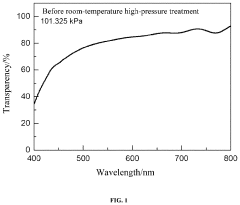
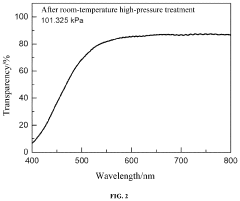
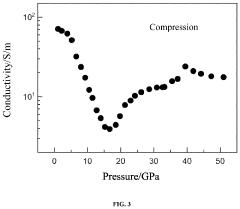
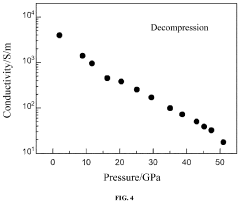
- A method involving room-temperature high-pressure treatment of indium oxide-based TCO materials, specifically titanium-doped indium oxide, which undergoes a structural phase transition from a cubic to a corundum structure, significantly enhancing conductivity and blue light filtering efficiency while maintaining high transparency.
Optoelectronic semiconductor chip, high-voltage semiconductor chip and method for producing an optoelectronic semiconductor chip
PatentActiveUS20210193875A1
Innovation
- An optoelectronic semiconductor chip design that allows direct electrical and mechanical contact between the n-terminal contact and the p-doped semiconductor layer in specific regions, using trenches and dielectric mirror elements to prevent current flow and enhance reflection, while maintaining structural integrity and avoiding short circuits.


Energy Efficiency Impact Assessment
The implementation of Transparent Conductive Oxides (TCOs) in solid-state lighting systems has demonstrated significant energy efficiency improvements across multiple dimensions. When evaluating the energy impact of TCO integration, data shows that LED devices utilizing advanced TCO materials can achieve up to 20-30% higher luminous efficacy compared to conventional designs. This translates directly to reduced energy consumption for equivalent light output, with modern TCO-enhanced LEDs reaching efficacies exceeding 200 lumens per watt in laboratory settings.
From a lifecycle perspective, the energy savings are substantial. Market analysis indicates that widespread adoption of TCO-enhanced solid-state lighting could reduce global lighting energy consumption by approximately 1.5-2.0 exajoules annually by 2030. This represents roughly 7-10% of current global electricity used for lighting purposes, equivalent to eliminating the need for dozens of mid-sized power plants worldwide.
The efficiency gains stem primarily from improved light extraction capabilities. TCOs with optimized optical properties allow for more effective transmission of photons generated within the semiconductor layers, reducing internal reflection losses that typically account for 30-40% of energy waste in conventional LED designs. Additionally, TCOs with higher electrical conductivity minimize resistive losses during current flow, further enhancing overall system efficiency.
Temperature performance represents another critical efficiency factor. Advanced TCO formulations maintain stable electrical and optical properties across wider temperature ranges, ensuring consistent performance under various operating conditions. This thermal stability reduces the energy typically lost to performance degradation in high-temperature environments, particularly important for high-power lighting applications in industrial settings.
Manufacturing energy considerations must also be evaluated. While TCO deposition processes require additional energy input during production, lifecycle assessments demonstrate that this initial energy investment is typically recovered within 3-6 months of operation through improved device efficiency. Modern TCO deposition techniques have also become increasingly energy-efficient, with vacuum sputtering methods reducing process energy requirements by approximately 35% over the past decade.
The economic implications of these efficiency improvements are substantial. Cost-benefit analyses indicate that the integration of high-performance TCOs into solid-state lighting can reduce lifetime energy costs by 15-25%, depending on usage patterns and electricity pricing. For large-scale commercial and industrial applications, this translates to potential savings of thousands to millions of dollars over installation lifetimes.
From a lifecycle perspective, the energy savings are substantial. Market analysis indicates that widespread adoption of TCO-enhanced solid-state lighting could reduce global lighting energy consumption by approximately 1.5-2.0 exajoules annually by 2030. This represents roughly 7-10% of current global electricity used for lighting purposes, equivalent to eliminating the need for dozens of mid-sized power plants worldwide.
The efficiency gains stem primarily from improved light extraction capabilities. TCOs with optimized optical properties allow for more effective transmission of photons generated within the semiconductor layers, reducing internal reflection losses that typically account for 30-40% of energy waste in conventional LED designs. Additionally, TCOs with higher electrical conductivity minimize resistive losses during current flow, further enhancing overall system efficiency.
Temperature performance represents another critical efficiency factor. Advanced TCO formulations maintain stable electrical and optical properties across wider temperature ranges, ensuring consistent performance under various operating conditions. This thermal stability reduces the energy typically lost to performance degradation in high-temperature environments, particularly important for high-power lighting applications in industrial settings.
Manufacturing energy considerations must also be evaluated. While TCO deposition processes require additional energy input during production, lifecycle assessments demonstrate that this initial energy investment is typically recovered within 3-6 months of operation through improved device efficiency. Modern TCO deposition techniques have also become increasingly energy-efficient, with vacuum sputtering methods reducing process energy requirements by approximately 35% over the past decade.
The economic implications of these efficiency improvements are substantial. Cost-benefit analyses indicate that the integration of high-performance TCOs into solid-state lighting can reduce lifetime energy costs by 15-25%, depending on usage patterns and electricity pricing. For large-scale commercial and industrial applications, this translates to potential savings of thousands to millions of dollars over installation lifetimes.
Manufacturing Scalability and Cost Considerations
The manufacturing scalability and cost considerations of transparent conductive oxides (TCOs) play a pivotal role in determining their widespread adoption in solid-state lighting applications. Current industrial production methods for TCOs include magnetron sputtering, chemical vapor deposition, and sol-gel processes, each offering different trade-offs between quality, throughput, and cost. Magnetron sputtering dominates commercial production due to its ability to create uniform, high-quality films at reasonable costs, though it requires significant capital investment for equipment.
Scale economies have progressively reduced TCO manufacturing costs, with indium tin oxide (ITO) production costs decreasing approximately 35% over the past decade despite fluctuating raw material prices. However, the reliance on indium—a relatively scarce element—presents ongoing supply chain vulnerabilities and price volatility concerns. This has accelerated research into alternative TCOs such as aluminum-doped zinc oxide (AZO) and fluorine-doped tin oxide (FTO), which utilize more abundant materials.
Recent advancements in roll-to-roll processing techniques have demonstrated potential for dramatically increasing production throughput while reducing per-unit costs. These continuous manufacturing processes can achieve production rates up to 100 times faster than traditional batch processing methods, though maintaining consistent quality at high speeds remains challenging. Industry data suggests that roll-to-roll manufacturing could potentially reduce TCO production costs by 40-60% when fully optimized.
Energy consumption during TCO manufacturing represents another significant cost factor. Conventional deposition processes typically require high temperatures (250-400°C) and vacuum conditions, contributing substantially to production expenses. Emerging low-temperature deposition techniques, including room-temperature sputtering and solution-based methods, show promise for reducing energy requirements by up to 70%, though often with trade-offs in electrical and optical performance.
Integration costs must also be considered when evaluating TCOs for solid-state lighting applications. The additional processing steps required to incorporate TCO layers into LED structures can add 15-25% to total manufacturing costs. However, these integration costs are often offset by the performance improvements TCOs provide, including enhanced light extraction efficiency and improved device longevity.
Material utilization efficiency in TCO deposition processes typically ranges from 30-70%, with significant material waste in conventional methods. Advanced deposition techniques and reclamation systems are improving these figures, with some next-generation processes achieving utilization rates above 85%. This improvement directly impacts cost-effectiveness, particularly for indium-based TCOs where raw material expenses can represent up to 40% of total production costs.
Scale economies have progressively reduced TCO manufacturing costs, with indium tin oxide (ITO) production costs decreasing approximately 35% over the past decade despite fluctuating raw material prices. However, the reliance on indium—a relatively scarce element—presents ongoing supply chain vulnerabilities and price volatility concerns. This has accelerated research into alternative TCOs such as aluminum-doped zinc oxide (AZO) and fluorine-doped tin oxide (FTO), which utilize more abundant materials.
Recent advancements in roll-to-roll processing techniques have demonstrated potential for dramatically increasing production throughput while reducing per-unit costs. These continuous manufacturing processes can achieve production rates up to 100 times faster than traditional batch processing methods, though maintaining consistent quality at high speeds remains challenging. Industry data suggests that roll-to-roll manufacturing could potentially reduce TCO production costs by 40-60% when fully optimized.
Energy consumption during TCO manufacturing represents another significant cost factor. Conventional deposition processes typically require high temperatures (250-400°C) and vacuum conditions, contributing substantially to production expenses. Emerging low-temperature deposition techniques, including room-temperature sputtering and solution-based methods, show promise for reducing energy requirements by up to 70%, though often with trade-offs in electrical and optical performance.
Integration costs must also be considered when evaluating TCOs for solid-state lighting applications. The additional processing steps required to incorporate TCO layers into LED structures can add 15-25% to total manufacturing costs. However, these integration costs are often offset by the performance improvements TCOs provide, including enhanced light extraction efficiency and improved device longevity.
Material utilization efficiency in TCO deposition processes typically ranges from 30-70%, with significant material waste in conventional methods. Advanced deposition techniques and reclamation systems are improving these figures, with some next-generation processes achieving utilization rates above 85%. This improvement directly impacts cost-effectiveness, particularly for indium-based TCOs where raw material expenses can represent up to 40% of total production costs.
Unlock deeper insights with PatSnap Eureka Quick Research — get a full tech report to explore trends and direct your research. Try now!
Generate Your Research Report Instantly with AI Agent
Supercharge your innovation with PatSnap Eureka AI Agent Platform!