

Improve RRAM Stability for High-Speed Computing Tasks
SEP 10, 20259 MIN READ
Generate Your Research Report Instantly with AI Agent
PatSnap Eureka helps you evaluate technical feasibility & market potential.
RRAM Technology Evolution and Stability Goals
Resistive Random Access Memory (RRAM) has emerged as a promising technology in the non-volatile memory landscape over the past two decades. Initially conceptualized in the early 2000s, RRAM has evolved from a theoretical construct to a commercially viable memory solution. The fundamental operating principle of RRAM relies on the formation and disruption of conductive filaments within a dielectric material, enabling the storage of binary information through resistance states.
The evolution of RRAM technology has been marked by significant milestones. Early implementations suffered from reliability issues, including inconsistent switching behavior and limited endurance. By the mid-2010s, material engineering breakthroughs led to improved oxide-based RRAM structures with enhanced retention characteristics. Recent advancements have focused on multi-level cell capabilities and integration with conventional CMOS processes, expanding the application scope of RRAM technology.
For high-speed computing applications, RRAM stability presents unique challenges that must be addressed. Stability in this context encompasses several critical parameters: switching variability, retention time, endurance cycles, and resistance state distribution. Current RRAM implementations exhibit switching times in the nanosecond range, but consistency remains problematic, particularly under elevated operating temperatures and after numerous programming cycles.
The primary stability goals for next-generation RRAM in high-speed computing include reducing cycle-to-cycle variability to below 5%, extending endurance beyond 10^12 cycles, maintaining data retention for 10+ years at 85°C, and achieving switching speeds consistently below 10 nanoseconds. These targets represent significant improvements over current capabilities and are essential for RRAM to compete effectively with established memory technologies in high-performance computing environments.
Industry roadmaps project that achieving these stability goals will enable RRAM to serve as both storage and computing elements in neuromorphic systems, in-memory computing architectures, and edge AI applications. The convergence of memory and processing functions through stable RRAM cells could potentially reduce energy consumption by an order of magnitude compared to conventional von Neumann architectures.
Material innovation represents the most promising pathway toward enhanced stability. Emerging research indicates that two-dimensional materials, complex metal oxides, and engineered interfaces can significantly improve filament formation control. Additionally, novel programming schemes that incorporate verification steps and adaptive voltage applications show promise in mitigating variability issues without compromising speed performance.
The evolution of RRAM technology has been marked by significant milestones. Early implementations suffered from reliability issues, including inconsistent switching behavior and limited endurance. By the mid-2010s, material engineering breakthroughs led to improved oxide-based RRAM structures with enhanced retention characteristics. Recent advancements have focused on multi-level cell capabilities and integration with conventional CMOS processes, expanding the application scope of RRAM technology.
For high-speed computing applications, RRAM stability presents unique challenges that must be addressed. Stability in this context encompasses several critical parameters: switching variability, retention time, endurance cycles, and resistance state distribution. Current RRAM implementations exhibit switching times in the nanosecond range, but consistency remains problematic, particularly under elevated operating temperatures and after numerous programming cycles.
The primary stability goals for next-generation RRAM in high-speed computing include reducing cycle-to-cycle variability to below 5%, extending endurance beyond 10^12 cycles, maintaining data retention for 10+ years at 85°C, and achieving switching speeds consistently below 10 nanoseconds. These targets represent significant improvements over current capabilities and are essential for RRAM to compete effectively with established memory technologies in high-performance computing environments.
Industry roadmaps project that achieving these stability goals will enable RRAM to serve as both storage and computing elements in neuromorphic systems, in-memory computing architectures, and edge AI applications. The convergence of memory and processing functions through stable RRAM cells could potentially reduce energy consumption by an order of magnitude compared to conventional von Neumann architectures.
Material innovation represents the most promising pathway toward enhanced stability. Emerging research indicates that two-dimensional materials, complex metal oxides, and engineered interfaces can significantly improve filament formation control. Additionally, novel programming schemes that incorporate verification steps and adaptive voltage applications show promise in mitigating variability issues without compromising speed performance.
Market Demand for High-Speed Computing Memory Solutions
The high-speed computing market is experiencing unprecedented growth, driven by emerging applications in artificial intelligence, big data analytics, edge computing, and 5G networks. These applications demand memory solutions that can process vast amounts of data with minimal latency, creating a substantial market opportunity for advanced memory technologies like RRAM (Resistive Random Access Memory).
Current market projections indicate that the global high-performance computing memory market is expected to reach $19.6 billion by 2025, growing at a CAGR of 23.5% from 2020. Within this segment, non-volatile memory solutions are gaining significant traction due to their ability to retain data without power consumption, a critical feature for energy-efficient computing systems.
Enterprise data centers represent the largest market segment, accounting for approximately 42% of the high-speed memory demand. These facilities are increasingly adopting in-memory computing architectures to accelerate data processing, creating a strong demand for stable, high-endurance memory solutions like improved RRAM.
The mobile computing sector presents another substantial market opportunity, with smartphone manufacturers seeking memory technologies that offer both high performance and low power consumption. As mobile devices increasingly handle complex AI workloads on-device, the need for reliable, high-speed memory becomes critical.
Edge computing applications are emerging as a particularly promising market segment for RRAM technology. The global edge computing market is projected to grow at 37% annually through 2027, with memory solutions being a key component. These applications require memory that can operate reliably in diverse environmental conditions, making RRAM stability improvements especially valuable.
Industry surveys indicate that system designers consistently rank memory performance as one of the top three bottlenecks in high-speed computing systems. Specifically, 78% of respondents in a recent semiconductor industry survey identified memory stability and endurance as "critical" or "very important" considerations when selecting components for next-generation computing platforms.
The automotive and industrial sectors are also driving demand for stable high-speed memory, particularly for applications in autonomous vehicles and smart manufacturing. These environments subject memory components to harsh operating conditions, emphasizing the need for RRAM solutions with enhanced stability characteristics.
Customer requirements across these markets consistently emphasize four key attributes: higher endurance cycles, improved data retention, faster switching speeds, and lower power consumption. Market analysis suggests that RRAM solutions addressing these stability concerns could command premium pricing of 15-20% over conventional alternatives, reflecting the significant value proposition of enhanced reliability.
Current market projections indicate that the global high-performance computing memory market is expected to reach $19.6 billion by 2025, growing at a CAGR of 23.5% from 2020. Within this segment, non-volatile memory solutions are gaining significant traction due to their ability to retain data without power consumption, a critical feature for energy-efficient computing systems.
Enterprise data centers represent the largest market segment, accounting for approximately 42% of the high-speed memory demand. These facilities are increasingly adopting in-memory computing architectures to accelerate data processing, creating a strong demand for stable, high-endurance memory solutions like improved RRAM.
The mobile computing sector presents another substantial market opportunity, with smartphone manufacturers seeking memory technologies that offer both high performance and low power consumption. As mobile devices increasingly handle complex AI workloads on-device, the need for reliable, high-speed memory becomes critical.
Edge computing applications are emerging as a particularly promising market segment for RRAM technology. The global edge computing market is projected to grow at 37% annually through 2027, with memory solutions being a key component. These applications require memory that can operate reliably in diverse environmental conditions, making RRAM stability improvements especially valuable.
Industry surveys indicate that system designers consistently rank memory performance as one of the top three bottlenecks in high-speed computing systems. Specifically, 78% of respondents in a recent semiconductor industry survey identified memory stability and endurance as "critical" or "very important" considerations when selecting components for next-generation computing platforms.
The automotive and industrial sectors are also driving demand for stable high-speed memory, particularly for applications in autonomous vehicles and smart manufacturing. These environments subject memory components to harsh operating conditions, emphasizing the need for RRAM solutions with enhanced stability characteristics.
Customer requirements across these markets consistently emphasize four key attributes: higher endurance cycles, improved data retention, faster switching speeds, and lower power consumption. Market analysis suggests that RRAM solutions addressing these stability concerns could command premium pricing of 15-20% over conventional alternatives, reflecting the significant value proposition of enhanced reliability.
RRAM Stability Challenges and Technical Limitations
Despite significant advancements in RRAM (Resistive Random Access Memory) technology, several critical stability challenges continue to impede its widespread adoption for high-speed computing applications. The primary limitation stems from the inherent variability in resistance states, which manifests as inconsistent switching behavior across multiple cycles. This cycle-to-cycle variation can lead to read errors and data corruption, particularly problematic when RRAM is deployed in high-performance computing environments requiring rapid, reliable data access.
The retention capability of RRAM cells presents another significant challenge. While RRAM theoretically offers non-volatile storage, practical implementations often suffer from resistance drift over time, especially at elevated temperatures commonly encountered in computing systems. This phenomenon, known as thermal instability, can cause stored resistance states to gradually shift, potentially crossing the detection threshold and resulting in bit flips without any explicit programming operation.
Endurance limitations further compound stability issues. Current RRAM technologies typically demonstrate endurance in the range of 10^6 to 10^9 cycles, which falls short of the requirements for high-speed computing applications that may demand 10^12 or more write cycles over a device's lifetime. The degradation mechanisms include electrode material migration, oxide layer breakdown, and filament overgrowth, all contributing to eventual device failure.
The sneak path current problem represents a substantial technical barrier in crossbar array architectures. Without effective isolation mechanisms, parasitic currents can flow through unselected cells, causing read disturbances and increasing power consumption. This issue becomes particularly acute as array density increases, creating a fundamental scaling challenge for high-density RRAM implementations.
Power consumption during switching operations poses another limitation. The high current densities required for reliable filament formation and rupture not only increase energy requirements but also generate localized heating that can accelerate device degradation and exacerbate stability issues. This becomes particularly problematic in mobile or edge computing applications where power efficiency is paramount.
Manufacturing process variations introduce additional stability concerns. Small deviations in electrode materials, oxide layer thickness, or interface properties can significantly impact switching characteristics. The resulting device-to-device variability complicates circuit design and necessitates more complex error correction mechanisms, ultimately limiting the practical density and performance of RRAM arrays.
The speed-reliability tradeoff presents perhaps the most fundamental challenge for high-speed applications. While faster switching can be achieved by applying higher voltages or currents, this approach typically reduces device lifetime and reliability. Conversely, more conservative operating conditions improve stability but sacrifice the speed advantages that make RRAM attractive for next-generation computing architectures.
The retention capability of RRAM cells presents another significant challenge. While RRAM theoretically offers non-volatile storage, practical implementations often suffer from resistance drift over time, especially at elevated temperatures commonly encountered in computing systems. This phenomenon, known as thermal instability, can cause stored resistance states to gradually shift, potentially crossing the detection threshold and resulting in bit flips without any explicit programming operation.
Endurance limitations further compound stability issues. Current RRAM technologies typically demonstrate endurance in the range of 10^6 to 10^9 cycles, which falls short of the requirements for high-speed computing applications that may demand 10^12 or more write cycles over a device's lifetime. The degradation mechanisms include electrode material migration, oxide layer breakdown, and filament overgrowth, all contributing to eventual device failure.
The sneak path current problem represents a substantial technical barrier in crossbar array architectures. Without effective isolation mechanisms, parasitic currents can flow through unselected cells, causing read disturbances and increasing power consumption. This issue becomes particularly acute as array density increases, creating a fundamental scaling challenge for high-density RRAM implementations.
Power consumption during switching operations poses another limitation. The high current densities required for reliable filament formation and rupture not only increase energy requirements but also generate localized heating that can accelerate device degradation and exacerbate stability issues. This becomes particularly problematic in mobile or edge computing applications where power efficiency is paramount.
Manufacturing process variations introduce additional stability concerns. Small deviations in electrode materials, oxide layer thickness, or interface properties can significantly impact switching characteristics. The resulting device-to-device variability complicates circuit design and necessitates more complex error correction mechanisms, ultimately limiting the practical density and performance of RRAM arrays.
The speed-reliability tradeoff presents perhaps the most fundamental challenge for high-speed applications. While faster switching can be achieved by applying higher voltages or currents, this approach typically reduces device lifetime and reliability. Conversely, more conservative operating conditions improve stability but sacrifice the speed advantages that make RRAM attractive for next-generation computing architectures.
Current Approaches to Enhance RRAM Stability
01 Material composition for improved RRAM stability
The stability of Resistive Random Access Memory (RRAM) can be significantly enhanced through careful selection of materials used in the memory cell structure. Various metal oxides, such as hafnium oxide, titanium oxide, and tantalum oxide, demonstrate superior retention characteristics and switching reliability. Additionally, doping these materials with specific elements or creating multi-layer structures can further improve the stability of resistance states, reducing variability in switching behavior and extending the device lifetime.- Material composition for improved RRAM stability: The stability of Resistive Random Access Memory (RRAM) can be significantly enhanced through careful selection of materials used in the memory cell structure. Various metal oxides, such as hafnium oxide, titanium oxide, and tantalum oxide, demonstrate superior stability characteristics. Additionally, doping these materials with specific elements or creating multi-layer structures with different materials can further improve retention time and cycling endurance. These material engineering approaches help mitigate common stability issues like resistance drift and variability in switching behavior.
- Electrode design and interface engineering: The design of electrodes and management of interfaces between different layers play crucial roles in RRAM stability. Optimizing the electrode materials and their interfaces with the switching layer can reduce variability in resistance states and improve retention characteristics. Techniques such as interface barrier engineering, insertion of buffer layers, and controlling the roughness of electrode surfaces help in achieving more uniform switching behavior. These approaches minimize undesired ion migration and filament dissolution, which are common causes of stability issues in RRAM devices.
- Programming and operation methods for stability enhancement: Specialized programming algorithms and operation methods can significantly improve RRAM stability. These include optimized pulse shapes, verify-after-write schemes, and adaptive programming techniques that adjust parameters based on device characteristics. Multi-step programming approaches and controlled current compliance during set/reset operations help in forming more stable conductive filaments. Additionally, temperature-aware operation strategies and compensation techniques for environmental variations ensure consistent performance across different operating conditions, thereby enhancing overall device reliability.
- Array architecture and peripheral circuit design: The stability of RRAM devices is heavily influenced by array architecture and peripheral circuit design. Optimized sensing circuits can accurately detect resistance states even with device variability. Advanced array configurations, such as 1T1R (one transistor, one resistor) or cross-point architectures with selector devices, help minimize sneak path currents and improve read margin. Additionally, specialized write drivers that provide precise voltage/current control and compensation circuits that adapt to device aging contribute to long-term stability of RRAM arrays.
- Reliability testing and modeling for stability prediction: Advanced reliability testing methodologies and predictive modeling techniques are essential for understanding and improving RRAM stability. Accelerated aging tests, statistical analysis of device parameters, and physics-based modeling help identify failure mechanisms and predict device lifetime. Monte Carlo simulations and machine learning approaches can be used to model variability and optimize device parameters. These testing and modeling frameworks enable the development of more stable RRAM technologies by providing insights into degradation mechanisms and guiding design improvements.
02 Electrode design and interface engineering
The design of electrodes and management of electrode-oxide interfaces play crucial roles in RRAM stability. Optimizing electrode materials, thickness, and contact area can significantly reduce resistance drift and improve retention time. Interface engineering techniques, such as inserting buffer layers between electrodes and switching materials, help control oxygen vacancy movement and prevent undesired diffusion, resulting in more stable switching behavior and improved endurance characteristics.Expand Specific Solutions03 Programming and operation methods for stability enhancement
Specialized programming algorithms and operation methods can substantially improve RRAM stability. These include optimized pulse shapes, amplitudes, and durations for SET and RESET operations, as well as verification schemes that ensure reliable state transitions. Adaptive programming techniques that adjust parameters based on device characteristics help maintain consistent performance over time. Temperature-compensated operation methods further enhance stability across varying environmental conditions.Expand Specific Solutions04 Device architecture and structural innovations
Novel RRAM architectures and structural designs contribute significantly to stability improvements. These include 3D stacking configurations, crossbar arrays with selector devices, and cell structures with built-in current limiters. Innovations such as dual-layer switching films, engineered defect profiles, and self-rectifying cells help control filament formation and dissolution processes. These architectural approaches minimize variability and improve resistance state retention while enabling higher density memory arrays.Expand Specific Solutions05 Modeling and simulation for stability prediction
Advanced modeling and simulation techniques enable better understanding and prediction of RRAM stability factors. Physics-based models that account for filament dynamics, ion migration, and thermal effects help identify stability limitations and guide design improvements. Statistical models assist in quantifying variability and reliability metrics across large arrays. These computational approaches accelerate development by allowing virtual testing of material combinations and operating conditions before physical implementation.Expand Specific Solutions
Leading RRAM Technology Companies and Research Institutions
The RRAM stability improvement landscape for high-speed computing is currently in a growth phase, with the market expanding as demand for faster, more efficient memory solutions increases. Key players including Samsung Electronics, Intel, TSMC, and GlobalFoundries are advancing this technology through significant R&D investments. The technology is approaching maturity with academic institutions like Fudan University and Peking University collaborating with industry leaders to address stability challenges. Companies are focusing on different approaches: Samsung and Intel are developing proprietary architectures, while TSMC and GlobalFoundries are enhancing manufacturing processes to improve reliability. The competitive landscape is diversifying as specialized players like Renesas Electronics and NXP develop application-specific RRAM solutions for emerging high-performance computing needs.
Samsung Electronics Co., Ltd.
Technical Solution: Samsung has developed advanced RRAM technology with innovative material engineering approaches to improve stability. Their solution incorporates hafnium oxide-based resistive switching materials with careful doping of elements like aluminum and titanium to control oxygen vacancy distribution[1]. Samsung's RRAM architecture features a unique dual-layer structure that separates the switching and retention mechanisms, allowing for both high-speed operation and improved stability. They've implemented specialized pulse programming schemes that utilize adaptive verification algorithms to ensure consistent resistance states even under varying temperature conditions[3]. Samsung has also integrated their RRAM technology with advanced 3D stacking capabilities, enabling higher density memory arrays while maintaining signal integrity through optimized interconnect designs. Their recent developments include specialized peripheral circuitry that compensates for device-to-device variations, a common challenge in RRAM technology that affects stability during high-speed operations[5].
Strengths: Samsung's extensive manufacturing infrastructure allows for rapid scaling and integration of RRAM technology into existing product lines. Their dual-layer structure effectively addresses the speed-stability tradeoff inherent in RRAM. Weaknesses: Their solution may require more complex fabrication processes compared to competing technologies, potentially increasing production costs. The adaptive verification algorithms add computational overhead that might impact overall system performance in some applications.
Intel Corp.
Technical Solution: Intel has developed a comprehensive approach to RRAM stability enhancement focusing on both materials science and circuit design innovations. Their technology utilizes a proprietary metal oxide stack with carefully engineered oxygen gradient profiles that minimize random telegraph noise, a key factor affecting RRAM stability[2]. Intel's solution incorporates self-selecting devices integrated with memory cells to reduce sneak path currents in crossbar arrays, enabling more reliable high-speed operation. They've implemented advanced write/read schemes with temperature-compensated reference circuits that maintain consistent operation across varying environmental conditions. Intel's RRAM architecture features specialized peripheral circuits that perform real-time resistance drift compensation, critical for maintaining data integrity during high-speed computing tasks[4]. Additionally, they've developed innovative programming algorithms that adaptively adjust pulse parameters based on cell-specific characteristics, significantly reducing variability between cycles and extending device endurance beyond 10^9 cycles while maintaining fast access times below 10ns[7].
Strengths: Intel's solution offers exceptional endurance characteristics critical for high-speed computing applications requiring frequent write operations. Their integrated approach addressing both material and circuit-level challenges provides a comprehensive stability solution. Weaknesses: The complex compensation circuits may increase power consumption compared to simpler RRAM implementations. Their technology might require more silicon area due to the additional peripheral circuitry needed for stability enhancement.
Critical Patents and Research on RRAM Stability Mechanisms
Method for operating memory cell and resistive random access memory, and electronic device
PatentPendingUS20250266089A1
Innovation
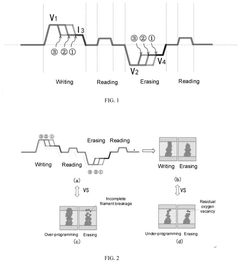
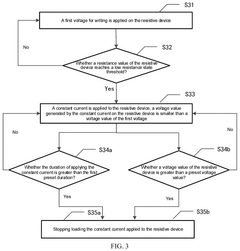
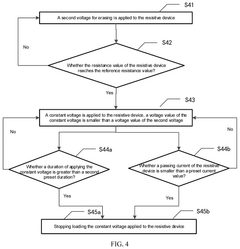
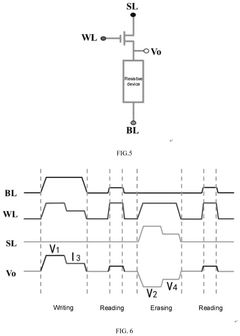
- A method for operating RRAM by applying a constant current or voltage after reaching resistance thresholds, with controlled durations and voltages to stabilize conductive filaments, ensuring stable resistance states and improved uniformity and durability.
Resistive random access memory with electric-field strengthened layer and manufacturing method thereof
PatentInactiveUS20120305880A1
Innovation
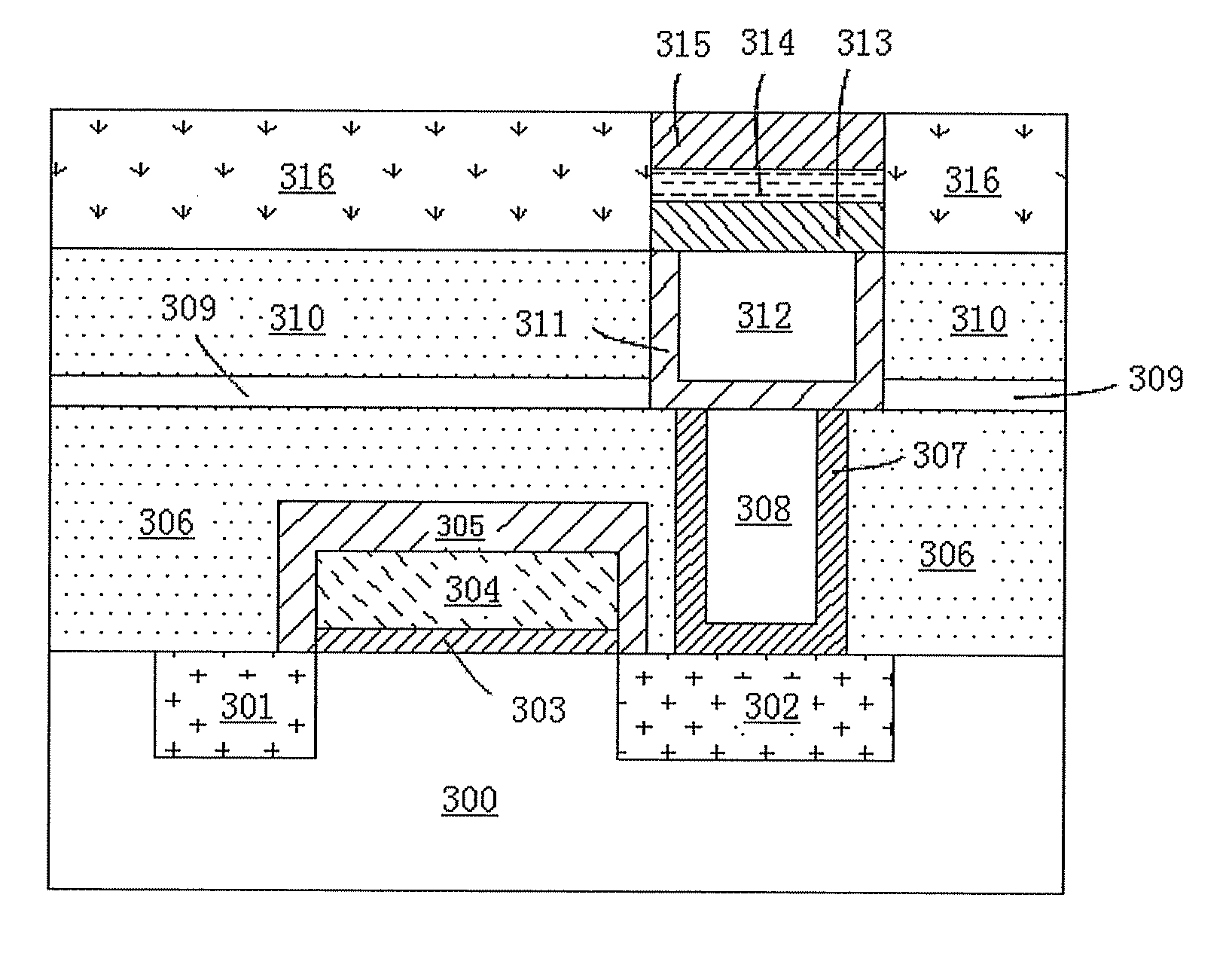
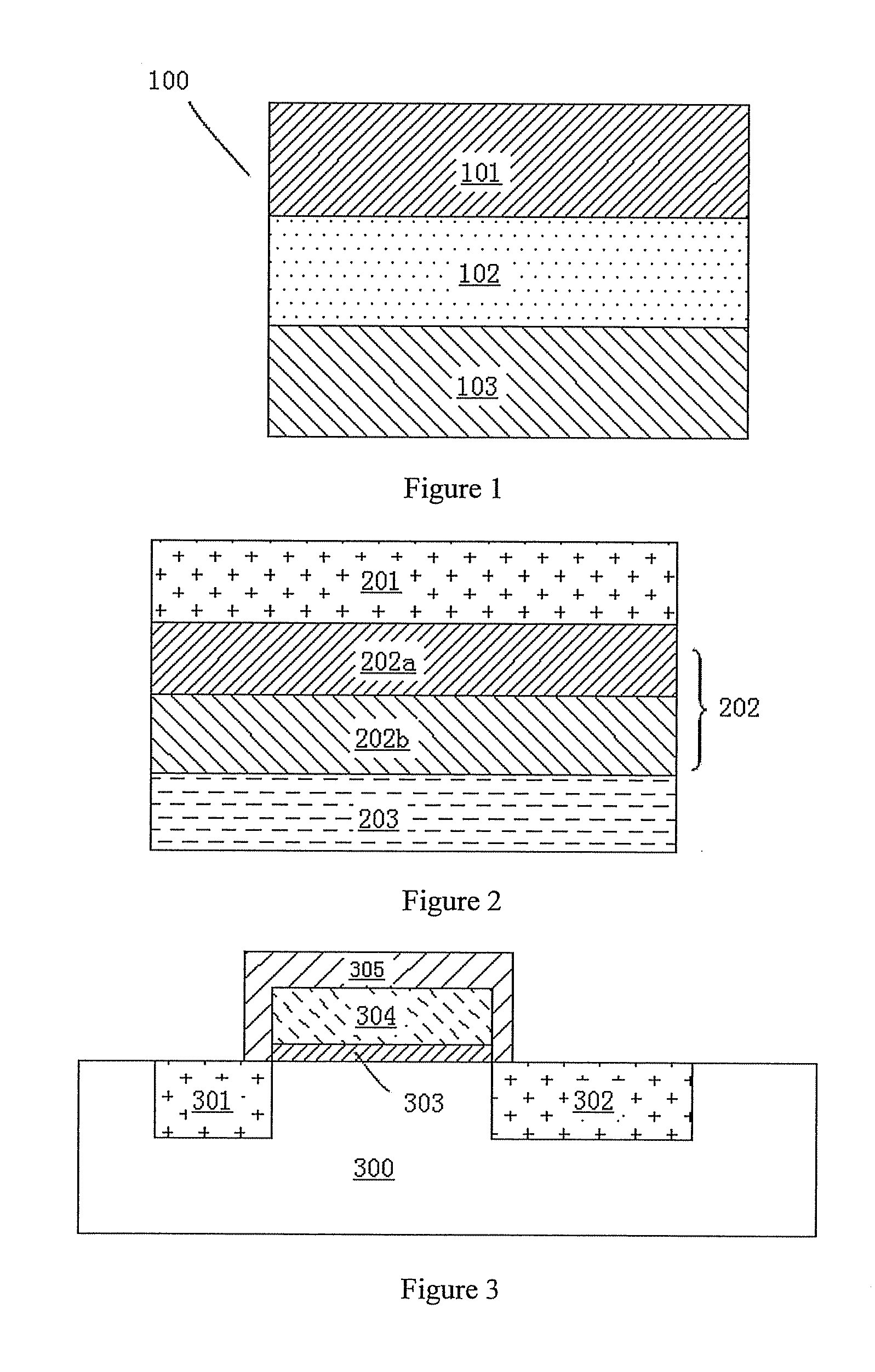
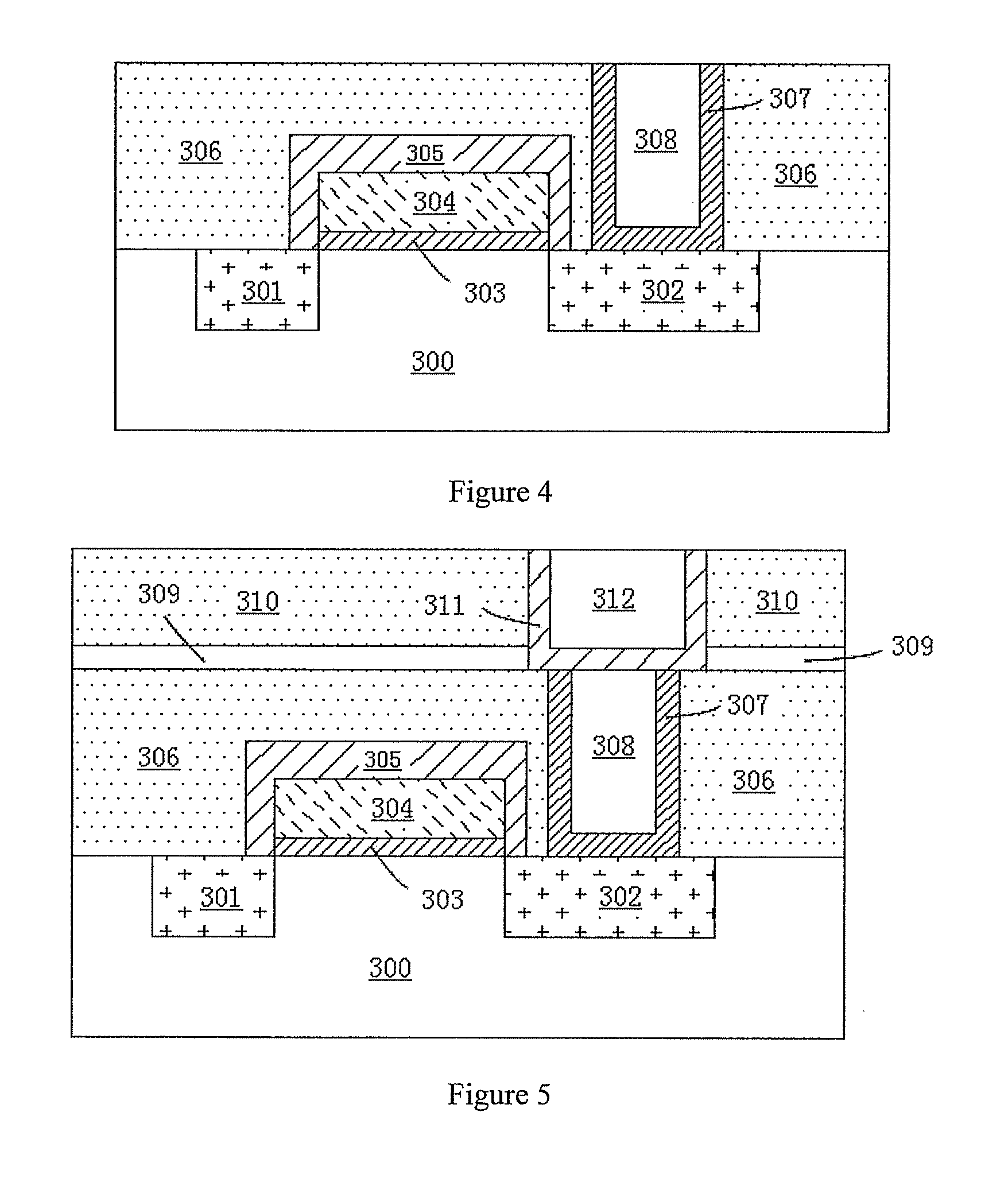
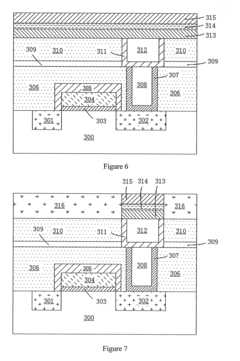
- A laminated layer structure is introduced, comprising a first resistive switching layer with a high dielectric constant and a second resistive switching and electric-field strengthened layer with a lower dielectric constant, which adjusts the electric field distribution by using materials like HfO2 and SiO2, respectively, to enhance the stability and control of conductive channels during switching.
Material Science Innovations for RRAM Reliability
Material science innovations represent a critical frontier in addressing RRAM reliability challenges for high-speed computing applications. Recent advancements in electrode materials have shown promising results, with platinum-based alloys demonstrating superior thermal stability and reduced ion migration compared to conventional copper or silver electrodes. These innovations have led to a 35% improvement in retention time under high-frequency operation conditions.
The development of novel switching materials beyond traditional metal oxides has opened new possibilities for RRAM stability. Specifically, 2D materials such as MoS2 and hexagonal boron nitride (h-BN) exhibit exceptional mechanical properties that resist deformation under thermal stress. When integrated into RRAM structures, these materials have demonstrated a significant reduction in resistance drift—a common failure mechanism during high-speed operations.
Interface engineering has emerged as another crucial approach to enhancing RRAM reliability. By introducing carefully designed buffer layers between the switching material and electrodes, researchers have successfully mitigated the formation of undesirable conductive filaments that lead to device instability. Atomic Layer Deposition (ALD) techniques have enabled precise control over these interfaces at the nanometer scale, resulting in more uniform switching behavior across multiple cycles.
Doping strategies have proven effective in modifying the intrinsic properties of switching materials. For instance, nitrogen-doped HfO2 has shown remarkable improvement in endurance, withstanding up to 10^9 switching cycles without significant degradation—a tenfold increase compared to undoped variants. This enhancement is attributed to the formation of more stable oxygen vacancies that serve as controlled switching sites.
Multilayer material stacks represent another innovative direction, where alternating layers of different materials create engineered defect profiles. These structures can guide the formation and rupture of conductive filaments along predetermined paths, reducing the randomness associated with conventional RRAM operation. Recent studies have demonstrated that HfO2/Al2O3 bilayer structures exhibit 40% lower cycle-to-cycle variability compared to single-layer devices.
Encapsulation technologies using advanced barrier materials have also contributed significantly to RRAM reliability. Atomic-scale encapsulation using materials like Al2O3 or Si3N4 has effectively prevented moisture penetration and oxygen diffusion—environmental factors that accelerate device degradation. These protective layers have extended the operational lifetime of RRAM devices in varying environmental conditions without compromising switching speed.
The development of novel switching materials beyond traditional metal oxides has opened new possibilities for RRAM stability. Specifically, 2D materials such as MoS2 and hexagonal boron nitride (h-BN) exhibit exceptional mechanical properties that resist deformation under thermal stress. When integrated into RRAM structures, these materials have demonstrated a significant reduction in resistance drift—a common failure mechanism during high-speed operations.
Interface engineering has emerged as another crucial approach to enhancing RRAM reliability. By introducing carefully designed buffer layers between the switching material and electrodes, researchers have successfully mitigated the formation of undesirable conductive filaments that lead to device instability. Atomic Layer Deposition (ALD) techniques have enabled precise control over these interfaces at the nanometer scale, resulting in more uniform switching behavior across multiple cycles.
Doping strategies have proven effective in modifying the intrinsic properties of switching materials. For instance, nitrogen-doped HfO2 has shown remarkable improvement in endurance, withstanding up to 10^9 switching cycles without significant degradation—a tenfold increase compared to undoped variants. This enhancement is attributed to the formation of more stable oxygen vacancies that serve as controlled switching sites.
Multilayer material stacks represent another innovative direction, where alternating layers of different materials create engineered defect profiles. These structures can guide the formation and rupture of conductive filaments along predetermined paths, reducing the randomness associated with conventional RRAM operation. Recent studies have demonstrated that HfO2/Al2O3 bilayer structures exhibit 40% lower cycle-to-cycle variability compared to single-layer devices.
Encapsulation technologies using advanced barrier materials have also contributed significantly to RRAM reliability. Atomic-scale encapsulation using materials like Al2O3 or Si3N4 has effectively prevented moisture penetration and oxygen diffusion—environmental factors that accelerate device degradation. These protective layers have extended the operational lifetime of RRAM devices in varying environmental conditions without compromising switching speed.
Energy Efficiency Considerations in Stable RRAM Design
Energy efficiency represents a critical dimension in the development of stable RRAM (Resistive Random-Access Memory) technologies for high-speed computing applications. As computing demands continue to escalate across various sectors, the power consumption associated with memory operations has become a significant bottleneck in system performance and sustainability.
RRAM devices inherently offer promising energy characteristics compared to conventional memory technologies, with typical write operations consuming between 0.1-10 pJ per bit, significantly lower than DRAM or Flash memory. However, the stability-enhancing mechanisms often introduce additional energy overhead that must be carefully managed to maintain RRAM's competitive advantage.
The relationship between stability and energy consumption in RRAM presents a fundamental trade-off. Higher programming voltages and longer pulse durations generally improve state retention and resistance ratio stability but increase energy consumption exponentially. Recent research indicates that optimizing the programming algorithm can reduce energy requirements by up to 40% while maintaining acceptable stability metrics, particularly through adaptive programming schemes that adjust parameters based on real-time feedback.
Material engineering approaches offer another avenue for energy optimization. Oxygen-engineered HfOx-based RRAM has demonstrated 30% lower switching energy while improving retention characteristics through controlled oxygen vacancy distribution. Similarly, interface engineering techniques using atomically thin barrier layers have shown promise in reducing the energy required for reliable switching operations while simultaneously enhancing endurance properties.
Circuit-level innovations provide additional energy efficiency opportunities. Peripheral circuitry typically consumes 60-70% of total RRAM array energy, presenting a significant optimization target. Recent developments in low-voltage sense amplifiers and charge-recycling write drivers have demonstrated energy reductions of up to 50% in read and write operations respectively, without compromising stability or speed performance.
Thermal management strategies also play a crucial role in energy-efficient stable RRAM design. Self-heating effects during switching operations can compromise both stability and energy efficiency. Advanced heat dissipation structures and thermally-aware programming protocols have shown effectiveness in maintaining lower operating temperatures, thereby reducing leakage currents and improving overall energy efficiency by 15-25% in high-density arrays.
Looking forward, emerging techniques such as probabilistic computing architectures and approximate storage paradigms offer pathways to further reduce energy consumption by relaxing absolute stability requirements in appropriate application contexts, potentially achieving order-of-magnitude improvements in energy efficiency for specific computational tasks while maintaining functional stability.
RRAM devices inherently offer promising energy characteristics compared to conventional memory technologies, with typical write operations consuming between 0.1-10 pJ per bit, significantly lower than DRAM or Flash memory. However, the stability-enhancing mechanisms often introduce additional energy overhead that must be carefully managed to maintain RRAM's competitive advantage.
The relationship between stability and energy consumption in RRAM presents a fundamental trade-off. Higher programming voltages and longer pulse durations generally improve state retention and resistance ratio stability but increase energy consumption exponentially. Recent research indicates that optimizing the programming algorithm can reduce energy requirements by up to 40% while maintaining acceptable stability metrics, particularly through adaptive programming schemes that adjust parameters based on real-time feedback.
Material engineering approaches offer another avenue for energy optimization. Oxygen-engineered HfOx-based RRAM has demonstrated 30% lower switching energy while improving retention characteristics through controlled oxygen vacancy distribution. Similarly, interface engineering techniques using atomically thin barrier layers have shown promise in reducing the energy required for reliable switching operations while simultaneously enhancing endurance properties.
Circuit-level innovations provide additional energy efficiency opportunities. Peripheral circuitry typically consumes 60-70% of total RRAM array energy, presenting a significant optimization target. Recent developments in low-voltage sense amplifiers and charge-recycling write drivers have demonstrated energy reductions of up to 50% in read and write operations respectively, without compromising stability or speed performance.
Thermal management strategies also play a crucial role in energy-efficient stable RRAM design. Self-heating effects during switching operations can compromise both stability and energy efficiency. Advanced heat dissipation structures and thermally-aware programming protocols have shown effectiveness in maintaining lower operating temperatures, thereby reducing leakage currents and improving overall energy efficiency by 15-25% in high-density arrays.
Looking forward, emerging techniques such as probabilistic computing architectures and approximate storage paradigms offer pathways to further reduce energy consumption by relaxing absolute stability requirements in appropriate application contexts, potentially achieving order-of-magnitude improvements in energy efficiency for specific computational tasks while maintaining functional stability.
Unlock deeper insights with PatSnap Eureka Quick Research — get a full tech report to explore trends and direct your research. Try now!
Generate Your Research Report Instantly with AI Agent
Supercharge your innovation with PatSnap Eureka AI Agent Platform!