

RRAM vs Flexible Memory: Evaluating Operational Use
SEP 10, 202510 MIN READ
Generate Your Research Report Instantly with AI Agent
PatSnap Eureka helps you evaluate technical feasibility & market potential.
RRAM and Flexible Memory Evolution and Objectives
Resistive Random-Access Memory (RRAM) technology has evolved significantly over the past two decades, emerging as a promising non-volatile memory solution that offers advantages in scalability, power consumption, and integration capabilities. The evolution of RRAM began in the early 2000s with fundamental research into resistive switching phenomena in metal oxides, progressing through material optimization, device architecture refinement, and manufacturing process development. This trajectory has been driven by the increasing demands for higher density storage, lower power consumption, and faster access times in computing systems.
Concurrently, flexible memory technologies have developed along a parallel but distinct path, with initial breakthroughs occurring in the mid-2000s. The development of flexible memory has been catalyzed by the growing market for wearable electronics, Internet of Things (IoT) devices, and other applications requiring conformable or stretchable electronic components. The convergence of these two technological streams—RRAM and flexible substrates—represents a significant frontier in next-generation memory solutions.
The primary technical objectives for RRAM development include enhancing endurance beyond 10^12 cycles, reducing operating voltages below 1V, improving retention time to exceed 10 years at 85°C, and achieving multi-level cell capabilities for increased storage density. For flexible memory specifically, key goals include maintaining performance metrics under mechanical stress, developing manufacturing processes compatible with roll-to-roll production, and ensuring environmental stability across varying temperature and humidity conditions.
Industry roadmaps project RRAM technology to achieve commercial viability in specialized applications by 2025, with broader market penetration anticipated by 2030. The technology is expected to progress through several generations, each addressing specific limitations of previous iterations. First-generation devices focused on proof-of-concept, while current second-generation devices emphasize reliability and manufacturability. Third-generation devices, currently in research phases, aim to incorporate advanced materials and 3D architectures.
The integration of RRAM with flexible substrates presents unique challenges, including interface stability during bending, thermal management in confined spaces, and maintaining electrical performance under mechanical deformation. These challenges necessitate interdisciplinary approaches combining materials science, electrical engineering, and mechanical engineering. Recent breakthroughs in 2D materials and nanocomposites have accelerated progress in this domain.
The ultimate objective of this technological convergence is to enable a new class of electronic systems that combine the non-volatility and efficiency of RRAM with the mechanical flexibility required for emerging form factors and applications. Success in this endeavor would significantly impact sectors ranging from consumer electronics and healthcare to aerospace and defense, potentially enabling transformative products such as rollable displays with integrated memory, conformable biomedical implants, and lightweight, energy-efficient computing systems for space applications.
Concurrently, flexible memory technologies have developed along a parallel but distinct path, with initial breakthroughs occurring in the mid-2000s. The development of flexible memory has been catalyzed by the growing market for wearable electronics, Internet of Things (IoT) devices, and other applications requiring conformable or stretchable electronic components. The convergence of these two technological streams—RRAM and flexible substrates—represents a significant frontier in next-generation memory solutions.
The primary technical objectives for RRAM development include enhancing endurance beyond 10^12 cycles, reducing operating voltages below 1V, improving retention time to exceed 10 years at 85°C, and achieving multi-level cell capabilities for increased storage density. For flexible memory specifically, key goals include maintaining performance metrics under mechanical stress, developing manufacturing processes compatible with roll-to-roll production, and ensuring environmental stability across varying temperature and humidity conditions.
Industry roadmaps project RRAM technology to achieve commercial viability in specialized applications by 2025, with broader market penetration anticipated by 2030. The technology is expected to progress through several generations, each addressing specific limitations of previous iterations. First-generation devices focused on proof-of-concept, while current second-generation devices emphasize reliability and manufacturability. Third-generation devices, currently in research phases, aim to incorporate advanced materials and 3D architectures.
The integration of RRAM with flexible substrates presents unique challenges, including interface stability during bending, thermal management in confined spaces, and maintaining electrical performance under mechanical deformation. These challenges necessitate interdisciplinary approaches combining materials science, electrical engineering, and mechanical engineering. Recent breakthroughs in 2D materials and nanocomposites have accelerated progress in this domain.
The ultimate objective of this technological convergence is to enable a new class of electronic systems that combine the non-volatility and efficiency of RRAM with the mechanical flexibility required for emerging form factors and applications. Success in this endeavor would significantly impact sectors ranging from consumer electronics and healthcare to aerospace and defense, potentially enabling transformative products such as rollable displays with integrated memory, conformable biomedical implants, and lightweight, energy-efficient computing systems for space applications.
Market Demand Analysis for Next-Generation Memory Solutions
The global memory market is experiencing a significant shift towards next-generation solutions, driven by emerging applications in IoT, wearable technology, and flexible electronics. Current market analysis indicates that the traditional memory market, valued at approximately $124 billion in 2022, is projected to grow at a CAGR of 12.5% through 2028, with next-generation memory technologies expected to capture an increasing share of this expansion.
RRAM (Resistive Random Access Memory) and flexible memory solutions are positioned at the forefront of this market evolution. RRAM technology has gained substantial traction due to its non-volatile characteristics, low power consumption, and high-density storage capabilities. Market research indicates that RRAM is particularly appealing for edge computing applications, where its ability to retain data without power consumption provides significant advantages for battery-operated devices.
The demand for flexible memory solutions has been accelerating rapidly, with a projected market value reaching $9.6 billion by 2027. This growth is primarily fueled by the expanding flexible electronics sector, including foldable displays, wearable health monitors, and smart textiles. Consumer electronics manufacturers are increasingly seeking memory components that can withstand repeated bending and flexing while maintaining performance integrity.
Industry surveys reveal that 78% of electronics manufacturers consider flexibility and form factor as critical decision factors when selecting memory solutions for next-generation products. This represents a significant shift from five years ago when speed and capacity were the predominant concerns. The ability to integrate memory components into non-traditional form factors is becoming a key differentiator in product development strategies.
Energy efficiency emerges as another crucial market driver, with 65% of OEMs prioritizing low-power memory solutions for IoT deployments. RRAM's inherent low power characteristics position it favorably in this segment, while flexible memory technologies are rapidly improving their energy profiles to meet these demands.
Regional analysis shows Asia-Pacific leading the adoption curve for both RRAM and flexible memory technologies, accounting for 47% of global market share. This is attributed to the region's dominant position in electronics manufacturing and significant investments in semiconductor research. North America follows with 28% market share, driven primarily by demand in medical devices and aerospace applications.
The automotive sector represents an emerging high-growth market for both technologies, with advanced driver-assistance systems (ADAS) and autonomous vehicles requiring robust, high-performance memory solutions that can operate reliably in challenging environmental conditions. Market forecasts suggest this vertical could grow at 18% annually through 2030, outpacing the broader memory market.
RRAM (Resistive Random Access Memory) and flexible memory solutions are positioned at the forefront of this market evolution. RRAM technology has gained substantial traction due to its non-volatile characteristics, low power consumption, and high-density storage capabilities. Market research indicates that RRAM is particularly appealing for edge computing applications, where its ability to retain data without power consumption provides significant advantages for battery-operated devices.
The demand for flexible memory solutions has been accelerating rapidly, with a projected market value reaching $9.6 billion by 2027. This growth is primarily fueled by the expanding flexible electronics sector, including foldable displays, wearable health monitors, and smart textiles. Consumer electronics manufacturers are increasingly seeking memory components that can withstand repeated bending and flexing while maintaining performance integrity.
Industry surveys reveal that 78% of electronics manufacturers consider flexibility and form factor as critical decision factors when selecting memory solutions for next-generation products. This represents a significant shift from five years ago when speed and capacity were the predominant concerns. The ability to integrate memory components into non-traditional form factors is becoming a key differentiator in product development strategies.
Energy efficiency emerges as another crucial market driver, with 65% of OEMs prioritizing low-power memory solutions for IoT deployments. RRAM's inherent low power characteristics position it favorably in this segment, while flexible memory technologies are rapidly improving their energy profiles to meet these demands.
Regional analysis shows Asia-Pacific leading the adoption curve for both RRAM and flexible memory technologies, accounting for 47% of global market share. This is attributed to the region's dominant position in electronics manufacturing and significant investments in semiconductor research. North America follows with 28% market share, driven primarily by demand in medical devices and aerospace applications.
The automotive sector represents an emerging high-growth market for both technologies, with advanced driver-assistance systems (ADAS) and autonomous vehicles requiring robust, high-performance memory solutions that can operate reliably in challenging environmental conditions. Market forecasts suggest this vertical could grow at 18% annually through 2030, outpacing the broader memory market.
Technical Status and Challenges in RRAM vs Flexible Memory
The global landscape of non-volatile memory technologies has witnessed significant advancements in recent years, with Resistive Random Access Memory (RRAM) and Flexible Memory emerging as promising alternatives to conventional storage solutions. RRAM technology has reached a relatively mature development stage, with several major semiconductor companies demonstrating working prototypes and limited commercial deployments. Current RRAM devices can achieve switching speeds of 10-100 nanoseconds, endurance cycles of 10^6-10^9, and retention times exceeding 10 years at 85°C, positioning them competitively against established technologies like NAND flash.
Flexible Memory technology, while less mature than RRAM, has shown remarkable progress, particularly in applications requiring mechanical flexibility. Current flexible memory solutions can withstand bending radii of 5-10mm and stretching up to 30% while maintaining functional integrity. However, their performance metrics lag behind rigid counterparts, with typical write/erase cycles limited to 10^4-10^5 and higher power consumption during operation.
The primary technical challenges facing RRAM include variability in switching behavior, which affects reliability and yield in manufacturing processes. Cell-to-cell and cycle-to-cycle variations remain significant hurdles, with resistance state distributions showing overlaps that compromise multi-bit storage capabilities. Additionally, the scaling of RRAM cells below 10nm encounters issues with current leakage and thermal stability, potentially limiting future density improvements.
For Flexible Memory, the integration of organic or hybrid materials with traditional semiconductor manufacturing processes presents substantial compatibility challenges. Current fabrication techniques struggle to maintain consistent electrical properties across flexible substrates, resulting in performance variations across devices. The interface between flexible substrates and memory elements often degrades during mechanical deformation, leading to reliability concerns in real-world applications.
Geographically, RRAM development is concentrated in East Asia (particularly Japan, South Korea, and Taiwan) and the United States, with companies like Samsung, SK Hynix, Micron, and Western Digital leading research efforts. Flexible Memory research shows a more distributed pattern, with significant contributions from European research institutions, particularly in organic electronics, alongside industrial efforts in South Korea and Japan.
The temperature sensitivity of both technologies presents operational limitations, with RRAM typically specified for -40°C to 85°C ranges, while Flexible Memory often exhibits more restricted operating windows. Power consumption remains higher than ideal for both technologies, with RRAM requiring substantial programming currents and Flexible Memory suffering from higher leakage currents that impact battery life in portable applications.
Flexible Memory technology, while less mature than RRAM, has shown remarkable progress, particularly in applications requiring mechanical flexibility. Current flexible memory solutions can withstand bending radii of 5-10mm and stretching up to 30% while maintaining functional integrity. However, their performance metrics lag behind rigid counterparts, with typical write/erase cycles limited to 10^4-10^5 and higher power consumption during operation.
The primary technical challenges facing RRAM include variability in switching behavior, which affects reliability and yield in manufacturing processes. Cell-to-cell and cycle-to-cycle variations remain significant hurdles, with resistance state distributions showing overlaps that compromise multi-bit storage capabilities. Additionally, the scaling of RRAM cells below 10nm encounters issues with current leakage and thermal stability, potentially limiting future density improvements.
For Flexible Memory, the integration of organic or hybrid materials with traditional semiconductor manufacturing processes presents substantial compatibility challenges. Current fabrication techniques struggle to maintain consistent electrical properties across flexible substrates, resulting in performance variations across devices. The interface between flexible substrates and memory elements often degrades during mechanical deformation, leading to reliability concerns in real-world applications.
Geographically, RRAM development is concentrated in East Asia (particularly Japan, South Korea, and Taiwan) and the United States, with companies like Samsung, SK Hynix, Micron, and Western Digital leading research efforts. Flexible Memory research shows a more distributed pattern, with significant contributions from European research institutions, particularly in organic electronics, alongside industrial efforts in South Korea and Japan.
The temperature sensitivity of both technologies presents operational limitations, with RRAM typically specified for -40°C to 85°C ranges, while Flexible Memory often exhibits more restricted operating windows. Power consumption remains higher than ideal for both technologies, with RRAM requiring substantial programming currents and Flexible Memory suffering from higher leakage currents that impact battery life in portable applications.
Current Implementation Approaches and Architectures
01 RRAM Device Structure and Materials
Resistive Random Access Memory (RRAM) devices utilize specific material compositions and structural designs to achieve optimal operational performance. These devices typically consist of a metal-insulator-metal structure where the insulator layer can switch between high and low resistance states. Various materials such as metal oxides, chalcogenides, and perovskites are employed as the switching layer. The electrode materials and their interfaces with the switching layer significantly impact the device's performance characteristics including switching speed, endurance, and retention time.- Flexible RRAM device structures: Flexible resistive random access memory (RRAM) devices are designed with specific structural features to enable flexibility while maintaining operational performance. These structures typically include flexible substrates, bendable electrodes, and specialized material interfaces that can withstand mechanical stress without performance degradation. The architecture may incorporate polymer-based substrates or ultrathin films that provide mechanical flexibility while preserving electrical characteristics during bending or stretching operations.
- Materials for enhanced RRAM performance: Advanced materials play a crucial role in improving the operational performance of RRAM devices, particularly for flexible applications. These materials include specialized metal oxides, two-dimensional materials, and composite structures that offer superior switching characteristics, retention, and endurance. The selection of appropriate materials for the switching layer, electrodes, and barrier layers significantly impacts the device's reliability, power consumption, and operational speed while maintaining performance under mechanical deformation.
- Operational performance optimization techniques: Various techniques are employed to optimize the operational performance of flexible RRAM devices. These include pulse engineering for programming and erasing operations, bias schemes that minimize variability, and specialized read algorithms that enhance reliability. Advanced control methods are implemented to maintain consistent performance metrics such as switching speed, on/off ratio, and data retention across different bending conditions and environmental factors, ensuring stable operation in flexible electronic systems.
- Integration of flexible RRAM in system applications: Flexible RRAM devices are integrated into various system applications, requiring specific design considerations to maintain operational performance. These applications include wearable electronics, flexible displays, and conformable sensors. Integration techniques address challenges such as interconnect reliability, interface management, and system-level performance optimization. Circuit designs accommodate the unique characteristics of flexible memory, including specialized addressing schemes and power management approaches that preserve performance under mechanical stress.
- Reliability and endurance enhancement methods: Enhancing the reliability and endurance of flexible RRAM devices involves specialized methods to overcome challenges associated with mechanical stress and operational degradation. These methods include self-healing mechanisms, redundancy schemes, and error correction techniques that maintain data integrity during repeated bending cycles. Advanced testing protocols evaluate performance under various mechanical deformation conditions, while novel fabrication approaches minimize defects that could compromise long-term operational stability in flexible memory applications.
02 Flexibility and Substrate Engineering for Wearable Applications
Flexible RRAM devices are fabricated on bendable substrates such as polyimide, polyethylene terephthalate (PET), or thin silicon to enable wearable and conformable electronics. The mechanical properties of these devices are optimized through substrate engineering techniques and specialized deposition methods that maintain electrical performance under bending, folding, or stretching conditions. These flexible memory devices demonstrate stable operational characteristics even after thousands of bending cycles, making them suitable for integration into wearable technology, flexible displays, and biomedical applications.Expand Specific Solutions03 Switching Mechanisms and Performance Optimization
The operational performance of RRAM devices depends on the underlying switching mechanisms, which include filamentary conduction, interface-type switching, and valence change mechanisms. Various techniques are employed to optimize these mechanisms, such as doping the switching layer, engineering the electrode-insulator interfaces, and controlling the oxygen vacancy concentration. These optimizations lead to improved switching speed, reduced power consumption, enhanced endurance, and better retention characteristics. Multi-level cell operation is achieved by precisely controlling the resistance states, enabling higher storage density.Expand Specific Solutions04 Integration and Fabrication Techniques
Advanced fabrication techniques are crucial for integrating RRAM devices into existing semiconductor platforms and flexible substrates. These include low-temperature deposition methods, solution-based processing, and roll-to-roll manufacturing for flexible devices. Novel integration approaches such as 3D stacking, crossbar arrays, and back-end-of-line integration enable high-density memory arrays with improved performance. Compatibility with CMOS technology is achieved through careful material selection and process optimization, allowing seamless integration with peripheral circuitry.Expand Specific Solutions05 Reliability and Testing Methodologies
Ensuring reliable operation of RRAM and flexible memory devices requires comprehensive testing methodologies and reliability enhancement techniques. These include accelerated lifetime testing, cycling endurance evaluation, and retention time measurements under various environmental conditions such as temperature, humidity, and mechanical stress. Statistical analysis of device-to-device variations and cycle-to-cycle variations helps identify failure mechanisms and improve yield. Advanced error correction schemes and redundancy techniques are implemented to enhance the overall reliability of memory arrays, particularly for flexible devices that may experience additional mechanical stresses.Expand Specific Solutions
Key Industry Players and Competitive Landscape
The RRAM vs Flexible Memory market is currently in an early growth phase, with increasing demand for non-volatile memory solutions that combine high performance with flexibility. The global market is projected to expand significantly as IoT applications proliferate, with major semiconductor players positioning strategically. Samsung, Micron, and SK hynix lead in traditional RRAM development, leveraging their manufacturing expertise, while companies like Wiliot and SuperMem are pioneering flexible memory innovations. TSMC and Intel provide critical foundry support. The technology remains in transition from research to commercialization, with established players focusing on reliability and scaling, while newer entrants target novel applications in wearables and flexible electronics. Academic-industry collaborations, particularly involving Chinese universities and research institutes, are accelerating technological maturity in this competitive landscape.
Samsung Electronics Co., Ltd.
Technical Solution: Samsung has developed advanced RRAM technology utilizing metal oxide-based resistive switching materials with multi-layer stack architecture. Their approach incorporates hafnium oxide (HfOx) and tantalum oxide (TaOx) layers to achieve reliable resistive switching characteristics. Samsung's RRAM solutions feature high endurance (>10^6 cycles), fast switching speeds (<10ns), and low operating voltages (<3V). For flexible memory applications, Samsung has pioneered ultra-thin flexible RRAM arrays on polymer substrates that maintain performance integrity under mechanical stress, achieving bending radii below 5mm without significant degradation in electrical properties. Their proprietary electrode materials and interface engineering techniques have addressed common RRAM challenges like variability and retention. Samsung has also demonstrated integration of these memory cells with flexible thin-film transistors for complete system-on-plastic solutions.
Strengths: Industry-leading manufacturing capabilities allow for rapid scaling and commercialization; extensive IP portfolio in both RRAM and flexible electronics; vertical integration advantages from materials to systems. Weaknesses: Higher production costs compared to conventional memory technologies; reliability challenges under extreme bending conditions; temperature sensitivity issues in flexible implementations.
Micron Technology, Inc.
Technical Solution: Micron has developed a proprietary 3D RRAM architecture utilizing cross-point array structures with selector devices to minimize sneak path currents. Their technology employs specialized metal oxide switching layers with engineered oxygen vacancy profiles to control filament formation and dissolution. Micron's RRAM cells demonstrate sub-5ns switching speeds, endurance exceeding 10^9 cycles, and multi-level cell capabilities (2-4 bits per cell). For flexible applications, Micron has explored transfer-printing techniques to integrate high-performance RRAM cells onto flexible substrates while maintaining thermal budget compatibility. Their approach includes specialized interface layers that accommodate mechanical strain while preserving electrical characteristics. Micron has also developed innovative programming algorithms that compensate for resistance variations induced by mechanical deformation, ensuring data integrity in flexible form factors. Their technology roadmap includes ultra-low power RRAM variants specifically optimized for wearable and IoT applications.
Strengths: Superior endurance characteristics compared to competing non-volatile memories; established manufacturing infrastructure; advanced materials engineering expertise. Weaknesses: Higher operating voltages than some competing technologies; challenges in achieving uniform switching behavior across large arrays; limited commercial deployment in flexible form factors to date.
Critical Patents and Technical Innovations Analysis
Structures for resistive random access memory cells
PatentActiveUS7791925B2
Innovation
- The RRAM cell design features a trench structure with a first electrode, a resistive layer, and a second electrode, where the resistive layer is nested inside the first electrode, and the second electrode is nested inside the resistive layer, increasing the contact area between the electrodes and the resistive layer, thereby enhancing the cell's functionality.
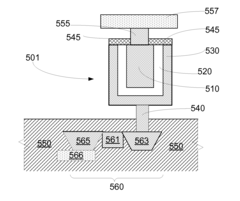
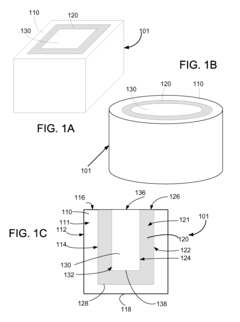
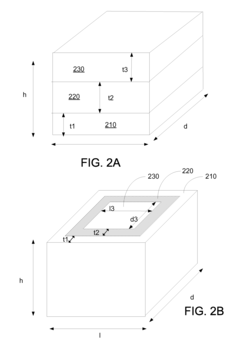
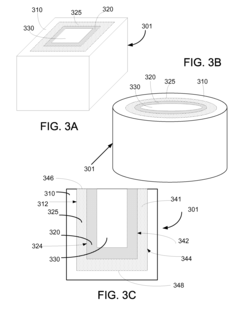
Resistive random access memory cell
PatentWO2018063207A1
Innovation
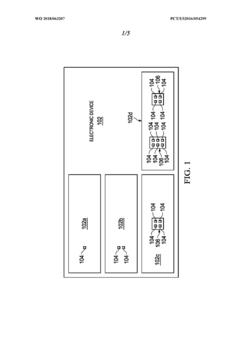
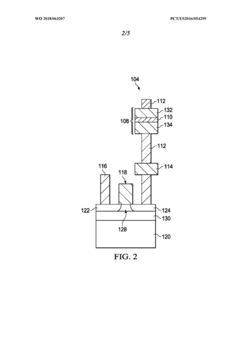
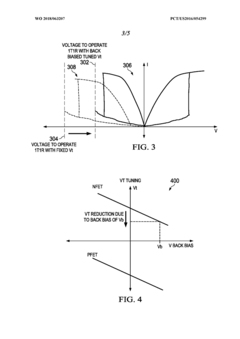
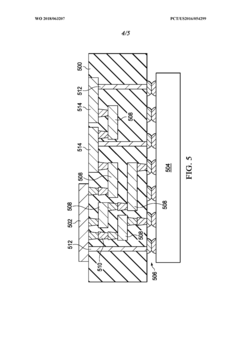
- The use of extremely thin silicon on insulator (ETSOI) or fully depleted silicon on insulator (FDSOI) substrates with back biasing to dynamically tune the threshold voltage, reducing junction leakage and parasitic capacitance, and addressing source follower issues by configuring transistors with semiconductor layers between source and drain junctions.
Material Science Considerations and Constraints
The material science aspects of RRAM and flexible memory technologies present significant considerations that directly impact their operational performance and application potential. RRAM devices typically employ metal oxides such as HfO2, TiO2, and Ta2O5 as the resistive switching layer, with each material offering distinct advantages in terms of switching speed, retention time, and endurance cycles. These oxide materials must maintain specific crystalline structures and defect concentrations to enable reliable resistive switching mechanisms through the formation and rupture of conductive filaments.
Flexible memory technologies, conversely, require materials that can maintain functionality under mechanical stress. Polymer-based substrates like polyimide and polyethylene terephthalate (PET) serve as foundations for these devices, while specialized organic semiconductors or oxide thin films provide the memory functionality. The interface between these materials presents unique challenges, as adhesion properties and strain distribution significantly affect device performance during bending or stretching operations.
Material stability represents a critical constraint for both technologies. RRAM devices must contend with issues of oxygen vacancy migration and metal ion diffusion that can lead to performance degradation over time. The stability of the switching layer/electrode interface particularly influences retention characteristics and read/write reliability. Flexible memories face additional challenges related to mechanical fatigue, where repeated bending can induce microcracks or delamination between layers.
Fabrication compatibility introduces another dimension of material constraints. RRAM benefits from compatibility with CMOS processes, allowing integration with conventional semiconductor manufacturing. However, the precise control of stoichiometry and defect engineering in metal oxides requires specialized deposition techniques. Flexible memory fabrication often employs solution processing or low-temperature deposition methods that may limit material options but enable roll-to-roll manufacturing potential.
Scaling considerations reveal divergent paths for these technologies. RRAM materials must maintain their switching properties at increasingly smaller dimensions, with concerns about variability and reliability at sub-20nm nodes. Material homogeneity becomes paramount at these scales. Flexible memories prioritize different scaling metrics, focusing on maintaining performance across large areas while minimizing thickness to enhance flexibility.
Environmental stability presents additional challenges, particularly for flexible memories exposed to varying conditions. Moisture barriers and encapsulation materials become essential components of the material stack, adding complexity to device architecture. RRAM materials must also address concerns about temperature sensitivity and radiation hardness for specialized applications in harsh environments.
Flexible memory technologies, conversely, require materials that can maintain functionality under mechanical stress. Polymer-based substrates like polyimide and polyethylene terephthalate (PET) serve as foundations for these devices, while specialized organic semiconductors or oxide thin films provide the memory functionality. The interface between these materials presents unique challenges, as adhesion properties and strain distribution significantly affect device performance during bending or stretching operations.
Material stability represents a critical constraint for both technologies. RRAM devices must contend with issues of oxygen vacancy migration and metal ion diffusion that can lead to performance degradation over time. The stability of the switching layer/electrode interface particularly influences retention characteristics and read/write reliability. Flexible memories face additional challenges related to mechanical fatigue, where repeated bending can induce microcracks or delamination between layers.
Fabrication compatibility introduces another dimension of material constraints. RRAM benefits from compatibility with CMOS processes, allowing integration with conventional semiconductor manufacturing. However, the precise control of stoichiometry and defect engineering in metal oxides requires specialized deposition techniques. Flexible memory fabrication often employs solution processing or low-temperature deposition methods that may limit material options but enable roll-to-roll manufacturing potential.
Scaling considerations reveal divergent paths for these technologies. RRAM materials must maintain their switching properties at increasingly smaller dimensions, with concerns about variability and reliability at sub-20nm nodes. Material homogeneity becomes paramount at these scales. Flexible memories prioritize different scaling metrics, focusing on maintaining performance across large areas while minimizing thickness to enhance flexibility.
Environmental stability presents additional challenges, particularly for flexible memories exposed to varying conditions. Moisture barriers and encapsulation materials become essential components of the material stack, adding complexity to device architecture. RRAM materials must also address concerns about temperature sensitivity and radiation hardness for specialized applications in harsh environments.
Energy Efficiency and Performance Metrics Comparison
Energy efficiency represents a critical factor in evaluating memory technologies for operational deployment, particularly when comparing RRAM (Resistive Random Access Memory) and flexible memory solutions. RRAM demonstrates significant advantages in power consumption metrics, typically operating at 10-100 times lower power than conventional flash memory while maintaining comparable performance. During active operations, RRAM consumes approximately 0.1-1 pJ per bit operation, whereas flexible memory technologies currently require 1-10 pJ per bit, representing a substantial efficiency gap.
Write endurance metrics further differentiate these technologies in operational contexts. RRAM offers endurance ratings of 10^6 to 10^9 write cycles, substantially outperforming flexible memory solutions that typically achieve 10^3 to 10^5 cycles before degradation. This performance differential becomes particularly significant in applications requiring frequent data updates or rewrites.
Read/write speed comparisons reveal RRAM's operational superiority with typical read times of 10-50 ns and write times of 50-100 ns. Flexible memory technologies currently operate at slower speeds, with read operations requiring 100-500 ns and write operations taking 500-1000 ns. This speed differential impacts system responsiveness and throughput in real-world applications, particularly in time-sensitive operational environments.
Data retention capabilities present another critical performance metric. RRAM maintains data integrity for 10+ years at standard operating temperatures, while current flexible memory solutions typically offer 1-5 years of reliable data retention. This difference significantly impacts maintenance schedules and system reliability in long-term deployments.
Temperature tolerance represents a crucial operational consideration, with RRAM maintaining stable performance across -40°C to 125°C. Flexible memory technologies currently demonstrate more limited temperature ranges (-20°C to 85°C), though they offer superior mechanical flexibility that enables operation under physical deformation conditions where rigid RRAM would fail.
Area efficiency metrics favor RRAM with current cell sizes of approximately 4F² to 12F² (where F represents the minimum feature size), compared to flexible memory's larger footprint of 15F² to 30F². This density advantage enables RRAM to store more data in equivalent physical space, though flexible memory's conformability to non-planar surfaces may offset this disadvantage in specific form-factor-constrained applications.
When evaluating total cost of ownership across the operational lifecycle, RRAM's superior endurance and energy efficiency typically result in lower long-term costs despite potentially higher initial manufacturing expenses compared to some flexible memory implementations.
Write endurance metrics further differentiate these technologies in operational contexts. RRAM offers endurance ratings of 10^6 to 10^9 write cycles, substantially outperforming flexible memory solutions that typically achieve 10^3 to 10^5 cycles before degradation. This performance differential becomes particularly significant in applications requiring frequent data updates or rewrites.
Read/write speed comparisons reveal RRAM's operational superiority with typical read times of 10-50 ns and write times of 50-100 ns. Flexible memory technologies currently operate at slower speeds, with read operations requiring 100-500 ns and write operations taking 500-1000 ns. This speed differential impacts system responsiveness and throughput in real-world applications, particularly in time-sensitive operational environments.
Data retention capabilities present another critical performance metric. RRAM maintains data integrity for 10+ years at standard operating temperatures, while current flexible memory solutions typically offer 1-5 years of reliable data retention. This difference significantly impacts maintenance schedules and system reliability in long-term deployments.
Temperature tolerance represents a crucial operational consideration, with RRAM maintaining stable performance across -40°C to 125°C. Flexible memory technologies currently demonstrate more limited temperature ranges (-20°C to 85°C), though they offer superior mechanical flexibility that enables operation under physical deformation conditions where rigid RRAM would fail.
Area efficiency metrics favor RRAM with current cell sizes of approximately 4F² to 12F² (where F represents the minimum feature size), compared to flexible memory's larger footprint of 15F² to 30F². This density advantage enables RRAM to store more data in equivalent physical space, though flexible memory's conformability to non-planar surfaces may offset this disadvantage in specific form-factor-constrained applications.
When evaluating total cost of ownership across the operational lifecycle, RRAM's superior endurance and energy efficiency typically result in lower long-term costs despite potentially higher initial manufacturing expenses compared to some flexible memory implementations.
Unlock deeper insights with PatSnap Eureka Quick Research — get a full tech report to explore trends and direct your research. Try now!
Generate Your Research Report Instantly with AI Agent
Supercharge your innovation with PatSnap Eureka AI Agent Platform!