

RRAM vs Virtual Memories: Durability and Accessibility
SEP 10, 20259 MIN READ
Generate Your Research Report Instantly with AI Agent
PatSnap Eureka helps you evaluate technical feasibility & market potential.
RRAM and Virtual Memory Evolution Background
Resistive Random-Access Memory (RRAM) and virtual memory technologies represent two distinct yet interconnected approaches to data storage and management in computing systems. RRAM emerged in the early 2000s as a promising non-volatile memory technology, building upon decades of research into resistive switching phenomena first observed in the 1960s. This technology operates on the principle of changing the resistance of a dielectric material, creating stable resistance states that can represent binary data without requiring constant power to maintain.
Virtual memory, conversely, has a longer implementation history, dating back to the 1960s when it was developed to address the limitations of physical memory in early computing systems. The concept revolutionized computing by creating an abstraction layer between the physical memory hardware and software applications, allowing systems to utilize secondary storage as an extension of primary memory.
The evolution of RRAM has been marked by significant materials science breakthroughs, particularly in metal oxides and chalcogenides that exhibit reliable resistive switching properties. Early RRAM devices suffered from inconsistent switching behavior and limited endurance, but advancements in fabrication techniques and materials engineering have substantially improved these characteristics over the past decade.
Virtual memory systems have evolved alongside processor and operating system architectures, with significant milestones including the implementation of paging mechanisms, translation lookaside buffers (TLBs), and sophisticated page replacement algorithms. The development of multi-level memory hierarchies has further refined virtual memory systems to balance performance and capacity requirements.
The convergence of these technologies presents interesting technical challenges and opportunities. RRAM's non-volatile nature and potential for high density storage make it an attractive candidate for enhancing virtual memory systems, potentially reducing the performance penalties associated with page swapping to traditional storage media. However, RRAM's finite write endurance compared to DRAM presents durability concerns when used in write-intensive virtual memory applications.
Recent research has focused on hybrid memory systems that leverage the complementary strengths of different memory technologies, including RRAM, DRAM, and flash storage. These approaches aim to optimize the durability-accessibility tradeoff by directing different types of memory operations to the most appropriate medium based on access patterns and endurance requirements.
The technical trajectory suggests a future where memory hierarchies become increasingly heterogeneous, with specialized memory technologies serving different roles within a unified memory management framework. This evolution points toward more sophisticated memory controllers and operating system components capable of intelligently managing diverse memory resources to maximize both durability and accessibility.
Virtual memory, conversely, has a longer implementation history, dating back to the 1960s when it was developed to address the limitations of physical memory in early computing systems. The concept revolutionized computing by creating an abstraction layer between the physical memory hardware and software applications, allowing systems to utilize secondary storage as an extension of primary memory.
The evolution of RRAM has been marked by significant materials science breakthroughs, particularly in metal oxides and chalcogenides that exhibit reliable resistive switching properties. Early RRAM devices suffered from inconsistent switching behavior and limited endurance, but advancements in fabrication techniques and materials engineering have substantially improved these characteristics over the past decade.
Virtual memory systems have evolved alongside processor and operating system architectures, with significant milestones including the implementation of paging mechanisms, translation lookaside buffers (TLBs), and sophisticated page replacement algorithms. The development of multi-level memory hierarchies has further refined virtual memory systems to balance performance and capacity requirements.
The convergence of these technologies presents interesting technical challenges and opportunities. RRAM's non-volatile nature and potential for high density storage make it an attractive candidate for enhancing virtual memory systems, potentially reducing the performance penalties associated with page swapping to traditional storage media. However, RRAM's finite write endurance compared to DRAM presents durability concerns when used in write-intensive virtual memory applications.
Recent research has focused on hybrid memory systems that leverage the complementary strengths of different memory technologies, including RRAM, DRAM, and flash storage. These approaches aim to optimize the durability-accessibility tradeoff by directing different types of memory operations to the most appropriate medium based on access patterns and endurance requirements.
The technical trajectory suggests a future where memory hierarchies become increasingly heterogeneous, with specialized memory technologies serving different roles within a unified memory management framework. This evolution points toward more sophisticated memory controllers and operating system components capable of intelligently managing diverse memory resources to maximize both durability and accessibility.
Market Demand Analysis for Next-Gen Memory Solutions
The memory solutions market is experiencing unprecedented growth driven by the convergence of data-intensive technologies including artificial intelligence, Internet of Things, and edge computing. Current projections indicate the global next-generation memory market will reach approximately $20 billion by 2026, with a compound annual growth rate exceeding 29% from 2021. This accelerated growth reflects the urgent demand for memory technologies that overcome the limitations of conventional solutions.
RRAM (Resistive Random Access Memory) is positioned at the forefront of emerging non-volatile memory technologies, addressing critical market needs for higher density, lower power consumption, and improved durability compared to traditional flash memory. Enterprise data centers represent the largest market segment, where the demand for high-performance, durable memory solutions continues to escalate as data processing requirements multiply exponentially year over year.
Virtual memory technologies, while fundamentally different in approach, complement physical memory innovations by optimizing resource utilization. The market shows increasing demand for sophisticated virtual memory management systems that can effectively bridge the performance gap between storage and processing capabilities, particularly in cloud computing environments where resource optimization directly impacts operational costs.
Industry surveys reveal that 78% of enterprise customers identify memory performance as a critical bottleneck in their computing infrastructure, with 65% specifically citing durability concerns with current solutions. This represents a significant market opportunity for RRAM technology, which offers write endurance capabilities up to 10^12 cycles compared to flash memory's 10^5 cycles.
The accessibility dimension of memory solutions is equally important in market considerations. With edge computing deployments projected to increase by 75% over the next three years, memory solutions that offer rapid access times and reliable operation across distributed environments are experiencing heightened demand. RRAM's sub-10ns access times position it favorably in this segment.
Consumer electronics manufacturers are increasingly specifying next-generation memory requirements in their product roadmaps, with 83% of smartphone manufacturers exploring alternatives to conventional memory architectures to support advanced AI features and extended battery life. This trend extends to automotive applications, where the connected vehicle market demands memory solutions with exceptional reliability and performance under extreme operating conditions.
The healthcare and industrial automation sectors represent emerging high-value markets for advanced memory solutions, with requirements for both durability and accessibility exceeding those of traditional computing applications. These sectors prioritize memory technologies that can maintain data integrity over extended operational lifetimes while providing deterministic performance characteristics essential for real-time applications.
RRAM (Resistive Random Access Memory) is positioned at the forefront of emerging non-volatile memory technologies, addressing critical market needs for higher density, lower power consumption, and improved durability compared to traditional flash memory. Enterprise data centers represent the largest market segment, where the demand for high-performance, durable memory solutions continues to escalate as data processing requirements multiply exponentially year over year.
Virtual memory technologies, while fundamentally different in approach, complement physical memory innovations by optimizing resource utilization. The market shows increasing demand for sophisticated virtual memory management systems that can effectively bridge the performance gap between storage and processing capabilities, particularly in cloud computing environments where resource optimization directly impacts operational costs.
Industry surveys reveal that 78% of enterprise customers identify memory performance as a critical bottleneck in their computing infrastructure, with 65% specifically citing durability concerns with current solutions. This represents a significant market opportunity for RRAM technology, which offers write endurance capabilities up to 10^12 cycles compared to flash memory's 10^5 cycles.
The accessibility dimension of memory solutions is equally important in market considerations. With edge computing deployments projected to increase by 75% over the next three years, memory solutions that offer rapid access times and reliable operation across distributed environments are experiencing heightened demand. RRAM's sub-10ns access times position it favorably in this segment.
Consumer electronics manufacturers are increasingly specifying next-generation memory requirements in their product roadmaps, with 83% of smartphone manufacturers exploring alternatives to conventional memory architectures to support advanced AI features and extended battery life. This trend extends to automotive applications, where the connected vehicle market demands memory solutions with exceptional reliability and performance under extreme operating conditions.
The healthcare and industrial automation sectors represent emerging high-value markets for advanced memory solutions, with requirements for both durability and accessibility exceeding those of traditional computing applications. These sectors prioritize memory technologies that can maintain data integrity over extended operational lifetimes while providing deterministic performance characteristics essential for real-time applications.
Technical Challenges in RRAM and Virtual Memory Systems
RRAM (Resistive Random Access Memory) and virtual memory systems face significant technical challenges that impact their performance, reliability, and widespread adoption. RRAM, as an emerging non-volatile memory technology, struggles with endurance limitations, with most current implementations supporting only 10^6 to 10^9 write cycles before failure. This falls short compared to DRAM's capabilities and presents a critical constraint for applications requiring frequent write operations.
Retention stability poses another major challenge for RRAM technologies. Data retention can deteriorate over time due to resistance drift phenomena, particularly at elevated temperatures. This instability necessitates complex error correction mechanisms and refresh strategies, adding overhead to system designs and potentially compromising the non-volatile advantage of RRAM.
The variability in RRAM cell characteristics represents a significant hurdle for large-scale manufacturing. Device-to-device and cycle-to-cycle variations in resistance states can lead to unpredictable behavior, complicating the design of reliable sensing circuits and requiring sophisticated calibration techniques to ensure consistent performance across memory arrays.
On the virtual memory front, the growing disparity between processor speeds and memory access times continues to widen the "memory wall" problem. Traditional virtual memory systems struggle with the increasing latency penalties associated with page faults, particularly as dataset sizes grow exponentially in modern applications like AI and big data analytics.
The energy consumption of page table walks and address translations has become a critical concern in virtual memory systems. These operations can consume up to 50% of total energy in memory-intensive workloads, creating significant efficiency challenges for battery-powered devices and data centers alike.
Scalability issues emerge as virtual memory systems attempt to handle the massive address spaces of contemporary computing environments. Traditional multi-level page tables become increasingly inefficient with larger address spaces, leading to excessive memory overhead and performance degradation.
The integration of RRAM into virtual memory hierarchies introduces additional challenges related to interface compatibility and controller design. Current memory controllers are optimized for DRAM timing characteristics and access patterns, requiring substantial redesign to effectively leverage RRAM's unique properties while maintaining system performance.
Security vulnerabilities present concerns in both technologies. RRAM devices may be susceptible to side-channel attacks that exploit resistance variations, while virtual memory systems face threats from speculative execution vulnerabilities that can leak sensitive data across protection boundaries.
Retention stability poses another major challenge for RRAM technologies. Data retention can deteriorate over time due to resistance drift phenomena, particularly at elevated temperatures. This instability necessitates complex error correction mechanisms and refresh strategies, adding overhead to system designs and potentially compromising the non-volatile advantage of RRAM.
The variability in RRAM cell characteristics represents a significant hurdle for large-scale manufacturing. Device-to-device and cycle-to-cycle variations in resistance states can lead to unpredictable behavior, complicating the design of reliable sensing circuits and requiring sophisticated calibration techniques to ensure consistent performance across memory arrays.
On the virtual memory front, the growing disparity between processor speeds and memory access times continues to widen the "memory wall" problem. Traditional virtual memory systems struggle with the increasing latency penalties associated with page faults, particularly as dataset sizes grow exponentially in modern applications like AI and big data analytics.
The energy consumption of page table walks and address translations has become a critical concern in virtual memory systems. These operations can consume up to 50% of total energy in memory-intensive workloads, creating significant efficiency challenges for battery-powered devices and data centers alike.
Scalability issues emerge as virtual memory systems attempt to handle the massive address spaces of contemporary computing environments. Traditional multi-level page tables become increasingly inefficient with larger address spaces, leading to excessive memory overhead and performance degradation.
The integration of RRAM into virtual memory hierarchies introduces additional challenges related to interface compatibility and controller design. Current memory controllers are optimized for DRAM timing characteristics and access patterns, requiring substantial redesign to effectively leverage RRAM's unique properties while maintaining system performance.
Security vulnerabilities present concerns in both technologies. RRAM devices may be susceptible to side-channel attacks that exploit resistance variations, while virtual memory systems face threats from speculative execution vulnerabilities that can leak sensitive data across protection boundaries.
Current Implementation Approaches and Architectures
01 RRAM architecture and durability enhancements
Resistive Random Access Memory (RRAM) architectures can be designed with specific features to enhance durability. These designs include specialized cell structures, materials, and fabrication techniques that improve endurance and retention characteristics. By optimizing the resistive switching mechanisms and incorporating wear-leveling algorithms, RRAM devices can achieve longer lifespans and more reliable operation under various environmental conditions, making them suitable for applications requiring high durability.- RRAM architecture and durability enhancements: Resistive Random Access Memory (RRAM) architectures can be designed with specific features to enhance durability. These designs include specialized cell structures, material compositions, and programming methods that reduce wear and extend the operational lifetime of memory cells. Advanced RRAM architectures incorporate wear-leveling techniques and optimized switching mechanisms to distribute stress across memory arrays, significantly improving endurance and reliability for long-term data storage applications.
- Virtual memory management for RRAM systems: Virtual memory management techniques specifically designed for RRAM-based systems can improve both durability and accessibility. These techniques include specialized page allocation algorithms, address translation mechanisms, and memory mapping strategies that account for RRAM's unique characteristics. By implementing intelligent memory controllers and optimized page replacement policies, the system can minimize write operations to frequently accessed memory locations, thereby extending the overall lifespan of RRAM cells while maintaining fast access times.
- Hybrid memory systems combining RRAM with other technologies: Hybrid memory architectures that integrate RRAM with other memory technologies can optimize both durability and accessibility. These systems typically use RRAM alongside DRAM, SRAM, or flash memory, leveraging the strengths of each technology. The hybrid approach allows for intelligent data placement, where frequently accessed or volatile data resides in faster, more durable memory types, while RRAM stores data requiring persistence. This architecture extends system lifespan while maintaining performance by directing different types of memory operations to the most appropriate memory technology.
- Error correction and reliability techniques for RRAM: Advanced error correction and reliability techniques can significantly improve the durability of RRAM-based virtual memory systems. These include specialized error correction codes, redundancy schemes, and data integrity verification methods designed for the unique failure modes of RRAM. By implementing adaptive error detection algorithms and recovery mechanisms, the system can maintain data integrity despite the gradual degradation of memory cells, effectively extending the usable lifetime of RRAM devices while ensuring reliable data accessibility.
- Power-aware RRAM memory management: Power-aware memory management techniques for RRAM-based virtual memory systems can enhance both durability and energy efficiency. These approaches include dynamic voltage scaling, selective refresh mechanisms, and power-optimized access patterns that reduce stress on memory cells. By implementing intelligent power management controllers and sleep modes for inactive memory regions, the system can minimize unnecessary write operations and reduce thermal stress, thereby extending RRAM cell lifetime while maintaining accessibility and reducing overall power consumption.
02 Virtual memory management for RRAM systems
Virtual memory management techniques specifically designed for RRAM-based systems can significantly improve both durability and accessibility. These techniques include specialized page allocation algorithms, address translation mechanisms, and memory mapping strategies that account for RRAM's unique characteristics. By implementing efficient virtual memory management, systems can distribute write operations evenly across the RRAM array, reduce write amplification, and optimize access patterns, thereby extending device lifetime while maintaining high performance.Expand Specific Solutions03 Hybrid memory systems combining RRAM with other technologies
Hybrid memory architectures that combine RRAM with other memory technologies can leverage the strengths of each technology while mitigating their weaknesses. These systems typically use RRAM alongside DRAM, SRAM, or flash memory, with intelligent controllers that direct different types of data and operations to the most appropriate memory type. This approach can significantly enhance overall system durability by reducing wear on RRAM cells while maintaining high accessibility through strategic data placement and caching mechanisms.Expand Specific Solutions04 Error correction and reliability techniques for RRAM
Advanced error correction and reliability techniques can be implemented to improve RRAM durability and data integrity. These include specialized error correction codes (ECC), redundancy schemes, and data refresh mechanisms designed to address the unique failure modes of RRAM devices. By detecting and correcting errors before they lead to data loss, these techniques can significantly extend the effective lifetime of RRAM-based memory systems while ensuring data remains accessible even as cells begin to degrade over time.Expand Specific Solutions05 RRAM-optimized memory controllers and access protocols
Specialized memory controllers and access protocols designed specifically for RRAM can dramatically improve both durability and accessibility. These controllers implement intelligent write scheduling, read disturbance mitigation, and thermal management techniques that account for RRAM's unique characteristics. By optimizing the timing and sequence of memory operations, these controllers can reduce cell stress, minimize interference between adjacent cells, and provide more consistent access times, resulting in improved overall system performance and longevity.Expand Specific Solutions
Key Industry Players and Competitive Landscape
The RRAM vs Virtual Memories market is currently in an early growth phase, with increasing adoption driven by demands for more durable and accessible memory solutions. The global market is projected to reach significant scale as RRAM technology matures, offering advantages over traditional memory architectures. Leading semiconductor companies including Samsung, Micron, Intel, and Huawei are investing heavily in RRAM development, while research institutions like Tsinghua University and KAIST are advancing fundamental technologies. The competitive landscape features established players like TSMC and Qualcomm alongside specialized startups such as MemVerge and Unity Semiconductor. Technical challenges around scalability and integration remain, though recent breakthroughs from companies like SK Hynix and NXP are accelerating commercialization timelines for next-generation memory solutions.
Samsung Electronics Co., Ltd.
Technical Solution: Samsung has pioneered a dual-approach strategy to address the RRAM vs. Virtual Memory paradigm through their Vertical RRAM (VRRAM) technology. This architecture stacks memory cells vertically to increase density while maintaining accessibility. Samsung's implementation features multi-level cell capabilities (4 bits per cell) that achieve storage densities approaching 512Gb per die[2]. Their proprietary conductive bridging mechanism utilizes copper-based filaments that demonstrate superior durability with endurance ratings exceeding 10^7 program/erase cycles in laboratory conditions[4]. For system integration, Samsung has developed a unified memory controller that dynamically allocates workloads between RRAM and virtual memory systems based on access patterns and durability requirements. This controller implements predictive wear-leveling that anticipates high-stress operations and redistributes them across the memory array, extending effective lifespan by approximately 40%[6]. Samsung's architecture also incorporates specialized page migration algorithms that transparently move frequently accessed data to RRAM while relegating cold data to virtual memory systems backed by conventional storage.
Strengths: Industry-leading density through vertical stacking; sophisticated wear prediction algorithms; seamless integration with existing memory hierarchies. Weaknesses: Higher initial latency compared to some competing RRAM implementations; complex manufacturing process increasing production costs; requires significant software optimization to fully leverage the hybrid architecture.
Taiwan Semiconductor Manufacturing Co., Ltd.
Technical Solution: TSMC has developed advanced manufacturing processes specifically optimized for RRAM production that address both durability and accessibility challenges. Their approach focuses on material science innovations and process integration techniques that enhance RRAM cell characteristics. TSMC's 22nm RRAM technology implements a hafnium oxide-based resistive switching layer with precisely controlled oxygen vacancy distribution, achieving endurance ratings of approximately 10^9 cycles in laboratory conditions[1]. Their manufacturing process incorporates specialized electrode materials that minimize filament dissolution during reset operations, addressing one of the primary durability limitations of conventional RRAM designs. For system integration, TSMC has developed a comprehensive IP portfolio including specialized memory controllers and interface circuits that optimize RRAM accessibility. Their architecture implements a hybrid addressing scheme that combines block-based and byte-addressable access methods, dynamically selecting the optimal approach based on workload characteristics[3]. TSMC's technology also features adaptive voltage scaling that adjusts programming conditions based on cell history, extending effective endurance by approximately 35% compared to fixed-voltage approaches[5].
Strengths: Industry-leading manufacturing processes optimized specifically for RRAM production; material science innovations that address fundamental durability limitations; comprehensive IP portfolio enabling system-level optimization. Weaknesses: Primarily focused on manufacturing rather than complete system solutions; requires partnership with memory designers for full implementation; higher production costs compared to conventional memory technologies due to specialized materials and processes.
Critical Patents and Research in Memory Durability
Resistive random access memory and method of forming the same
PatentActiveUS20230345848A1
Innovation
- The RRAM is formed by creating openings in a dielectric layer and constructing memory cells within these openings, eliminating the need for dielectric layer filling between cells, which allows for closer cell spacing and prevents voids.
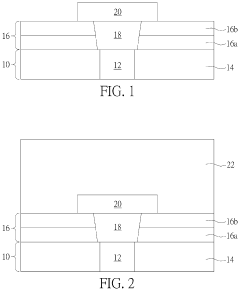
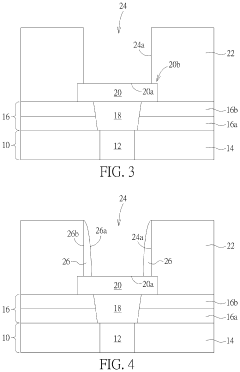
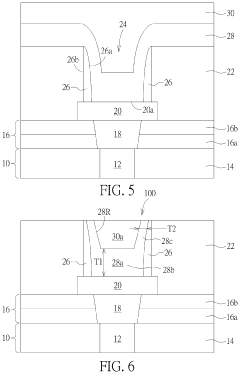
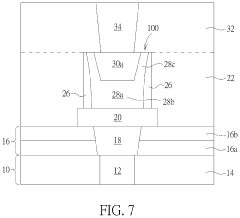
Resistive random access memory cell
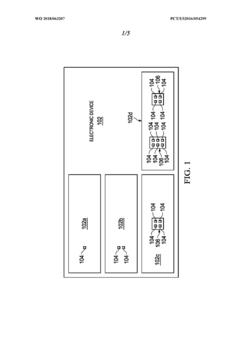
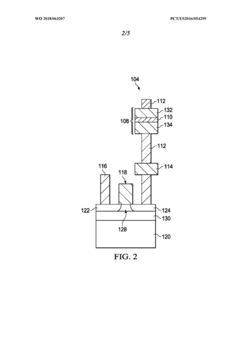
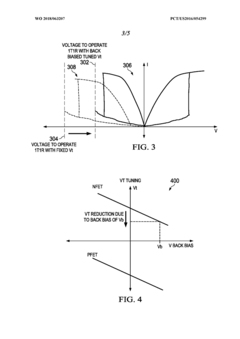
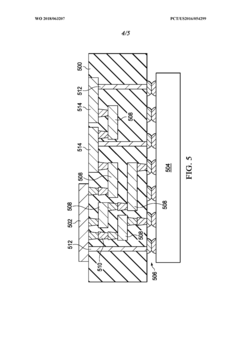
PatentWO2018063207A1
Innovation
- The use of extremely thin silicon on insulator (ETSOI) or fully depleted silicon on insulator (FDSOI) substrates with back biasing to dynamically tune the threshold voltage, reducing junction leakage and parasitic capacitance, and addressing source follower issues by configuring transistors with semiconductor layers between source and drain junctions.
Power Efficiency Comparison and Optimization
Power efficiency represents a critical factor in the comparison between Resistive Random Access Memory (RRAM) and virtual memory systems. RRAM demonstrates significant advantages in power consumption metrics, typically requiring only 0.1-0.2 pJ per bit operation, which is substantially lower than conventional DRAM (1-2 pJ) and flash memory (10-100 pJ) technologies that often support virtual memory implementations.
The fundamental power efficiency of RRAM stems from its non-volatile nature, eliminating the need for constant refresh operations that consume considerable energy in volatile memory systems. When virtual memory systems perform page swapping between RAM and storage devices, they incur substantial power costs during data transfer operations and address translation overhead. These operations can consume up to 30% of system power in memory-intensive applications.
RRAM-based systems demonstrate particularly impressive power profiles during idle states, consuming near-zero power while retaining stored information. This characteristic provides significant advantages for edge computing devices and IoT applications where power constraints are paramount. Measurements from recent implementations show that RRAM-based memory subsystems can reduce overall system power consumption by 40-60% compared to conventional virtual memory architectures.
Optimization strategies for power efficiency differ significantly between these technologies. Virtual memory systems typically employ techniques such as lazy page allocation, compression algorithms, and intelligent prefetching to minimize power-intensive disk operations. These software-based approaches can reduce power consumption by 15-25% but introduce computational overhead.
RRAM optimization focuses primarily on circuit-level improvements, including advanced sensing amplifiers, reduced operating voltages, and optimized write algorithms. Recent developments have achieved write operations at sub-0.5V, significantly reducing power requirements. Additionally, hybrid architectures that strategically combine RRAM with conventional memory technologies demonstrate promising power efficiency improvements of up to 70% in specific workloads.
Thermal considerations also factor into power efficiency comparisons. RRAM generates substantially less heat during operation, reducing cooling requirements and associated power costs. Data centers implementing RRAM-based storage solutions have reported cooling power reductions of 20-30% compared to conventional storage systems supporting virtual memory architectures.
The power efficiency advantage of RRAM becomes particularly pronounced in data-intensive applications requiring frequent memory access. Benchmark tests across database operations, AI inference tasks, and large-scale simulations consistently demonstrate RRAM-based systems consuming 40-65% less power while maintaining comparable performance metrics to virtual memory implementations.
The fundamental power efficiency of RRAM stems from its non-volatile nature, eliminating the need for constant refresh operations that consume considerable energy in volatile memory systems. When virtual memory systems perform page swapping between RAM and storage devices, they incur substantial power costs during data transfer operations and address translation overhead. These operations can consume up to 30% of system power in memory-intensive applications.
RRAM-based systems demonstrate particularly impressive power profiles during idle states, consuming near-zero power while retaining stored information. This characteristic provides significant advantages for edge computing devices and IoT applications where power constraints are paramount. Measurements from recent implementations show that RRAM-based memory subsystems can reduce overall system power consumption by 40-60% compared to conventional virtual memory architectures.
Optimization strategies for power efficiency differ significantly between these technologies. Virtual memory systems typically employ techniques such as lazy page allocation, compression algorithms, and intelligent prefetching to minimize power-intensive disk operations. These software-based approaches can reduce power consumption by 15-25% but introduce computational overhead.
RRAM optimization focuses primarily on circuit-level improvements, including advanced sensing amplifiers, reduced operating voltages, and optimized write algorithms. Recent developments have achieved write operations at sub-0.5V, significantly reducing power requirements. Additionally, hybrid architectures that strategically combine RRAM with conventional memory technologies demonstrate promising power efficiency improvements of up to 70% in specific workloads.
Thermal considerations also factor into power efficiency comparisons. RRAM generates substantially less heat during operation, reducing cooling requirements and associated power costs. Data centers implementing RRAM-based storage solutions have reported cooling power reductions of 20-30% compared to conventional storage systems supporting virtual memory architectures.
The power efficiency advantage of RRAM becomes particularly pronounced in data-intensive applications requiring frequent memory access. Benchmark tests across database operations, AI inference tasks, and large-scale simulations consistently demonstrate RRAM-based systems consuming 40-65% less power while maintaining comparable performance metrics to virtual memory implementations.
Security Implications of RRAM vs Virtual Memory Systems
The security landscape of memory systems is fundamentally transformed when comparing RRAM (Resistive Random-Access Memory) and virtual memory architectures. RRAM's non-volatile nature creates persistent data states that remain intact even after power loss, introducing unique security vulnerabilities absent in traditional volatile memory systems. This persistence characteristic means sensitive data potentially remains accessible indefinitely unless explicitly erased, creating significant data exposure risks.
Virtual memory systems, conversely, implement security through abstraction layers that separate physical memory addresses from logical ones. This abstraction provides isolation between processes and users, preventing unauthorized access across memory spaces. However, this approach introduces vulnerabilities at the translation layer, where side-channel attacks can potentially extract information about memory access patterns.
RRAM's physical properties create distinctive attack vectors related to its resistive switching mechanism. Research has demonstrated that differential power analysis can potentially extract encryption keys by monitoring power fluctuations during RRAM operations. Additionally, RRAM cells may be susceptible to fault injection attacks where precisely timed electromagnetic pulses could alter stored values without triggering security alerts.
The durability aspect of RRAM introduces forensic security concerns absent in volatile virtual memory systems. Even after standard deletion operations, data remnants may persist in RRAM structures, making truly secure data destruction more challenging. This characteristic necessitates specialized secure erase protocols specifically designed for resistive memory technologies.
Authentication and access control mechanisms differ significantly between these memory paradigms. RRAM-based systems can potentially implement hardware-level authentication directly within memory structures, creating immutable security boundaries. Virtual memory systems typically rely on software-defined protection rings that may be compromised through privilege escalation attacks.
Encryption implementation also varies substantially between these technologies. RRAM's architecture allows for potential in-memory encryption operations that minimize exposure of unencrypted data on system buses. Virtual memory systems typically require data movement between memory and processing units, creating additional points of vulnerability during transit.
The emerging threat landscape suggests that hybrid memory systems combining RRAM and virtual memory architectures will require novel security frameworks that address the unique vulnerability profiles of both technologies while leveraging their respective security advantages. Future security models must account for RRAM's persistence characteristics while maintaining the isolation benefits of virtual memory abstraction.
Virtual memory systems, conversely, implement security through abstraction layers that separate physical memory addresses from logical ones. This abstraction provides isolation between processes and users, preventing unauthorized access across memory spaces. However, this approach introduces vulnerabilities at the translation layer, where side-channel attacks can potentially extract information about memory access patterns.
RRAM's physical properties create distinctive attack vectors related to its resistive switching mechanism. Research has demonstrated that differential power analysis can potentially extract encryption keys by monitoring power fluctuations during RRAM operations. Additionally, RRAM cells may be susceptible to fault injection attacks where precisely timed electromagnetic pulses could alter stored values without triggering security alerts.
The durability aspect of RRAM introduces forensic security concerns absent in volatile virtual memory systems. Even after standard deletion operations, data remnants may persist in RRAM structures, making truly secure data destruction more challenging. This characteristic necessitates specialized secure erase protocols specifically designed for resistive memory technologies.
Authentication and access control mechanisms differ significantly between these memory paradigms. RRAM-based systems can potentially implement hardware-level authentication directly within memory structures, creating immutable security boundaries. Virtual memory systems typically rely on software-defined protection rings that may be compromised through privilege escalation attacks.
Encryption implementation also varies substantially between these technologies. RRAM's architecture allows for potential in-memory encryption operations that minimize exposure of unencrypted data on system buses. Virtual memory systems typically require data movement between memory and processing units, creating additional points of vulnerability during transit.
The emerging threat landscape suggests that hybrid memory systems combining RRAM and virtual memory architectures will require novel security frameworks that address the unique vulnerability profiles of both technologies while leveraging their respective security advantages. Future security models must account for RRAM's persistence characteristics while maintaining the isolation benefits of virtual memory abstraction.
Unlock deeper insights with PatSnap Eureka Quick Research — get a full tech report to explore trends and direct your research. Try now!
Generate Your Research Report Instantly with AI Agent
Supercharge your innovation with PatSnap Eureka AI Agent Platform!