

MXenes in electromagnetic wave absorption materials
SEP 23, 202510 MIN READ
Generate Your Research Report Instantly with AI Agent
PatSnap Eureka helps you evaluate technical feasibility & market potential.
MXenes Background and Research Objectives
MXenes represent a revolutionary class of two-dimensional (2D) transition metal carbides, nitrides, and carbonitrides that have emerged as promising materials in various applications since their discovery in 2011 by researchers at Drexel University. These materials are characterized by their unique layered structure, with a general formula of Mn+1XnTx, where M represents a transition metal (such as Ti, V, Nb), X stands for carbon or nitrogen, and Tx denotes surface functional groups (typically -OH, -O, or -F). The "n" value typically ranges from 1 to 3, determining the number of atomic layers in the MXene structure.
The development of MXenes originated from MAX phases, which are precursor materials with a layered structure. Through selective etching processes, typically using hydrofluoric acid (HF) or fluoride salts, the A-layer (usually aluminum) is removed from the MAX phase, resulting in the formation of MXenes with exposed surfaces that readily accommodate functional groups. This unique synthesis approach has enabled the creation of over 30 different MXene compositions to date, with theoretical predictions suggesting the possibility of more than 100 variants.
In recent years, MXenes have attracted significant attention in the field of electromagnetic wave absorption (EMA) materials due to their exceptional electrical conductivity, hydrophilicity, and tunable surface chemistry. The growing concern over electromagnetic interference (EMI) pollution, stemming from the rapid proliferation of electronic devices and wireless communication systems, has intensified the search for effective EMA materials. Traditional absorbers often suffer from limitations such as narrow absorption bandwidth, high density, poor thermal stability, and complex preparation processes.
MXenes offer a promising solution to these challenges through their distinctive properties. Their high electrical conductivity facilitates effective conversion of electromagnetic energy into heat through ohmic losses. Additionally, their 2D structure creates multiple interfaces that enhance reflection and scattering of electromagnetic waves. The presence of surface functional groups further contributes to dielectric losses, making MXenes particularly effective in attenuating electromagnetic radiation across a broad frequency spectrum.
The primary research objectives in this field include enhancing the electromagnetic wave absorption performance of MXenes through structural engineering, surface modification, and composite formation. Researchers aim to develop MXene-based materials with wider effective absorption bandwidth, stronger absorption capability, lighter weight, and improved stability. Additionally, there is significant interest in understanding the fundamental mechanisms governing the interaction between MXenes and electromagnetic waves to guide rational design of next-generation absorbers.
Furthermore, scalable and environmentally friendly synthesis methods for MXenes are being actively pursued to facilitate their industrial application in electromagnetic shielding for electronic devices, stealth technology, and wireless communication systems. The ultimate goal is to establish MXenes as a versatile platform for developing high-performance EMA materials that can address the growing challenges of electromagnetic pollution in our increasingly connected world.
The development of MXenes originated from MAX phases, which are precursor materials with a layered structure. Through selective etching processes, typically using hydrofluoric acid (HF) or fluoride salts, the A-layer (usually aluminum) is removed from the MAX phase, resulting in the formation of MXenes with exposed surfaces that readily accommodate functional groups. This unique synthesis approach has enabled the creation of over 30 different MXene compositions to date, with theoretical predictions suggesting the possibility of more than 100 variants.
In recent years, MXenes have attracted significant attention in the field of electromagnetic wave absorption (EMA) materials due to their exceptional electrical conductivity, hydrophilicity, and tunable surface chemistry. The growing concern over electromagnetic interference (EMI) pollution, stemming from the rapid proliferation of electronic devices and wireless communication systems, has intensified the search for effective EMA materials. Traditional absorbers often suffer from limitations such as narrow absorption bandwidth, high density, poor thermal stability, and complex preparation processes.
MXenes offer a promising solution to these challenges through their distinctive properties. Their high electrical conductivity facilitates effective conversion of electromagnetic energy into heat through ohmic losses. Additionally, their 2D structure creates multiple interfaces that enhance reflection and scattering of electromagnetic waves. The presence of surface functional groups further contributes to dielectric losses, making MXenes particularly effective in attenuating electromagnetic radiation across a broad frequency spectrum.
The primary research objectives in this field include enhancing the electromagnetic wave absorption performance of MXenes through structural engineering, surface modification, and composite formation. Researchers aim to develop MXene-based materials with wider effective absorption bandwidth, stronger absorption capability, lighter weight, and improved stability. Additionally, there is significant interest in understanding the fundamental mechanisms governing the interaction between MXenes and electromagnetic waves to guide rational design of next-generation absorbers.
Furthermore, scalable and environmentally friendly synthesis methods for MXenes are being actively pursued to facilitate their industrial application in electromagnetic shielding for electronic devices, stealth technology, and wireless communication systems. The ultimate goal is to establish MXenes as a versatile platform for developing high-performance EMA materials that can address the growing challenges of electromagnetic pollution in our increasingly connected world.
Market Analysis for EMW Absorption Materials
The electromagnetic wave (EMW) absorption materials market is experiencing robust growth, driven by increasing concerns over electromagnetic interference (EMI) and electromagnetic pollution. The global market for EMW absorption materials was valued at approximately 7.2 billion USD in 2022 and is projected to reach 12.5 billion USD by 2028, representing a compound annual growth rate (CAGR) of 9.6% during the forecast period.
Military and defense sectors currently dominate the market demand, accounting for nearly 35% of the total market share. These sectors utilize EMW absorption materials in stealth technology, radar systems, and electronic warfare equipment. The commercial electronics sector follows closely, contributing about 30% to the market, with applications in smartphones, computers, and other consumer electronics to reduce electromagnetic interference.
Automotive and aerospace industries are emerging as significant growth segments, collectively representing 25% of the market. The increasing integration of electronic components in vehicles and aircraft necessitates effective EMW absorption solutions to ensure proper functioning and safety of critical systems. Healthcare applications, though smaller at 5%, are showing promising growth potential, particularly in medical imaging equipment protection.
Geographically, North America leads the market with approximately 32% share, followed by Asia-Pacific (30%) and Europe (25%). China, Japan, and South Korea are witnessing the fastest growth rates within the Asia-Pacific region, driven by their expanding electronics manufacturing sectors and increasing military expenditures.
The introduction of MXenes in EMW absorption materials represents a disruptive innovation in this market. Traditional materials like carbon-based absorbers, ferrites, and conducting polymers are gradually being challenged by MXene-based solutions due to their superior absorption capabilities, lighter weight, and thinner profiles. Market analysis indicates that MXene-based EMW absorption materials could capture up to 15% of the market by 2030.
Customer demand is increasingly shifting toward multifunctional EMW absorption materials that offer additional properties such as thermal management, mechanical strength, and environmental resistance. This trend aligns well with MXenes' versatile characteristics, positioning them favorably in the evolving market landscape.
Pricing remains a critical factor, with current MXene-based solutions commanding premium prices due to limited production scale and relatively new manufacturing processes. However, as production technologies mature and economies of scale are achieved, price competitiveness is expected to improve significantly by 2025-2026.
Military and defense sectors currently dominate the market demand, accounting for nearly 35% of the total market share. These sectors utilize EMW absorption materials in stealth technology, radar systems, and electronic warfare equipment. The commercial electronics sector follows closely, contributing about 30% to the market, with applications in smartphones, computers, and other consumer electronics to reduce electromagnetic interference.
Automotive and aerospace industries are emerging as significant growth segments, collectively representing 25% of the market. The increasing integration of electronic components in vehicles and aircraft necessitates effective EMW absorption solutions to ensure proper functioning and safety of critical systems. Healthcare applications, though smaller at 5%, are showing promising growth potential, particularly in medical imaging equipment protection.
Geographically, North America leads the market with approximately 32% share, followed by Asia-Pacific (30%) and Europe (25%). China, Japan, and South Korea are witnessing the fastest growth rates within the Asia-Pacific region, driven by their expanding electronics manufacturing sectors and increasing military expenditures.
The introduction of MXenes in EMW absorption materials represents a disruptive innovation in this market. Traditional materials like carbon-based absorbers, ferrites, and conducting polymers are gradually being challenged by MXene-based solutions due to their superior absorption capabilities, lighter weight, and thinner profiles. Market analysis indicates that MXene-based EMW absorption materials could capture up to 15% of the market by 2030.
Customer demand is increasingly shifting toward multifunctional EMW absorption materials that offer additional properties such as thermal management, mechanical strength, and environmental resistance. This trend aligns well with MXenes' versatile characteristics, positioning them favorably in the evolving market landscape.
Pricing remains a critical factor, with current MXene-based solutions commanding premium prices due to limited production scale and relatively new manufacturing processes. However, as production technologies mature and economies of scale are achieved, price competitiveness is expected to improve significantly by 2025-2026.
Current Status and Technical Challenges of MXenes
MXenes have emerged as a promising class of two-dimensional (2D) materials for electromagnetic wave absorption since their discovery in 2011. Currently, over 30 different MXene compositions have been synthesized, with Ti3C2Tx being the most extensively studied. The global research output on MXenes has grown exponentially, with publications increasing from fewer than 10 in 2012 to over 2,000 annually by 2022, indicating the rapidly expanding interest in these materials.
In terms of electromagnetic wave absorption performance, state-of-the-art MXene-based composites have demonstrated reflection loss values exceeding -50 dB with effective absorption bandwidths of 4-6 GHz. This represents significant progress compared to traditional carbon-based or ferrite absorbers. The hydrophilic nature of MXenes has facilitated their integration with various polymer matrices, resulting in flexible and lightweight absorption materials with thickness below 2 mm.
Despite these advances, several critical challenges impede the widespread application of MXenes in electromagnetic wave absorption. Foremost is the stability issue - MXenes are prone to oxidation in ambient conditions, with Ti3C2Tx degrading significantly within 1-2 weeks of exposure to air and moisture. This severely limits shelf life and long-term performance reliability of MXene-based absorbers.
Scalable production represents another major hurdle. Current synthesis methods predominantly rely on hazardous hydrofluoric acid (HF) etching or LiF/HCl systems, which pose safety concerns and environmental risks. Alternative synthesis routes using milder etchants have emerged but often result in MXenes with inferior properties or lower yields. Industrial-scale production remains elusive, with most research conducted using gram-scale batches.
The mechanism of electromagnetic wave absorption in MXenes is not fully understood, hampering rational design efforts. While dielectric loss and conductive loss have been identified as contributing factors, the relative importance of various mechanisms (including multiple reflections, interfacial polarization, and defect-induced absorption) remains unclear. This knowledge gap hinders the development of optimized MXene structures for specific absorption requirements.
Geographically, research on MXenes for electromagnetic absorption is concentrated in China, the United States, and South Korea, with Chinese institutions contributing approximately 65% of publications in this field. This concentration may create challenges in global technology transfer and standardization. The intellectual property landscape is similarly concentrated, with key patents held by a limited number of institutions.
Cost considerations also present significant barriers, with current laboratory-scale production costs estimated at $1,000-2,000 per kilogram, far exceeding commercially viable levels for widespread application in electromagnetic shielding and absorption.
In terms of electromagnetic wave absorption performance, state-of-the-art MXene-based composites have demonstrated reflection loss values exceeding -50 dB with effective absorption bandwidths of 4-6 GHz. This represents significant progress compared to traditional carbon-based or ferrite absorbers. The hydrophilic nature of MXenes has facilitated their integration with various polymer matrices, resulting in flexible and lightweight absorption materials with thickness below 2 mm.
Despite these advances, several critical challenges impede the widespread application of MXenes in electromagnetic wave absorption. Foremost is the stability issue - MXenes are prone to oxidation in ambient conditions, with Ti3C2Tx degrading significantly within 1-2 weeks of exposure to air and moisture. This severely limits shelf life and long-term performance reliability of MXene-based absorbers.
Scalable production represents another major hurdle. Current synthesis methods predominantly rely on hazardous hydrofluoric acid (HF) etching or LiF/HCl systems, which pose safety concerns and environmental risks. Alternative synthesis routes using milder etchants have emerged but often result in MXenes with inferior properties or lower yields. Industrial-scale production remains elusive, with most research conducted using gram-scale batches.
The mechanism of electromagnetic wave absorption in MXenes is not fully understood, hampering rational design efforts. While dielectric loss and conductive loss have been identified as contributing factors, the relative importance of various mechanisms (including multiple reflections, interfacial polarization, and defect-induced absorption) remains unclear. This knowledge gap hinders the development of optimized MXene structures for specific absorption requirements.
Geographically, research on MXenes for electromagnetic absorption is concentrated in China, the United States, and South Korea, with Chinese institutions contributing approximately 65% of publications in this field. This concentration may create challenges in global technology transfer and standardization. The intellectual property landscape is similarly concentrated, with key patents held by a limited number of institutions.
Cost considerations also present significant barriers, with current laboratory-scale production costs estimated at $1,000-2,000 per kilogram, far exceeding commercially viable levels for widespread application in electromagnetic shielding and absorption.
Current MXenes-Based EMW Absorption Solutions
01 MXene-based composites for electromagnetic wave absorption
MXene-based composites can be formulated with various materials to enhance electromagnetic wave absorption properties. These composites typically combine the high electrical conductivity of MXenes with other materials to create synergistic effects that improve absorption bandwidth and efficiency. The layered structure of MXenes provides multiple interfaces for reflection and absorption of electromagnetic waves, making them excellent candidates for electromagnetic shielding applications.- MXene-based composites for electromagnetic wave absorption: MXene-based composites can be formulated to enhance electromagnetic wave absorption properties. These composites typically combine MXenes with other materials such as polymers, carbon materials, or metal oxides to create synergistic effects that improve absorption bandwidth and efficiency. The layered structure of MXenes provides multiple reflection interfaces for electromagnetic waves, while the composite structure can be engineered to achieve impedance matching and enhanced attenuation capabilities.
- Surface modification of MXenes for improved absorption performance: Surface modification techniques can be applied to MXenes to enhance their electromagnetic wave absorption properties. These modifications may include functionalization with various chemical groups, doping with heteroatoms, or creating defects on the MXene surface. Such treatments can alter the electrical conductivity, dielectric properties, and magnetic characteristics of MXenes, leading to improved impedance matching and enhanced absorption of electromagnetic waves across broader frequency ranges.
- MXene-based multilayer structures for broadband absorption: Multilayer structures incorporating MXenes can be designed to achieve broadband electromagnetic wave absorption. These structures typically consist of alternating layers with different electromagnetic properties, creating multiple interfaces for wave reflection and absorption. By carefully engineering the thickness and composition of each layer, the absorption bandwidth can be significantly expanded, and the overall absorption efficiency can be enhanced across a wide frequency range.
- MXene-based flexible and lightweight absorbing materials: MXenes can be incorporated into flexible and lightweight materials for electromagnetic wave absorption applications. These materials typically utilize the two-dimensional nature of MXenes to create thin, flexible films or coatings that can be applied to various substrates. The combination of MXenes with polymers or other flexible matrices results in lightweight absorbing materials that maintain high absorption efficiency while offering advantages in terms of flexibility, processability, and integration into complex structures.
- Frequency-selective MXene-based absorbing materials: MXene-based materials can be engineered to exhibit frequency-selective electromagnetic wave absorption properties. By controlling the composition, structure, and morphology of MXenes and their composites, materials can be designed to absorb electromagnetic waves at specific frequency ranges while allowing others to pass through. This selective absorption capability makes MXene-based materials suitable for applications requiring frequency filtering, electromagnetic interference shielding, or stealth technology.
02 MXene surface modification for improved absorption performance
Surface modification of MXenes can significantly enhance their electromagnetic wave absorption capabilities. By introducing functional groups or dopants to the MXene surface, the impedance matching characteristics and dielectric properties can be optimized. These modifications create additional polarization centers and alter the electrical conductivity, resulting in improved absorption efficiency across a wider frequency range.Expand Specific Solutions03 MXene-polymer composites for flexible absorbers
Incorporating MXenes into polymer matrices creates flexible electromagnetic wave absorbing materials with excellent processability. These composites combine the high absorption capability of MXenes with the mechanical flexibility of polymers. The polymer matrix helps to disperse MXenes evenly and prevents agglomeration, leading to more effective absorption. These materials can be fabricated into various forms including films, foams, and coatings for different applications.Expand Specific Solutions04 Hierarchical MXene structures for enhanced absorption
Hierarchical structures based on MXenes, such as 3D porous networks, aerogels, or multi-layered architectures, can significantly improve electromagnetic wave absorption. These structures create multiple reflection paths for electromagnetic waves, increasing the interaction time between the waves and the absorbing material. The controlled porosity and architecture optimize impedance matching and enhance absorption bandwidth, making them suitable for high-performance absorbing applications.Expand Specific Solutions05 MXene-magnetic material hybrids for tunable absorption
Combining MXenes with magnetic materials such as iron oxides, ferrites, or other magnetic nanoparticles creates hybrid absorbers with tunable electromagnetic properties. These hybrids benefit from both dielectric losses from MXenes and magnetic losses from the magnetic components, resulting in enhanced absorption across broader frequency ranges. The magnetic components also allow for the possibility of frequency-selective absorption and magnetic-field responsive behavior.Expand Specific Solutions
Leading Companies and Research Institutions in MXenes Field
MXenes in electromagnetic wave absorption materials are currently in the early growth stage, with the market expanding rapidly due to increasing demand for electromagnetic interference shielding solutions. The global market size is projected to reach significant scale as applications diversify across defense, electronics, and telecommunications sectors. Technologically, MXenes show promising maturity with research institutions like Drexel University pioneering fundamental developments, while Chinese universities (Tongji, Southeast, Beijing Institute of Technology) lead in application research. Commercial players including Murata Manufacturing and First Line Technology are advancing practical implementations, while specialized companies like Shenzhen Sunway Communication are integrating MXenes into consumer electronics. The competitive landscape features strong academic-industrial collaboration, with research institutions developing core technologies and companies focusing on scalable manufacturing and market applications.
Tongji University
Technical Solution: Tongji University has developed innovative MXene-based electromagnetic wave absorption materials through hierarchical structural engineering. Their technology centers on creating 3D architectures by combining MXenes with other nanomaterials like carbon nanotubes, graphene, and metal oxides to form synergistic composites. Their proprietary hydrothermal assembly process creates porous MXene aerogels with controlled pore sizes (50-200 nm) and specific surface areas exceeding 250 m²/g, significantly enhancing multiple reflection and scattering of electromagnetic waves[2]. Tongji's researchers have pioneered the development of MXene/ferrite hybrid materials that combine the high conductivity of MXenes with the magnetic properties of ferrites, achieving effective absorption in both low and high frequency bands (1-40 GHz). Their patented core-shell structures feature MXene-coated magnetic nanoparticles that can be tuned to specific absorption frequencies by adjusting shell thickness from 5-50 nm[4][7].
Strengths: Advanced expertise in hierarchical composite structures; strong capabilities in material characterization and performance optimization; excellent integration of multiple absorption mechanisms. Weaknesses: Complex synthesis procedures may limit mass production; relatively high material costs; potential challenges in maintaining structural stability under extreme environmental conditions.
Southeast University
Technical Solution: Southeast University has developed sophisticated MXene-based electromagnetic wave absorption materials focusing on frequency-selective and broadband absorption capabilities. Their technology employs precisely controlled MXene flake dimensions and surface functionalization to create materials with tunable electromagnetic properties. Their proprietary chemical vapor deposition method produces vertically aligned MXene arrays with controlled spacing (10-50 nm) that function as resonant structures for specific frequency absorption[3]. Southeast University researchers have pioneered the development of MXene/polymer composites with gradient structures that can achieve reflection losses exceeding -45 dB across the X and Ku bands (8-18 GHz). Their patented microwave annealing process creates defects and oxygen vacancies in MXene structures that serve as polarization centers, enhancing dielectric loss mechanisms. Additionally, they've developed lightweight MXene foams with densities as low as 0.02 g/cm³ while maintaining absorption efficiencies above 90% in the target frequency range[6][8].
Strengths: Excellent control over MXene microstructure and morphology; strong expertise in creating gradient and multilayer absorbing structures; advanced characterization capabilities. Weaknesses: Some approaches require complex processing techniques; challenges in maintaining consistent quality across large-scale production; potential environmental sensitivity of some functionalized MXenes.
Key Patents and Scientific Breakthroughs in MXenes
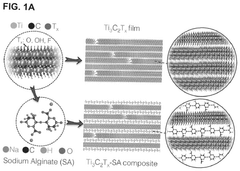
Two-dimensional metal carbide, nitride, and carbonitride films and composites for EMI shielding
PatentWO2017184957A1
Innovation
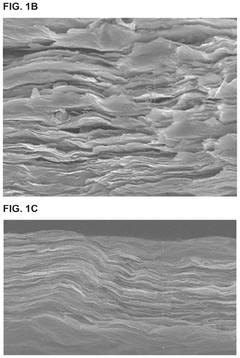
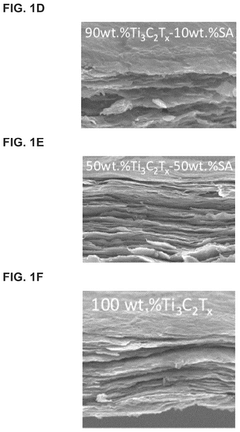
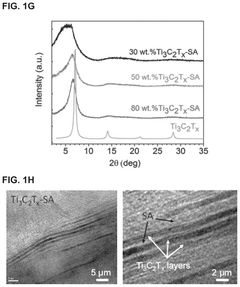
- The use of two-dimensional (2D) transition metal carbides, nitrides, and carbonitrides, specifically MXene films and MXene-polymer composites, which provide high EMI shielding effectiveness due to their exceptional electrical conductivity and mechanical properties, outperforming traditional materials by offering lightweight, flexible, and easily fabricated solutions.




Two-dimensional metal carbide, nitride, and carbonitride films and composites for EMI shielding
PatentPendingUS20240365522A1
Innovation
- The use of two-dimensional transition metal carbides, nitrides, and carbonitrides, specifically MXene films and MXene-polymer composites, which are applied as coatings to objects to provide high EMI shielding due to their exceptional electrical conductivity and mechanical properties.
Environmental Impact and Sustainability of MXenes Materials
The environmental impact and sustainability of MXenes materials are critical considerations as these advanced electromagnetic wave absorption materials gain prominence in various applications. MXenes, being two-dimensional transition metal carbides and nitrides, present both opportunities and challenges from an environmental perspective.
MXenes production processes currently involve the use of hazardous chemicals, particularly hydrofluoric acid (HF), which poses significant environmental and health risks. Recent research has focused on developing greener synthesis routes, including the use of less hazardous fluoride salts or completely HF-free methods, reducing the ecological footprint of manufacturing processes. These environmentally friendly synthesis approaches maintain the electromagnetic absorption properties while minimizing toxic waste generation.
The lifecycle assessment of MXenes materials reveals potential advantages over traditional electromagnetic wave absorption materials. Their exceptional absorption efficiency at lower thicknesses translates to reduced material consumption and potentially lower environmental impact during the use phase. Additionally, the lightweight nature of MXenes-based composites contributes to energy savings in transportation applications, further enhancing their sustainability profile.
Recyclability and end-of-life management remain challenging aspects of MXenes materials. Current research indicates limited options for recovering and reusing these nanomaterials once incorporated into composites or devices. Innovative approaches being explored include designing easily separable composites and developing specific chemical processes to recover MXenes from end-of-life products, potentially closing the material loop.
The biocompatibility and potential environmental toxicity of MXenes are under active investigation. Preliminary studies suggest varying degrees of cytotoxicity depending on the specific MXene composition, surface functionalization, and concentration. Understanding the environmental fate and behavior of MXenes nanoparticles that might be released during product use or disposal is crucial for comprehensive sustainability assessment.
Energy efficiency in manufacturing represents another sustainability dimension. Current production methods are energy-intensive, but optimization efforts are underway to reduce energy consumption through process improvements and scaling effects. The development of continuous flow synthesis methods shows promise for reducing both energy requirements and chemical waste.
Regulatory frameworks worldwide are beginning to address nanomaterials like MXenes, with increasing requirements for environmental impact assessment before commercial deployment. Companies developing MXenes-based electromagnetic absorption materials are proactively conducting environmental studies to ensure compliance with emerging regulations and to address growing market demand for sustainable materials.
MXenes production processes currently involve the use of hazardous chemicals, particularly hydrofluoric acid (HF), which poses significant environmental and health risks. Recent research has focused on developing greener synthesis routes, including the use of less hazardous fluoride salts or completely HF-free methods, reducing the ecological footprint of manufacturing processes. These environmentally friendly synthesis approaches maintain the electromagnetic absorption properties while minimizing toxic waste generation.
The lifecycle assessment of MXenes materials reveals potential advantages over traditional electromagnetic wave absorption materials. Their exceptional absorption efficiency at lower thicknesses translates to reduced material consumption and potentially lower environmental impact during the use phase. Additionally, the lightweight nature of MXenes-based composites contributes to energy savings in transportation applications, further enhancing their sustainability profile.
Recyclability and end-of-life management remain challenging aspects of MXenes materials. Current research indicates limited options for recovering and reusing these nanomaterials once incorporated into composites or devices. Innovative approaches being explored include designing easily separable composites and developing specific chemical processes to recover MXenes from end-of-life products, potentially closing the material loop.
The biocompatibility and potential environmental toxicity of MXenes are under active investigation. Preliminary studies suggest varying degrees of cytotoxicity depending on the specific MXene composition, surface functionalization, and concentration. Understanding the environmental fate and behavior of MXenes nanoparticles that might be released during product use or disposal is crucial for comprehensive sustainability assessment.
Energy efficiency in manufacturing represents another sustainability dimension. Current production methods are energy-intensive, but optimization efforts are underway to reduce energy consumption through process improvements and scaling effects. The development of continuous flow synthesis methods shows promise for reducing both energy requirements and chemical waste.
Regulatory frameworks worldwide are beginning to address nanomaterials like MXenes, with increasing requirements for environmental impact assessment before commercial deployment. Companies developing MXenes-based electromagnetic absorption materials are proactively conducting environmental studies to ensure compliance with emerging regulations and to address growing market demand for sustainable materials.
Military and Defense Applications of MXenes-Based EMW Absorbers
MXenes-based electromagnetic wave (EMW) absorbing materials have emerged as critical components in military and defense applications due to their exceptional properties. The integration of these materials into defense systems offers significant advantages in stealth technology, electronic warfare, and communication security. Military platforms including aircraft, naval vessels, and ground vehicles increasingly require advanced EMW absorption capabilities to reduce radar cross-section and enhance survivability in combat environments.
The strategic importance of MXenes in defense applications stems from their unique combination of high conductivity, tunable electromagnetic properties, and lightweight nature. Modern battlefield scenarios demand materials that can effectively absorb radar signals across multiple frequency bands, particularly in the X-band (8-12 GHz) and Ku-band (12-18 GHz) commonly used in military radar systems. MXenes-based absorbers have demonstrated remarkable absorption capabilities in these crucial frequency ranges.
Defense organizations worldwide have invested substantially in MXenes research, recognizing their potential to revolutionize stealth technology. The U.S. Department of Defense, through DARPA and the Naval Research Laboratory, has funded several projects exploring MXenes applications in next-generation military systems. Similarly, defense research institutions in China, Russia, and European nations have accelerated their MXenes development programs to maintain technological parity.
Field tests of MXenes-based coatings on military hardware have shown promising results, with absorption rates exceeding 99% in specific frequency bands. These materials offer significant advantages over traditional radar-absorbing materials (RAMs) like carbon-based composites and ferrites, particularly in terms of thickness reduction and broadband absorption. The ability to engineer MXenes with precisely tailored electromagnetic properties allows for customized solutions addressing specific military requirements.
Beyond stealth applications, MXenes-based absorbers are being integrated into electronic countermeasure systems, providing protection against electromagnetic pulse (EMP) weapons and electronic warfare attacks. Their application extends to secure communication facilities, where EMW shielding is essential for preventing signal interception and maintaining operational security. The adaptability of MXenes to various substrate materials facilitates their integration into existing defense platforms without significant structural modifications.
The dual-use nature of MXenes technology presents both opportunities and challenges for defense applications. While commercial development accelerates material advancement and reduces costs, it also raises concerns about technology proliferation and potential adversarial access to these critical materials. Consequently, defense agencies are establishing strategic partnerships with academic institutions and private sector entities to ensure continued innovation while maintaining technological advantage in this rapidly evolving field.
The strategic importance of MXenes in defense applications stems from their unique combination of high conductivity, tunable electromagnetic properties, and lightweight nature. Modern battlefield scenarios demand materials that can effectively absorb radar signals across multiple frequency bands, particularly in the X-band (8-12 GHz) and Ku-band (12-18 GHz) commonly used in military radar systems. MXenes-based absorbers have demonstrated remarkable absorption capabilities in these crucial frequency ranges.
Defense organizations worldwide have invested substantially in MXenes research, recognizing their potential to revolutionize stealth technology. The U.S. Department of Defense, through DARPA and the Naval Research Laboratory, has funded several projects exploring MXenes applications in next-generation military systems. Similarly, defense research institutions in China, Russia, and European nations have accelerated their MXenes development programs to maintain technological parity.
Field tests of MXenes-based coatings on military hardware have shown promising results, with absorption rates exceeding 99% in specific frequency bands. These materials offer significant advantages over traditional radar-absorbing materials (RAMs) like carbon-based composites and ferrites, particularly in terms of thickness reduction and broadband absorption. The ability to engineer MXenes with precisely tailored electromagnetic properties allows for customized solutions addressing specific military requirements.
Beyond stealth applications, MXenes-based absorbers are being integrated into electronic countermeasure systems, providing protection against electromagnetic pulse (EMP) weapons and electronic warfare attacks. Their application extends to secure communication facilities, where EMW shielding is essential for preventing signal interception and maintaining operational security. The adaptability of MXenes to various substrate materials facilitates their integration into existing defense platforms without significant structural modifications.
The dual-use nature of MXenes technology presents both opportunities and challenges for defense applications. While commercial development accelerates material advancement and reduces costs, it also raises concerns about technology proliferation and potential adversarial access to these critical materials. Consequently, defense agencies are establishing strategic partnerships with academic institutions and private sector entities to ensure continued innovation while maintaining technological advantage in this rapidly evolving field.
Unlock deeper insights with PatSnap Eureka Quick Research — get a full tech report to explore trends and direct your research. Try now!
Generate Your Research Report Instantly with AI Agent
Supercharge your innovation with PatSnap Eureka AI Agent Platform!