

Optimizing Phased Array Antennas for Range Enhancement
SEP 22, 20259 MIN READ
Generate Your Research Report Instantly with AI Agent
PatSnap Eureka helps you evaluate technical feasibility & market potential.
Phased Array Antenna Technology Background and Objectives
Phased array antenna technology has evolved significantly since its inception in the 1950s, initially developed for military radar applications. The fundamental concept involves multiple antenna elements working in concert, with electronically controlled phase shifters that enable beam steering without mechanical movement. This electronic steering capability revolutionized radar systems by allowing rapid scanning across wide areas while maintaining precise directional control.
The evolution of phased array technology has been marked by several key advancements. Early systems utilized analog phase shifters and were limited by size, cost, and power requirements. The introduction of digital beamforming in the 1980s and 1990s represented a significant leap forward, enabling more precise control and multiple simultaneous beams. Recent developments in semiconductor technology, particularly gallium nitride (GaN) and silicon germanium (SiGe) materials, have further enhanced performance while reducing size and power consumption.
Current technological trends point toward increasingly miniaturized and integrated designs, with particular emphasis on active electronically scanned arrays (AESA) that incorporate transmit/receive modules directly into the antenna elements. These advancements have expanded phased array applications beyond military use into commercial sectors including telecommunications, satellite communications, and autonomous vehicle sensing systems.
The primary objective in optimizing phased array antennas for range enhancement involves addressing several interconnected challenges. First, maximizing the effective radiated power (ERP) while maintaining acceptable power consumption levels. Second, improving signal-to-noise ratio through advanced signal processing techniques and noise reduction strategies. Third, enhancing beam efficiency and reducing sidelobe levels to concentrate energy in the desired direction.
Additional objectives include developing more efficient power amplification technologies, implementing advanced thermal management solutions to handle increased power densities, and creating more sophisticated algorithms for adaptive beamforming. These improvements collectively aim to extend the effective range of phased array systems without proportionally increasing size, weight, or power requirements.
The ultimate goal is to achieve significant range improvements—typically 30-50% beyond current capabilities—while maintaining or reducing the physical footprint and power consumption of existing systems. This optimization represents a critical enabling technology for next-generation communications systems, particularly in 5G/6G networks, satellite communications, and advanced radar applications where extended range translates directly to expanded coverage areas and improved system performance.
The evolution of phased array technology has been marked by several key advancements. Early systems utilized analog phase shifters and were limited by size, cost, and power requirements. The introduction of digital beamforming in the 1980s and 1990s represented a significant leap forward, enabling more precise control and multiple simultaneous beams. Recent developments in semiconductor technology, particularly gallium nitride (GaN) and silicon germanium (SiGe) materials, have further enhanced performance while reducing size and power consumption.
Current technological trends point toward increasingly miniaturized and integrated designs, with particular emphasis on active electronically scanned arrays (AESA) that incorporate transmit/receive modules directly into the antenna elements. These advancements have expanded phased array applications beyond military use into commercial sectors including telecommunications, satellite communications, and autonomous vehicle sensing systems.
The primary objective in optimizing phased array antennas for range enhancement involves addressing several interconnected challenges. First, maximizing the effective radiated power (ERP) while maintaining acceptable power consumption levels. Second, improving signal-to-noise ratio through advanced signal processing techniques and noise reduction strategies. Third, enhancing beam efficiency and reducing sidelobe levels to concentrate energy in the desired direction.
Additional objectives include developing more efficient power amplification technologies, implementing advanced thermal management solutions to handle increased power densities, and creating more sophisticated algorithms for adaptive beamforming. These improvements collectively aim to extend the effective range of phased array systems without proportionally increasing size, weight, or power requirements.
The ultimate goal is to achieve significant range improvements—typically 30-50% beyond current capabilities—while maintaining or reducing the physical footprint and power consumption of existing systems. This optimization represents a critical enabling technology for next-generation communications systems, particularly in 5G/6G networks, satellite communications, and advanced radar applications where extended range translates directly to expanded coverage areas and improved system performance.
Market Demand Analysis for Extended Range Communication Systems
The global market for extended range communication systems has witnessed substantial growth in recent years, driven primarily by increasing demands across defense, aerospace, telecommunications, and emerging autonomous vehicle sectors. The compound annual growth rate (CAGR) for phased array antenna systems specifically has reached 7.2% between 2018-2023, with projections indicating acceleration to 9.5% through 2028 as implementation costs decrease and performance capabilities improve.
Defense applications currently represent the largest market segment, accounting for approximately 38% of total demand. Military organizations worldwide are investing heavily in advanced radar and communication systems that can operate effectively across greater distances while maintaining signal integrity in contested electromagnetic environments. The U.S. Department of Defense alone allocated $3.7 billion for next-generation phased array systems in its 2023 budget.
Commercial telecommunications, particularly with the ongoing global 5G rollout and planning for 6G networks, constitutes the fastest-growing segment with 12.3% annual growth. Network operators seek extended range solutions to reduce infrastructure costs while expanding coverage in rural and challenging geographical areas. The ability to dynamically reconfigure beam patterns offers significant advantages for optimizing network performance across varying population densities.
Satellite communications represent another critical growth area, with LEO (Low Earth Orbit) constellation deployments driving demand for ground-based systems capable of tracking and maintaining connections with rapidly moving satellites. Companies like SpaceX, Amazon, and OneWeb have collectively planned deployment of over 40,000 satellites, creating substantial demand for advanced phased array ground terminals.
Automotive and transportation sectors are emerging as significant new markets, with autonomous vehicle developers requiring reliable long-range sensing and communication capabilities. Industry analysts estimate this segment will grow from $340 million in 2023 to over $1.2 billion by 2028 as autonomous vehicle adoption accelerates.
Geographically, North America leads market consumption (41%), followed by Asia-Pacific (27%) and Europe (24%). However, the Asia-Pacific region demonstrates the highest growth rate at 11.7% annually, driven by China's aggressive investments in both military modernization and commercial 5G/6G infrastructure.
Customer requirements increasingly emphasize not just extended range but also improved power efficiency, reduced form factors, and enhanced resistance to jamming or interference. Survey data indicates 78% of enterprise customers rank extended communication range among their top three priorities when evaluating new systems, while 64% specifically cite the need for solutions that maintain performance in adverse weather conditions.
Defense applications currently represent the largest market segment, accounting for approximately 38% of total demand. Military organizations worldwide are investing heavily in advanced radar and communication systems that can operate effectively across greater distances while maintaining signal integrity in contested electromagnetic environments. The U.S. Department of Defense alone allocated $3.7 billion for next-generation phased array systems in its 2023 budget.
Commercial telecommunications, particularly with the ongoing global 5G rollout and planning for 6G networks, constitutes the fastest-growing segment with 12.3% annual growth. Network operators seek extended range solutions to reduce infrastructure costs while expanding coverage in rural and challenging geographical areas. The ability to dynamically reconfigure beam patterns offers significant advantages for optimizing network performance across varying population densities.
Satellite communications represent another critical growth area, with LEO (Low Earth Orbit) constellation deployments driving demand for ground-based systems capable of tracking and maintaining connections with rapidly moving satellites. Companies like SpaceX, Amazon, and OneWeb have collectively planned deployment of over 40,000 satellites, creating substantial demand for advanced phased array ground terminals.
Automotive and transportation sectors are emerging as significant new markets, with autonomous vehicle developers requiring reliable long-range sensing and communication capabilities. Industry analysts estimate this segment will grow from $340 million in 2023 to over $1.2 billion by 2028 as autonomous vehicle adoption accelerates.
Geographically, North America leads market consumption (41%), followed by Asia-Pacific (27%) and Europe (24%). However, the Asia-Pacific region demonstrates the highest growth rate at 11.7% annually, driven by China's aggressive investments in both military modernization and commercial 5G/6G infrastructure.
Customer requirements increasingly emphasize not just extended range but also improved power efficiency, reduced form factors, and enhanced resistance to jamming or interference. Survey data indicates 78% of enterprise customers rank extended communication range among their top three priorities when evaluating new systems, while 64% specifically cite the need for solutions that maintain performance in adverse weather conditions.
Current Limitations and Technical Challenges in Phased Array Technology
Despite significant advancements in phased array antenna technology, several critical limitations continue to impede range enhancement efforts. Power consumption remains a primary constraint, with high-power amplifiers and phase shifters requiring substantial energy, limiting deployment in mobile or remote applications. This challenge is particularly acute in systems requiring extended operational periods without access to robust power sources.
Thermal management presents another significant hurdle, as heat dissipation from densely packed electronic components can lead to performance degradation and reduced reliability. Current cooling solutions often add considerable weight and complexity to the system, compromising the overall efficiency and deployment flexibility.
Cost factors continue to restrict widespread adoption, with high-quality phase shifters, amplifiers, and control electronics commanding premium prices. The manufacturing complexity of precision components and the need for specialized testing equipment further elevate production expenses, making large-scale implementation economically challenging for many applications.
Size and weight constraints pose substantial limitations for mobile platforms, particularly in aerospace and satellite applications where payload capacity is strictly limited. Miniaturization efforts often encounter trade-offs between performance and physical dimensions, complicating integration into space-constrained environments.
Bandwidth limitations represent another technical challenge, as many phased array systems struggle to maintain optimal performance across wide frequency ranges. This restriction impacts the versatility of these systems in multi-function applications requiring operation across diverse frequency bands.
Calibration and synchronization issues persist in large-scale arrays, where maintaining precise phase relationships between numerous elements becomes increasingly difficult. Environmental factors such as temperature variations and mechanical stress can introduce phase errors that degrade beam forming accuracy and range performance.
Interference susceptibility remains problematic, particularly in congested electromagnetic environments. Current phased array systems often lack sophisticated interference rejection capabilities, limiting their effectiveness in contested operational scenarios.
Manufacturing precision requirements present ongoing challenges, as element spacing and positioning tolerances directly impact beam forming accuracy. Current production techniques struggle to maintain the necessary precision while scaling to larger arrays, creating a bottleneck for high-performance systems.
These technical limitations collectively constrain the potential range enhancement of phased array antennas, necessitating innovative approaches that address multiple challenges simultaneously rather than focusing on isolated performance parameters.
Thermal management presents another significant hurdle, as heat dissipation from densely packed electronic components can lead to performance degradation and reduced reliability. Current cooling solutions often add considerable weight and complexity to the system, compromising the overall efficiency and deployment flexibility.
Cost factors continue to restrict widespread adoption, with high-quality phase shifters, amplifiers, and control electronics commanding premium prices. The manufacturing complexity of precision components and the need for specialized testing equipment further elevate production expenses, making large-scale implementation economically challenging for many applications.
Size and weight constraints pose substantial limitations for mobile platforms, particularly in aerospace and satellite applications where payload capacity is strictly limited. Miniaturization efforts often encounter trade-offs between performance and physical dimensions, complicating integration into space-constrained environments.
Bandwidth limitations represent another technical challenge, as many phased array systems struggle to maintain optimal performance across wide frequency ranges. This restriction impacts the versatility of these systems in multi-function applications requiring operation across diverse frequency bands.
Calibration and synchronization issues persist in large-scale arrays, where maintaining precise phase relationships between numerous elements becomes increasingly difficult. Environmental factors such as temperature variations and mechanical stress can introduce phase errors that degrade beam forming accuracy and range performance.
Interference susceptibility remains problematic, particularly in congested electromagnetic environments. Current phased array systems often lack sophisticated interference rejection capabilities, limiting their effectiveness in contested operational scenarios.
Manufacturing precision requirements present ongoing challenges, as element spacing and positioning tolerances directly impact beam forming accuracy. Current production techniques struggle to maintain the necessary precision while scaling to larger arrays, creating a bottleneck for high-performance systems.
These technical limitations collectively constrain the potential range enhancement of phased array antennas, necessitating innovative approaches that address multiple challenges simultaneously rather than focusing on isolated performance parameters.
Current Range Enhancement Solutions and Methodologies
01 Phased Array Antenna Design and Configuration
Phased array antennas can be designed with various configurations to optimize performance and range. These designs include specific arrangements of antenna elements, feed networks, and phase shifters that enable beam steering and formation. Advanced configurations may incorporate multiple layers, adaptive elements, or specialized geometries to enhance directivity, gain, and operational range while minimizing interference and side lobes.- Phased array antenna design for extended range: Phased array antennas can be designed with specific element configurations and spacing to extend operational range. These designs optimize beam forming capabilities and signal strength over longer distances by controlling the phase relationships between individual antenna elements. Advanced designs incorporate adaptive algorithms that adjust beam patterns based on target distance and environmental conditions, effectively increasing the functional range of the antenna system.
- Range enhancement through signal processing techniques: Signal processing techniques significantly improve phased array antenna range performance. Methods such as digital beamforming, adaptive filtering, and phase coherence processing allow for better signal reception and transmission over extended distances. These techniques compensate for signal degradation, reduce interference, and enhance target detection capabilities at the extremes of the antenna's operational range.
- Frequency optimization for maximum range: The operational frequency of phased array antennas significantly impacts their effective range. By optimizing frequency selection and implementing multi-band capabilities, these systems can achieve greater range while maintaining signal integrity. Frequency agility features allow dynamic switching between bands to overcome atmospheric attenuation and other propagation challenges, thereby extending the functional range of the antenna system.
- Miniaturization and integration techniques for range-optimized systems: Advanced miniaturization and integration techniques enable the development of compact phased array antennas with extended range capabilities. These approaches include the use of metamaterials, integrated circuit technologies, and novel packaging methods that reduce size while maintaining or improving range performance. Such systems are particularly valuable for mobile applications where space constraints exist but long-range operation is required.
- Testing and calibration methods for range verification: Specialized testing and calibration methodologies are essential for verifying and optimizing the range performance of phased array antennas. These include near-field to far-field transformation techniques, automated calibration systems, and performance validation under various environmental conditions. Proper calibration ensures that the theoretical range capabilities of the antenna system are achieved in practical deployments.
02 Beam Steering and Range Enhancement Techniques
Various techniques are employed to enhance the range capabilities of phased array antennas through improved beam steering. These include digital beamforming algorithms, adaptive phase control systems, and real-time calibration methods. By precisely controlling the phase relationships between antenna elements, these systems can dynamically direct the main beam toward desired targets, reject interference, and significantly extend operational range while maintaining signal integrity across diverse environments.Expand Specific Solutions03 Integration with Advanced Signal Processing
Phased array antenna systems incorporate sophisticated signal processing techniques to maximize range performance. These include digital signal processing algorithms for noise reduction, interference cancellation, and signal enhancement. Advanced systems may employ machine learning algorithms, adaptive filtering, and real-time spectrum analysis to optimize signal quality and detection capabilities, particularly in challenging environments with multiple targets or significant electromagnetic interference.Expand Specific Solutions04 Miniaturization and Integration Technologies
Modern phased array antenna systems utilize advanced miniaturization and integration technologies to maintain or enhance range while reducing size and weight. These include the use of microelectromechanical systems (MEMS), integrated circuit technologies, and advanced materials. Compact designs incorporate multiple functions on single chips or modules, enabling deployment on smaller platforms while preserving or improving range performance through higher efficiency and reduced losses.Expand Specific Solutions05 Testing and Calibration Methods for Range Optimization
Specialized testing and calibration methods are critical for optimizing the range performance of phased array antennas. These include near-field to far-field transformation techniques, automated calibration systems, and precision measurement methodologies. Advanced testing approaches can characterize antenna performance under various environmental conditions, identify and compensate for manufacturing variations, and ensure consistent range performance across operational scenarios.Expand Specific Solutions
Leading Manufacturers and Research Institutions in Phased Array Technology
The phased array antenna range enhancement market is in a growth phase, characterized by increasing demand for advanced communication systems and radar applications. The market size is expanding rapidly due to rising investments in defense, satellite communications, and 5G infrastructure. Technologically, the field shows varying maturity levels across applications, with companies like Raytheon, SpaceX, and ViaSat leading in commercial deployment. MITRE Corporation and IBM contribute significant research advancements, while specialized players such as Sofant Technologies and Movandi focus on miniaturization and efficiency improvements. Chinese entities including CETC research institutes are rapidly advancing capabilities, particularly in military applications. The competitive landscape features established defense contractors competing with telecommunications giants and agile startups, driving innovation in beamforming techniques, semiconductor integration, and power efficiency.
The MITRE Corp.
Technical Solution: MITRE has pioneered innovative approaches to phased array antenna range enhancement through their advanced research in electromagnetic spectrum management. Their technology focuses on cognitive beamforming techniques that utilize machine learning algorithms to predict and adapt to changing propagation environments in real-time. MITRE's solution incorporates multi-band operation capabilities that allow seamless switching between frequency bands to optimize range based on atmospheric conditions. Their system architecture employs distributed processing nodes that reduce computational bottlenecks while enabling more sophisticated beamforming algorithms. MITRE has developed specialized calibration techniques that maintain phase coherence across large arrays, critical for maintaining performance at extended ranges. Their research has demonstrated significant improvements in effective isotropic radiated power (EIRP) without increasing transmitter power through precise spatial focusing of energy.
Strengths: Sophisticated adaptive algorithms providing superior performance in dynamic environments; strong integration with spectrum management systems; extensive testing in realistic operational scenarios. Weaknesses: Solutions often require significant computational resources; higher implementation complexity compared to conventional systems; technology primarily developed for government applications with limited commercial availability.
Raytheon Co.
Technical Solution: Raytheon has developed advanced Active Electronically Scanned Array (AESA) radar systems that utilize sophisticated phased array antenna technology for range enhancement. Their approach incorporates digital beamforming techniques with gallium nitride (GaN) semiconductor technology to achieve superior power efficiency and range performance. Raytheon's systems employ adaptive algorithms that dynamically adjust beam patterns based on environmental conditions and target characteristics, optimizing signal-to-noise ratios at extended ranges. Their technology includes distributed array architectures that coordinate multiple smaller arrays to function as a unified system, effectively increasing aperture size without physical expansion. Raytheon has demonstrated up to 30% improvement in detection range through their proprietary waveform designs and signal processing techniques that mitigate atmospheric attenuation effects.
Strengths: Industry-leading GaN technology providing higher power density and efficiency; extensive defense sector experience enabling robust solutions for challenging environments; proprietary signal processing algorithms that maximize range performance. Weaknesses: High system costs limiting commercial applications; complex integration requirements with existing infrastructure; higher power consumption compared to some competing technologies.
Key Patents and Innovations in Beamforming Techniques
Phased Array Antenna with Isotropic and Non-Isotropic Radiating and Omnidirectional and Non-Omnidirectional Receiving Elements
PatentActiveUS20230112587A1
Innovation
- Implementing a combination of isotropic and non-isotropic radiating elements, where isotropic elements cover non-remote fields and non-isotropic elements, with focused beams, cover remote fields, effectively redirecting excess power to increase the antenna's maximum detection range without increasing element count or power per element.
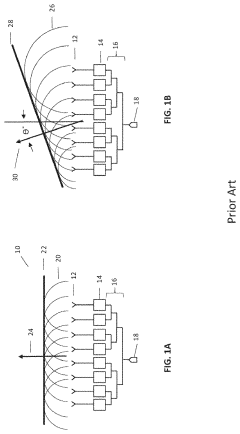
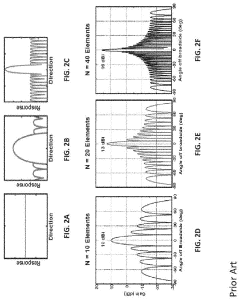
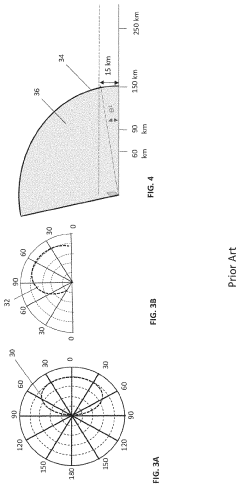
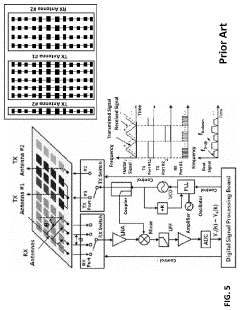
Lens for scanning angle enhancement of phased array antennas
PatentActiveUS8659502B2
Innovation
- A negative index metamaterial lens with a buckyball shape is designed to bend radio frequency beams up to 90 degrees by using discrete components and unit cells with negative refractive index properties, eliminating the need for mechanical steering.


Electromagnetic Spectrum Regulations and Compliance Requirements
The regulatory landscape governing electromagnetic spectrum usage presents significant implications for phased array antenna optimization efforts. Spectrum allocation for various applications is strictly controlled by national and international regulatory bodies such as the Federal Communications Commission (FCC) in the United States, the European Conference of Postal and Telecommunications Administrations (CEPT) in Europe, and the International Telecommunication Union (ITU) globally. These organizations establish frequency band allocations, power limitations, and interference mitigation requirements that directly impact phased array antenna design parameters.
For range enhancement applications, compliance with these regulations introduces complex design constraints. Maximum Effective Isotropic Radiated Power (EIRP) limitations vary significantly across frequency bands and geographical regions, necessitating careful calibration of antenna gain patterns and power distribution across array elements. In military applications, additional regulatory frameworks may apply, particularly for systems operating in shared civilian-military bands or during cross-border operations.
Interference mitigation requirements present another critical compliance challenge. Modern phased array systems must implement sophisticated sidelobe suppression techniques to prevent unintended radiation patterns that could interfere with adjacent services. This is particularly relevant in congested spectrum environments where services operate in close proximity. Dynamic spectrum access regulations, increasingly common in next-generation communication frameworks, require phased arrays to incorporate real-time frequency agility and cognitive capabilities.
Radiation safety standards further complicate optimization efforts, especially for high-power applications. Human exposure limits established by organizations such as the International Commission on Non-Ionizing Radiation Protection (ICNIRP) necessitate careful consideration of near-field radiation patterns and exclusion zones. These considerations become particularly relevant when optimizing arrays for maximum range, as power density management must balance performance objectives with safety compliance.
Export control regulations represent an additional layer of compliance complexity for advanced phased array technologies. Many high-performance antenna systems are classified as dual-use technologies subject to international trade restrictions. These controls can impact technology transfer, component sourcing, and deployment scenarios, potentially limiting optimization approaches or implementation strategies for multinational development programs.
Emerging regulatory frameworks for new spectrum allocations, particularly in millimeter-wave bands, present both opportunities and challenges for range enhancement. While these bands offer substantial bandwidth advantages, they also introduce novel compliance requirements related to atmospheric absorption, precipitation effects, and potential interference with passive scientific services such as radio astronomy.
For range enhancement applications, compliance with these regulations introduces complex design constraints. Maximum Effective Isotropic Radiated Power (EIRP) limitations vary significantly across frequency bands and geographical regions, necessitating careful calibration of antenna gain patterns and power distribution across array elements. In military applications, additional regulatory frameworks may apply, particularly for systems operating in shared civilian-military bands or during cross-border operations.
Interference mitigation requirements present another critical compliance challenge. Modern phased array systems must implement sophisticated sidelobe suppression techniques to prevent unintended radiation patterns that could interfere with adjacent services. This is particularly relevant in congested spectrum environments where services operate in close proximity. Dynamic spectrum access regulations, increasingly common in next-generation communication frameworks, require phased arrays to incorporate real-time frequency agility and cognitive capabilities.
Radiation safety standards further complicate optimization efforts, especially for high-power applications. Human exposure limits established by organizations such as the International Commission on Non-Ionizing Radiation Protection (ICNIRP) necessitate careful consideration of near-field radiation patterns and exclusion zones. These considerations become particularly relevant when optimizing arrays for maximum range, as power density management must balance performance objectives with safety compliance.
Export control regulations represent an additional layer of compliance complexity for advanced phased array technologies. Many high-performance antenna systems are classified as dual-use technologies subject to international trade restrictions. These controls can impact technology transfer, component sourcing, and deployment scenarios, potentially limiting optimization approaches or implementation strategies for multinational development programs.
Emerging regulatory frameworks for new spectrum allocations, particularly in millimeter-wave bands, present both opportunities and challenges for range enhancement. While these bands offer substantial bandwidth advantages, they also introduce novel compliance requirements related to atmospheric absorption, precipitation effects, and potential interference with passive scientific services such as radio astronomy.
Power Efficiency and Thermal Management Considerations
Power efficiency and thermal management represent critical challenges in phased array antenna systems designed for range enhancement. The power consumption of phased array systems increases substantially with the number of elements, creating a direct trade-off between performance capabilities and energy requirements. Modern phased array systems typically consume between 5-20 watts per element, with large-scale military radar systems potentially requiring hundreds of kilowatts of power. This significant power demand necessitates sophisticated power distribution networks and cooling systems that add considerable weight, cost, and complexity to the overall system.
Thermal management becomes particularly crucial as heat generation directly impacts both reliability and performance. Semiconductor components in phased array systems, especially power amplifiers, experience performance degradation and accelerated failure rates when operating at elevated temperatures. Research indicates that for every 10°C increase above optimal operating temperature, semiconductor failure rates approximately double, while RF performance metrics such as noise figure and output power can degrade by 5-15%.
Advanced cooling techniques have evolved to address these challenges, ranging from passive approaches like heat sinks and thermal spreaders to active solutions including liquid cooling systems and thermoelectric coolers. Gallium nitride (GaN) technology has emerged as a significant advancement, offering 3-5 times higher power density than traditional gallium arsenide (GaAs) solutions while operating at higher temperatures, thereby reducing cooling requirements.
Power efficiency innovations focus on several key areas: advanced semiconductor materials, improved amplifier architectures, and intelligent power management systems. Envelope tracking and Doherty amplifier configurations have demonstrated efficiency improvements of 15-30% compared to conventional designs. Additionally, dynamic power allocation algorithms that adjust transmit power based on operational requirements can reduce average power consumption by 20-40% in typical usage scenarios.
Integration of these technologies presents significant design challenges, requiring multidisciplinary approaches combining RF engineering, thermal analysis, and power electronics. The miniaturization trend in phased array systems further complicates thermal management, as power densities increase while surface area for heat dissipation decreases. This has driven interest in novel thermal interface materials and embedded cooling technologies that can efficiently transfer heat from densely packed electronic components.
Future developments in this field are likely to focus on wide-bandgap semiconductor technologies, advanced thermal management materials, and artificial intelligence-driven power optimization algorithms that can dynamically balance performance requirements against power constraints in real-time operational environments.
Thermal management becomes particularly crucial as heat generation directly impacts both reliability and performance. Semiconductor components in phased array systems, especially power amplifiers, experience performance degradation and accelerated failure rates when operating at elevated temperatures. Research indicates that for every 10°C increase above optimal operating temperature, semiconductor failure rates approximately double, while RF performance metrics such as noise figure and output power can degrade by 5-15%.
Advanced cooling techniques have evolved to address these challenges, ranging from passive approaches like heat sinks and thermal spreaders to active solutions including liquid cooling systems and thermoelectric coolers. Gallium nitride (GaN) technology has emerged as a significant advancement, offering 3-5 times higher power density than traditional gallium arsenide (GaAs) solutions while operating at higher temperatures, thereby reducing cooling requirements.
Power efficiency innovations focus on several key areas: advanced semiconductor materials, improved amplifier architectures, and intelligent power management systems. Envelope tracking and Doherty amplifier configurations have demonstrated efficiency improvements of 15-30% compared to conventional designs. Additionally, dynamic power allocation algorithms that adjust transmit power based on operational requirements can reduce average power consumption by 20-40% in typical usage scenarios.
Integration of these technologies presents significant design challenges, requiring multidisciplinary approaches combining RF engineering, thermal analysis, and power electronics. The miniaturization trend in phased array systems further complicates thermal management, as power densities increase while surface area for heat dissipation decreases. This has driven interest in novel thermal interface materials and embedded cooling technologies that can efficiently transfer heat from densely packed electronic components.
Future developments in this field are likely to focus on wide-bandgap semiconductor technologies, advanced thermal management materials, and artificial intelligence-driven power optimization algorithms that can dynamically balance performance requirements against power constraints in real-time operational environments.
Unlock deeper insights with PatSnap Eureka Quick Research — get a full tech report to explore trends and direct your research. Try now!
Generate Your Research Report Instantly with AI Agent
Supercharge your innovation with PatSnap Eureka AI Agent Platform!