

Proprietary Spray Drying Technologies: A Patent Landscape Analysis
SEP 25, 20259 MIN READ
Generate Your Research Report Instantly with AI Agent
PatSnap Eureka helps you evaluate technical feasibility & market potential.
Spray Drying Technology Evolution and Objectives
Spray drying technology has evolved significantly since its inception in the late 19th century, transforming from a simple dehydration method to a sophisticated process engineering technique. The earliest documented spray dryer was patented in 1872, but industrial applications only gained momentum in the 1920s with the dairy industry's adoption for milk powder production. This marked the beginning of the first evolutionary phase characterized by mechanical atomization and simple chamber designs.
The second evolutionary phase (1950s-1970s) witnessed significant advancements in atomization technologies, including the development of pressure nozzles, rotary atomizers, and two-fluid nozzles. During this period, spray drying expanded beyond food applications into pharmaceuticals, ceramics, and chemical industries, necessitating more precise control over particle characteristics.
The third phase (1980s-2000s) brought computational fluid dynamics (CFD) modeling and automation into spray drying operations, enabling manufacturers to predict and control drying behavior with unprecedented precision. This era also saw the integration of additional processing steps such as agglomeration, coating, and encapsulation directly within spray drying systems.
Currently, in the fourth evolutionary phase (2000s-present), spray drying technology has become increasingly specialized with proprietary innovations focusing on energy efficiency, product quality enhancement, and novel applications. Patent activity has surged, particularly in areas such as nano-spray drying, aseptic processing, and continuous manufacturing integration.
The primary objectives of contemporary spray drying technology development center around five key areas. First, enhancing energy efficiency through heat recovery systems, alternative energy sources, and optimized process designs to reduce the traditionally high energy consumption. Second, improving product quality attributes including particle morphology control, enhanced bioavailability, and stability of sensitive compounds.
Third, expanding processing capabilities to handle increasingly complex formulations, including heat-sensitive biologics, nanoparticles, and composite materials. Fourth, developing environmentally sustainable operations through closed-loop solvent recovery, reduced emissions, and water conservation measures. Finally, achieving greater process intensification by combining multiple unit operations within a single integrated system.
Patent landscape analysis reveals that these objectives are driving significant proprietary technology development, with multinational corporations and specialized equipment manufacturers leading innovation. The geographical distribution of patents shows concentration in Europe, North America, and increasingly in Asia, particularly China and India, reflecting the global importance of this technology across multiple industries.
The second evolutionary phase (1950s-1970s) witnessed significant advancements in atomization technologies, including the development of pressure nozzles, rotary atomizers, and two-fluid nozzles. During this period, spray drying expanded beyond food applications into pharmaceuticals, ceramics, and chemical industries, necessitating more precise control over particle characteristics.
The third phase (1980s-2000s) brought computational fluid dynamics (CFD) modeling and automation into spray drying operations, enabling manufacturers to predict and control drying behavior with unprecedented precision. This era also saw the integration of additional processing steps such as agglomeration, coating, and encapsulation directly within spray drying systems.
Currently, in the fourth evolutionary phase (2000s-present), spray drying technology has become increasingly specialized with proprietary innovations focusing on energy efficiency, product quality enhancement, and novel applications. Patent activity has surged, particularly in areas such as nano-spray drying, aseptic processing, and continuous manufacturing integration.
The primary objectives of contemporary spray drying technology development center around five key areas. First, enhancing energy efficiency through heat recovery systems, alternative energy sources, and optimized process designs to reduce the traditionally high energy consumption. Second, improving product quality attributes including particle morphology control, enhanced bioavailability, and stability of sensitive compounds.
Third, expanding processing capabilities to handle increasingly complex formulations, including heat-sensitive biologics, nanoparticles, and composite materials. Fourth, developing environmentally sustainable operations through closed-loop solvent recovery, reduced emissions, and water conservation measures. Finally, achieving greater process intensification by combining multiple unit operations within a single integrated system.
Patent landscape analysis reveals that these objectives are driving significant proprietary technology development, with multinational corporations and specialized equipment manufacturers leading innovation. The geographical distribution of patents shows concentration in Europe, North America, and increasingly in Asia, particularly China and India, reflecting the global importance of this technology across multiple industries.
Market Applications and Demand Analysis
The global spray drying technology market has witnessed substantial growth, driven by increasing demand across multiple industries including pharmaceuticals, food and beverages, chemicals, and materials science. Current market valuations indicate that the spray drying equipment market exceeds $4.5 billion, with projections showing a compound annual growth rate of 6-7% through 2028. This growth trajectory is particularly pronounced in emerging economies where rapid industrialization and expanding manufacturing sectors create new application opportunities.
In the pharmaceutical sector, spray drying technologies have become essential for improving bioavailability of poorly water-soluble drugs, enabling controlled release formulations, and facilitating the production of inhalable dry powder medications. The rise in biopharmaceuticals has further accelerated demand, as spray drying offers viable solutions for stabilizing sensitive biological molecules. This application segment represents approximately 30% of the total market value.
The food and beverage industry remains the largest consumer of spray drying technologies, accounting for over 40% of market applications. Demand is primarily driven by the production of powdered ingredients including milk powder, coffee, flavors, and nutritional supplements. Consumer preference for convenience foods with extended shelf life continues to fuel market expansion in this sector.
Emerging applications in advanced materials manufacturing represent the fastest-growing segment, with annual growth rates exceeding 9%. These applications include the production of ceramic powders, catalysts, and specialized polymer materials. The electronics industry has also begun adopting spray drying for the production of high-performance materials used in semiconductors and battery components.
Regional analysis reveals that Asia-Pacific dominates market demand, accounting for approximately 35% of global consumption, followed by North America and Europe. China and India are experiencing particularly rapid growth rates due to expanding pharmaceutical manufacturing capabilities and increasing food processing activities.
Patent analysis indicates that market demand is increasingly focused on technologies offering enhanced energy efficiency, greater process control, and improved product quality. Innovations addressing these needs command premium pricing and enjoy faster market adoption. Additionally, there is growing demand for modular and flexible spray drying systems that can be rapidly reconfigured for different product specifications, particularly in contract manufacturing operations.
Environmental regulations are also shaping market demand, with increasing requirements for systems featuring improved solvent recovery, reduced emissions, and lower energy consumption. This regulatory pressure has created distinct market opportunities for technologies that can demonstrate superior sustainability metrics while maintaining product quality.
In the pharmaceutical sector, spray drying technologies have become essential for improving bioavailability of poorly water-soluble drugs, enabling controlled release formulations, and facilitating the production of inhalable dry powder medications. The rise in biopharmaceuticals has further accelerated demand, as spray drying offers viable solutions for stabilizing sensitive biological molecules. This application segment represents approximately 30% of the total market value.
The food and beverage industry remains the largest consumer of spray drying technologies, accounting for over 40% of market applications. Demand is primarily driven by the production of powdered ingredients including milk powder, coffee, flavors, and nutritional supplements. Consumer preference for convenience foods with extended shelf life continues to fuel market expansion in this sector.
Emerging applications in advanced materials manufacturing represent the fastest-growing segment, with annual growth rates exceeding 9%. These applications include the production of ceramic powders, catalysts, and specialized polymer materials. The electronics industry has also begun adopting spray drying for the production of high-performance materials used in semiconductors and battery components.
Regional analysis reveals that Asia-Pacific dominates market demand, accounting for approximately 35% of global consumption, followed by North America and Europe. China and India are experiencing particularly rapid growth rates due to expanding pharmaceutical manufacturing capabilities and increasing food processing activities.
Patent analysis indicates that market demand is increasingly focused on technologies offering enhanced energy efficiency, greater process control, and improved product quality. Innovations addressing these needs command premium pricing and enjoy faster market adoption. Additionally, there is growing demand for modular and flexible spray drying systems that can be rapidly reconfigured for different product specifications, particularly in contract manufacturing operations.
Environmental regulations are also shaping market demand, with increasing requirements for systems featuring improved solvent recovery, reduced emissions, and lower energy consumption. This regulatory pressure has created distinct market opportunities for technologies that can demonstrate superior sustainability metrics while maintaining product quality.
Global Patent Landscape and Technical Barriers
The global patent landscape for spray drying technologies reveals a complex and competitive environment with significant geographical concentration. North America, particularly the United States, leads in patent filings with approximately 35% of global patents, followed by Europe (28%) and Asia (25%), with China showing the fastest growth rate in recent years. This distribution reflects the historical development of spray drying technology, which originated in Western countries but is rapidly expanding in emerging markets.
Patent analysis indicates that multinational corporations dominate the proprietary spray drying technology space, with companies like GEA Group, Bühler, SPX FLOW, and Niro holding substantial patent portfolios. These companies have established strong patent protection around core technologies, creating significant barriers to entry for new market participants. Academic institutions and research organizations contribute approximately 15% of patents, primarily focusing on novel applications and fundamental process improvements.
Technical barriers in spray drying technology patents center around several key challenges. Energy efficiency remains a primary concern, with patents addressing heat recovery systems, alternative energy sources, and optimized drying chamber designs. Another significant barrier involves achieving precise particle size control and morphology, with numerous patents covering specialized atomization techniques, multi-fluid nozzles, and electrostatic-assisted spray systems.
Process scalability presents another major technical barrier, as laboratory-scale innovations often face significant challenges during industrial implementation. Patents addressing this barrier typically focus on modular designs, computational fluid dynamics modeling, and process parameter optimization algorithms that maintain product quality across different production scales.
Material-specific challenges constitute a fourth category of technical barriers, with patents targeting specialized solutions for heat-sensitive compounds, high-viscosity materials, and complex formulations. These patents often incorporate protective additives, modified chamber environments, or hybrid drying approaches to overcome inherent material limitations.
Cross-licensing agreements and patent pools have emerged as strategic responses to these technical barriers, particularly in pharmaceutical and food processing applications. Analysis of citation networks reveals that approximately 20% of spray drying patents build directly upon previous innovations, indicating incremental rather than disruptive technological advancement in this mature field.
Emerging markets show different patent strategies, with Chinese filings focusing more on application-specific improvements rather than fundamental technology development. This suggests potential opportunities for technological leapfrogging in regions where established patent protections are less comprehensive.
Patent analysis indicates that multinational corporations dominate the proprietary spray drying technology space, with companies like GEA Group, Bühler, SPX FLOW, and Niro holding substantial patent portfolios. These companies have established strong patent protection around core technologies, creating significant barriers to entry for new market participants. Academic institutions and research organizations contribute approximately 15% of patents, primarily focusing on novel applications and fundamental process improvements.
Technical barriers in spray drying technology patents center around several key challenges. Energy efficiency remains a primary concern, with patents addressing heat recovery systems, alternative energy sources, and optimized drying chamber designs. Another significant barrier involves achieving precise particle size control and morphology, with numerous patents covering specialized atomization techniques, multi-fluid nozzles, and electrostatic-assisted spray systems.
Process scalability presents another major technical barrier, as laboratory-scale innovations often face significant challenges during industrial implementation. Patents addressing this barrier typically focus on modular designs, computational fluid dynamics modeling, and process parameter optimization algorithms that maintain product quality across different production scales.
Material-specific challenges constitute a fourth category of technical barriers, with patents targeting specialized solutions for heat-sensitive compounds, high-viscosity materials, and complex formulations. These patents often incorporate protective additives, modified chamber environments, or hybrid drying approaches to overcome inherent material limitations.
Cross-licensing agreements and patent pools have emerged as strategic responses to these technical barriers, particularly in pharmaceutical and food processing applications. Analysis of citation networks reveals that approximately 20% of spray drying patents build directly upon previous innovations, indicating incremental rather than disruptive technological advancement in this mature field.
Emerging markets show different patent strategies, with Chinese filings focusing more on application-specific improvements rather than fundamental technology development. This suggests potential opportunities for technological leapfrogging in regions where established patent protections are less comprehensive.
Current Proprietary Spray Drying Solutions
01 Spray drying equipment and apparatus innovations
Innovations in spray drying equipment focus on improving efficiency and performance through specialized apparatus designs. These include advanced nozzle configurations, chamber designs, and integrated systems that enhance particle formation and collection. Such equipment innovations address challenges in heat transfer, atomization quality, and overall process control, resulting in more uniform dried products with desired characteristics.- Spray drying equipment and apparatus innovations: Innovations in spray drying equipment focus on improving efficiency and functionality through specialized apparatus designs. These include advanced nozzle configurations, chamber designs, and integrated systems that enhance the drying process. The equipment innovations address challenges such as particle size control, energy efficiency, and handling of heat-sensitive materials, enabling more precise control over the final product characteristics.
- Process control and optimization methods: Methods for controlling and optimizing spray drying processes involve sophisticated monitoring systems and algorithms that adjust parameters in real-time. These approaches include adaptive control strategies, predictive modeling techniques, and data-driven optimization frameworks that enhance process stability and product quality. By implementing advanced control methodologies, manufacturers can achieve consistent product properties while minimizing energy consumption and reducing waste.
- Formulation technologies for spray-dried products: Specialized formulation technologies have been developed to enhance the properties of spray-dried products. These include the use of novel excipients, stabilizers, and carrier materials that improve flowability, stability, and dissolution characteristics. Formulation approaches also address challenges such as hygroscopicity, agglomeration, and encapsulation efficiency, enabling the production of high-quality powders with tailored functional properties for various applications.
- Energy-efficient and sustainable spray drying systems: Environmentally conscious spray drying technologies focus on reducing energy consumption and environmental impact. These systems incorporate heat recovery mechanisms, alternative energy sources, and optimized air flow designs that significantly improve thermal efficiency. Innovations in this area also include closed-loop systems that minimize emissions and waste, as well as novel approaches to reduce water usage and carbon footprint during the drying process.
- Specialized spray drying for sensitive materials: Technologies specifically designed for processing heat-sensitive materials such as biologics, pharmaceuticals, and food ingredients have emerged as a significant innovation area. These approaches include low-temperature spray drying, protective additives, and modified process conditions that preserve the activity and integrity of sensitive compounds. Advanced atomization techniques and controlled drying environments enable the successful processing of materials that would otherwise be damaged by conventional spray drying methods.
02 Pharmaceutical and bioactive material spray drying
Spray drying technologies specifically developed for pharmaceutical and bioactive materials focus on preserving biological activity while achieving desired particle properties. These methods include specialized formulations and process parameters to create stable, bioavailable drug delivery systems. The technologies address challenges such as heat sensitivity, sterility requirements, and controlled release properties, enabling the production of inhalable powders, microencapsulated drugs, and other pharmaceutical dosage forms.Expand Specific Solutions03 Process control and monitoring systems
Advanced process control and monitoring systems for spray drying operations incorporate sensors, data analytics, and automation to optimize performance. These systems enable real-time adjustments of critical parameters such as temperature, humidity, and flow rates. By implementing feedback loops and predictive algorithms, these technologies improve product consistency, reduce energy consumption, and minimize batch-to-batch variations while enhancing overall process reliability and efficiency.Expand Specific Solutions04 Novel spray drying formulation techniques
Innovative formulation techniques for spray drying focus on enhancing product stability, solubility, and functionality through specialized carrier materials and additives. These approaches include the use of modified starches, proteins, and synthetic polymers as encapsulating agents, as well as the incorporation of surfactants and stabilizers. Such formulation strategies enable the production of powders with improved flowability, reduced hygroscopicity, and enhanced reconstitution properties for various industrial applications.Expand Specific Solutions05 Sustainable and energy-efficient spray drying
Sustainable spray drying technologies focus on reducing energy consumption and environmental impact through innovative designs and operational strategies. These include heat recovery systems, alternative energy sources, and optimized drying cycles that minimize resource use. Advanced approaches such as low-temperature drying, pulsed operations, and hybrid drying techniques further enhance sustainability while maintaining product quality and production efficiency.Expand Specific Solutions
Leading Patent Holders and Industry Competitors
The spray drying technology landscape is currently in a growth phase, with an expanding market driven by pharmaceutical, agricultural, and industrial applications. The competitive field features established players like BASF, Hovione, and Spraying Systems Co. alongside emerging specialists such as Velico Medical developing proprietary technologies for specific applications. Academic institutions (Harvard, University of Florida, Jiangsu University) are actively contributing to innovation through research partnerships. The technology shows varying maturity levels across sectors - highly advanced in pharmaceuticals and food processing but still evolving in specialized applications like blood product preservation. Patent activity indicates increasing competition in equipment design, process optimization, and novel applications, with cross-industry collaboration becoming a key competitive advantage.
SPRAYING SYSTEMS CO
Technical Solution: Spraying Systems Co. has developed advanced spray drying technologies featuring precision fluid atomization systems that create uniform droplet sizes for consistent particle formation. Their patented modular nozzle designs allow for quick changeover between different spray patterns and droplet sizes without replacing entire assemblies. The company's PulsaJet® electronic spray control technology enables precise intermittent spraying with millisecond response times, significantly reducing overspray and material waste. Their AutoJet® spray control systems integrate with industrial automation platforms to provide real-time adjustments based on process variables. Spraying Systems has also pioneered multi-fluid atomization techniques that combine different liquids or gases at the nozzle point for specialized applications requiring complex particle structures.
Strengths: Industry-leading precision in droplet size control and distribution uniformity; highly adaptable systems for various industrial applications; significant reduction in material waste through electronic control systems. Weaknesses: Higher initial investment costs compared to conventional systems; requires specialized technical knowledge for optimal configuration; some solutions may be over-engineered for simpler applications.
Capsugel Belgium SA
Technical Solution: Capsugel Belgium SA (now part of Lonza) has developed proprietary spray drying technology specifically optimized for pharmaceutical applications. Their QbD (Quality by Design) approach integrates computational fluid dynamics modeling with experimental design to predict and control critical quality attributes of spray-dried dispersions. The company's ProCaps™ technology enables the production of amorphous solid dispersions with enhanced bioavailability for poorly water-soluble drugs. Their patented multi-nozzle spray drying systems feature independently controlled atomization parameters for each nozzle, allowing precise control over particle morphology and size distribution. Capsugel has also pioneered integrated spray drying and secondary processing technologies that enable direct compression of spray-dried powders into tablets without intermediate processing steps, significantly reducing manufacturing complexity and potential contamination risks.
Strengths: Specialized expertise in pharmaceutical-grade spray drying; advanced modeling capabilities for process optimization; integrated solutions that streamline manufacturing workflows. Weaknesses: Technologies primarily focused on pharmaceutical applications with limited crossover to other industries; high regulatory compliance requirements increase implementation complexity; specialized equipment requires significant capital investment.
Key Patent Analysis and Technical Breakthroughs
Process for making spray dried compositions and spray drying apparatus
PatentWO2018069777A1
Innovation
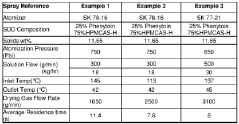
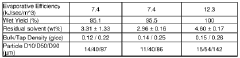
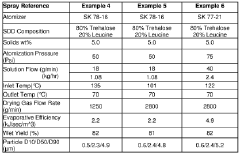
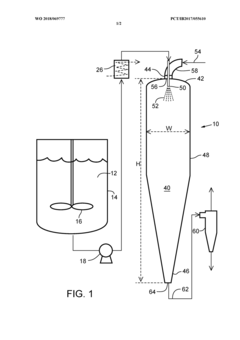
- A compact spray drying apparatus with a tapered cone design and recirculation of drying gas, allowing for a smaller chamber size while maintaining sufficient drying time and increasing throughput by optimizing the aspect ratio and evaporation rate within the chamber.
Spray drying techniques
PatentWO2012087350A2
Innovation
- The use of microfluidic channels to mix fluids before spray drying, where the first fluid is exposed to a second fluid, causing precipitation before expulsion through a nozzle, and the fluids are then sprayed into a drying region with controlled conditions such as temperature and humidity.

Cross-Industry Applications and Technology Transfer
Spray drying technology, traditionally associated with food and pharmaceutical industries, has demonstrated remarkable versatility across multiple sectors. The patent landscape reveals significant cross-industry applications where innovations originally developed for one sector have been successfully transferred to others. The food industry's advancements in flavor encapsulation have been adapted by the pharmaceutical sector for controlled drug release systems, while pharmaceutical spray drying techniques for bioavailability enhancement have found applications in nutraceutical product development.
The chemical industry has benefited from spray drying technologies initially developed for ceramic powder production, particularly in catalyst manufacturing where precise particle size distribution is critical. Similarly, spray drying methods from the detergent industry have been transferred to agricultural formulations, improving the stability and efficacy of crop protection products. This cross-pollination of technologies has accelerated innovation cycles and expanded the utility of spray drying across diverse applications.
Patent analysis indicates that companies with diversified portfolios spanning multiple industries tend to generate more valuable intellectual property. These organizations leverage their expertise across sectors, creating novel applications by combining principles from different fields. For instance, patents originally filed for dairy powder production have been cited in subsequent innovations for pharmaceutical excipients, demonstrating the transferability of core spray drying principles.
Technology transfer mechanisms identified in the patent landscape include strategic licensing agreements, joint ventures between companies from different sectors, and acquisition of specialized spray drying technology firms. These mechanisms have facilitated knowledge diffusion across industry boundaries, with patent citations showing clear lineages of technological evolution across seemingly unrelated applications.
The most successful cross-industry applications have emerged when fundamental spray drying principles are adapted to address specific challenges in new domains. For example, aseptic spray drying techniques developed for pharmaceutical applications have been modified for producing sensitive food ingredients, while specialized atomization technologies from industrial coating applications have enhanced pharmaceutical particle engineering capabilities.
Future opportunities for technology transfer appear most promising in emerging fields such as advanced materials, biotechnology, and sustainable manufacturing. Patents related to spray drying of nanomaterials, for instance, draw heavily on techniques originally developed for conventional applications but adapted to address the unique challenges of nanoscale production.
The chemical industry has benefited from spray drying technologies initially developed for ceramic powder production, particularly in catalyst manufacturing where precise particle size distribution is critical. Similarly, spray drying methods from the detergent industry have been transferred to agricultural formulations, improving the stability and efficacy of crop protection products. This cross-pollination of technologies has accelerated innovation cycles and expanded the utility of spray drying across diverse applications.
Patent analysis indicates that companies with diversified portfolios spanning multiple industries tend to generate more valuable intellectual property. These organizations leverage their expertise across sectors, creating novel applications by combining principles from different fields. For instance, patents originally filed for dairy powder production have been cited in subsequent innovations for pharmaceutical excipients, demonstrating the transferability of core spray drying principles.
Technology transfer mechanisms identified in the patent landscape include strategic licensing agreements, joint ventures between companies from different sectors, and acquisition of specialized spray drying technology firms. These mechanisms have facilitated knowledge diffusion across industry boundaries, with patent citations showing clear lineages of technological evolution across seemingly unrelated applications.
The most successful cross-industry applications have emerged when fundamental spray drying principles are adapted to address specific challenges in new domains. For example, aseptic spray drying techniques developed for pharmaceutical applications have been modified for producing sensitive food ingredients, while specialized atomization technologies from industrial coating applications have enhanced pharmaceutical particle engineering capabilities.
Future opportunities for technology transfer appear most promising in emerging fields such as advanced materials, biotechnology, and sustainable manufacturing. Patents related to spray drying of nanomaterials, for instance, draw heavily on techniques originally developed for conventional applications but adapted to address the unique challenges of nanoscale production.
Environmental Impact and Sustainability Considerations
Spray drying technologies have significant environmental implications that warrant careful consideration in today's sustainability-focused industrial landscape. The energy consumption associated with spray drying processes represents a major environmental concern, as these operations typically require substantial thermal energy for the atomization and drying phases. Patent analysis reveals an increasing trend toward energy-efficient designs, with innovations focusing on heat recovery systems and optimized air circulation patterns that can reduce energy requirements by up to 30% compared to conventional systems.
Water usage and wastewater management constitute another critical environmental dimension. Recent proprietary technologies have introduced closed-loop water systems that minimize freshwater consumption and reduce wastewater discharge. Several patents filed between 2018-2023 demonstrate novel approaches to water reclamation within spray drying operations, potentially decreasing water footprint by 40-60% in pharmaceutical and food processing applications.
Emissions control has emerged as a priority area in spray drying innovation, particularly regarding particulate matter and volatile organic compounds (VOCs). Advanced filtration systems and electrostatic precipitators featured in recent patents show efficiency improvements of 15-25% in capturing fine particles. Additionally, catalytic oxidation technologies for VOC abatement have been increasingly incorporated into proprietary spray drying systems, addressing regulatory compliance requirements across multiple jurisdictions.
Raw material efficiency represents another sustainability frontier, with patents highlighting technologies that optimize product yield and minimize waste generation. Precision control systems that dynamically adjust operational parameters based on feed characteristics can improve product recovery rates by 5-10%, significantly reducing material losses. Furthermore, several patents describe modular designs that facilitate equipment cleaning and maintenance with minimal chemical usage.
The lifecycle assessment of spray drying equipment has gained prominence in recent patent filings, with manufacturers developing designs that consider end-of-life disassembly and material recovery. Modular construction approaches and the use of recyclable components feature prominently in patents from industry leaders, reflecting a shift toward circular economy principles in equipment design and manufacturing.
Carbon footprint reduction strategies are increasingly evident in the patent landscape, with innovations targeting both direct and indirect emissions. Hybrid heating systems that combine conventional energy sources with renewable alternatives appear in multiple recent patents, potentially reducing greenhouse gas emissions by 20-40% depending on implementation scale and energy mix.
Water usage and wastewater management constitute another critical environmental dimension. Recent proprietary technologies have introduced closed-loop water systems that minimize freshwater consumption and reduce wastewater discharge. Several patents filed between 2018-2023 demonstrate novel approaches to water reclamation within spray drying operations, potentially decreasing water footprint by 40-60% in pharmaceutical and food processing applications.
Emissions control has emerged as a priority area in spray drying innovation, particularly regarding particulate matter and volatile organic compounds (VOCs). Advanced filtration systems and electrostatic precipitators featured in recent patents show efficiency improvements of 15-25% in capturing fine particles. Additionally, catalytic oxidation technologies for VOC abatement have been increasingly incorporated into proprietary spray drying systems, addressing regulatory compliance requirements across multiple jurisdictions.
Raw material efficiency represents another sustainability frontier, with patents highlighting technologies that optimize product yield and minimize waste generation. Precision control systems that dynamically adjust operational parameters based on feed characteristics can improve product recovery rates by 5-10%, significantly reducing material losses. Furthermore, several patents describe modular designs that facilitate equipment cleaning and maintenance with minimal chemical usage.
The lifecycle assessment of spray drying equipment has gained prominence in recent patent filings, with manufacturers developing designs that consider end-of-life disassembly and material recovery. Modular construction approaches and the use of recyclable components feature prominently in patents from industry leaders, reflecting a shift toward circular economy principles in equipment design and manufacturing.
Carbon footprint reduction strategies are increasingly evident in the patent landscape, with innovations targeting both direct and indirect emissions. Hybrid heating systems that combine conventional energy sources with renewable alternatives appear in multiple recent patents, potentially reducing greenhouse gas emissions by 20-40% depending on implementation scale and energy mix.
Unlock deeper insights with PatSnap Eureka Quick Research — get a full tech report to explore trends and direct your research. Try now!
Generate Your Research Report Instantly with AI Agent
Supercharge your innovation with PatSnap Eureka AI Agent Platform!