

Quantum Computing and its Contribution to Knowledge Automation
JUL 17, 20259 MIN READ
Generate Your Research Report Instantly with AI Agent
PatSnap Eureka helps you evaluate technical feasibility & market potential.
Quantum Computing Evolution and Objectives
Quantum computing has emerged as a revolutionary technology with the potential to transform various fields, including knowledge automation. The evolution of quantum computing can be traced back to the early 1980s when Richard Feynman proposed the idea of using quantum mechanical systems for computation. Since then, the field has progressed rapidly, driven by advancements in quantum physics, computer science, and engineering.
The primary objective of quantum computing in the context of knowledge automation is to harness the power of quantum mechanics to process and analyze vast amounts of data at unprecedented speeds. This technology aims to solve complex problems that are currently intractable for classical computers, particularly in areas such as machine learning, optimization, and simulation.
Over the past four decades, quantum computing has witnessed several key milestones. In the 1990s, Peter Shor developed a quantum algorithm for factoring large numbers, demonstrating the potential of quantum computers to break widely used encryption systems. This breakthrough sparked increased interest and investment in quantum computing research.
The early 2000s saw the development of the first rudimentary quantum processors, capable of manipulating a few qubits. As the technology progressed, researchers focused on improving qubit coherence times, error correction techniques, and scalability. By the 2010s, companies like IBM, Google, and D-Wave Systems began offering cloud-based access to quantum processors, enabling wider experimentation and application development.
Recent years have witnessed significant advancements in quantum hardware, with processors now capable of manipulating dozens to hundreds of qubits. The race towards achieving quantum supremacy – the point at which quantum computers can outperform classical computers in specific tasks – has intensified, with Google claiming this milestone in 2019.
Looking ahead, the objectives for quantum computing in knowledge automation are ambitious and far-reaching. Researchers aim to develop more stable and scalable quantum systems, with the ultimate goal of creating fault-tolerant quantum computers capable of performing complex calculations with minimal errors. This would enable the processing of massive datasets and the execution of sophisticated algorithms for knowledge discovery and automation.
Another key objective is the integration of quantum computing with existing classical systems to create hybrid solutions that leverage the strengths of both paradigms. This approach could lead to significant advancements in areas such as financial modeling, drug discovery, and climate prediction, where complex simulations and data analysis are crucial.
As quantum computing continues to evolve, its potential impact on knowledge automation grows exponentially. The technology promises to revolutionize how we process, analyze, and derive insights from vast amounts of data, potentially leading to breakthroughs in artificial intelligence, machine learning, and data-driven decision-making processes.
The primary objective of quantum computing in the context of knowledge automation is to harness the power of quantum mechanics to process and analyze vast amounts of data at unprecedented speeds. This technology aims to solve complex problems that are currently intractable for classical computers, particularly in areas such as machine learning, optimization, and simulation.
Over the past four decades, quantum computing has witnessed several key milestones. In the 1990s, Peter Shor developed a quantum algorithm for factoring large numbers, demonstrating the potential of quantum computers to break widely used encryption systems. This breakthrough sparked increased interest and investment in quantum computing research.
The early 2000s saw the development of the first rudimentary quantum processors, capable of manipulating a few qubits. As the technology progressed, researchers focused on improving qubit coherence times, error correction techniques, and scalability. By the 2010s, companies like IBM, Google, and D-Wave Systems began offering cloud-based access to quantum processors, enabling wider experimentation and application development.
Recent years have witnessed significant advancements in quantum hardware, with processors now capable of manipulating dozens to hundreds of qubits. The race towards achieving quantum supremacy – the point at which quantum computers can outperform classical computers in specific tasks – has intensified, with Google claiming this milestone in 2019.
Looking ahead, the objectives for quantum computing in knowledge automation are ambitious and far-reaching. Researchers aim to develop more stable and scalable quantum systems, with the ultimate goal of creating fault-tolerant quantum computers capable of performing complex calculations with minimal errors. This would enable the processing of massive datasets and the execution of sophisticated algorithms for knowledge discovery and automation.
Another key objective is the integration of quantum computing with existing classical systems to create hybrid solutions that leverage the strengths of both paradigms. This approach could lead to significant advancements in areas such as financial modeling, drug discovery, and climate prediction, where complex simulations and data analysis are crucial.
As quantum computing continues to evolve, its potential impact on knowledge automation grows exponentially. The technology promises to revolutionize how we process, analyze, and derive insights from vast amounts of data, potentially leading to breakthroughs in artificial intelligence, machine learning, and data-driven decision-making processes.
Market Demand for Knowledge Automation
The market demand for knowledge automation has been steadily increasing, driven by the growing complexity of information systems and the need for more efficient data processing and decision-making capabilities. As organizations across various sectors grapple with the challenges of managing vast amounts of data and extracting meaningful insights, the potential of quantum computing to revolutionize knowledge automation has garnered significant attention.
In the financial sector, there is a pressing need for advanced risk assessment and portfolio optimization tools that can process complex market data in real-time. Quantum computing's ability to perform parallel computations and solve optimization problems exponentially faster than classical computers makes it a promising solution for these challenges. Major financial institutions are actively exploring quantum-enhanced algorithms for fraud detection, algorithmic trading, and financial forecasting.
The healthcare industry is another key driver of demand for knowledge automation, particularly in drug discovery and personalized medicine. Quantum computing's potential to simulate molecular interactions and analyze genetic data at unprecedented scales could dramatically accelerate the development of new treatments and enable more accurate disease prediction models. Pharmaceutical companies and research institutions are investing heavily in quantum technologies to gain a competitive edge in this field.
In the realm of artificial intelligence and machine learning, there is a growing interest in quantum machine learning algorithms that could potentially outperform classical methods in certain tasks. This has implications for a wide range of applications, from natural language processing to computer vision, where more sophisticated pattern recognition and data analysis capabilities are constantly sought after.
The cybersecurity sector is also closely watching the development of quantum computing, both as a potential threat to current encryption methods and as a tool for developing more robust security protocols. As quantum computers become more powerful, there is an increasing demand for quantum-resistant cryptography and quantum key distribution systems to protect sensitive data.
Manufacturing and logistics industries are exploring quantum optimization algorithms to solve complex supply chain and resource allocation problems. The ability to efficiently manage large-scale operations and optimize routes could lead to significant cost savings and improved operational efficiency.
Despite the growing interest and potential applications, it's important to note that the market for quantum computing in knowledge automation is still in its early stages. Many organizations are in the exploratory phase, conducting proof-of-concept projects and building partnerships with quantum technology providers. The full realization of quantum computing's potential in knowledge automation will likely unfold over the coming years as the technology matures and becomes more accessible.
In the financial sector, there is a pressing need for advanced risk assessment and portfolio optimization tools that can process complex market data in real-time. Quantum computing's ability to perform parallel computations and solve optimization problems exponentially faster than classical computers makes it a promising solution for these challenges. Major financial institutions are actively exploring quantum-enhanced algorithms for fraud detection, algorithmic trading, and financial forecasting.
The healthcare industry is another key driver of demand for knowledge automation, particularly in drug discovery and personalized medicine. Quantum computing's potential to simulate molecular interactions and analyze genetic data at unprecedented scales could dramatically accelerate the development of new treatments and enable more accurate disease prediction models. Pharmaceutical companies and research institutions are investing heavily in quantum technologies to gain a competitive edge in this field.
In the realm of artificial intelligence and machine learning, there is a growing interest in quantum machine learning algorithms that could potentially outperform classical methods in certain tasks. This has implications for a wide range of applications, from natural language processing to computer vision, where more sophisticated pattern recognition and data analysis capabilities are constantly sought after.
The cybersecurity sector is also closely watching the development of quantum computing, both as a potential threat to current encryption methods and as a tool for developing more robust security protocols. As quantum computers become more powerful, there is an increasing demand for quantum-resistant cryptography and quantum key distribution systems to protect sensitive data.
Manufacturing and logistics industries are exploring quantum optimization algorithms to solve complex supply chain and resource allocation problems. The ability to efficiently manage large-scale operations and optimize routes could lead to significant cost savings and improved operational efficiency.
Despite the growing interest and potential applications, it's important to note that the market for quantum computing in knowledge automation is still in its early stages. Many organizations are in the exploratory phase, conducting proof-of-concept projects and building partnerships with quantum technology providers. The full realization of quantum computing's potential in knowledge automation will likely unfold over the coming years as the technology matures and becomes more accessible.
Quantum Computing: Current State and Challenges
Quantum computing represents a paradigm shift in computational capabilities, leveraging the principles of quantum mechanics to perform complex calculations exponentially faster than classical computers. Currently, the field is experiencing rapid advancements, with significant progress in qubit technologies, error correction methods, and quantum algorithms. However, several challenges persist, hindering the widespread adoption and practical implementation of quantum systems.
One of the primary challenges in quantum computing is maintaining qubit coherence. Qubits are highly sensitive to environmental disturbances, leading to decoherence and loss of quantum information. Researchers are actively working on developing more robust qubit architectures and improving error correction techniques to mitigate this issue. Superconducting qubits, trapped ions, and topological qubits are among the promising approaches being explored to enhance qubit stability and longevity.
Scalability remains another significant hurdle in quantum computing. While small-scale quantum processors have been demonstrated, scaling up to systems with hundreds or thousands of qubits presents formidable engineering challenges. Issues such as qubit connectivity, control systems, and cryogenic infrastructure need to be addressed to realize large-scale quantum computers capable of outperforming classical systems in practical applications.
The development of quantum algorithms and software tools is crucial for harnessing the power of quantum computers. While quantum algorithms for specific problems, such as Shor's algorithm for factoring and Grover's algorithm for search, have shown theoretical advantages, there is a need for more diverse and practical quantum algorithms applicable to real-world problems. Bridging the gap between quantum hardware and software remains an active area of research.
Quantum error correction is a critical aspect of building fault-tolerant quantum computers. Current quantum systems are prone to errors due to noise and decoherence, limiting their computational capabilities. Developing efficient error correction codes and implementing them in hardware is essential for achieving reliable quantum computations. Surface codes and other topological quantum error correction schemes are being investigated to address this challenge.
The integration of quantum systems with classical computing infrastructure poses both technical and logistical challenges. Developing hybrid quantum-classical algorithms and optimizing the interface between quantum and classical components are crucial for leveraging the strengths of both paradigms. Additionally, standardization efforts and the development of quantum programming languages and frameworks are necessary to facilitate the adoption of quantum technologies across various industries.
As quantum computing advances, addressing these challenges will be crucial for realizing its potential in revolutionizing fields such as cryptography, drug discovery, financial modeling, and artificial intelligence. Continued research and collaboration between academia, industry, and government institutions will be essential in overcoming these obstacles and unlocking the full potential of quantum computing in the realm of knowledge automation and beyond.
One of the primary challenges in quantum computing is maintaining qubit coherence. Qubits are highly sensitive to environmental disturbances, leading to decoherence and loss of quantum information. Researchers are actively working on developing more robust qubit architectures and improving error correction techniques to mitigate this issue. Superconducting qubits, trapped ions, and topological qubits are among the promising approaches being explored to enhance qubit stability and longevity.
Scalability remains another significant hurdle in quantum computing. While small-scale quantum processors have been demonstrated, scaling up to systems with hundreds or thousands of qubits presents formidable engineering challenges. Issues such as qubit connectivity, control systems, and cryogenic infrastructure need to be addressed to realize large-scale quantum computers capable of outperforming classical systems in practical applications.
The development of quantum algorithms and software tools is crucial for harnessing the power of quantum computers. While quantum algorithms for specific problems, such as Shor's algorithm for factoring and Grover's algorithm for search, have shown theoretical advantages, there is a need for more diverse and practical quantum algorithms applicable to real-world problems. Bridging the gap between quantum hardware and software remains an active area of research.
Quantum error correction is a critical aspect of building fault-tolerant quantum computers. Current quantum systems are prone to errors due to noise and decoherence, limiting their computational capabilities. Developing efficient error correction codes and implementing them in hardware is essential for achieving reliable quantum computations. Surface codes and other topological quantum error correction schemes are being investigated to address this challenge.
The integration of quantum systems with classical computing infrastructure poses both technical and logistical challenges. Developing hybrid quantum-classical algorithms and optimizing the interface between quantum and classical components are crucial for leveraging the strengths of both paradigms. Additionally, standardization efforts and the development of quantum programming languages and frameworks are necessary to facilitate the adoption of quantum technologies across various industries.
As quantum computing advances, addressing these challenges will be crucial for realizing its potential in revolutionizing fields such as cryptography, drug discovery, financial modeling, and artificial intelligence. Continued research and collaboration between academia, industry, and government institutions will be essential in overcoming these obstacles and unlocking the full potential of quantum computing in the realm of knowledge automation and beyond.
Quantum Approaches to Knowledge Automation
01 Quantum algorithm optimization and automation
This approach focuses on developing automated systems to optimize quantum algorithms. It involves creating tools that can analyze and improve quantum circuits, reducing the complexity and increasing the efficiency of quantum computations. These systems can automatically adjust parameters, simplify gate sequences, and suggest optimal implementations for specific quantum hardware.- Quantum computing-based knowledge automation systems: These systems leverage quantum computing principles to automate knowledge processing and management. They can handle complex data structures and perform advanced computations, enabling more efficient and accurate knowledge automation processes compared to classical systems.
- Quantum machine learning for knowledge automation: Quantum machine learning algorithms are applied to enhance knowledge automation tasks. These algorithms can process vast amounts of data more efficiently, leading to improved pattern recognition, classification, and prediction capabilities in knowledge management systems.
- Quantum-enhanced natural language processing: Quantum computing techniques are used to improve natural language processing capabilities in knowledge automation systems. This enables more accurate language understanding, translation, and generation, facilitating better knowledge extraction and representation.
- Quantum-assisted knowledge graph construction and analysis: Quantum algorithms are employed to enhance the construction, querying, and analysis of knowledge graphs. This approach allows for more efficient representation and exploration of complex relationships within large-scale knowledge bases.
- Quantum error correction for reliable knowledge automation: Quantum error correction techniques are integrated into knowledge automation systems to improve the reliability and accuracy of quantum computations. This ensures more robust and dependable knowledge processing in quantum-based automation platforms.
02 Quantum-classical hybrid knowledge systems
This innovation combines classical machine learning techniques with quantum computing to create hybrid knowledge systems. These systems leverage the strengths of both classical and quantum computing to process and analyze complex data sets, potentially leading to more efficient problem-solving and decision-making processes in various fields such as finance, healthcare, and scientific research.Expand Specific Solutions03 Automated quantum error correction and mitigation
This technology focuses on developing automated systems for quantum error correction and mitigation. It involves creating algorithms and software that can detect and correct errors in quantum computations in real-time, improving the reliability and accuracy of quantum systems. These automated systems can adapt to different types of quantum noise and errors, enhancing the overall performance of quantum computers.Expand Specific Solutions04 Quantum machine learning for knowledge discovery
This approach utilizes quantum computing principles to enhance machine learning algorithms for knowledge discovery. It involves developing quantum versions of classical machine learning models, such as quantum neural networks and quantum support vector machines. These quantum-enhanced algorithms can potentially process complex data patterns more efficiently, leading to faster and more accurate knowledge extraction from large datasets.Expand Specific Solutions05 Automated quantum circuit design and optimization
This innovation focuses on creating automated systems for designing and optimizing quantum circuits. It involves developing AI-powered tools that can generate efficient quantum circuit designs based on specific problem requirements. These systems can automatically select appropriate quantum gates, optimize circuit depth, and adapt designs to different quantum hardware architectures, streamlining the process of quantum algorithm implementation.Expand Specific Solutions
Key Players in Quantum Computing Industry
The quantum computing landscape is rapidly evolving, with significant advancements in both hardware and software. The market is in its early growth stage, characterized by intense research and development efforts from major tech companies and specialized quantum startups. Key players like Google, IBM, and Amazon are investing heavily in quantum technologies, while startups such as IonQ and Zapata Computing are pushing innovation boundaries. The global quantum computing market is projected to grow substantially, driven by potential applications in cryptography, drug discovery, and financial modeling. However, the technology is still in its nascent stages, with varying levels of maturity across different quantum computing approaches. Companies like Origin Quantum and Terra Quantum are working on full-stack quantum solutions, indicating a trend towards integrated quantum ecosystems.
Google LLC
Technical Solution: Google's quantum computing efforts are centered around their Sycamore processor, which achieved quantum supremacy in 2019 by performing a calculation in 200 seconds that would take a classical supercomputer 10,000 years[4]. They use superconducting qubits and focus on error correction techniques to improve qubit coherence times. Google is also exploring quantum machine learning algorithms and quantum simulation for materials science[5]. Their Cirq framework allows developers to write quantum algorithms for various hardware platforms. Recently, they've been working on time crystals, a new phase of matter, using their quantum computers[6].
Strengths: Demonstrated quantum supremacy, strong focus on error correction. Weaknesses: Limited commercial applications so far, high resource requirements for operation.
International Business Machines Corp.
Technical Solution: IBM has been at the forefront of quantum computing research and development. Their approach focuses on superconducting qubits, with their latest IBM Quantum System One boasting 127 qubits[1]. IBM's quantum computers are accessible via cloud services, allowing researchers and businesses to experiment with quantum algorithms. They have developed Qiskit, an open-source quantum computing software development kit, which facilitates the creation and optimization of quantum circuits[2]. IBM is also working on error correction techniques and quantum-resistant cryptography to address the challenges of quantum decoherence and potential threats to current encryption methods[3].
Strengths: Strong research foundation, cloud accessibility, and open-source tools. Weaknesses: Scalability challenges and the need for extreme cooling for superconducting qubits.
Quantum Algorithms for Information Processing
Enabling quantum machine learning to be used effectively with classical data by mapping classical data into a quantum state space
PatentPendingUS20250200417A1
Innovation
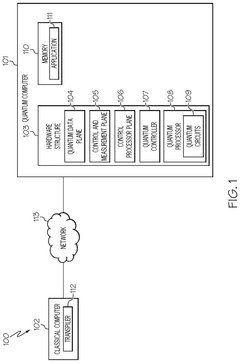
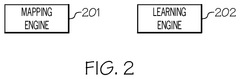
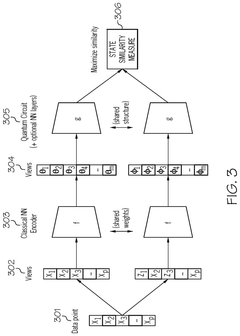
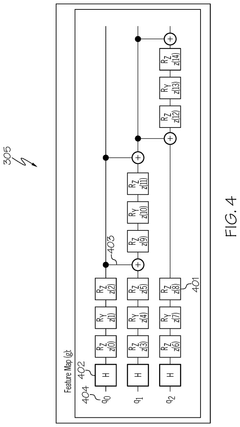
- The method involves mapping classical data into a quantum state space using a classical machine learning model, generating different views of the data points through corruption or quantum hardware noise, encoding these views into quantum state representations, and optimizing the encoder parameters based on similarity measures to enhance the encoding efficiency.
Performing quantum error mitigation at runtime using trained machine learning model
PatentPendingUS20250086492A1
Innovation
- A method for runtime quantum error mitigation that involves generating training data, training a machine learning model using this data, and executing a quantum circuit to perform error mitigation on quantum results at runtime using the trained model.


Quantum Computing Infrastructure Requirements
Quantum computing infrastructure requirements are critical for the successful implementation and operation of quantum systems. These requirements encompass a wide range of specialized hardware, software, and environmental conditions necessary to harness the power of quantum mechanics for computational purposes.
At the hardware level, quantum computers require highly specialized components such as quantum processors, cryogenic cooling systems, and precision control electronics. Quantum processors, often based on superconducting circuits or trapped ions, must be maintained at extremely low temperatures, typically near absolute zero, to preserve quantum coherence. This necessitates the use of sophisticated cryogenic systems, including dilution refrigerators and liquid helium cooling units.
The control and measurement of quantum states demand ultra-precise electronics and signal processing equipment. These systems must be capable of generating and manipulating microwave pulses with exceptional accuracy and timing precision. Additionally, quantum error correction mechanisms are essential to mitigate the effects of decoherence and maintain the integrity of quantum information.
Software infrastructure for quantum computing includes specialized quantum programming languages, compilers, and development environments. These tools enable researchers and developers to create quantum algorithms and translate them into instructions that can be executed on quantum hardware. Quantum simulation software is also crucial for testing and optimizing quantum circuits before deployment on actual quantum systems.
Quantum networking infrastructure is an emerging requirement, facilitating the distribution of quantum information between distant quantum processors. This involves the development of quantum repeaters, quantum memories, and quantum-safe cryptographic protocols to ensure secure communication.
Environmental considerations play a significant role in quantum computing infrastructure. Quantum systems are highly sensitive to electromagnetic interference, vibrations, and temperature fluctuations. As a result, quantum computing facilities must be designed with extensive shielding, vibration isolation, and precise environmental control systems to maintain optimal operating conditions.
As quantum computing scales up, the integration of classical and quantum systems becomes increasingly important. Hybrid quantum-classical architectures require sophisticated interfaces and control systems to seamlessly combine the strengths of both paradigms. This integration extends to data centers and high-performance computing facilities, where quantum accelerators may be incorporated alongside traditional supercomputing resources.
At the hardware level, quantum computers require highly specialized components such as quantum processors, cryogenic cooling systems, and precision control electronics. Quantum processors, often based on superconducting circuits or trapped ions, must be maintained at extremely low temperatures, typically near absolute zero, to preserve quantum coherence. This necessitates the use of sophisticated cryogenic systems, including dilution refrigerators and liquid helium cooling units.
The control and measurement of quantum states demand ultra-precise electronics and signal processing equipment. These systems must be capable of generating and manipulating microwave pulses with exceptional accuracy and timing precision. Additionally, quantum error correction mechanisms are essential to mitigate the effects of decoherence and maintain the integrity of quantum information.
Software infrastructure for quantum computing includes specialized quantum programming languages, compilers, and development environments. These tools enable researchers and developers to create quantum algorithms and translate them into instructions that can be executed on quantum hardware. Quantum simulation software is also crucial for testing and optimizing quantum circuits before deployment on actual quantum systems.
Quantum networking infrastructure is an emerging requirement, facilitating the distribution of quantum information between distant quantum processors. This involves the development of quantum repeaters, quantum memories, and quantum-safe cryptographic protocols to ensure secure communication.
Environmental considerations play a significant role in quantum computing infrastructure. Quantum systems are highly sensitive to electromagnetic interference, vibrations, and temperature fluctuations. As a result, quantum computing facilities must be designed with extensive shielding, vibration isolation, and precise environmental control systems to maintain optimal operating conditions.
As quantum computing scales up, the integration of classical and quantum systems becomes increasingly important. Hybrid quantum-classical architectures require sophisticated interfaces and control systems to seamlessly combine the strengths of both paradigms. This integration extends to data centers and high-performance computing facilities, where quantum accelerators may be incorporated alongside traditional supercomputing resources.
Ethical Implications of Quantum-Powered AI
The integration of quantum computing with artificial intelligence raises profound ethical considerations that demand careful examination. As quantum-powered AI systems become increasingly capable, they have the potential to significantly impact decision-making processes across various domains, from healthcare to finance. One primary concern is the amplification of existing biases in data and algorithms, which could lead to discriminatory outcomes at an unprecedented scale and speed.
Privacy and security issues also come to the forefront, as quantum computers may eventually be able to break current encryption methods, potentially compromising sensitive personal and organizational data. This capability could lead to a new era of cyber vulnerabilities and necessitate the development of quantum-resistant cryptography to protect individual privacy and national security interests.
The question of accountability and transparency in quantum AI systems is another critical ethical challenge. The complexity and often opaque nature of quantum algorithms may make it difficult to explain or justify decisions made by these systems, particularly in high-stakes scenarios such as medical diagnoses or judicial proceedings. This lack of interpretability could undermine public trust and pose challenges for regulatory compliance.
Furthermore, the potential for quantum AI to surpass human cognitive capabilities in certain areas raises questions about the future of work and human agency. As these systems become more advanced, there is a risk of over-reliance on AI-driven decision-making, potentially marginalizing human judgment and expertise. This shift could have far-reaching societal implications, affecting employment patterns and the very nature of human-machine interaction.
The ethical use of quantum-powered AI in military and defense applications is another area of significant concern. The strategic advantages offered by such technology could alter the landscape of international relations and conflict, potentially leading to a new arms race or exacerbating global power imbalances.
Addressing these ethical implications requires a multidisciplinary approach, involving not only technologists and AI researchers but also ethicists, policymakers, and representatives from various stakeholder groups. Developing robust ethical frameworks and governance structures for quantum AI will be crucial to ensure that this powerful technology is deployed responsibly and in alignment with human values and societal well-being.
Privacy and security issues also come to the forefront, as quantum computers may eventually be able to break current encryption methods, potentially compromising sensitive personal and organizational data. This capability could lead to a new era of cyber vulnerabilities and necessitate the development of quantum-resistant cryptography to protect individual privacy and national security interests.
The question of accountability and transparency in quantum AI systems is another critical ethical challenge. The complexity and often opaque nature of quantum algorithms may make it difficult to explain or justify decisions made by these systems, particularly in high-stakes scenarios such as medical diagnoses or judicial proceedings. This lack of interpretability could undermine public trust and pose challenges for regulatory compliance.
Furthermore, the potential for quantum AI to surpass human cognitive capabilities in certain areas raises questions about the future of work and human agency. As these systems become more advanced, there is a risk of over-reliance on AI-driven decision-making, potentially marginalizing human judgment and expertise. This shift could have far-reaching societal implications, affecting employment patterns and the very nature of human-machine interaction.
The ethical use of quantum-powered AI in military and defense applications is another area of significant concern. The strategic advantages offered by such technology could alter the landscape of international relations and conflict, potentially leading to a new arms race or exacerbating global power imbalances.
Addressing these ethical implications requires a multidisciplinary approach, involving not only technologists and AI researchers but also ethicists, policymakers, and representatives from various stakeholder groups. Developing robust ethical frameworks and governance structures for quantum AI will be crucial to ensure that this powerful technology is deployed responsibly and in alignment with human values and societal well-being.
Unlock deeper insights with PatSnap Eureka Quick Research — get a full tech report to explore trends and direct your research. Try now!
Generate Your Research Report Instantly with AI Agent
Supercharge your innovation with PatSnap Eureka AI Agent Platform!