Quantum Computing in Streamlining Healthcare Analytics Solutions
JUL 17, 202510 MIN READ
Generate Your Research Report Instantly with AI Agent
Patsnap Eureka helps you evaluate technical feasibility & market potential.
Quantum Computing in Healthcare Analytics: Background and Objectives
Quantum computing represents a paradigm shift in computational capabilities, offering unprecedented processing power that could revolutionize healthcare analytics. The evolution of quantum technology has been marked by significant milestones, from theoretical concepts in the 1980s to the development of practical quantum systems in recent years. This technological progression aligns with the growing complexity of healthcare data and the increasing demand for more sophisticated analytical tools.
The primary objective of integrating quantum computing into healthcare analytics is to enhance the speed and accuracy of data processing, enabling more efficient diagnosis, treatment planning, and drug discovery. By leveraging quantum principles such as superposition and entanglement, these systems have the potential to analyze vast datasets and complex molecular structures at speeds unattainable by classical computers.
In the healthcare sector, the exponential growth of patient data, genomic information, and medical imaging has created a pressing need for advanced computational solutions. Quantum computing aims to address this challenge by offering novel approaches to data analysis, pattern recognition, and predictive modeling. The technology's ability to simultaneously process multiple data points makes it particularly suited for tasks such as protein folding simulations, drug interaction predictions, and personalized medicine algorithms.
The convergence of quantum computing and healthcare analytics is driven by several key factors. First, the increasing prevalence of chronic diseases and the aging population necessitate more efficient and personalized healthcare solutions. Second, the rise of precision medicine requires computational power to analyze individual genetic profiles and environmental factors. Lastly, the global focus on improving healthcare outcomes while reducing costs creates a fertile ground for innovative technologies that can optimize resource allocation and treatment efficacy.
As quantum computing in healthcare analytics progresses, it aims to overcome current limitations in data processing and analysis. This includes reducing the time required for complex simulations, improving the accuracy of predictive models, and enabling real-time analysis of large-scale health datasets. The ultimate goal is to create a more responsive, efficient, and personalized healthcare system that can adapt to individual patient needs and global health challenges.
The development of quantum computing in healthcare analytics is not without challenges. Technical hurdles such as maintaining quantum coherence, scaling up qubit systems, and developing quantum-resistant encryption methods need to be addressed. Additionally, integrating quantum systems with existing healthcare infrastructure and ensuring data privacy and security are critical considerations in the advancement of this technology.
The primary objective of integrating quantum computing into healthcare analytics is to enhance the speed and accuracy of data processing, enabling more efficient diagnosis, treatment planning, and drug discovery. By leveraging quantum principles such as superposition and entanglement, these systems have the potential to analyze vast datasets and complex molecular structures at speeds unattainable by classical computers.
In the healthcare sector, the exponential growth of patient data, genomic information, and medical imaging has created a pressing need for advanced computational solutions. Quantum computing aims to address this challenge by offering novel approaches to data analysis, pattern recognition, and predictive modeling. The technology's ability to simultaneously process multiple data points makes it particularly suited for tasks such as protein folding simulations, drug interaction predictions, and personalized medicine algorithms.
The convergence of quantum computing and healthcare analytics is driven by several key factors. First, the increasing prevalence of chronic diseases and the aging population necessitate more efficient and personalized healthcare solutions. Second, the rise of precision medicine requires computational power to analyze individual genetic profiles and environmental factors. Lastly, the global focus on improving healthcare outcomes while reducing costs creates a fertile ground for innovative technologies that can optimize resource allocation and treatment efficacy.
As quantum computing in healthcare analytics progresses, it aims to overcome current limitations in data processing and analysis. This includes reducing the time required for complex simulations, improving the accuracy of predictive models, and enabling real-time analysis of large-scale health datasets. The ultimate goal is to create a more responsive, efficient, and personalized healthcare system that can adapt to individual patient needs and global health challenges.
The development of quantum computing in healthcare analytics is not without challenges. Technical hurdles such as maintaining quantum coherence, scaling up qubit systems, and developing quantum-resistant encryption methods need to be addressed. Additionally, integrating quantum systems with existing healthcare infrastructure and ensuring data privacy and security are critical considerations in the advancement of this technology.
Market Demand for Advanced Healthcare Analytics
The healthcare analytics market is experiencing a significant surge in demand for advanced solutions, driven by the increasing complexity of healthcare data and the need for more efficient, accurate, and timely insights. As healthcare organizations strive to improve patient outcomes, reduce costs, and enhance operational efficiency, the integration of quantum computing in healthcare analytics presents a promising avenue for addressing these challenges.
The global healthcare analytics market is projected to grow substantially in the coming years, with a compound annual growth rate (CAGR) exceeding 20% through 2027. This growth is fueled by the exponential increase in healthcare data generated from electronic health records (EHRs), wearable devices, genomic sequencing, and other sources. Traditional analytics tools are struggling to keep pace with this data deluge, creating a pressing need for more sophisticated solutions.
Healthcare providers are increasingly seeking analytics platforms that can process and analyze vast amounts of structured and unstructured data in real-time. This demand is particularly acute in areas such as population health management, personalized medicine, and predictive analytics for disease prevention. Quantum computing offers the potential to revolutionize these areas by enabling complex calculations and simulations that are currently infeasible with classical computing systems.
The pharmaceutical industry is another key driver of demand for advanced healthcare analytics. Drug discovery and development processes are time-consuming and expensive, with high failure rates. Quantum computing could significantly accelerate these processes by simulating molecular interactions and predicting drug efficacy with unprecedented accuracy. This capability could lead to faster drug development cycles and more targeted therapies, addressing a critical need in the pharmaceutical sector.
Healthcare payers and insurers are also showing increased interest in advanced analytics solutions. These organizations are looking to leverage big data and machine learning to improve risk assessment, detect fraud, and optimize reimbursement models. Quantum computing could enhance these capabilities by processing complex risk models and identifying patterns that are invisible to classical algorithms.
The COVID-19 pandemic has further underscored the importance of robust healthcare analytics. There is a growing demand for tools that can rapidly analyze epidemiological data, predict disease spread, and optimize resource allocation during public health crises. Quantum computing's ability to handle complex optimization problems could prove invaluable in these scenarios, potentially revolutionizing pandemic response strategies.
As healthcare systems worldwide grapple with aging populations and the rising prevalence of chronic diseases, there is an urgent need for analytics solutions that can support proactive and preventive care models. Quantum-enhanced analytics could enable more accurate risk stratification and personalized intervention strategies, aligning with the broader shift towards value-based care.
The global healthcare analytics market is projected to grow substantially in the coming years, with a compound annual growth rate (CAGR) exceeding 20% through 2027. This growth is fueled by the exponential increase in healthcare data generated from electronic health records (EHRs), wearable devices, genomic sequencing, and other sources. Traditional analytics tools are struggling to keep pace with this data deluge, creating a pressing need for more sophisticated solutions.
Healthcare providers are increasingly seeking analytics platforms that can process and analyze vast amounts of structured and unstructured data in real-time. This demand is particularly acute in areas such as population health management, personalized medicine, and predictive analytics for disease prevention. Quantum computing offers the potential to revolutionize these areas by enabling complex calculations and simulations that are currently infeasible with classical computing systems.
The pharmaceutical industry is another key driver of demand for advanced healthcare analytics. Drug discovery and development processes are time-consuming and expensive, with high failure rates. Quantum computing could significantly accelerate these processes by simulating molecular interactions and predicting drug efficacy with unprecedented accuracy. This capability could lead to faster drug development cycles and more targeted therapies, addressing a critical need in the pharmaceutical sector.
Healthcare payers and insurers are also showing increased interest in advanced analytics solutions. These organizations are looking to leverage big data and machine learning to improve risk assessment, detect fraud, and optimize reimbursement models. Quantum computing could enhance these capabilities by processing complex risk models and identifying patterns that are invisible to classical algorithms.
The COVID-19 pandemic has further underscored the importance of robust healthcare analytics. There is a growing demand for tools that can rapidly analyze epidemiological data, predict disease spread, and optimize resource allocation during public health crises. Quantum computing's ability to handle complex optimization problems could prove invaluable in these scenarios, potentially revolutionizing pandemic response strategies.
As healthcare systems worldwide grapple with aging populations and the rising prevalence of chronic diseases, there is an urgent need for analytics solutions that can support proactive and preventive care models. Quantum-enhanced analytics could enable more accurate risk stratification and personalized intervention strategies, aligning with the broader shift towards value-based care.
Current State and Challenges in Quantum Healthcare Analytics
Quantum computing in healthcare analytics is currently in a nascent stage, with significant potential to revolutionize the field. The integration of quantum algorithms into healthcare data processing and analysis promises to address complex computational challenges that classical computers struggle with. However, the current state of quantum healthcare analytics faces several technological and practical hurdles.
One of the primary challenges is the limited availability of quantum hardware with sufficient qubits and coherence times to handle real-world healthcare problems. Most existing quantum computers are still in the noisy intermediate-scale quantum (NISQ) era, with qubit counts in the dozens to hundreds. This restricts their ability to process the vast amounts of healthcare data generated daily.
Another significant obstacle is the development of quantum algorithms specifically tailored for healthcare applications. While quantum algorithms for certain tasks like optimization and machine learning exist, their adaptation to healthcare-specific problems requires further research and refinement. The complexity of biological systems and the heterogeneity of healthcare data pose unique challenges in algorithm design.
Data preparation and encoding for quantum systems present additional difficulties. Classical healthcare data must be efficiently transformed into a quantum-compatible format, a process that is not yet standardized or optimized for large-scale implementation. This bottleneck limits the practical application of quantum computing in real-world healthcare scenarios.
The integration of quantum systems with existing classical healthcare IT infrastructure is another hurdle. Developing hybrid quantum-classical systems that can seamlessly interface with current electronic health records and analytics platforms is crucial for widespread adoption. This integration requires not only technological advancements but also standardization efforts and regulatory compliance.
Error correction and fault tolerance remain critical challenges in quantum computing, particularly for healthcare applications where accuracy is paramount. Current quantum systems are highly susceptible to environmental noise and decoherence, which can lead to computational errors. Developing robust error correction techniques is essential for ensuring the reliability of quantum healthcare analytics solutions.
The shortage of skilled professionals who understand both quantum computing and healthcare analytics is a significant bottleneck. Training and educating a workforce capable of developing and implementing quantum solutions in healthcare settings is a long-term challenge that needs to be addressed.
Lastly, the high cost and complexity of quantum systems pose barriers to widespread adoption in healthcare organizations. The current expense of quantum hardware and the specialized infrastructure required for its operation make it challenging for many healthcare providers to invest in this technology.
Despite these challenges, ongoing research and development efforts are making steady progress. Collaborations between quantum computing companies, healthcare providers, and academic institutions are driving innovations in quantum algorithms, error correction techniques, and hardware improvements. As these challenges are gradually overcome, the potential for quantum computing to streamline healthcare analytics solutions and unlock new insights in medical research and patient care remains promising.
One of the primary challenges is the limited availability of quantum hardware with sufficient qubits and coherence times to handle real-world healthcare problems. Most existing quantum computers are still in the noisy intermediate-scale quantum (NISQ) era, with qubit counts in the dozens to hundreds. This restricts their ability to process the vast amounts of healthcare data generated daily.
Another significant obstacle is the development of quantum algorithms specifically tailored for healthcare applications. While quantum algorithms for certain tasks like optimization and machine learning exist, their adaptation to healthcare-specific problems requires further research and refinement. The complexity of biological systems and the heterogeneity of healthcare data pose unique challenges in algorithm design.
Data preparation and encoding for quantum systems present additional difficulties. Classical healthcare data must be efficiently transformed into a quantum-compatible format, a process that is not yet standardized or optimized for large-scale implementation. This bottleneck limits the practical application of quantum computing in real-world healthcare scenarios.
The integration of quantum systems with existing classical healthcare IT infrastructure is another hurdle. Developing hybrid quantum-classical systems that can seamlessly interface with current electronic health records and analytics platforms is crucial for widespread adoption. This integration requires not only technological advancements but also standardization efforts and regulatory compliance.
Error correction and fault tolerance remain critical challenges in quantum computing, particularly for healthcare applications where accuracy is paramount. Current quantum systems are highly susceptible to environmental noise and decoherence, which can lead to computational errors. Developing robust error correction techniques is essential for ensuring the reliability of quantum healthcare analytics solutions.
The shortage of skilled professionals who understand both quantum computing and healthcare analytics is a significant bottleneck. Training and educating a workforce capable of developing and implementing quantum solutions in healthcare settings is a long-term challenge that needs to be addressed.
Lastly, the high cost and complexity of quantum systems pose barriers to widespread adoption in healthcare organizations. The current expense of quantum hardware and the specialized infrastructure required for its operation make it challenging for many healthcare providers to invest in this technology.
Despite these challenges, ongoing research and development efforts are making steady progress. Collaborations between quantum computing companies, healthcare providers, and academic institutions are driving innovations in quantum algorithms, error correction techniques, and hardware improvements. As these challenges are gradually overcome, the potential for quantum computing to streamline healthcare analytics solutions and unlock new insights in medical research and patient care remains promising.
Existing Quantum Solutions for Healthcare Analytics
01 Quantum Circuit Optimization
Techniques for optimizing quantum circuits to improve efficiency and reduce computational complexity. This includes methods for reducing the number of quantum gates, minimizing qubit usage, and streamlining quantum algorithms to enhance overall performance of quantum computations.- Quantum Circuit Optimization: Techniques for optimizing quantum circuits to improve efficiency and reduce computational complexity. This includes methods for reducing the number of quantum gates, minimizing qubit usage, and streamlining quantum algorithms to enhance overall performance of quantum computations.
- Error Correction and Mitigation: Advanced error correction and mitigation strategies for quantum computing systems. These methods aim to improve the reliability and accuracy of quantum computations by addressing quantum decoherence and other sources of errors in quantum circuits.
- Quantum-Classical Hybrid Algorithms: Development of hybrid algorithms that leverage both quantum and classical computing resources. These approaches aim to optimize problem-solving by utilizing the strengths of both quantum and classical systems, particularly for complex computational tasks.
- Quantum Machine Learning Optimization: Techniques for enhancing quantum machine learning algorithms and models. This includes methods for improving the efficiency of quantum neural networks, optimizing quantum feature maps, and developing quantum-inspired classical algorithms for machine learning tasks.
- Quantum Resource Management: Strategies for efficient allocation and management of quantum computing resources. This encompasses techniques for optimizing qubit utilization, reducing quantum circuit depth, and improving the overall scalability of quantum computing systems for practical applications.
02 Quantum-Classical Hybrid Computing
Integration of quantum and classical computing systems to leverage the strengths of both paradigms. This approach involves developing algorithms and architectures that efficiently distribute computational tasks between quantum and classical processors, optimizing resource allocation and enhancing overall system performance.Expand Specific Solutions03 Error Mitigation in Quantum Systems
Advanced techniques for reducing and correcting errors in quantum computations. This includes developing robust error correction codes, implementing noise reduction strategies, and designing fault-tolerant quantum architectures to improve the reliability and accuracy of quantum operations.Expand Specific Solutions04 Quantum Algorithm Acceleration
Methods for accelerating quantum algorithms to achieve faster computation times and improved efficiency. This involves developing novel quantum algorithmic approaches, optimizing existing algorithms, and creating specialized hardware architectures designed to speed up specific quantum computational tasks.Expand Specific Solutions05 Quantum Resource Management
Efficient management and allocation of quantum computing resources, including qubits, quantum gates, and classical control systems. This encompasses developing sophisticated scheduling algorithms, optimizing qubit connectivity, and implementing dynamic resource allocation strategies to maximize the utilization of quantum hardware.Expand Specific Solutions
Key Players in Quantum Healthcare Analytics
The quantum computing landscape in healthcare analytics is evolving rapidly, with the market still in its early stages but showing significant growth potential. The technology's maturity varies across different applications, with some areas more advanced than others. Key players like Google, Zapata Computing, and D-Wave Systems are driving innovation in quantum algorithms for healthcare data analysis. Established healthcare technology companies such as Philips and Roche Diagnostics are exploring quantum computing's potential to enhance their analytics capabilities. Meanwhile, financial institutions like Bank of America and Wells Fargo are investigating quantum solutions for risk assessment and fraud detection in healthcare financing. As the field progresses, collaboration between quantum computing specialists, healthcare providers, and data analytics experts is likely to accelerate the development of practical applications.
Google LLC
Technical Solution: Google's approach to quantum computing in healthcare analytics involves the development of quantum algorithms for drug discovery and optimization of clinical trials. They have demonstrated the potential of quantum machine learning for analyzing complex biological data[1]. Google's Sycamore quantum processor has shown quantum supremacy, performing a specific task in 200 seconds that would take a classical supercomputer 10,000 years[2]. In healthcare analytics, they are exploring quantum-inspired algorithms for patient data analysis and predictive modeling, potentially revolutionizing personalized medicine approaches[3].
Strengths: Cutting-edge quantum hardware, vast computational resources, and expertise in AI/ML integration. Weaknesses: Still in early stages of healthcare-specific quantum applications, potential challenges in data privacy and regulatory compliance.
Zapata Computing, Inc.
Technical Solution: Zapata Computing specializes in quantum-ready applications for various industries, including healthcare. Their Orquestra platform enables the development and deployment of quantum-classical hybrid solutions for healthcare analytics[4]. They focus on quantum machine learning algorithms for drug discovery, optimizing clinical trials, and improving diagnostic accuracy. Zapata has demonstrated quantum-inspired algorithms for analyzing genomic data and predicting drug responses, potentially accelerating personalized medicine initiatives[5]. Their approach includes quantum-classical hybrid methods to address near-term quantum hardware limitations while still leveraging quantum advantages[6].
Strengths: Specialized in quantum software and algorithms, adaptable to various quantum hardware platforms. Weaknesses: Reliance on third-party quantum hardware, potential scalability challenges as quantum technology evolves.
Core Innovations in Quantum Healthcare Algorithms
Characterizing permeability, neovascularization, necrosis, collagen breakdown, or inflammation
PatentActiveUS20240161296A1
Innovation
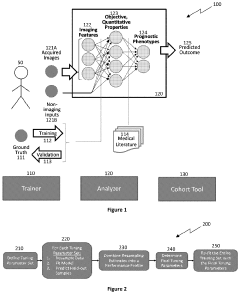
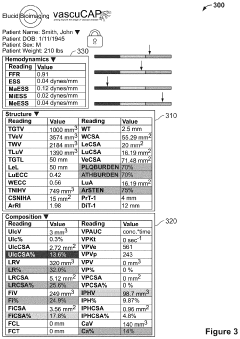
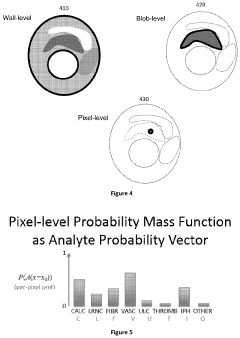
- A hierarchical analytics framework that combines computerized image analysis and data fusion algorithms with clinical chemistry and blood biomarker data to provide a multi-factorial panel for distinguishing between disease subtypes, using convolutional neural networks for phenotyping and risk stratification, and incorporating enriched datasets for improved accuracy and objectivity.
Regulatory Framework for Quantum Computing in Healthcare
The regulatory framework for quantum computing in healthcare is a complex and evolving landscape that requires careful consideration of existing healthcare regulations, data protection laws, and emerging quantum-specific guidelines. As quantum computing technologies advance and their potential applications in healthcare analytics become more apparent, regulatory bodies are grappling with the need to balance innovation with patient safety and data security.
Currently, there is no comprehensive regulatory framework specifically designed for quantum computing in healthcare. However, existing regulations such as the Health Insurance Portability and Accountability Act (HIPAA) in the United States and the General Data Protection Regulation (GDPR) in the European Union provide a foundation for data protection and privacy in healthcare settings. These regulations will likely need to be adapted or expanded to address the unique challenges posed by quantum computing.
One of the primary concerns in developing a regulatory framework for quantum computing in healthcare is ensuring the security and integrity of sensitive medical data. Quantum computers have the potential to break current encryption methods, necessitating the development of quantum-resistant cryptographic algorithms. Regulatory bodies are working with industry experts to establish standards for post-quantum cryptography to protect healthcare data in the quantum era.
Another critical aspect of the regulatory framework is addressing the ethical implications of quantum computing in healthcare analytics. As quantum computers enable more sophisticated analysis of large-scale genomic and clinical data, there are concerns about privacy, consent, and the potential for discrimination based on genetic information. Regulators are exploring ways to balance the benefits of advanced analytics with the need to protect individual rights and prevent misuse of sensitive information.
The regulatory landscape is also being shaped by international collaboration and standardization efforts. Organizations such as the International Organization for Standardization (ISO) and the Institute of Electrical and Electronics Engineers (IEEE) are working on developing standards for quantum computing technologies, including their applications in healthcare. These standards will likely inform future regulatory frameworks and help ensure interoperability and consistency across different healthcare systems and jurisdictions.
As quantum computing in healthcare analytics moves closer to practical implementation, regulatory bodies are also considering the need for specialized approval processes and certification requirements. This may include the development of guidelines for validating quantum algorithms used in medical diagnosis or treatment planning, as well as establishing protocols for assessing the reliability and reproducibility of quantum-enhanced analytics solutions.
Currently, there is no comprehensive regulatory framework specifically designed for quantum computing in healthcare. However, existing regulations such as the Health Insurance Portability and Accountability Act (HIPAA) in the United States and the General Data Protection Regulation (GDPR) in the European Union provide a foundation for data protection and privacy in healthcare settings. These regulations will likely need to be adapted or expanded to address the unique challenges posed by quantum computing.
One of the primary concerns in developing a regulatory framework for quantum computing in healthcare is ensuring the security and integrity of sensitive medical data. Quantum computers have the potential to break current encryption methods, necessitating the development of quantum-resistant cryptographic algorithms. Regulatory bodies are working with industry experts to establish standards for post-quantum cryptography to protect healthcare data in the quantum era.
Another critical aspect of the regulatory framework is addressing the ethical implications of quantum computing in healthcare analytics. As quantum computers enable more sophisticated analysis of large-scale genomic and clinical data, there are concerns about privacy, consent, and the potential for discrimination based on genetic information. Regulators are exploring ways to balance the benefits of advanced analytics with the need to protect individual rights and prevent misuse of sensitive information.
The regulatory landscape is also being shaped by international collaboration and standardization efforts. Organizations such as the International Organization for Standardization (ISO) and the Institute of Electrical and Electronics Engineers (IEEE) are working on developing standards for quantum computing technologies, including their applications in healthcare. These standards will likely inform future regulatory frameworks and help ensure interoperability and consistency across different healthcare systems and jurisdictions.
As quantum computing in healthcare analytics moves closer to practical implementation, regulatory bodies are also considering the need for specialized approval processes and certification requirements. This may include the development of guidelines for validating quantum algorithms used in medical diagnosis or treatment planning, as well as establishing protocols for assessing the reliability and reproducibility of quantum-enhanced analytics solutions.
Ethical Implications of Quantum-Enhanced Healthcare Analytics
The integration of quantum computing in healthcare analytics raises significant ethical considerations that must be carefully addressed. As quantum-enhanced systems process vast amounts of sensitive medical data at unprecedented speeds, concerns about privacy and data security become paramount. The potential for quantum computers to break current encryption methods poses a serious threat to patient confidentiality, necessitating the development of quantum-resistant cryptographic protocols.
Furthermore, the enhanced predictive capabilities of quantum-powered analytics may lead to ethical dilemmas in healthcare decision-making. The ability to forecast health outcomes with greater accuracy could influence treatment decisions, resource allocation, and insurance policies. This raises questions about fairness, discrimination, and the potential for algorithmic bias in healthcare delivery.
The rapid advancement of quantum computing in healthcare analytics also brings forth issues of equity and access. As quantum technologies become more prevalent, there is a risk of exacerbating existing healthcare disparities. Institutions with access to quantum resources may gain significant advantages in research and treatment capabilities, potentially widening the gap between well-funded and under-resourced healthcare providers.
Another ethical concern is the potential for quantum-enhanced analytics to impact patient autonomy and informed consent. The complexity of quantum algorithms and their decision-making processes may make it challenging for patients to fully understand how their data is being used and how treatment recommendations are generated. This opacity could undermine the principle of informed consent in medical practice.
The use of quantum computing in genomic analysis and personalized medicine also raises ethical questions about genetic privacy and the implications of predictive health information. The ability to process and analyze genetic data at an unprecedented scale could lead to new insights into disease predisposition and treatment efficacy. However, it also increases the risk of genetic discrimination and raises concerns about the ownership and control of genetic information.
Lastly, the potential for quantum computing to accelerate drug discovery and development processes brings ethical considerations regarding clinical trials and patient safety. While expedited drug development could bring life-saving treatments to market faster, it also raises questions about the adequacy of traditional safety protocols and the ethical implications of accelerated approval processes.
As quantum computing continues to revolutionize healthcare analytics, it is crucial to establish robust ethical frameworks and governance structures. These should address data protection, algorithmic transparency, equitable access, and the responsible use of predictive health information. Ongoing dialogue between technologists, healthcare professionals, ethicists, and policymakers will be essential in navigating the complex ethical landscape of quantum-enhanced healthcare analytics.
Furthermore, the enhanced predictive capabilities of quantum-powered analytics may lead to ethical dilemmas in healthcare decision-making. The ability to forecast health outcomes with greater accuracy could influence treatment decisions, resource allocation, and insurance policies. This raises questions about fairness, discrimination, and the potential for algorithmic bias in healthcare delivery.
The rapid advancement of quantum computing in healthcare analytics also brings forth issues of equity and access. As quantum technologies become more prevalent, there is a risk of exacerbating existing healthcare disparities. Institutions with access to quantum resources may gain significant advantages in research and treatment capabilities, potentially widening the gap between well-funded and under-resourced healthcare providers.
Another ethical concern is the potential for quantum-enhanced analytics to impact patient autonomy and informed consent. The complexity of quantum algorithms and their decision-making processes may make it challenging for patients to fully understand how their data is being used and how treatment recommendations are generated. This opacity could undermine the principle of informed consent in medical practice.
The use of quantum computing in genomic analysis and personalized medicine also raises ethical questions about genetic privacy and the implications of predictive health information. The ability to process and analyze genetic data at an unprecedented scale could lead to new insights into disease predisposition and treatment efficacy. However, it also increases the risk of genetic discrimination and raises concerns about the ownership and control of genetic information.
Lastly, the potential for quantum computing to accelerate drug discovery and development processes brings ethical considerations regarding clinical trials and patient safety. While expedited drug development could bring life-saving treatments to market faster, it also raises questions about the adequacy of traditional safety protocols and the ethical implications of accelerated approval processes.
As quantum computing continues to revolutionize healthcare analytics, it is crucial to establish robust ethical frameworks and governance structures. These should address data protection, algorithmic transparency, equitable access, and the responsible use of predictive health information. Ongoing dialogue between technologists, healthcare professionals, ethicists, and policymakers will be essential in navigating the complex ethical landscape of quantum-enhanced healthcare analytics.
Unlock deeper insights with Patsnap Eureka Quick Research — get a full tech report to explore trends and direct your research. Try now!
Generate Your Research Report Instantly with AI Agent
Supercharge your innovation with Patsnap Eureka AI Agent Platform!