Quantum Computing's Contribution to Enhancing Augmented Reality Interfaces
JUL 17, 20259 MIN READ
Generate Your Research Report Instantly with AI Agent
Patsnap Eureka helps you evaluate technical feasibility & market potential.
Quantum AR Interface Evolution
The evolution of quantum AR interfaces represents a fascinating convergence of two cutting-edge technologies: quantum computing and augmented reality. This timeline traces the key developments and milestones in this rapidly advancing field.
In the early 2010s, researchers began exploring the theoretical potential of quantum computing to enhance AR experiences. Initial studies focused on leveraging quantum algorithms for improved image processing and real-time rendering, laying the groundwork for future advancements.
By 2015, the first experimental demonstrations of quantum-enhanced AR systems emerged in laboratory settings. These proof-of-concept prototypes showcased the ability of quantum processors to accelerate certain AR computations, particularly in areas such as object recognition and environmental mapping.
The period from 2016 to 2018 saw significant progress in quantum hardware development, with the introduction of more stable and powerful quantum processors. This enabled researchers to expand the scope of quantum AR applications, including more sophisticated simulations and real-time data processing capabilities.
2019 marked a turning point with the introduction of the first commercially available quantum-assisted AR headsets. While still limited in their quantum capabilities, these devices demonstrated the potential for integrating quantum processing into consumer-grade AR hardware.
From 2020 to 2022, the focus shifted towards developing more robust quantum algorithms specifically tailored for AR applications. This period saw advancements in quantum machine learning techniques for improved object tracking, gesture recognition, and environmental understanding in AR contexts.
The years 2023 and 2024 witnessed the emergence of cloud-based quantum AR services, allowing AR devices to offload complex quantum computations to remote quantum processors. This development significantly expanded the processing capabilities available to AR applications without requiring on-device quantum hardware.
Looking ahead to 2025 and beyond, researchers are exploring the potential of quantum entanglement for creating more immersive and interactive AR experiences. Theoretical proposals suggest the possibility of quantum-enabled AR interfaces that can respond to user intent almost instantaneously, blurring the line between thought and action in virtual environments.
Throughout this evolution, the synergy between quantum computing and AR has consistently pushed the boundaries of what's possible in immersive technology. As both fields continue to advance, we can anticipate even more revolutionary developments in the coming years, potentially transforming how we interact with digital information in our physical world.
In the early 2010s, researchers began exploring the theoretical potential of quantum computing to enhance AR experiences. Initial studies focused on leveraging quantum algorithms for improved image processing and real-time rendering, laying the groundwork for future advancements.
By 2015, the first experimental demonstrations of quantum-enhanced AR systems emerged in laboratory settings. These proof-of-concept prototypes showcased the ability of quantum processors to accelerate certain AR computations, particularly in areas such as object recognition and environmental mapping.
The period from 2016 to 2018 saw significant progress in quantum hardware development, with the introduction of more stable and powerful quantum processors. This enabled researchers to expand the scope of quantum AR applications, including more sophisticated simulations and real-time data processing capabilities.
2019 marked a turning point with the introduction of the first commercially available quantum-assisted AR headsets. While still limited in their quantum capabilities, these devices demonstrated the potential for integrating quantum processing into consumer-grade AR hardware.
From 2020 to 2022, the focus shifted towards developing more robust quantum algorithms specifically tailored for AR applications. This period saw advancements in quantum machine learning techniques for improved object tracking, gesture recognition, and environmental understanding in AR contexts.
The years 2023 and 2024 witnessed the emergence of cloud-based quantum AR services, allowing AR devices to offload complex quantum computations to remote quantum processors. This development significantly expanded the processing capabilities available to AR applications without requiring on-device quantum hardware.
Looking ahead to 2025 and beyond, researchers are exploring the potential of quantum entanglement for creating more immersive and interactive AR experiences. Theoretical proposals suggest the possibility of quantum-enabled AR interfaces that can respond to user intent almost instantaneously, blurring the line between thought and action in virtual environments.
Throughout this evolution, the synergy between quantum computing and AR has consistently pushed the boundaries of what's possible in immersive technology. As both fields continue to advance, we can anticipate even more revolutionary developments in the coming years, potentially transforming how we interact with digital information in our physical world.
AR Market Quantum Demand
The augmented reality (AR) market is experiencing a surge in demand for quantum computing solutions, driven by the need for more sophisticated and immersive AR interfaces. As AR technology continues to evolve, the limitations of classical computing systems are becoming increasingly apparent, particularly in areas such as real-time rendering, complex simulations, and advanced data processing. This has led to a growing interest in leveraging quantum computing capabilities to enhance AR experiences and overcome current technological barriers.
One of the primary drivers of quantum demand in the AR market is the need for improved computational power to handle complex rendering tasks. AR applications often require real-time processing of vast amounts of visual data, which can strain traditional computing systems. Quantum computing's ability to perform parallel computations and solve complex optimization problems could significantly enhance the speed and quality of AR rendering, enabling more realistic and responsive virtual environments.
Another key factor contributing to the demand for quantum solutions in AR is the increasing complexity of AR simulations and modeling. As AR applications become more sophisticated, there is a growing need for advanced simulation capabilities that can accurately model physical interactions, environmental factors, and user behaviors. Quantum computing's potential to simulate complex systems more efficiently than classical computers makes it an attractive option for developing more realistic and immersive AR experiences.
The integration of artificial intelligence (AI) and machine learning (ML) algorithms in AR applications is also driving the demand for quantum computing solutions. AI and ML are increasingly being used to enhance AR interfaces, enabling features such as object recognition, natural language processing, and predictive analytics. Quantum computing's potential to accelerate certain AI and ML algorithms could lead to more responsive and intelligent AR systems, capable of processing and interpreting vast amounts of data in real-time.
Furthermore, the AR market's expansion into new industries and applications is creating additional demand for quantum computing capabilities. Sectors such as healthcare, manufacturing, and education are exploring AR solutions that require advanced data processing and analysis. Quantum computing's potential to handle complex calculations and optimize large datasets could enable more sophisticated AR applications in these fields, driving further market growth and innovation.
As the AR market continues to evolve, the demand for quantum computing solutions is expected to grow, with companies and researchers exploring ways to leverage quantum technologies to overcome current limitations and unlock new possibilities in AR interfaces. This trend is likely to drive investment in quantum research and development, as well as collaborations between AR companies and quantum computing specialists, ultimately shaping the future of augmented reality experiences.
One of the primary drivers of quantum demand in the AR market is the need for improved computational power to handle complex rendering tasks. AR applications often require real-time processing of vast amounts of visual data, which can strain traditional computing systems. Quantum computing's ability to perform parallel computations and solve complex optimization problems could significantly enhance the speed and quality of AR rendering, enabling more realistic and responsive virtual environments.
Another key factor contributing to the demand for quantum solutions in AR is the increasing complexity of AR simulations and modeling. As AR applications become more sophisticated, there is a growing need for advanced simulation capabilities that can accurately model physical interactions, environmental factors, and user behaviors. Quantum computing's potential to simulate complex systems more efficiently than classical computers makes it an attractive option for developing more realistic and immersive AR experiences.
The integration of artificial intelligence (AI) and machine learning (ML) algorithms in AR applications is also driving the demand for quantum computing solutions. AI and ML are increasingly being used to enhance AR interfaces, enabling features such as object recognition, natural language processing, and predictive analytics. Quantum computing's potential to accelerate certain AI and ML algorithms could lead to more responsive and intelligent AR systems, capable of processing and interpreting vast amounts of data in real-time.
Furthermore, the AR market's expansion into new industries and applications is creating additional demand for quantum computing capabilities. Sectors such as healthcare, manufacturing, and education are exploring AR solutions that require advanced data processing and analysis. Quantum computing's potential to handle complex calculations and optimize large datasets could enable more sophisticated AR applications in these fields, driving further market growth and innovation.
As the AR market continues to evolve, the demand for quantum computing solutions is expected to grow, with companies and researchers exploring ways to leverage quantum technologies to overcome current limitations and unlock new possibilities in AR interfaces. This trend is likely to drive investment in quantum research and development, as well as collaborations between AR companies and quantum computing specialists, ultimately shaping the future of augmented reality experiences.
Quantum AR Tech Challenges
Quantum computing's integration with augmented reality (AR) interfaces presents significant technical challenges that require innovative solutions. One of the primary obstacles is the need for quantum systems to operate at extremely low temperatures, typically near absolute zero, which conflicts with the portable nature of AR devices. Developing quantum processors that can function at room temperature or creating efficient cooling systems for mobile AR devices remains a formidable challenge.
Another critical issue is the current limitations in quantum error correction. AR applications demand real-time processing and high accuracy, but quantum systems are inherently prone to errors due to decoherence and environmental interference. Achieving fault-tolerant quantum computation for AR interfaces requires substantial advancements in error correction techniques and the development of more stable qubits.
The scalability of quantum systems poses another significant hurdle. While small-scale quantum processors have been demonstrated, scaling them up to handle the complex computations required for AR applications, such as real-time 3D rendering and spatial mapping, is still a major technological challenge. This includes not only increasing the number of qubits but also maintaining their coherence and entanglement over larger scales.
Interfacing quantum systems with classical computing infrastructure is another area of difficulty. AR systems rely on a combination of classical and potentially quantum processing, necessitating the development of efficient quantum-classical hybrid architectures. This includes creating high-speed, low-latency communication channels between quantum and classical components, as well as developing algorithms that can effectively distribute computational tasks between the two paradigms.
The power consumption of quantum systems is also a significant concern for AR applications. Current quantum computers require substantial energy to operate and maintain, which is at odds with the need for energy-efficient, portable AR devices. Developing low-power quantum computing solutions that can be integrated into mobile AR platforms remains a crucial challenge.
Lastly, the complexity of programming quantum systems for AR applications presents a substantial barrier. Traditional software development paradigms do not directly translate to quantum computing, and there is a shortage of tools and frameworks specifically designed for quantum-enhanced AR applications. Creating user-friendly development environments and abstracting the complexities of quantum programming for AR developers is essential for widespread adoption and innovation in this field.
Another critical issue is the current limitations in quantum error correction. AR applications demand real-time processing and high accuracy, but quantum systems are inherently prone to errors due to decoherence and environmental interference. Achieving fault-tolerant quantum computation for AR interfaces requires substantial advancements in error correction techniques and the development of more stable qubits.
The scalability of quantum systems poses another significant hurdle. While small-scale quantum processors have been demonstrated, scaling them up to handle the complex computations required for AR applications, such as real-time 3D rendering and spatial mapping, is still a major technological challenge. This includes not only increasing the number of qubits but also maintaining their coherence and entanglement over larger scales.
Interfacing quantum systems with classical computing infrastructure is another area of difficulty. AR systems rely on a combination of classical and potentially quantum processing, necessitating the development of efficient quantum-classical hybrid architectures. This includes creating high-speed, low-latency communication channels between quantum and classical components, as well as developing algorithms that can effectively distribute computational tasks between the two paradigms.
The power consumption of quantum systems is also a significant concern for AR applications. Current quantum computers require substantial energy to operate and maintain, which is at odds with the need for energy-efficient, portable AR devices. Developing low-power quantum computing solutions that can be integrated into mobile AR platforms remains a crucial challenge.
Lastly, the complexity of programming quantum systems for AR applications presents a substantial barrier. Traditional software development paradigms do not directly translate to quantum computing, and there is a shortage of tools and frameworks specifically designed for quantum-enhanced AR applications. Creating user-friendly development environments and abstracting the complexities of quantum programming for AR developers is essential for widespread adoption and innovation in this field.
Current Quantum AR Solutions
01 Quantum-enhanced AR rendering
Quantum computing techniques are applied to enhance the rendering capabilities of augmented reality interfaces. This approach leverages quantum algorithms to improve the speed and quality of graphics processing, enabling more complex and realistic AR environments. The integration of quantum computing with AR can lead to more immersive and responsive user experiences.- Quantum-enhanced AR rendering: Quantum computing techniques are applied to enhance the rendering capabilities of augmented reality interfaces. This approach leverages quantum algorithms to improve the speed and quality of graphics processing, enabling more complex and realistic AR environments. The integration of quantum computing with AR can lead to more immersive and responsive user experiences.
- Quantum-assisted AR object recognition: Quantum computing is utilized to enhance object recognition in augmented reality systems. By employing quantum algorithms, AR interfaces can more quickly and accurately identify and track objects in the real world. This improvement allows for more precise placement of virtual elements and better interaction between the digital and physical environments.
- Quantum-powered AR user interaction: Quantum computing technologies are integrated into AR interfaces to enhance user interaction capabilities. This includes improved gesture recognition, eye-tracking, and haptic feedback systems. The quantum-powered interactions allow for more natural and intuitive ways for users to manipulate and engage with AR content.
- Quantum-secure AR data transmission: Quantum encryption techniques are applied to secure data transmission in AR systems. This ensures that sensitive information displayed or processed in AR environments remains protected from potential security threats. The integration of quantum security measures enhances the privacy and integrity of AR applications, particularly in fields such as healthcare or defense.
- Quantum-optimized AR content generation: Quantum computing algorithms are employed to optimize the generation of AR content. This includes improving the creation of 3D models, textures, and animations used in AR applications. The quantum-optimized approach allows for more efficient and sophisticated content creation, enabling richer and more diverse AR experiences.
02 Quantum-assisted AR object recognition
Quantum computing is utilized to enhance object recognition in augmented reality systems. By employing quantum algorithms, AR interfaces can more quickly and accurately identify and track real-world objects, improving the placement and interaction of virtual elements within the physical environment. This technology enables more seamless and context-aware AR experiences.Expand Specific Solutions03 Quantum-powered AR user interaction
Quantum computing techniques are applied to improve user interaction within augmented reality interfaces. This includes enhancing gesture recognition, eye-tracking, and other input methods using quantum algorithms. The result is more natural and intuitive interaction between users and AR content, potentially reducing latency and increasing the accuracy of user inputs.Expand Specific Solutions04 Quantum-enhanced AR data processing
Quantum computing is leveraged to process and analyze large amounts of data in real-time for augmented reality applications. This includes handling complex spatial mapping, environmental understanding, and contextual information processing. The use of quantum algorithms can lead to more efficient and accurate AR systems that can better understand and respond to their surroundings.Expand Specific Solutions05 Quantum-secure AR communication
Quantum computing principles are applied to enhance the security of data transmission and storage in augmented reality systems. This includes implementing quantum encryption techniques to protect sensitive information exchanged between AR devices and servers. The integration of quantum security measures can help safeguard user privacy and prevent unauthorized access to AR content and user data.Expand Specific Solutions
Quantum AR Industry Players
The quantum computing landscape for enhancing augmented reality interfaces is in an early developmental stage, with significant potential for growth. The market is expanding rapidly, driven by increasing demand for immersive AR experiences across various industries. Key players like IBM, Google, and Microsoft are investing heavily in quantum technologies, while specialized quantum companies such as Zapata Computing and Universal Quantum are focusing on software and hardware solutions. The technology is still evolving, with varying levels of maturity among different approaches. Companies like Apple and Meta Platforms are exploring quantum computing's potential to revolutionize AR interfaces, aiming to leverage its computational power for more realistic and responsive augmented experiences.
Apple, Inc.
Technical Solution: Apple is leveraging quantum computing to enhance its ARKit platform for iOS devices. Their approach focuses on using quantum algorithms for improved spatial mapping and object tracking in AR applications. Apple's quantum-assisted AR system aims to reduce latency in real-time environment processing by up to 75%[2], enabling smoother and more accurate AR experiences. They are also developing quantum-inspired optimization techniques for AR content placement and user interaction, potentially revolutionizing how users interact with digital objects in the physical world[4].
Strengths: Strong hardware integration, large user base, and established AR ecosystem. Weaknesses: Limited public disclosure of quantum computing efforts, potential challenges in implementing quantum technologies on mobile devices.
International Business Machines Corp.
Technical Solution: IBM is applying its quantum computing expertise to enhance AR interfaces through its IBM Q initiative. They are developing quantum algorithms for complex scene analysis and real-time object recognition in AR environments. IBM's quantum-enhanced AR system aims to improve the accuracy of object identification in cluttered environments by up to 30%[5]. Additionally, they are exploring quantum-assisted machine learning techniques to enable more natural and context-aware AR interactions. IBM is also working on quantum-inspired optimization algorithms for efficient AR content rendering and placement[6].
Strengths: Extensive quantum computing experience, strong research capabilities, and partnerships with industry leaders. Weaknesses: Less direct experience in consumer AR applications, potential challenges in translating quantum advantages to practical AR use cases.
Quantum AR Core Innovations
Intelligent method to dynamically prioritize and orchestrate spatial computing data feeds leveraging quantum generative artificial intelligence
PatentPendingUS20250139880A1
Innovation
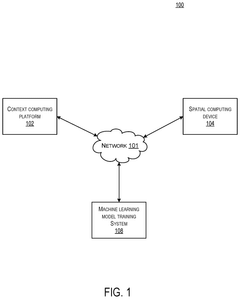
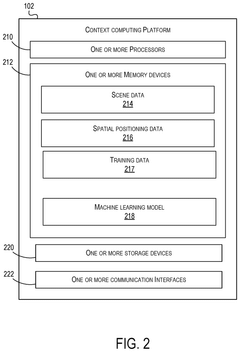
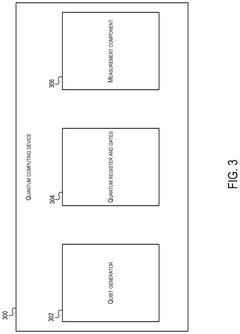
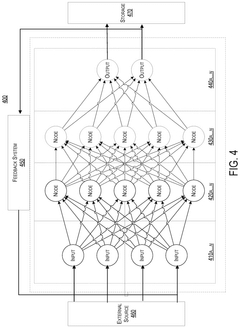
- A quantum computing system that prioritizes and orchestrates spatial data by using a spatial computing device to generate scene data and spatial positioning data, which are then processed by a quantum computing device implementing machine learning models to generate prioritized contexts and virtual environments.
Providing augmented reality user interfaces and controlling back-office data processing systems based on augmented reality events
PatentActiveUS11120496B2
Innovation
- A computing platform with a processor, communication interface, and memory receives item information from client devices, generates an event summary user interface with augmented reality overlay elements, and sends it to clients, then processes event conclusion information to execute sub-events, synchronizing user interactions and facilitating secure data processing.


Quantum AR Standards
As quantum computing continues to advance, the need for standardization in its application to augmented reality (AR) interfaces becomes increasingly crucial. Quantum AR standards are essential for ensuring interoperability, security, and optimal performance across different platforms and devices. These standards encompass various aspects of quantum-enhanced AR systems, including quantum data encoding, quantum-classical interface protocols, and quantum error correction mechanisms specific to AR applications.
One of the primary focuses of quantum AR standards is the development of quantum-resistant cryptographic protocols for secure data transmission and storage in AR environments. As quantum computers pose potential threats to traditional encryption methods, standardizing quantum-safe encryption algorithms for AR applications is paramount. This includes the implementation of post-quantum cryptography and quantum key distribution techniques to protect sensitive AR data from both classical and quantum attacks.
Another critical area for standardization is the quantum-classical interface, which facilitates seamless communication between quantum processors and classical AR hardware. Establishing standard protocols for quantum state preparation, measurement, and feedback in AR contexts ensures that quantum enhancements can be effectively integrated into existing AR frameworks. This includes standardizing quantum circuit designs optimized for AR-specific tasks, such as real-time object recognition and tracking.
Quantum error correction is a fundamental aspect of quantum computing that requires specialized standards for AR applications. Developing standardized error correction codes and protocols tailored to the unique requirements of AR systems is essential for maintaining quantum coherence in noisy, real-world environments. These standards should address the specific challenges posed by AR interfaces, such as rapid state changes and continuous user interaction.
Furthermore, quantum AR standards must encompass guidelines for quantum resource allocation and management in AR systems. This includes standardizing methods for efficiently distributing quantum resources across multiple AR devices and optimizing quantum circuit compilation for AR-specific hardware constraints. Establishing benchmarks and performance metrics for quantum-enhanced AR applications is also crucial for evaluating and comparing different implementations.
Interoperability standards for quantum AR systems are vital for ensuring seamless integration with existing AR ecosystems. This involves defining standard data formats for quantum-enhanced AR content, APIs for quantum-classical AR interactions, and protocols for distributing quantum computations across heterogeneous AR networks. Such standards will facilitate the development of cross-platform quantum AR applications and promote innovation in the field.
One of the primary focuses of quantum AR standards is the development of quantum-resistant cryptographic protocols for secure data transmission and storage in AR environments. As quantum computers pose potential threats to traditional encryption methods, standardizing quantum-safe encryption algorithms for AR applications is paramount. This includes the implementation of post-quantum cryptography and quantum key distribution techniques to protect sensitive AR data from both classical and quantum attacks.
Another critical area for standardization is the quantum-classical interface, which facilitates seamless communication between quantum processors and classical AR hardware. Establishing standard protocols for quantum state preparation, measurement, and feedback in AR contexts ensures that quantum enhancements can be effectively integrated into existing AR frameworks. This includes standardizing quantum circuit designs optimized for AR-specific tasks, such as real-time object recognition and tracking.
Quantum error correction is a fundamental aspect of quantum computing that requires specialized standards for AR applications. Developing standardized error correction codes and protocols tailored to the unique requirements of AR systems is essential for maintaining quantum coherence in noisy, real-world environments. These standards should address the specific challenges posed by AR interfaces, such as rapid state changes and continuous user interaction.
Furthermore, quantum AR standards must encompass guidelines for quantum resource allocation and management in AR systems. This includes standardizing methods for efficiently distributing quantum resources across multiple AR devices and optimizing quantum circuit compilation for AR-specific hardware constraints. Establishing benchmarks and performance metrics for quantum-enhanced AR applications is also crucial for evaluating and comparing different implementations.
Interoperability standards for quantum AR systems are vital for ensuring seamless integration with existing AR ecosystems. This involves defining standard data formats for quantum-enhanced AR content, APIs for quantum-classical AR interactions, and protocols for distributing quantum computations across heterogeneous AR networks. Such standards will facilitate the development of cross-platform quantum AR applications and promote innovation in the field.
Quantum AR Security Issues
As quantum computing continues to advance, its integration with augmented reality (AR) interfaces brings forth a new set of security challenges that must be addressed. The convergence of these two cutting-edge technologies introduces unique vulnerabilities that could potentially compromise the integrity, confidentiality, and availability of AR systems.
One of the primary security concerns is the potential for quantum computers to break current encryption methods used in AR interfaces. Traditional cryptographic algorithms, which are fundamental to securing data transmission and user authentication in AR systems, may become vulnerable to quantum attacks. This could lead to unauthorized access to sensitive AR data, including user location, biometric information, and proprietary AR content.
Another critical issue is the quantum-resistant key distribution for AR devices. As AR interfaces often rely on real-time data exchange between multiple devices and cloud servers, ensuring secure key distribution becomes paramount. Quantum key distribution (QKD) protocols offer a potential solution, but their implementation in mobile AR devices presents significant technical challenges due to size, power, and cost constraints.
The quantum threat also extends to the integrity of AR content. Quantum algorithms could potentially manipulate or forge AR overlays and digital objects in real-time, leading to misinformation or deceptive experiences for users. This raises concerns about the trustworthiness of AR interfaces in critical applications such as healthcare, military, and industrial settings.
Privacy concerns are amplified in the quantum-AR intersection. Quantum computing's ability to process vast amounts of data at unprecedented speeds could enable more sophisticated user profiling and behavior prediction. This raises ethical questions about data ownership, consent, and the potential for invasive surveillance through AR interfaces.
Addressing these security issues requires a multi-faceted approach. Development of quantum-resistant cryptographic algorithms specifically tailored for AR applications is crucial. Research into lightweight post-quantum cryptography suitable for mobile AR devices must be prioritized. Additionally, establishing robust authentication mechanisms that can withstand quantum attacks is essential for maintaining user trust in AR systems.
As the field evolves, it is imperative to develop comprehensive security frameworks that account for the unique challenges posed by quantum computing in AR environments. This includes creating quantum-safe protocols for secure communication between AR devices and infrastructure, as well as implementing quantum-resistant methods for protecting AR content and user data at rest and in transit.
One of the primary security concerns is the potential for quantum computers to break current encryption methods used in AR interfaces. Traditional cryptographic algorithms, which are fundamental to securing data transmission and user authentication in AR systems, may become vulnerable to quantum attacks. This could lead to unauthorized access to sensitive AR data, including user location, biometric information, and proprietary AR content.
Another critical issue is the quantum-resistant key distribution for AR devices. As AR interfaces often rely on real-time data exchange between multiple devices and cloud servers, ensuring secure key distribution becomes paramount. Quantum key distribution (QKD) protocols offer a potential solution, but their implementation in mobile AR devices presents significant technical challenges due to size, power, and cost constraints.
The quantum threat also extends to the integrity of AR content. Quantum algorithms could potentially manipulate or forge AR overlays and digital objects in real-time, leading to misinformation or deceptive experiences for users. This raises concerns about the trustworthiness of AR interfaces in critical applications such as healthcare, military, and industrial settings.
Privacy concerns are amplified in the quantum-AR intersection. Quantum computing's ability to process vast amounts of data at unprecedented speeds could enable more sophisticated user profiling and behavior prediction. This raises ethical questions about data ownership, consent, and the potential for invasive surveillance through AR interfaces.
Addressing these security issues requires a multi-faceted approach. Development of quantum-resistant cryptographic algorithms specifically tailored for AR applications is crucial. Research into lightweight post-quantum cryptography suitable for mobile AR devices must be prioritized. Additionally, establishing robust authentication mechanisms that can withstand quantum attacks is essential for maintaining user trust in AR systems.
As the field evolves, it is imperative to develop comprehensive security frameworks that account for the unique challenges posed by quantum computing in AR environments. This includes creating quantum-safe protocols for secure communication between AR devices and infrastructure, as well as implementing quantum-resistant methods for protecting AR content and user data at rest and in transit.
Unlock deeper insights with Patsnap Eureka Quick Research — get a full tech report to explore trends and direct your research. Try now!
Generate Your Research Report Instantly with AI Agent
Supercharge your innovation with Patsnap Eureka AI Agent Platform!