

Quantum Computing's Effect on Social Impact Analyses
JUL 17, 20259 MIN READ
Generate Your Research Report Instantly with AI Agent
PatSnap Eureka helps you evaluate technical feasibility & market potential.
Quantum Computing and Social Impact: Background and Objectives
Quantum computing represents a paradigm shift in computational capabilities, leveraging the principles of quantum mechanics to perform complex calculations at unprecedented speeds. This revolutionary technology has the potential to transform various fields, including social impact analyses. The evolution of quantum computing can be traced back to the early 1980s when Richard Feynman proposed the idea of using quantum systems for computation. Since then, significant advancements have been made in both theoretical foundations and practical implementations.
The technological trajectory of quantum computing has been marked by key milestones, such as the development of quantum algorithms like Shor's algorithm for factoring large numbers and Grover's algorithm for database search. These breakthroughs have demonstrated the potential of quantum computers to solve certain problems exponentially faster than classical computers. As the field progresses, we are witnessing a transition from proof-of-concept experiments to the creation of increasingly powerful and stable quantum systems.
In the context of social impact analyses, quantum computing offers promising applications that could revolutionize how we understand and address complex societal challenges. The ability to process vast amounts of data and model intricate systems with numerous variables aligns well with the multifaceted nature of social issues. This technology could enable more accurate predictions of social trends, optimize resource allocation in public services, and enhance decision-making processes in policy formulation.
The primary objective of exploring quantum computing's effect on social impact analyses is to harness its computational power to gain deeper insights into social phenomena and develop more effective interventions. By leveraging quantum algorithms, researchers and policymakers aim to tackle previously intractable problems in areas such as economic modeling, climate change mitigation, healthcare optimization, and urban planning. The goal is to move beyond the limitations of classical computing and unlock new possibilities for understanding and addressing societal challenges.
As we delve into this emerging field, it is crucial to consider both the technological advancements and the ethical implications of applying quantum computing to social impact analyses. The potential for more precise and comprehensive assessments of social issues must be balanced with concerns about data privacy, algorithmic bias, and the equitable distribution of benefits derived from this technology. Addressing these challenges will be essential in realizing the full potential of quantum computing in the realm of social impact.
The technological trajectory of quantum computing has been marked by key milestones, such as the development of quantum algorithms like Shor's algorithm for factoring large numbers and Grover's algorithm for database search. These breakthroughs have demonstrated the potential of quantum computers to solve certain problems exponentially faster than classical computers. As the field progresses, we are witnessing a transition from proof-of-concept experiments to the creation of increasingly powerful and stable quantum systems.
In the context of social impact analyses, quantum computing offers promising applications that could revolutionize how we understand and address complex societal challenges. The ability to process vast amounts of data and model intricate systems with numerous variables aligns well with the multifaceted nature of social issues. This technology could enable more accurate predictions of social trends, optimize resource allocation in public services, and enhance decision-making processes in policy formulation.
The primary objective of exploring quantum computing's effect on social impact analyses is to harness its computational power to gain deeper insights into social phenomena and develop more effective interventions. By leveraging quantum algorithms, researchers and policymakers aim to tackle previously intractable problems in areas such as economic modeling, climate change mitigation, healthcare optimization, and urban planning. The goal is to move beyond the limitations of classical computing and unlock new possibilities for understanding and addressing societal challenges.
As we delve into this emerging field, it is crucial to consider both the technological advancements and the ethical implications of applying quantum computing to social impact analyses. The potential for more precise and comprehensive assessments of social issues must be balanced with concerns about data privacy, algorithmic bias, and the equitable distribution of benefits derived from this technology. Addressing these challenges will be essential in realizing the full potential of quantum computing in the realm of social impact.
Market Demand for Quantum-Enhanced Social Analysis
The market demand for quantum-enhanced social impact analysis is rapidly growing as organizations and governments recognize the potential of quantum computing to revolutionize complex societal problem-solving. Traditional social impact analyses often struggle with the sheer volume and complexity of data involved in understanding societal issues. Quantum computing offers a promising solution to these challenges by providing unprecedented computational power and the ability to process vast amounts of data simultaneously.
One of the primary drivers of market demand is the increasing need for more accurate and comprehensive social impact assessments. As societies become more interconnected and complex, decision-makers require deeper insights into the potential consequences of policies, programs, and interventions. Quantum-enhanced social analysis can offer more nuanced and multifaceted evaluations, considering a broader range of variables and their interactions than classical computing methods.
The financial sector has shown particular interest in quantum-enhanced social impact analysis for ESG (Environmental, Social, and Governance) investing. As sustainable and socially responsible investing gains traction, there is a growing demand for more sophisticated tools to evaluate the social impact of investments. Quantum computing can potentially provide more accurate risk assessments and impact predictions, leading to better-informed investment decisions.
Government agencies and policymakers are another significant market segment driving demand for quantum-enhanced social analysis. The ability to simulate complex social systems and predict outcomes of various policy interventions with greater accuracy could revolutionize public policy development. This demand is further fueled by the increasing focus on evidence-based policymaking and the need to address complex societal challenges such as climate change, inequality, and public health crises.
The non-profit sector and international development organizations are also showing interest in quantum-enhanced social impact analysis. These organizations often deal with complex, interconnected social issues that traditional analytical methods struggle to fully capture. Quantum computing could provide more holistic assessments of program effectiveness and help optimize resource allocation for maximum social impact.
As awareness of quantum computing's potential in this field grows, we are seeing an emergence of specialized consulting firms and software companies developing quantum-enhanced social impact analysis tools. This burgeoning industry is indicative of the growing market demand and the recognition of the technology's transformative potential in social sciences and policy analysis.
However, it's important to note that the market is still in its early stages. Many potential users are in the exploratory phase, seeking to understand how quantum-enhanced social analysis can be integrated into their existing processes. This presents both challenges and opportunities for early adopters and technology providers in shaping the market and establishing best practices.
One of the primary drivers of market demand is the increasing need for more accurate and comprehensive social impact assessments. As societies become more interconnected and complex, decision-makers require deeper insights into the potential consequences of policies, programs, and interventions. Quantum-enhanced social analysis can offer more nuanced and multifaceted evaluations, considering a broader range of variables and their interactions than classical computing methods.
The financial sector has shown particular interest in quantum-enhanced social impact analysis for ESG (Environmental, Social, and Governance) investing. As sustainable and socially responsible investing gains traction, there is a growing demand for more sophisticated tools to evaluate the social impact of investments. Quantum computing can potentially provide more accurate risk assessments and impact predictions, leading to better-informed investment decisions.
Government agencies and policymakers are another significant market segment driving demand for quantum-enhanced social analysis. The ability to simulate complex social systems and predict outcomes of various policy interventions with greater accuracy could revolutionize public policy development. This demand is further fueled by the increasing focus on evidence-based policymaking and the need to address complex societal challenges such as climate change, inequality, and public health crises.
The non-profit sector and international development organizations are also showing interest in quantum-enhanced social impact analysis. These organizations often deal with complex, interconnected social issues that traditional analytical methods struggle to fully capture. Quantum computing could provide more holistic assessments of program effectiveness and help optimize resource allocation for maximum social impact.
As awareness of quantum computing's potential in this field grows, we are seeing an emergence of specialized consulting firms and software companies developing quantum-enhanced social impact analysis tools. This burgeoning industry is indicative of the growing market demand and the recognition of the technology's transformative potential in social sciences and policy analysis.
However, it's important to note that the market is still in its early stages. Many potential users are in the exploratory phase, seeking to understand how quantum-enhanced social analysis can be integrated into their existing processes. This presents both challenges and opportunities for early adopters and technology providers in shaping the market and establishing best practices.
Current State and Challenges in Quantum Social Computing
Quantum computing's impact on social impact analyses is still in its nascent stages, with significant potential yet to be fully realized. Currently, the field of quantum social computing is characterized by a mix of theoretical advancements and early-stage practical applications. Researchers are exploring how quantum algorithms and systems can enhance the processing and analysis of complex social data sets, potentially revolutionizing our understanding of social phenomena and decision-making processes.
One of the primary challenges in this domain is the limited availability of quantum hardware with sufficient qubits and coherence times to handle large-scale social data. Most existing quantum computers are still in the noisy intermediate-scale quantum (NISQ) era, which restricts their ability to process the vast amounts of data typically involved in social impact analyses. This hardware limitation has led to a focus on developing hybrid classical-quantum algorithms that can leverage the strengths of both computing paradigms.
Another significant challenge is the development of quantum algorithms specifically tailored for social science applications. While quantum algorithms for optimization and machine learning show promise, their adaptation to social impact analyses requires interdisciplinary collaboration between quantum physicists, computer scientists, and social scientists. This collaboration is crucial for identifying which social problems are most amenable to quantum approaches and how to formulate these problems in ways that can exploit quantum advantages.
Data preparation and encoding for quantum systems present additional hurdles. Social data is often unstructured, noisy, and high-dimensional, making it challenging to map onto quantum states effectively. Researchers are working on quantum feature maps and data encoding techniques that can preserve the relevant social information while being compatible with quantum processing.
Privacy and ethical considerations also pose significant challenges in quantum social computing. As quantum systems potentially offer more powerful data analysis capabilities, ensuring the protection of individual privacy and preventing misuse of sensitive social data become even more critical. Developing quantum-resistant encryption methods and establishing ethical guidelines for quantum-enhanced social analyses are ongoing areas of research and debate.
Despite these challenges, progress is being made. Quantum-inspired algorithms are already showing improvements in certain social network analyses and optimization problems related to resource allocation. As quantum hardware continues to advance, it is expected that more sophisticated quantum social computing applications will emerge, potentially offering insights into complex social systems that were previously computationally intractable.
One of the primary challenges in this domain is the limited availability of quantum hardware with sufficient qubits and coherence times to handle large-scale social data. Most existing quantum computers are still in the noisy intermediate-scale quantum (NISQ) era, which restricts their ability to process the vast amounts of data typically involved in social impact analyses. This hardware limitation has led to a focus on developing hybrid classical-quantum algorithms that can leverage the strengths of both computing paradigms.
Another significant challenge is the development of quantum algorithms specifically tailored for social science applications. While quantum algorithms for optimization and machine learning show promise, their adaptation to social impact analyses requires interdisciplinary collaboration between quantum physicists, computer scientists, and social scientists. This collaboration is crucial for identifying which social problems are most amenable to quantum approaches and how to formulate these problems in ways that can exploit quantum advantages.
Data preparation and encoding for quantum systems present additional hurdles. Social data is often unstructured, noisy, and high-dimensional, making it challenging to map onto quantum states effectively. Researchers are working on quantum feature maps and data encoding techniques that can preserve the relevant social information while being compatible with quantum processing.
Privacy and ethical considerations also pose significant challenges in quantum social computing. As quantum systems potentially offer more powerful data analysis capabilities, ensuring the protection of individual privacy and preventing misuse of sensitive social data become even more critical. Developing quantum-resistant encryption methods and establishing ethical guidelines for quantum-enhanced social analyses are ongoing areas of research and debate.
Despite these challenges, progress is being made. Quantum-inspired algorithms are already showing improvements in certain social network analyses and optimization problems related to resource allocation. As quantum hardware continues to advance, it is expected that more sophisticated quantum social computing applications will emerge, potentially offering insights into complex social systems that were previously computationally intractable.
Existing Quantum Solutions for Social Impact Assessment
01 Quantum Circuit Design and Optimization
This area focuses on developing and optimizing quantum circuits for various applications. It involves creating efficient quantum gate sequences, reducing circuit depth, and improving qubit connectivity to enhance the performance of quantum algorithms.- Quantum Circuit Design and Optimization: This area focuses on developing and optimizing quantum circuits for various applications. It involves creating efficient quantum gate sequences, reducing circuit depth, and improving qubit utilization. Techniques include circuit compression, gate decomposition, and noise-aware circuit design to enhance the performance of quantum algorithms on current and near-term quantum hardware.
- Error Correction and Fault Tolerance: Error correction and fault tolerance are crucial for building reliable quantum computers. This field encompasses developing quantum error correction codes, implementing fault-tolerant quantum gates, and designing architectures that can withstand noise and decoherence. Techniques include surface codes, topological quantum computing, and magic state distillation to improve the overall stability and reliability of quantum systems.
- Quantum-Classical Hybrid Algorithms: Hybrid quantum-classical algorithms leverage the strengths of both quantum and classical computing paradigms. This approach involves developing algorithms that use quantum processors for specific subroutines while relying on classical computers for other parts of the computation. Examples include variational quantum eigensolvers (VQE) and quantum approximate optimization algorithms (QAOA) for solving optimization problems in chemistry, finance, and machine learning.
- Quantum Hardware Architectures: This area focuses on designing and implementing various quantum hardware architectures. It includes developing different qubit technologies such as superconducting qubits, trapped ions, and topological qubits. Research also covers scalable qubit control systems, quantum memory, and quantum-classical interfaces to build larger and more powerful quantum processors.
- Quantum Software and Programming Languages: Quantum software and programming languages are essential for making quantum computers accessible to developers. This field involves creating high-level quantum programming languages, software development kits (SDKs), and compilers that can translate quantum algorithms into executable code for specific quantum hardware. It also includes developing simulation tools and debugging techniques for quantum programs.
02 Error Correction and Fault Tolerance
Error correction and fault tolerance are crucial for building reliable quantum computers. This field involves developing techniques to mitigate the effects of decoherence and quantum errors, including surface codes, topological quantum computing, and other error correction schemes.Expand Specific Solutions03 Quantum-Classical Hybrid Algorithms
Hybrid algorithms combine classical and quantum computing to solve complex problems. This approach leverages the strengths of both classical and quantum systems, enabling practical applications in areas such as optimization, machine learning, and chemistry simulations.Expand Specific Solutions04 Quantum Hardware Architectures
This area focuses on developing novel quantum hardware architectures, including superconducting qubits, trapped ions, and topological qubits. It involves improving qubit coherence times, scalability, and control systems for quantum processors.Expand Specific Solutions05 Quantum Software and Programming Languages
Quantum software development involves creating programming languages, compilers, and tools specifically designed for quantum computers. This field aims to make quantum computing more accessible to developers and researchers, enabling the creation of quantum applications and algorithms.Expand Specific Solutions
Key Players in Quantum Computing and Social Impact Analysis
The quantum computing landscape for social impact analyses is in its early stages, with significant potential for growth. The market is still relatively small but expanding rapidly as technology matures. Key players like Google, IBM, and Intel are leading research and development efforts, leveraging their expertise in quantum hardware and algorithms. Universities such as Chicago and Melbourne are contributing to foundational research. Startups like Zapata Computing and IonQ are focusing on specialized quantum software and hardware solutions. While quantum computing's impact on social analyses is not yet fully realized, the technology's ability to process complex data sets could revolutionize fields like economic modeling, climate change prediction, and social network analysis in the coming years.
Google LLC
Technical Solution: Google's approach to quantum computing's effect on social impact analyses involves leveraging their Sycamore quantum processor and TensorFlow Quantum framework. They are developing quantum machine learning algorithms to enhance the processing of complex social data sets. Google's quantum supremacy experiment demonstrated the potential for quantum computers to solve certain problems exponentially faster than classical computers[1]. In social impact analyses, this translates to more accurate predictive models for societal trends, economic forecasts, and policy outcomes. Google is also exploring quantum-enhanced optimization techniques for resource allocation in social programs and urban planning[2].
Strengths: Cutting-edge quantum hardware and software integration, vast data resources for social analysis. Weaknesses: Still in early stages of practical application for social impact analyses, potential ethical concerns regarding data privacy and algorithmic bias.
International Business Machines Corp.
Technical Solution: IBM's quantum computing approach to social impact analyses centers on their IBM Q System One and Qiskit software framework. They are developing quantum algorithms for social network analysis, sentiment analysis, and complex system modeling. IBM's quantum volume metric, which reached 64 in 2020[3], indicates their progress in building high-quality quantum systems capable of handling intricate social data. Their quantum-classical hybrid approach allows for the integration of quantum algorithms into existing social science computational methods. IBM is also pioneering quantum-inspired algorithms that can run on classical computers, providing immediate benefits to social impact analyses while quantum hardware continues to mature[4].
Strengths: Robust quantum ecosystem with cloud access, strong focus on practical applications. Weaknesses: Hardware scalability challenges, competition from other tech giants in quantum social analytics.
Core Innovations in Quantum Social Science Applications
Quantum Computer with Improved Quantum Optimization by Exploiting Marginal Data
PatentPendingUS20230289636A1
Innovation
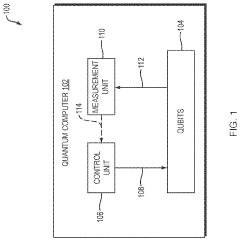
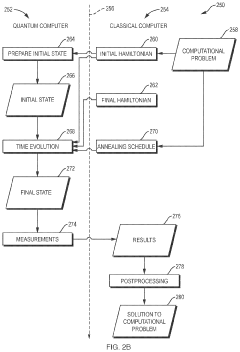
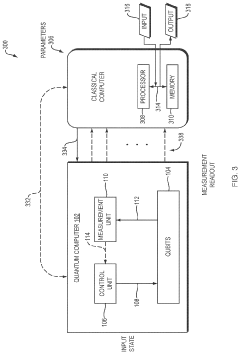
- A quantum optimization method that estimates the expectation value of a Hamiltonian on a classical computer and transforms either the Hamiltonian or the quantum state to reduce the expectation value, using techniques such as unitary transformations, fermionic rotations, and semidefinite programming, effectively increasing circuit depth without adding actual quantum gates, thereby improving the expressibility and coherence of quantum states.

System and method of in-queue optimizations for quantum cloud computing
PatentWO2022231846A1
Innovation
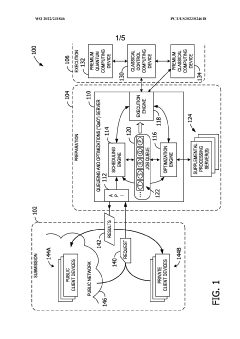
- A quantum computing system with a queueing and optimizations (QaO) server that performs in-queue optimizations, including prediction models for execution times and machine calibration, to improve the quality of quantum circuit execution, reduce wait times, and balance performance characteristics, utilizing both intra-job and inter-job optimizations to enhance fidelity and throughput.
Ethical Implications of Quantum Social Impact Analysis
The ethical implications of quantum social impact analysis are profound and far-reaching, necessitating careful consideration as this technology advances. Quantum computing's potential to revolutionize social impact assessments raises significant ethical concerns that must be addressed proactively.
One primary ethical consideration is the potential for quantum-enhanced social impact analyses to exacerbate existing societal inequalities. The advanced computational power of quantum systems may enable more sophisticated modeling of social dynamics, potentially leading to more accurate predictions of social outcomes. However, this increased accuracy could disproportionately benefit those with access to quantum resources, widening the gap between the technologically advantaged and disadvantaged segments of society.
Privacy and data protection present another critical ethical challenge. Quantum computing's ability to process vast amounts of data at unprecedented speeds may enable more comprehensive social impact analyses. This capability, while valuable for decision-making, raises concerns about the potential for invasive surveillance and the erosion of individual privacy rights. Striking a balance between the societal benefits of quantum-enhanced social impact analysis and the protection of personal data will be crucial.
The issue of algorithmic bias takes on new dimensions in the quantum realm. While quantum computing may offer opportunities to mitigate some forms of bias present in classical algorithms, it also introduces new complexities. The inherent probabilistic nature of quantum systems could lead to unexpected biases in social impact analyses, potentially reinforcing or creating new forms of discrimination if not carefully managed.
Transparency and interpretability of quantum-enhanced social impact models pose significant ethical challenges. The complexity of quantum algorithms may make it difficult for stakeholders to understand and scrutinize the decision-making processes, potentially undermining public trust and accountability in social policy decisions informed by these analyses.
The potential for quantum social impact analysis to influence human behavior and societal norms raises ethical questions about free will and social engineering. If quantum-enhanced models can predict social outcomes with high accuracy, there is a risk that this knowledge could be used to manipulate public opinion or steer societal development in ways that benefit certain groups at the expense of others.
As quantum social impact analysis capabilities evolve, it will be crucial to develop ethical frameworks and governance structures that can keep pace with technological advancements. This may include establishing interdisciplinary ethics committees, implementing rigorous oversight mechanisms, and fostering public dialogue on the ethical use of quantum technologies in social sciences.
One primary ethical consideration is the potential for quantum-enhanced social impact analyses to exacerbate existing societal inequalities. The advanced computational power of quantum systems may enable more sophisticated modeling of social dynamics, potentially leading to more accurate predictions of social outcomes. However, this increased accuracy could disproportionately benefit those with access to quantum resources, widening the gap between the technologically advantaged and disadvantaged segments of society.
Privacy and data protection present another critical ethical challenge. Quantum computing's ability to process vast amounts of data at unprecedented speeds may enable more comprehensive social impact analyses. This capability, while valuable for decision-making, raises concerns about the potential for invasive surveillance and the erosion of individual privacy rights. Striking a balance between the societal benefits of quantum-enhanced social impact analysis and the protection of personal data will be crucial.
The issue of algorithmic bias takes on new dimensions in the quantum realm. While quantum computing may offer opportunities to mitigate some forms of bias present in classical algorithms, it also introduces new complexities. The inherent probabilistic nature of quantum systems could lead to unexpected biases in social impact analyses, potentially reinforcing or creating new forms of discrimination if not carefully managed.
Transparency and interpretability of quantum-enhanced social impact models pose significant ethical challenges. The complexity of quantum algorithms may make it difficult for stakeholders to understand and scrutinize the decision-making processes, potentially undermining public trust and accountability in social policy decisions informed by these analyses.
The potential for quantum social impact analysis to influence human behavior and societal norms raises ethical questions about free will and social engineering. If quantum-enhanced models can predict social outcomes with high accuracy, there is a risk that this knowledge could be used to manipulate public opinion or steer societal development in ways that benefit certain groups at the expense of others.
As quantum social impact analysis capabilities evolve, it will be crucial to develop ethical frameworks and governance structures that can keep pace with technological advancements. This may include establishing interdisciplinary ethics committees, implementing rigorous oversight mechanisms, and fostering public dialogue on the ethical use of quantum technologies in social sciences.
Policy Framework for Quantum Computing in Social Sciences
The integration of quantum computing into social sciences necessitates a robust policy framework to guide its responsible development and application. This framework should address the unique challenges and opportunities presented by quantum technologies in social impact analyses. A comprehensive approach would include guidelines for data privacy and security, ethical considerations, and standardization of methodologies.
Firstly, the policy framework must establish clear protocols for data handling and protection. Quantum computing's ability to process vast amounts of sensitive social data requires stringent safeguards to prevent unauthorized access or misuse. Policymakers should collaborate with quantum computing experts and social scientists to develop encryption standards that can withstand potential quantum-based attacks, ensuring the long-term integrity of social data.
Ethical guidelines form another crucial component of the framework. As quantum computing enhances the precision and scope of social impact analyses, there is a need to address potential biases in algorithms and ensure fair representation of diverse populations. The framework should mandate regular audits of quantum-powered social models to detect and mitigate any unintended discriminatory outcomes.
Standardization of methodologies is essential for the credible application of quantum computing in social sciences. The policy framework should outline best practices for integrating quantum algorithms into existing social impact analysis tools. This includes defining benchmarks for accuracy, reliability, and reproducibility of results. Additionally, the framework should promote transparency in reporting quantum-enhanced findings, enabling peer review and public scrutiny.
The policy framework must also address the potential socioeconomic implications of quantum computing in social sciences. It should include provisions for workforce development, ensuring that social scientists and policymakers are adequately trained to interpret and utilize quantum-enhanced analyses. Furthermore, the framework should encourage equitable access to quantum resources across academic institutions and research organizations to prevent a widening gap in analytical capabilities.
Lastly, the policy framework should establish mechanisms for international cooperation in quantum social sciences. As social issues often transcend national boundaries, a coordinated global approach is necessary. This could involve creating international working groups to share best practices, harmonize standards, and address cross-border challenges in quantum-powered social impact analyses.
Firstly, the policy framework must establish clear protocols for data handling and protection. Quantum computing's ability to process vast amounts of sensitive social data requires stringent safeguards to prevent unauthorized access or misuse. Policymakers should collaborate with quantum computing experts and social scientists to develop encryption standards that can withstand potential quantum-based attacks, ensuring the long-term integrity of social data.
Ethical guidelines form another crucial component of the framework. As quantum computing enhances the precision and scope of social impact analyses, there is a need to address potential biases in algorithms and ensure fair representation of diverse populations. The framework should mandate regular audits of quantum-powered social models to detect and mitigate any unintended discriminatory outcomes.
Standardization of methodologies is essential for the credible application of quantum computing in social sciences. The policy framework should outline best practices for integrating quantum algorithms into existing social impact analysis tools. This includes defining benchmarks for accuracy, reliability, and reproducibility of results. Additionally, the framework should promote transparency in reporting quantum-enhanced findings, enabling peer review and public scrutiny.
The policy framework must also address the potential socioeconomic implications of quantum computing in social sciences. It should include provisions for workforce development, ensuring that social scientists and policymakers are adequately trained to interpret and utilize quantum-enhanced analyses. Furthermore, the framework should encourage equitable access to quantum resources across academic institutions and research organizations to prevent a widening gap in analytical capabilities.
Lastly, the policy framework should establish mechanisms for international cooperation in quantum social sciences. As social issues often transcend national boundaries, a coordinated global approach is necessary. This could involve creating international working groups to share best practices, harmonize standards, and address cross-border challenges in quantum-powered social impact analyses.
Unlock deeper insights with PatSnap Eureka Quick Research — get a full tech report to explore trends and direct your research. Try now!
Generate Your Research Report Instantly with AI Agent
Supercharge your innovation with PatSnap Eureka AI Agent Platform!