Standards and Protocols in Vehicle-to-Grid Implementations
SEP 23, 20259 MIN READ
Generate Your Research Report Instantly with AI Agent
Patsnap Eureka helps you evaluate technical feasibility & market potential.
V2G Technology Background and Objectives
Vehicle-to-Grid (V2G) technology represents a transformative approach to energy management that has evolved significantly over the past decade. The concept emerged in the late 1990s but gained substantial momentum after 2010 as electric vehicle (EV) adoption increased and smart grid technologies matured. V2G enables bidirectional power flow between electric vehicles and the electricity grid, allowing EVs to not only consume energy but also feed stored energy back to the grid when needed.
The evolution of V2G technology has been closely tied to advancements in power electronics, battery management systems, and communication protocols. Early implementations focused primarily on unidirectional charging (grid-to-vehicle), while modern systems emphasize bidirectional capabilities that can provide grid services such as peak shaving, frequency regulation, and voltage support.
Current technological trends indicate a move toward more sophisticated V2G systems with enhanced interoperability, improved efficiency in power conversion, and reduced latency in communication between vehicles and grid operators. The integration of artificial intelligence and machine learning algorithms is enabling more predictive and adaptive V2G operations, optimizing both grid stability and vehicle battery longevity.
The primary technical objectives for V2G implementations include establishing universal communication protocols that ensure seamless interaction between diverse vehicle models and varying grid infrastructures. Standardization efforts aim to create a cohesive ecosystem where any EV can connect to any charging station regardless of manufacturer or geographic location.
Another critical objective is minimizing the degradation impact on vehicle batteries during V2G operations. Research indicates that controlled bidirectional power flow, when properly managed, can be achieved without significantly compromising battery lifespan. Advanced battery management systems are being developed to monitor and regulate the charging and discharging cycles more effectively.
Energy security and grid resilience represent additional goals for V2G technology development. By creating distributed energy resources through connected EVs, power systems can better withstand disruptions and reduce dependency on centralized generation facilities. This distributed architecture also supports the integration of renewable energy sources by providing flexible storage capacity that can absorb excess production during peak generation periods.
The technical trajectory for V2G standards and protocols is moving toward open-source frameworks that facilitate innovation while maintaining security and reliability. These frameworks must address challenges related to cybersecurity, user privacy, and the economic models that incentivize vehicle owners to participate in grid services programs.
The evolution of V2G technology has been closely tied to advancements in power electronics, battery management systems, and communication protocols. Early implementations focused primarily on unidirectional charging (grid-to-vehicle), while modern systems emphasize bidirectional capabilities that can provide grid services such as peak shaving, frequency regulation, and voltage support.
Current technological trends indicate a move toward more sophisticated V2G systems with enhanced interoperability, improved efficiency in power conversion, and reduced latency in communication between vehicles and grid operators. The integration of artificial intelligence and machine learning algorithms is enabling more predictive and adaptive V2G operations, optimizing both grid stability and vehicle battery longevity.
The primary technical objectives for V2G implementations include establishing universal communication protocols that ensure seamless interaction between diverse vehicle models and varying grid infrastructures. Standardization efforts aim to create a cohesive ecosystem where any EV can connect to any charging station regardless of manufacturer or geographic location.
Another critical objective is minimizing the degradation impact on vehicle batteries during V2G operations. Research indicates that controlled bidirectional power flow, when properly managed, can be achieved without significantly compromising battery lifespan. Advanced battery management systems are being developed to monitor and regulate the charging and discharging cycles more effectively.
Energy security and grid resilience represent additional goals for V2G technology development. By creating distributed energy resources through connected EVs, power systems can better withstand disruptions and reduce dependency on centralized generation facilities. This distributed architecture also supports the integration of renewable energy sources by providing flexible storage capacity that can absorb excess production during peak generation periods.
The technical trajectory for V2G standards and protocols is moving toward open-source frameworks that facilitate innovation while maintaining security and reliability. These frameworks must address challenges related to cybersecurity, user privacy, and the economic models that incentivize vehicle owners to participate in grid services programs.
Market Demand Analysis for V2G Solutions
The Vehicle-to-Grid (V2G) market is experiencing significant growth driven by the convergence of renewable energy integration, grid stability concerns, and the rapid adoption of electric vehicles (EVs). Current market analysis indicates that the global V2G technology market is projected to grow at a CAGR of 48% between 2022 and 2027, reaching approximately $17.4 billion by 2027. This exceptional growth rate reflects the increasing recognition of EVs as mobile energy storage units rather than mere transportation assets.
Primary market demand drivers for V2G solutions include grid operators seeking frequency regulation services and peak shaving capabilities. Utility companies are increasingly viewing V2G as a cost-effective alternative to traditional grid infrastructure investments, with pilot programs demonstrating up to 30% cost savings compared to conventional grid upgrades. Additionally, renewable energy integration challenges have created demand for flexible storage solutions, with V2G offering a distributed approach to balance intermittent generation.
Consumer-side demand is developing more gradually but shows promising signals. EV owners express interest in V2G participation when presented with clear financial incentives, with surveys indicating that 65% of EV owners would consider V2G programs offering annual returns exceeding $500. Fleet operators represent another significant market segment, with commercial fleets showing stronger early adoption rates due to predictable usage patterns and centralized charging infrastructure.
Regional market analysis reveals varying adoption rates and drivers. Europe leads in V2G implementation due to supportive regulatory frameworks, particularly in the UK, Denmark, and the Netherlands. North America follows with utility-driven pilot programs expanding across California, New York, and Ontario. The Asia-Pacific region shows the highest growth potential, with Japan and South Korea making significant investments in V2G infrastructure.
Market barriers remain substantial, including high implementation costs, regulatory uncertainties, and consumer concerns about battery degradation. The average cost of bidirectional charging equipment remains 2-3 times higher than standard charging solutions, creating adoption friction. However, technological advancements are rapidly reducing these cost differentials, with projections suggesting price parity by 2025.
Industry forecasts indicate that V2G will transition from pilot programs to mainstream adoption between 2023-2026, with initial growth concentrated in fleet applications before expanding to residential markets. The market is expected to reach an inflection point when bidirectional charging becomes a standard feature in mid-range EVs, anticipated by 2025 based on current automotive manufacturer roadmaps.
Primary market demand drivers for V2G solutions include grid operators seeking frequency regulation services and peak shaving capabilities. Utility companies are increasingly viewing V2G as a cost-effective alternative to traditional grid infrastructure investments, with pilot programs demonstrating up to 30% cost savings compared to conventional grid upgrades. Additionally, renewable energy integration challenges have created demand for flexible storage solutions, with V2G offering a distributed approach to balance intermittent generation.
Consumer-side demand is developing more gradually but shows promising signals. EV owners express interest in V2G participation when presented with clear financial incentives, with surveys indicating that 65% of EV owners would consider V2G programs offering annual returns exceeding $500. Fleet operators represent another significant market segment, with commercial fleets showing stronger early adoption rates due to predictable usage patterns and centralized charging infrastructure.
Regional market analysis reveals varying adoption rates and drivers. Europe leads in V2G implementation due to supportive regulatory frameworks, particularly in the UK, Denmark, and the Netherlands. North America follows with utility-driven pilot programs expanding across California, New York, and Ontario. The Asia-Pacific region shows the highest growth potential, with Japan and South Korea making significant investments in V2G infrastructure.
Market barriers remain substantial, including high implementation costs, regulatory uncertainties, and consumer concerns about battery degradation. The average cost of bidirectional charging equipment remains 2-3 times higher than standard charging solutions, creating adoption friction. However, technological advancements are rapidly reducing these cost differentials, with projections suggesting price parity by 2025.
Industry forecasts indicate that V2G will transition from pilot programs to mainstream adoption between 2023-2026, with initial growth concentrated in fleet applications before expanding to residential markets. The market is expected to reach an inflection point when bidirectional charging becomes a standard feature in mid-range EVs, anticipated by 2025 based on current automotive manufacturer roadmaps.
Current V2G Standards Landscape and Challenges
The Vehicle-to-Grid (V2G) standards landscape currently presents a complex ecosystem of competing and complementary protocols across different regions. The primary standards governing V2G implementations include ISO 15118, which establishes the communication protocol between electric vehicles (EVs) and charging stations, and IEC 61851 that defines the general requirements for EV charging systems. These foundational standards are supplemented by regional variations such as SAE J3072 in North America and GB/T 27930 in China.
Despite significant standardization efforts, the V2G domain faces substantial fragmentation challenges. Different regions have developed their own standards, creating interoperability issues for vehicle manufacturers and charging infrastructure providers operating globally. This fragmentation increases implementation costs and slows widespread adoption of V2G technology.
Communication protocols represent another critical challenge area. Current standards like ISO 15118-20 support bidirectional power flow necessary for V2G, but implementation remains inconsistent. The standard's complexity has led to varying interpretations and implementations across the industry, resulting in compatibility issues between vehicles and charging equipment from different manufacturers.
Security considerations present significant hurdles in V2G standardization. While ISO 15118 incorporates certificate-based authentication and encrypted communication, the management of security certificates across diverse stakeholders remains problematic. The lack of a universally accepted Public Key Infrastructure (PKI) for V2G applications creates vulnerabilities in the ecosystem.
Grid integration standards also remain underdeveloped. While IEEE 1547 and IEC 61850 provide frameworks for distributed energy resources connecting to the grid, they were not specifically designed for the dynamic nature of mobile V2G resources. This gap creates uncertainty regarding how EVs should interact with grid operators' systems during demand response events or frequency regulation services.
Regulatory compliance adds another layer of complexity. Standards must address varying regulatory requirements across jurisdictions, including metering accuracy for financial settlements, grid codes for power quality, and cybersecurity mandates. The evolving nature of these regulations makes standardization efforts particularly challenging.
The pace of technological evolution further complicates standardization efforts. As battery technologies, power electronics, and communication systems advance rapidly, standards development processes struggle to keep pace. This creates a risk of standards becoming outdated shortly after implementation, potentially hindering innovation or creating legacy compatibility issues.
Despite significant standardization efforts, the V2G domain faces substantial fragmentation challenges. Different regions have developed their own standards, creating interoperability issues for vehicle manufacturers and charging infrastructure providers operating globally. This fragmentation increases implementation costs and slows widespread adoption of V2G technology.
Communication protocols represent another critical challenge area. Current standards like ISO 15118-20 support bidirectional power flow necessary for V2G, but implementation remains inconsistent. The standard's complexity has led to varying interpretations and implementations across the industry, resulting in compatibility issues between vehicles and charging equipment from different manufacturers.
Security considerations present significant hurdles in V2G standardization. While ISO 15118 incorporates certificate-based authentication and encrypted communication, the management of security certificates across diverse stakeholders remains problematic. The lack of a universally accepted Public Key Infrastructure (PKI) for V2G applications creates vulnerabilities in the ecosystem.
Grid integration standards also remain underdeveloped. While IEEE 1547 and IEC 61850 provide frameworks for distributed energy resources connecting to the grid, they were not specifically designed for the dynamic nature of mobile V2G resources. This gap creates uncertainty regarding how EVs should interact with grid operators' systems during demand response events or frequency regulation services.
Regulatory compliance adds another layer of complexity. Standards must address varying regulatory requirements across jurisdictions, including metering accuracy for financial settlements, grid codes for power quality, and cybersecurity mandates. The evolving nature of these regulations makes standardization efforts particularly challenging.
The pace of technological evolution further complicates standardization efforts. As battery technologies, power electronics, and communication systems advance rapidly, standards development processes struggle to keep pace. This creates a risk of standards becoming outdated shortly after implementation, potentially hindering innovation or creating legacy compatibility issues.
Current V2G Communication Protocol Solutions
01 Communication protocols for V2G interoperability
Various communication protocols are essential for enabling effective Vehicle-to-Grid (V2G) interoperability. These protocols facilitate standardized communication between electric vehicles and the power grid, allowing for seamless integration and data exchange. The protocols ensure that different systems can communicate effectively, supporting functions such as authentication, authorization, and secure data transmission between vehicles and grid infrastructure.- Communication protocols for V2G interoperability: Various communication protocols are essential for enabling Vehicle-to-Grid (V2G) interoperability. These protocols facilitate seamless communication between electric vehicles and the power grid, allowing for efficient energy exchange. Standardized communication frameworks ensure that different systems can interact effectively, supporting functions such as authentication, authorization, and secure data exchange between vehicles and grid infrastructure.
- Grid integration and management systems: Grid integration systems are crucial for V2G interoperability, enabling electric vehicles to effectively interact with power grids. These systems manage the bidirectional flow of electricity, coordinate charging and discharging operations, and optimize energy distribution. Advanced management platforms incorporate load balancing, demand response capabilities, and real-time monitoring to ensure grid stability while maximizing the benefits of V2G technology.
- Security and authentication frameworks: Security frameworks for V2G systems protect against unauthorized access and ensure data integrity during vehicle-grid interactions. These frameworks implement robust authentication mechanisms, encryption protocols, and secure communication channels to safeguard sensitive information and prevent cyber attacks. Comprehensive security measures are essential for building trust in V2G systems and protecting both the grid infrastructure and connected vehicles from potential vulnerabilities.
- Standardized charging interfaces: Standardized charging interfaces are fundamental to V2G interoperability, ensuring compatibility between different vehicle models and charging infrastructure. These interfaces define physical connectors, electrical specifications, and communication protocols that enable seamless connection between electric vehicles and grid systems. Unified standards for charging interfaces reduce market fragmentation, lower implementation costs, and improve the overall user experience of V2G technology.
- Network architecture for V2G systems: Network architectures for V2G systems establish the structural framework that supports communication between vehicles, charging stations, and grid operators. These architectures define how different components interact within the V2G ecosystem, including data routing, network topology, and system integration. Well-designed network architectures ensure scalability, reliability, and efficiency in V2G operations, accommodating growing numbers of electric vehicles while maintaining system performance.
02 Grid integration standards for electric vehicles
Standards for integrating electric vehicles with the power grid define the technical requirements and specifications for V2G systems. These standards address aspects such as power flow control, grid synchronization, and energy management to ensure safe and efficient bidirectional power transfer. They establish common frameworks that manufacturers and utility providers can follow to develop compatible V2G solutions, promoting wider adoption and interoperability across different regions and systems.Expand Specific Solutions03 Security and authentication mechanisms for V2G systems
Security protocols and authentication mechanisms are crucial for protecting V2G communications and transactions. These include encryption standards, digital certificates, and secure handshake procedures that verify the identity of connected devices and protect against unauthorized access or data manipulation. Such security measures ensure the integrity of the power grid while enabling trusted interactions between vehicles, charging stations, and grid operators.Expand Specific Solutions04 Data management and interoperability frameworks
Frameworks for managing data exchange between vehicles and grid infrastructure enable seamless interoperability across different platforms and systems. These frameworks define data formats, messaging structures, and APIs that facilitate communication between diverse V2G components. They support functions such as energy trading, demand response, and grid services by establishing common data models and exchange patterns that can be implemented across various hardware and software systems.Expand Specific Solutions05 Smart charging and energy management protocols
Protocols for smart charging and energy management coordinate the charging and discharging of electric vehicles based on grid conditions and user preferences. These protocols enable dynamic scheduling, load balancing, and demand response capabilities by standardizing how charging stations communicate with vehicles and the grid. They support advanced features such as time-of-use pricing, renewable energy integration, and grid stabilization services, maximizing the benefits of V2G technology while maintaining grid reliability.Expand Specific Solutions
Key Industry Players in V2G Ecosystem
The Vehicle-to-Grid (V2G) implementation market is currently in its early growth phase, characterized by significant technological development but limited widespread commercial deployment. The global V2G market is projected to reach approximately $17-20 billion by 2030, with a compound annual growth rate exceeding 40%. Regarding technical maturity, major automotive manufacturers like Volkswagen AG, Ford Motor Co., Toyota Motor Corp., and AUDI AG are advancing core V2G technologies, while technology companies such as QUALCOMM, Intel Corp., and Huawei Technologies are developing essential communication protocols. Energy and infrastructure players including ABB E-mobility and Robert Bosch GmbH are focusing on charging infrastructure standardization. The industry faces challenges in protocol harmonization, with competing standards emerging across different regions, requiring collaborative efforts between automotive OEMs and technology providers to establish unified global protocols.
ABB E-mobility BV
Technical Solution: ABB E-mobility has developed a comprehensive V2G implementation framework centered around their OCPP (Open Charge Point Protocol) compliant charging infrastructure. Their solution integrates ISO 15118 standards for vehicle-to-grid communication, enabling bidirectional power flow between electric vehicles and the grid. ABB's V2G technology incorporates both CHAdeMO and CCS (Combined Charging System) protocols to ensure broad compatibility across vehicle manufacturers. Their smart charging stations feature dynamic load management capabilities that respond to grid signals through OpenADR 2.0b protocol integration, allowing for automated demand response functionality. ABB has also implemented IEC 61850 standards for grid integration, ensuring seamless communication between charging infrastructure and utility systems[1]. Their V2G platform includes robust cybersecurity measures compliant with IEC 62351 standards, addressing critical security concerns in grid-connected systems.
Strengths: Extensive global deployment experience with established grid operators; comprehensive protocol support across multiple standards; advanced grid integration capabilities with utility-grade reliability. Weaknesses: Higher implementation costs compared to some competitors; complex integration requirements for legacy grid systems; proprietary elements in their management software may limit interoperability with third-party systems.
Volkswagen AG
Technical Solution: Volkswagen has developed an advanced V2G implementation framework based on their Modular Electric Drive Matrix (MEB) platform. Their approach centers on ISO 15118-20 compliance for bidirectional charging communication, with particular emphasis on Plug & Charge functionality for seamless authentication and billing. Volkswagen's V2G architecture incorporates both CHAdeMO and CCS protocols, with a strategic shift toward CCS as their primary standard for future implementations. Their system utilizes the IEC 63110 protocol for management of electric vehicle charging and discharging, enabling sophisticated grid integration. Volkswagen has pioneered a "Smart Charging" ecosystem that includes dynamic rate adaptation based on grid signals received through OpenADR 2.0b integration. Their V2G platform features a distributed energy resource management system (DERMS) interface compliant with IEC 61850-90-8 standards, allowing for aggregation of vehicle batteries as virtual power plants. Volkswagen has implemented robust security measures following IETF RFC 8366 guidelines for secure device bootstrapping and IEC 62351 standards for data protection[3]. Their V2G implementation includes predictive analytics capabilities that optimize battery usage based on driving patterns, grid conditions, and renewable energy availability.
Strengths: Extensive vehicle portfolio with V2G capability being integrated across multiple models; strong European utility partnerships for standardization; sophisticated battery management systems that protect battery health during grid services. Weaknesses: Limited commercial-scale deployments compared to some competitors; regional variations in implementation approach may create fragmentation; current focus primarily on European grid standards with less emphasis on North American or Asian markets.
Critical Standards and Interoperability Frameworks
Interaction system between electric vehicle and power grid
PatentPendingUS20240283250A1
Innovation
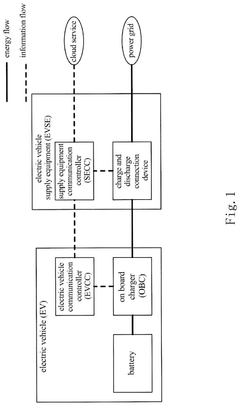
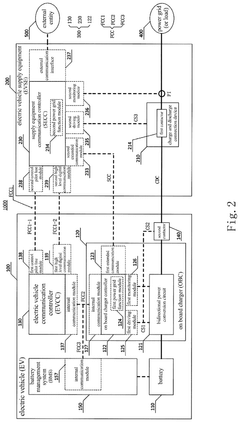
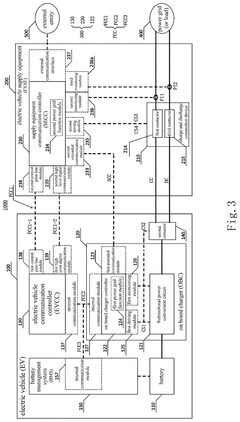
- An interaction system between an electric vehicle and a power grid is introduced, featuring a bidirectional power conversion circuit, on-board charger controller, and communication controllers that enable direct communication between the supply equipment communication controller and the on-board charger, allowing for the execution of power grid functions with high response time requirements, such as power regulation and fault protection.
Methods and systems for managing vehicle-grid integration
PatentActiveUS12038726B2
Innovation
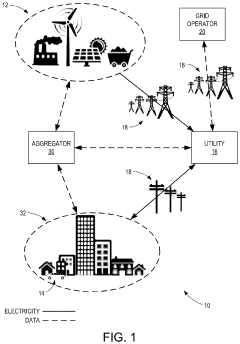
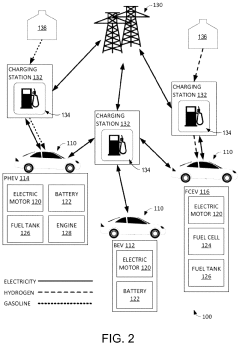
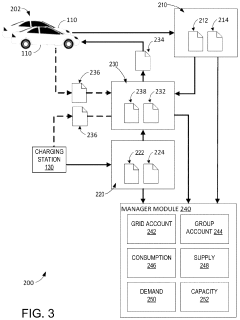
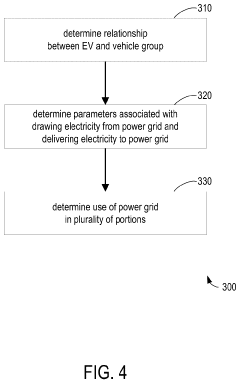
- A vehicle-grid integration (VGI) management system that includes computer storage media and processors to determine the use of the power grid by EVs in a dual multi-part rate structure, allowing for organized and controllable participation of EVs in power and energy management, enabling strategic dispatching to balance supply and demand, and equitably attribute costs and benefits.
Regulatory Framework and Policy Implications
The regulatory landscape for Vehicle-to-Grid (V2G) implementations varies significantly across regions, creating a complex environment for technology deployment. In the United States, the Federal Energy Regulatory Commission (FERC) Order 2222 represents a milestone by allowing distributed energy resources, including electric vehicles, to participate in wholesale electricity markets. This regulatory framework enables EVs to provide grid services and receive compensation, though implementation details are left to regional transmission organizations.
The European Union has established a more comprehensive approach through its Clean Energy Package, which explicitly recognizes energy storage systems, including EVs, as distinct market participants. The EU's Electricity Directive (2019/944) mandates that member states develop regulatory frameworks that facilitate V2G integration and ensure non-discriminatory market access for storage providers. Countries like Denmark, the Netherlands, and the UK have pioneered supportive policies, including reduced taxation for electricity used in V2G operations.
In Asia, Japan's strategic energy plan specifically promotes V2G as part of its resilience strategy following the Fukushima disaster. The Japanese government offers subsidies for V2G-capable charging infrastructure and has simplified grid connection procedures. China, meanwhile, has incorporated V2G into its New Energy Vehicle (NEV) policies, though regulatory clarity remains a work in progress.
Policy implications extend beyond market access to include critical areas such as grid interconnection standards, metering requirements, and taxation structures. Double taxation—where electricity is taxed both when charging and discharging—remains a significant barrier in many jurisdictions. Additionally, regulatory uncertainty regarding liability for battery degradation has slowed commercial adoption, as stakeholders debate whether utilities, vehicle manufacturers, or consumers should bear these costs.
Data privacy and cybersecurity regulations also significantly impact V2G implementations. As V2G systems collect and transmit sensitive data about energy usage patterns and vehicle location, they must comply with regulations like GDPR in Europe or various state-level privacy laws in the US. These requirements necessitate robust security protocols and transparent data management practices.
Forward-looking policy development is increasingly focusing on creating technology-neutral frameworks that can accommodate rapid innovation in V2G technologies while ensuring grid stability and consumer protection. Regulatory sandboxes, which allow controlled testing of new business models under regulatory supervision, have emerged as valuable tools for policy refinement in countries including Singapore, the UK, and Australia.
The European Union has established a more comprehensive approach through its Clean Energy Package, which explicitly recognizes energy storage systems, including EVs, as distinct market participants. The EU's Electricity Directive (2019/944) mandates that member states develop regulatory frameworks that facilitate V2G integration and ensure non-discriminatory market access for storage providers. Countries like Denmark, the Netherlands, and the UK have pioneered supportive policies, including reduced taxation for electricity used in V2G operations.
In Asia, Japan's strategic energy plan specifically promotes V2G as part of its resilience strategy following the Fukushima disaster. The Japanese government offers subsidies for V2G-capable charging infrastructure and has simplified grid connection procedures. China, meanwhile, has incorporated V2G into its New Energy Vehicle (NEV) policies, though regulatory clarity remains a work in progress.
Policy implications extend beyond market access to include critical areas such as grid interconnection standards, metering requirements, and taxation structures. Double taxation—where electricity is taxed both when charging and discharging—remains a significant barrier in many jurisdictions. Additionally, regulatory uncertainty regarding liability for battery degradation has slowed commercial adoption, as stakeholders debate whether utilities, vehicle manufacturers, or consumers should bear these costs.
Data privacy and cybersecurity regulations also significantly impact V2G implementations. As V2G systems collect and transmit sensitive data about energy usage patterns and vehicle location, they must comply with regulations like GDPR in Europe or various state-level privacy laws in the US. These requirements necessitate robust security protocols and transparent data management practices.
Forward-looking policy development is increasingly focusing on creating technology-neutral frameworks that can accommodate rapid innovation in V2G technologies while ensuring grid stability and consumer protection. Regulatory sandboxes, which allow controlled testing of new business models under regulatory supervision, have emerged as valuable tools for policy refinement in countries including Singapore, the UK, and Australia.
Cybersecurity Considerations in V2G Implementation
Vehicle-to-Grid (V2G) implementations face significant cybersecurity challenges that must be addressed to ensure system integrity, data protection, and operational safety. As V2G systems integrate critical infrastructure components from both energy and transportation sectors, they present an expanded attack surface with unique vulnerabilities. These systems process sensitive data including vehicle charging patterns, energy consumption metrics, and potentially personal information of EV owners.
The primary cybersecurity threats to V2G systems include unauthorized access to charging infrastructure, data breaches exposing user information, manipulation of energy transactions, and potential disruption of grid operations through coordinated attacks on multiple charging points. These threats are particularly concerning as V2G implementations scale up, potentially creating systemic risks to energy infrastructure.
Authentication and authorization mechanisms represent the first line of defense in V2G systems. Current implementations typically employ a combination of certificate-based authentication, multi-factor authentication for user access, and role-based access controls. However, the distributed nature of V2G networks necessitates more robust approaches, including mutual authentication between vehicles, charging stations, and grid management systems.
Data protection in V2G communications requires end-to-end encryption for all data exchanges, secure key management systems, and privacy-preserving protocols that minimize exposure of personally identifiable information. Leading implementations utilize TLS/SSL for transport layer security, with some advanced systems implementing quantum-resistant encryption algorithms in anticipation of future threats.
Secure firmware management presents another critical consideration, as charging infrastructure components require regular updates to address emerging vulnerabilities. Best practices include signed firmware updates, secure boot processes, and remote attestation capabilities to verify device integrity. Several major V2G projects have implemented over-the-air update mechanisms with rollback protection to ensure operational continuity.
Intrusion detection and prevention systems specifically designed for V2G environments are emerging as essential components of comprehensive security architectures. These systems monitor for anomalous behaviors across the charging network, including unusual energy flows, unexpected authentication attempts, or communication patterns that deviate from established baselines.
Regulatory frameworks addressing V2G cybersecurity remain fragmented globally, though efforts toward standardization are progressing. The IEC 63110 standard addresses security aspects of EV charging management, while NIST's Cybersecurity Framework provides broader guidance applicable to V2G implementations. The European Network for Cyber Security (ENCS) has also published specific guidelines for securing EV charging infrastructure.
The primary cybersecurity threats to V2G systems include unauthorized access to charging infrastructure, data breaches exposing user information, manipulation of energy transactions, and potential disruption of grid operations through coordinated attacks on multiple charging points. These threats are particularly concerning as V2G implementations scale up, potentially creating systemic risks to energy infrastructure.
Authentication and authorization mechanisms represent the first line of defense in V2G systems. Current implementations typically employ a combination of certificate-based authentication, multi-factor authentication for user access, and role-based access controls. However, the distributed nature of V2G networks necessitates more robust approaches, including mutual authentication between vehicles, charging stations, and grid management systems.
Data protection in V2G communications requires end-to-end encryption for all data exchanges, secure key management systems, and privacy-preserving protocols that minimize exposure of personally identifiable information. Leading implementations utilize TLS/SSL for transport layer security, with some advanced systems implementing quantum-resistant encryption algorithms in anticipation of future threats.
Secure firmware management presents another critical consideration, as charging infrastructure components require regular updates to address emerging vulnerabilities. Best practices include signed firmware updates, secure boot processes, and remote attestation capabilities to verify device integrity. Several major V2G projects have implemented over-the-air update mechanisms with rollback protection to ensure operational continuity.
Intrusion detection and prevention systems specifically designed for V2G environments are emerging as essential components of comprehensive security architectures. These systems monitor for anomalous behaviors across the charging network, including unusual energy flows, unexpected authentication attempts, or communication patterns that deviate from established baselines.
Regulatory frameworks addressing V2G cybersecurity remain fragmented globally, though efforts toward standardization are progressing. The IEC 63110 standard addresses security aspects of EV charging management, while NIST's Cybersecurity Framework provides broader guidance applicable to V2G implementations. The European Network for Cyber Security (ENCS) has also published specific guidelines for securing EV charging infrastructure.
Unlock deeper insights with Patsnap Eureka Quick Research — get a full tech report to explore trends and direct your research. Try now!
Generate Your Research Report Instantly with AI Agent
Supercharge your innovation with Patsnap Eureka AI Agent Platform!