

Thermo-Mechanical Simulation Frameworks For Predictive Build Planning
SEP 3, 20259 MIN READ
Generate Your Research Report Instantly with AI Agent
PatSnap Eureka helps you evaluate technical feasibility & market potential.
Thermal Simulation Background and Objectives
Thermo-mechanical simulation has emerged as a critical technology in advanced manufacturing processes, particularly in additive manufacturing (AM) where thermal gradients and mechanical stresses significantly impact part quality. The evolution of thermal simulation capabilities traces back to the 1970s with finite element analysis (FEA) applications in traditional manufacturing, progressing through significant advancements in computational fluid dynamics (CFD) integration in the 1990s, and culminating in today's multi-physics simulation frameworks that can model complex thermal-mechanical interactions at multiple scales.
The current technological trajectory is moving toward real-time simulation capabilities with adaptive mesh refinement and machine learning acceleration techniques. These developments are enabling more accurate predictions of thermal history, residual stress formation, and potential defects during the build process, which are essential for quality control in advanced manufacturing operations.
The primary objective of thermo-mechanical simulation frameworks for predictive build planning is to create digital twins of manufacturing processes that can accurately forecast thermal behavior, mechanical response, and resulting microstructure evolution. This enables manufacturers to optimize process parameters, predict and mitigate distortion, and ensure consistent part quality while reducing the need for costly physical prototyping and testing.
Specific technical goals include developing simulation models that can account for complex material phase changes, anisotropic thermal conductivity, and non-linear mechanical behavior under varying thermal conditions. Additionally, these frameworks aim to bridge the gap between microscale phenomena (such as grain growth and solidification) and macroscale outcomes (like warping and residual stress distribution) through multi-scale modeling approaches.
Another critical objective is computational efficiency, as current high-fidelity simulations often require substantial computing resources and time, limiting their practical application in production environments. Research is focused on developing reduced-order models and leveraging GPU acceleration to enable near-real-time simulation capabilities that can be integrated into manufacturing execution systems.
The ultimate goal is to establish predictive simulation frameworks that can serve as virtual process certification tools, allowing manufacturers to validate build strategies before physical production begins. This would revolutionize quality assurance approaches in advanced manufacturing by shifting from post-process inspection to pre-process validation, significantly reducing waste, energy consumption, and time-to-market for complex components.
The current technological trajectory is moving toward real-time simulation capabilities with adaptive mesh refinement and machine learning acceleration techniques. These developments are enabling more accurate predictions of thermal history, residual stress formation, and potential defects during the build process, which are essential for quality control in advanced manufacturing operations.
The primary objective of thermo-mechanical simulation frameworks for predictive build planning is to create digital twins of manufacturing processes that can accurately forecast thermal behavior, mechanical response, and resulting microstructure evolution. This enables manufacturers to optimize process parameters, predict and mitigate distortion, and ensure consistent part quality while reducing the need for costly physical prototyping and testing.
Specific technical goals include developing simulation models that can account for complex material phase changes, anisotropic thermal conductivity, and non-linear mechanical behavior under varying thermal conditions. Additionally, these frameworks aim to bridge the gap between microscale phenomena (such as grain growth and solidification) and macroscale outcomes (like warping and residual stress distribution) through multi-scale modeling approaches.
Another critical objective is computational efficiency, as current high-fidelity simulations often require substantial computing resources and time, limiting their practical application in production environments. Research is focused on developing reduced-order models and leveraging GPU acceleration to enable near-real-time simulation capabilities that can be integrated into manufacturing execution systems.
The ultimate goal is to establish predictive simulation frameworks that can serve as virtual process certification tools, allowing manufacturers to validate build strategies before physical production begins. This would revolutionize quality assurance approaches in advanced manufacturing by shifting from post-process inspection to pre-process validation, significantly reducing waste, energy consumption, and time-to-market for complex components.
Market Analysis for Predictive Build Planning Solutions
The global market for predictive build planning solutions in additive manufacturing is experiencing robust growth, driven by increasing adoption of 3D printing technologies across multiple industries. Current market valuations indicate that the thermal simulation software segment alone reached approximately 2.3 billion USD in 2022, with projections suggesting a compound annual growth rate of 15-18% through 2028.
Manufacturing sectors, particularly aerospace and automotive, represent the largest market segments, collectively accounting for over 60% of the current demand. These industries require high precision in predicting thermal behaviors during additive manufacturing processes to ensure component reliability and performance. Healthcare and biomedical sectors are emerging as the fastest-growing segments, with demand increasing at nearly 22% annually as these industries adopt more complex 3D printing applications.
Geographically, North America dominates the market with approximately 42% share, followed by Europe at 31% and Asia-Pacific at 22%. The Asia-Pacific region, particularly China and India, is expected to witness the highest growth rate due to rapid industrialization and increasing investments in advanced manufacturing technologies.
Customer demand analysis reveals that end-users prioritize simulation accuracy, computational efficiency, and integration capabilities with existing manufacturing execution systems. Over 78% of surveyed manufacturers indicated that reducing build failures and minimizing post-processing requirements were their primary motivations for adopting thermo-mechanical simulation frameworks.
The market is currently segmented into three primary solution categories: standalone simulation software (38% market share), integrated manufacturing platforms (45%), and cloud-based simulation services (17%). Cloud-based solutions are projected to grow at the highest rate due to lower entry barriers and subscription-based pricing models that appeal to small and medium enterprises.
Pricing models vary significantly across the market, with enterprise solutions ranging from 50,000 to 250,000 USD annually, while mid-tier solutions typically fall between 15,000 and 45,000 USD. The emergence of SaaS models is disrupting traditional pricing structures, with subscription-based offerings gaining traction among new market entrants.
Market barriers include high implementation costs, technical complexity requiring specialized expertise, and challenges in achieving simulation accuracy for novel materials. Despite these challenges, the market shows strong growth potential as manufacturing industries increasingly recognize the return on investment through reduced material waste, decreased build failures, and optimized production schedules.
Manufacturing sectors, particularly aerospace and automotive, represent the largest market segments, collectively accounting for over 60% of the current demand. These industries require high precision in predicting thermal behaviors during additive manufacturing processes to ensure component reliability and performance. Healthcare and biomedical sectors are emerging as the fastest-growing segments, with demand increasing at nearly 22% annually as these industries adopt more complex 3D printing applications.
Geographically, North America dominates the market with approximately 42% share, followed by Europe at 31% and Asia-Pacific at 22%. The Asia-Pacific region, particularly China and India, is expected to witness the highest growth rate due to rapid industrialization and increasing investments in advanced manufacturing technologies.
Customer demand analysis reveals that end-users prioritize simulation accuracy, computational efficiency, and integration capabilities with existing manufacturing execution systems. Over 78% of surveyed manufacturers indicated that reducing build failures and minimizing post-processing requirements were their primary motivations for adopting thermo-mechanical simulation frameworks.
The market is currently segmented into three primary solution categories: standalone simulation software (38% market share), integrated manufacturing platforms (45%), and cloud-based simulation services (17%). Cloud-based solutions are projected to grow at the highest rate due to lower entry barriers and subscription-based pricing models that appeal to small and medium enterprises.
Pricing models vary significantly across the market, with enterprise solutions ranging from 50,000 to 250,000 USD annually, while mid-tier solutions typically fall between 15,000 and 45,000 USD. The emergence of SaaS models is disrupting traditional pricing structures, with subscription-based offerings gaining traction among new market entrants.
Market barriers include high implementation costs, technical complexity requiring specialized expertise, and challenges in achieving simulation accuracy for novel materials. Despite these challenges, the market shows strong growth potential as manufacturing industries increasingly recognize the return on investment through reduced material waste, decreased build failures, and optimized production schedules.
Current Challenges in Thermo-Mechanical Simulation
Despite significant advancements in thermo-mechanical simulation for additive manufacturing, several critical challenges persist that impede the development of fully predictive build planning frameworks. The multi-physics nature of metal additive manufacturing processes creates substantial computational complexity, with thermal gradients, phase transformations, and mechanical responses occurring simultaneously across multiple time and length scales. Current simulation frameworks struggle to balance computational efficiency with accuracy when modeling these coupled phenomena.
Resolution limitations present another significant obstacle. Most commercial simulation tools cannot adequately capture microscale phenomena such as melt pool dynamics and powder particle interactions while simultaneously modeling part-scale thermal history and residual stress development. This multi-scale modeling challenge often forces researchers to make simplifications that compromise predictive accuracy.
Material behavior characterization under extreme thermal conditions remains inadequately addressed in current frameworks. The rapid heating and cooling rates in additive manufacturing (exceeding 10^6 K/s) create non-equilibrium microstructures and properties that are difficult to characterize experimentally and incorporate into simulation models. Temperature-dependent material properties and phase transformation kinetics are often approximated using limited data, introducing significant uncertainty into simulation results.
Computational resource requirements pose practical limitations for industry adoption. High-fidelity thermo-mechanical simulations can require days or weeks of computation time on high-performance computing clusters, making them impractical for routine use in production environments. While reduced-order models offer faster solutions, they typically sacrifice accuracy in predicting localized phenomena critical for defect prediction.
Validation methodologies represent another significant challenge. The lack of standardized approaches for comparing simulation predictions with experimental measurements creates uncertainty in model reliability. In-situ monitoring technologies provide valuable data but integrating these measurements with simulation frameworks for real-time validation remains difficult.
Process parameter sensitivity presents additional complexity. Small variations in laser power, scan strategy, or powder characteristics can significantly impact thermal history and resulting mechanical properties. Current simulation frameworks struggle to efficiently explore this vast parameter space to identify robust processing windows.
Integration with downstream manufacturing steps also remains underdeveloped. Most thermo-mechanical simulations focus exclusively on the build process without considering how subsequent heat treatments, machining operations, or service conditions will interact with the as-built material state and residual stress distribution.
Resolution limitations present another significant obstacle. Most commercial simulation tools cannot adequately capture microscale phenomena such as melt pool dynamics and powder particle interactions while simultaneously modeling part-scale thermal history and residual stress development. This multi-scale modeling challenge often forces researchers to make simplifications that compromise predictive accuracy.
Material behavior characterization under extreme thermal conditions remains inadequately addressed in current frameworks. The rapid heating and cooling rates in additive manufacturing (exceeding 10^6 K/s) create non-equilibrium microstructures and properties that are difficult to characterize experimentally and incorporate into simulation models. Temperature-dependent material properties and phase transformation kinetics are often approximated using limited data, introducing significant uncertainty into simulation results.
Computational resource requirements pose practical limitations for industry adoption. High-fidelity thermo-mechanical simulations can require days or weeks of computation time on high-performance computing clusters, making them impractical for routine use in production environments. While reduced-order models offer faster solutions, they typically sacrifice accuracy in predicting localized phenomena critical for defect prediction.
Validation methodologies represent another significant challenge. The lack of standardized approaches for comparing simulation predictions with experimental measurements creates uncertainty in model reliability. In-situ monitoring technologies provide valuable data but integrating these measurements with simulation frameworks for real-time validation remains difficult.
Process parameter sensitivity presents additional complexity. Small variations in laser power, scan strategy, or powder characteristics can significantly impact thermal history and resulting mechanical properties. Current simulation frameworks struggle to efficiently explore this vast parameter space to identify robust processing windows.
Integration with downstream manufacturing steps also remains underdeveloped. Most thermo-mechanical simulations focus exclusively on the build process without considering how subsequent heat treatments, machining operations, or service conditions will interact with the as-built material state and residual stress distribution.
Existing Thermo-Mechanical Modeling Approaches
01 Thermo-mechanical simulation models for additive manufacturing
Advanced simulation frameworks that integrate thermal and mechanical analyses to predict material behavior during additive manufacturing processes. These models account for temperature gradients, thermal stresses, and mechanical deformations to optimize build parameters and minimize defects. The simulations help in understanding how heat transfer affects structural integrity and can predict potential issues like warping or residual stress before physical production begins.- Thermo-mechanical simulation models for additive manufacturing: Advanced simulation frameworks that integrate thermal and mechanical analyses to predict material behavior during additive manufacturing processes. These models account for heat transfer, thermal gradients, residual stresses, and deformation to optimize build parameters and ensure structural integrity of printed parts. The simulations help in predicting potential defects and optimizing process parameters before physical production.
- Predictive build planning algorithms for manufacturing: Algorithms and computational methods that optimize build planning by predicting optimal part orientation, support structure placement, and build sequence. These systems analyze geometric features, thermal considerations, and mechanical constraints to determine the most efficient build strategy while minimizing material usage, build time, and post-processing requirements.
- Digital twin technology for manufacturing simulation: Implementation of digital twin frameworks that create virtual replicas of physical manufacturing processes to enable real-time simulation and optimization. These systems integrate sensor data with simulation models to predict process outcomes, detect anomalies, and enable adaptive control strategies during production. The technology bridges the gap between simulation and physical manufacturing environments.
- Multi-physics simulation integration for build process optimization: Comprehensive simulation frameworks that combine multiple physical phenomena including thermal, mechanical, fluid dynamics, and material phase transformations. These integrated approaches provide more accurate predictions of complex manufacturing processes by accounting for interactions between different physical domains, enabling better optimization of process parameters and build strategies.
- AI-enhanced predictive modeling for manufacturing processes: Application of artificial intelligence and machine learning techniques to enhance the accuracy and efficiency of thermo-mechanical simulations. These approaches leverage historical data and real-time feedback to improve prediction capabilities, reduce computational requirements, and enable adaptive optimization of manufacturing processes. The AI models can identify patterns and relationships that traditional simulation methods might miss.
02 Predictive build planning algorithms for manufacturing optimization
Algorithms that analyze design specifications and material properties to generate optimized build plans for manufacturing processes. These systems use predictive modeling to determine the most efficient build sequences, tool paths, and process parameters. By simulating various build scenarios before physical production, these algorithms help reduce material waste, minimize production time, and improve overall product quality while accounting for manufacturing constraints.Expand Specific Solutions03 Digital twin technology for real-time process monitoring
Implementation of digital twin frameworks that create virtual replicas of physical manufacturing systems to enable real-time monitoring and adjustment of build processes. These systems continuously compare actual production data with simulation predictions to detect deviations and automatically adjust parameters. The technology allows for adaptive control of manufacturing processes based on thermo-mechanical feedback, improving quality control and reducing the need for post-processing operations.Expand Specific Solutions04 Multi-physics simulation integration for complex manufacturing
Comprehensive simulation frameworks that integrate multiple physical domains including thermal, mechanical, fluid dynamics, and material phase transformations. These integrated systems provide more accurate predictions for complex manufacturing processes by accounting for interdependent physical phenomena. The multi-physics approach enables engineers to understand how various physical factors interact during the build process, leading to more robust designs and manufacturing strategies for challenging components.Expand Specific Solutions05 Cloud-based simulation platforms for collaborative manufacturing planning
Distributed computing environments that enable collaborative development and execution of thermo-mechanical simulations across multiple stakeholders in the manufacturing process. These platforms provide scalable computational resources for complex simulations while facilitating data sharing between design teams, production engineers, and quality control personnel. The cloud-based approach allows for parallel processing of multiple simulation scenarios, reducing time-to-market and enabling more thorough exploration of manufacturing options.Expand Specific Solutions
Leading Companies in Thermal Simulation Technology
Thermo-Mechanical Simulation Frameworks for Predictive Build Planning is currently in an emerging growth phase, with increasing market adoption across aerospace, automotive, and energy sectors. The global market is expanding rapidly, driven by demand for optimized manufacturing processes and reduced material waste. Leading industrial players like Siemens AG, Rolls-Royce Plc, and Airbus Espana SL are investing heavily in these technologies, while specialized software providers such as Landmark Graphics Corp. and Materialise GmbH are developing sophisticated simulation platforms. Academic institutions including Northwestern University and Xi'an Jiaotong University are advancing fundamental research. The technology is approaching maturity in certain applications but still evolving for complex multi-physics simulations, with industry-academia collaborations accelerating development toward standardized frameworks.
Airbus Espana SL
Technical Solution: Airbus España has developed a sophisticated thermo-mechanical simulation framework specifically designed for aerospace manufacturing applications. Their solution integrates multiphysics modeling capabilities to simulate the complex interactions between thermal gradients and mechanical stresses during the fabrication of large composite and metallic aerospace structures. The framework employs hierarchical modeling approaches that enable simulations across multiple length scales, from detailed process-level models to full-component analyses. Airbus's system incorporates specialized material models that account for the anisotropic behavior of composite materials and the temperature-dependent properties of aerospace alloys. Their predictive build planning tools utilize topology optimization algorithms to generate optimal tooling designs that minimize thermal distortion during curing or forming processes. The framework has been extensively validated through correlation with physical tests on representative aerospace components, demonstrating the ability to accurately predict critical manufacturing outcomes such as spring-back in formed parts, residual stresses in welded assemblies, and dimensional stability of composite structures after cure.
Strengths: Exceptional capability for handling large, complex aerospace structures; specialized material models for aerospace-grade materials; and integration with Airbus's broader digital manufacturing ecosystem. Weaknesses: Highly specialized for aerospace applications; significant computational requirements for full-scale component simulations; and limited accessibility outside Airbus's supply chain.
Robert Bosch GmbH
Technical Solution: Bosch has developed an advanced thermo-mechanical simulation framework that integrates with their manufacturing execution systems for predictive build planning. Their solution employs a multi-scale modeling approach that bridges microscale material behavior with macroscale component performance. The framework incorporates real-time sensor data from manufacturing equipment to continuously update and refine simulation models, creating a closed-loop system for process optimization. Bosch's approach utilizes parallel computing architectures to accelerate simulation speed, enabling rapid iteration of build plans. Their system includes specialized modules for various manufacturing processes, including injection molding, metal casting, and additive manufacturing, with particular emphasis on predicting and minimizing thermal distortion. The framework incorporates uncertainty quantification methods to assess the robustness of build plans against variations in material properties and process parameters. Bosch has implemented this system across multiple production facilities, demonstrating significant reductions in scrap rates and development time for new components.
Strengths: Excellent integration with manufacturing execution systems; robust handling of process variability; and proven implementation in high-volume production environments. Weaknesses: Heavily optimized for automotive applications; requires significant customization for new manufacturing processes; and limited public documentation of technical details.
Key Innovations in Predictive Build Planning
Simulation method for developing a production process
PatentWO2016082810A1
Innovation
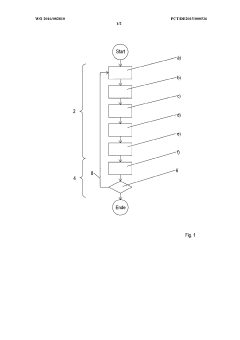
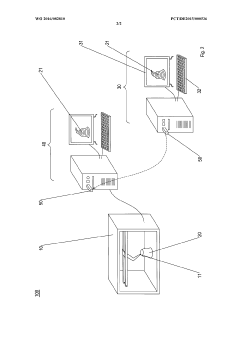
- A method involving a multi-scale, physically based simulation chain to detach material-specific properties from component geometry and simulate the additive structure, allowing for a holistic view of the production chain, reducing the need for costly tests and trials by identifying parameter windows for new materials and process parameters.
Method for additive manufacturing of a component with a topology optimized support structure based on a thermo-mechanical process simulation
PatentPendingEP4287060A1
Innovation
- A method that employs thermo-mechanical process simulations to optimize support structures by combining thermal and mechanical inputs, allowing for reduced mass density while considering heat dissipation and mechanical stresses through topology optimization algorithms, and generating instructions for additive manufacturing devices to produce optimized support structures.


Computational Resource Requirements and Optimization
Thermo-mechanical simulation frameworks for predictive build planning demand substantial computational resources due to their multi-physics nature and high-resolution requirements. Current high-fidelity simulations typically require HPC (High Performance Computing) clusters with 32-128 CPU cores and 128-512 GB RAM for reasonable execution times. GPU acceleration has shown promising results, reducing simulation times by 5-10x for certain solver types, particularly those involving matrix operations and parallel processing capabilities.
Resource optimization strategies have evolved significantly in recent years. Adaptive mesh refinement techniques can reduce computational load by 30-60% by concentrating computational power on critical regions while maintaining coarser meshes elsewhere. Multi-scale modeling approaches that combine macro, meso, and micro-scale simulations have demonstrated effective resource utilization by applying appropriate resolution levels to different physical phenomena.
Cloud computing platforms have transformed accessibility to computational resources, with major providers offering specialized HPC instances optimized for simulation workloads. These platforms enable scalable, on-demand resource allocation without significant capital investment. Containerization technologies further enhance resource utilization by allowing efficient deployment across heterogeneous computing environments.
Real-time simulation capabilities remain challenging but are advancing through reduced-order modeling techniques. These approaches use machine learning to create surrogate models that approximate full simulations at a fraction of the computational cost, enabling interactive feedback during build planning. Benchmark studies indicate that properly trained surrogate models can achieve 95% accuracy while reducing computation time by two orders of magnitude.
Storage requirements present another significant challenge, with high-fidelity simulations generating 10-100 GB of data per build scenario. Implementing intelligent data management strategies, including selective storage of critical time steps and regions of interest, can reduce storage requirements by 40-70% without significant loss of analytical capability.
Future optimization directions include quantum computing applications for specific simulation components, though practical implementation remains several years away. More immediately applicable are hybrid CPU-GPU architectures specifically designed for multi-physics simulations, with early prototypes demonstrating 3-4x performance improvements over traditional HPC configurations at equivalent cost points.
Resource optimization strategies have evolved significantly in recent years. Adaptive mesh refinement techniques can reduce computational load by 30-60% by concentrating computational power on critical regions while maintaining coarser meshes elsewhere. Multi-scale modeling approaches that combine macro, meso, and micro-scale simulations have demonstrated effective resource utilization by applying appropriate resolution levels to different physical phenomena.
Cloud computing platforms have transformed accessibility to computational resources, with major providers offering specialized HPC instances optimized for simulation workloads. These platforms enable scalable, on-demand resource allocation without significant capital investment. Containerization technologies further enhance resource utilization by allowing efficient deployment across heterogeneous computing environments.
Real-time simulation capabilities remain challenging but are advancing through reduced-order modeling techniques. These approaches use machine learning to create surrogate models that approximate full simulations at a fraction of the computational cost, enabling interactive feedback during build planning. Benchmark studies indicate that properly trained surrogate models can achieve 95% accuracy while reducing computation time by two orders of magnitude.
Storage requirements present another significant challenge, with high-fidelity simulations generating 10-100 GB of data per build scenario. Implementing intelligent data management strategies, including selective storage of critical time steps and regions of interest, can reduce storage requirements by 40-70% without significant loss of analytical capability.
Future optimization directions include quantum computing applications for specific simulation components, though practical implementation remains several years away. More immediately applicable are hybrid CPU-GPU architectures specifically designed for multi-physics simulations, with early prototypes demonstrating 3-4x performance improvements over traditional HPC configurations at equivalent cost points.
Industry Standards and Validation Methodologies
The validation of thermo-mechanical simulation frameworks for additive manufacturing requires adherence to established industry standards and methodologies. ASTM International and ISO have developed several standards specifically addressing simulation validation in additive manufacturing, including ASTM F3122 for mechanical property verification and ISO/ASTM 52901 for qualification principles. These standards provide essential guidelines for ensuring simulation accuracy and reliability across different manufacturing scenarios.
Validation methodologies typically follow a multi-tiered approach, beginning with basic verification against analytical solutions for simplified geometries. This establishes fundamental computational accuracy before progressing to more complex validation stages. The second tier involves benchmarking against controlled experimental data, where simulated thermal histories and residual stress distributions are compared with measurements from instrumented builds using techniques such as in-situ thermography and neutron diffraction.
Round-robin testing represents a critical component of validation protocols, where identical simulation scenarios are executed across different software platforms and compared against standardized reference datasets. The America Makes and ANSI Additive Manufacturing Standardization Collaborative (AMSC) has established several benchmark test cases specifically designed for thermo-mechanical simulation validation, providing a common foundation for cross-platform assessment.
Digital twin validation methodologies have emerged as particularly valuable for predictive build planning, requiring real-time comparison between simulation predictions and actual build conditions. This approach necessitates standardized data exchange formats, with initiatives like STEP-NC (ISO 10303-238) and MTConnect providing frameworks for seamless information transfer between simulation environments and manufacturing equipment.
Uncertainty quantification has become an integral part of validation standards, with methodologies such as ASME V&V 20-2009 providing guidelines for assessing simulation uncertainty. These approaches require statistical analysis of multiple simulation runs with varied input parameters to establish confidence intervals for predicted outcomes, particularly critical for safety-critical applications in aerospace and medical sectors.
Industry consortia like the Additive Manufacturing Consortium (AMC) and the Manufacturing Technology Centre (MTC) have developed specialized validation protocols for thermo-mechanical simulations, incorporating material-specific considerations and process parameter sensitivities. These protocols typically include standardized test artifacts designed to challenge specific aspects of simulation frameworks, from thermal gradient prediction to distortion compensation algorithms.
Validation methodologies typically follow a multi-tiered approach, beginning with basic verification against analytical solutions for simplified geometries. This establishes fundamental computational accuracy before progressing to more complex validation stages. The second tier involves benchmarking against controlled experimental data, where simulated thermal histories and residual stress distributions are compared with measurements from instrumented builds using techniques such as in-situ thermography and neutron diffraction.
Round-robin testing represents a critical component of validation protocols, where identical simulation scenarios are executed across different software platforms and compared against standardized reference datasets. The America Makes and ANSI Additive Manufacturing Standardization Collaborative (AMSC) has established several benchmark test cases specifically designed for thermo-mechanical simulation validation, providing a common foundation for cross-platform assessment.
Digital twin validation methodologies have emerged as particularly valuable for predictive build planning, requiring real-time comparison between simulation predictions and actual build conditions. This approach necessitates standardized data exchange formats, with initiatives like STEP-NC (ISO 10303-238) and MTConnect providing frameworks for seamless information transfer between simulation environments and manufacturing equipment.
Uncertainty quantification has become an integral part of validation standards, with methodologies such as ASME V&V 20-2009 providing guidelines for assessing simulation uncertainty. These approaches require statistical analysis of multiple simulation runs with varied input parameters to establish confidence intervals for predicted outcomes, particularly critical for safety-critical applications in aerospace and medical sectors.
Industry consortia like the Additive Manufacturing Consortium (AMC) and the Manufacturing Technology Centre (MTC) have developed specialized validation protocols for thermo-mechanical simulations, incorporating material-specific considerations and process parameter sensitivities. These protocols typically include standardized test artifacts designed to challenge specific aspects of simulation frameworks, from thermal gradient prediction to distortion compensation algorithms.
Unlock deeper insights with PatSnap Eureka Quick Research — get a full tech report to explore trends and direct your research. Try now!
Generate Your Research Report Instantly with AI Agent
Supercharge your innovation with PatSnap Eureka AI Agent Platform!