

Method of welding alloy articles
Patent Information
- Authority / Receiving Office
- US · United States
- Current Assignee / Owner
- Publication Date
- 2014-01-16
Smart Images
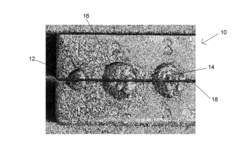
Figure 1 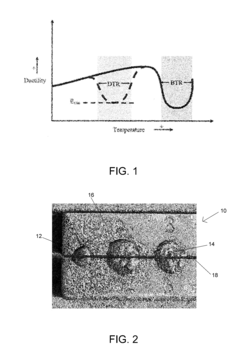
Figure 2 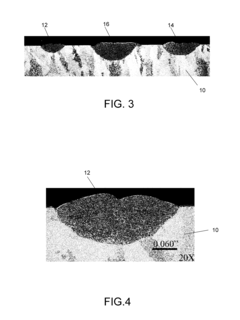
Figure 3
Abstract
Description
BACKGROUND OF THE INVENTION
[0001] The present invention generally relates to welding processes and materials. More particularly, this invention relates to a process for welding alloys that are prone to cracking when welded.
[0002] Components of gas turbine engines, such as blades (buckets), vanes (nozzles) and combustors, are typically formed of nickel, cobalt or iron-base superalloys with desirable mechanical properties for turbine operating temperatures and conditions. Notable examples are gamma prime precipitation-strengthened nickel-base superalloys, particular examples of which include René 125, René 80, René N5, René N4, René 108, GTD-111®, GTD-444®, IN738, IN792, MAR-M200, MAR-M247, CMSX-3, CMSX-4, PWA1480, PWA1483, and PWA1484. Each of these alloys has a relatively high gamma prime (principally Ni3(Al,Ti) content as a result of containing significant amounts of aluminum and / or titanium. As the material requirements for gas turbine components have increased with higher operating...
Examples
Embodiment Construction
[0024]The invention will be described in reference to a gamma prime-strengthened (principally Ni3(Al,Ti)) nickel-based superalloy (hereinafter, gamma-prime nickel superalloy), as is often the case for nozzles (vanes), buckets (blades), and other components located within the combustors and turbine sections of industrial and aircraft gas turbines. Particularly notable examples of gamma-prime nickel superalloys include René 125, René 80, René N5, René N4, René 108, GTD-111®, GTD-444®, IN738, IN792, MAR-M200, MAR-M247, CMSX-3, CMSX-4, PWA1480, PWA1483, and PWA1484, each of which has a relatively high gamma prime content as a result of the significant amounts of aluminum and / or titanium they contain. However, it is foreseeable that the advantages of this invention could be obtained with components formed by other methods from a variety of materials that are prone to cracking during welding. A method in accordance with the present invention is especially suitable for alloys which do not ...